
Masai Mara Safari Guide: Wildlife & Ground Logistics
Masai Mara Fast Facts
- Location: Narok County, southwestern Kenya (1°29′S, 35°09′E), along the border with Tanzania’s Serengeti National Park.
- Ecosystem area: 1,510 km² (583 sq miles) National Reserve, plus about 1,450 km² (560 sq miles) of surrounding private community conservancies.
- Elevation: 1,500 m to 2,180 m (4,920 ft to 7,150 ft) above sea level.
- Key rivers: Mara River, Talek River and Sand River.
- Name: “Mara” means “spotted” in the Maa language, describing a landscape dotted with acacia trees, cloud shadows and thickets. More on our Masai Mara facts and where is Masai Mara located pages.
The Masai Mara National Reserve in Brief
The Masai Mara covers about 1,510 square kilometers (583 square miles) of protected savanna in southwestern Kenya, joined to Tanzania’s Serengeti along its southern border. Narok County runs the reserve, and the non-profit Mara Conservancy manages the western Mara Triangle on the county’s behalf. It holds one of the highest concentrations of big cats in Africa, and each year, from July to October, it hosts the wildebeest migration and its river crossings.
Our safari packages start at KES 62,500 (USD 660) per person for 2 days and KES 98,500 (USD 1,025) for the popular 3-day trip, both in low season. A 5-day Masai Mara safari starts at KES 168,000 (USD 1,680), and a 7-day Mara and Amboseli circuit runs up to KES 1,535,000 (USD 15,350) at the top tier in peak season.
Prices are per person, for two adults sharing a private 4×4 Safari Land Cruiser, and include fuel, a licensed driver-guide, full board and park fees. Non-residents pay USD 100 per day in park fees from January to June and USD 200 per day from July to December.
When you book directly through Masaimara.co.ke, we itemize every cost before you travel, so there are no gate disputes or fuel surcharges once you’re in the bush.
Our Top 2026/27 Safari Packages and Prices
Every price is the full trip cost per person, with two adults sharing a private 4×4 Safari Land Cruiser. “From” is the budget tier in low season (January to June). Peak season (July to December) runs roughly 1.4 to 2 times higher. Please see our complete Masai Mara safari packages 2026/2027.
|
Top Package |
Nights |
Citizens from |
Non-residents from |
|---|---|---|---|
|
1 |
KES 62,500 |
USD 660 |
|
|
2 |
KES 98,500 |
USD 1,025 |
|
|
3 |
KES 132,000 |
Ask for quote |
|
|
4 |
KES 168,000 |
USD 1,680 |
|
|
2 |
KES 145,000 |
USD 1,450 |
|
|
3 |
KES 167,700 |
Ask for quote |
|
|
4 |
KES 215,000 |
USD 1,850 |
|
|
4 |
KES 278,000 |
USD 2,450 |
|
|
6 |
KES 385,000 |
USD 3,450 |
|
|
7 |
KES 485,500 |
USD 4,450 |
|
|
9 |
KES 585,000 |
USD 5,950 |
|
|
Any package |
3 Days Masai Mara Safari, tier by tier (2 nights, 5 game drives)
|
Tier |
Jan–Jun |
Jul–Dec |
|---|---|---|
|
Budget |
KES 98,500 / USD 1,025 |
KES 187,000 / USD 1,985 |
|
Mid-Range |
KES 118,500 / USD 1,180 |
KES 212,000 / USD 2,195 |
|
Luxury |
KES 156,000 / USD 1,465 |
KES 258,000 / USD 2,540 |
|
Premium |
KES 215,000 / USD 1,890 |
KES 285,000 / USD 2,890 |
Camps: Budget – Mara Sidai, Enchoro Wildlife Camp, Aruba Mara. Mid-Range – Sentrim Mara, Mara Sopa Lodge, Ashnil Mara Camp. Luxury – Mara Serena, Sarova Mara, Keekorok Lodge. Premium – Governors’ Camp, Mara Intrepids, Kichwa Tembo.
Full tier tables for every route are on our Masai Mara safaris page. Prefer to fly? See the Masai Mara flying packages.
What the Price Covers
Included:
- Private 4×4 Safari Land Cruiser with a pop-up roof and high-clearance suspension, with fuel and a TRA-licensed driver-guide.
- Full-board accommodation at the listed lodges and tented camps.
- Daily park fees, paid to Narok County, and KWS fees through the KWS payment portal for Nakuru or Amboseli stops.
- Bottled water on game drives and AMREF Flying Doctors evacuation cover.
Not included:
- Tips: about KES 3,000 a day for your driver-guide and KES 1,500 a day shared among camp staff.
- International flights, Kenya’s eTA (about KES 3,900 / USD 30), and drinks beyond water.
- Optional extras such as a dawn flight with the Masai Mara hot air balloons, from about KES 58,500 (USD 450) per person.
The Mara’s Three Areas
Knowing how the Masai Mara is divided gets you a bed near the wildlife you came for.
The National Reserve (about 1,510 km²). Run by Narok County. The loops along the Talek River and the Mara River are here, where the river crossings happen and the resident lion prides shelter in the croton thickets. Most guests enter through Sekenani Gate, where we’re based.
The Mara Triangle (about 510 km²). Managed by the non-profit Mara Conservancy, between the Oloololo Escarpment and the Mara River. Graded all-weather tracks, strict vehicle limits, and the Mara’s small population of black rhinos.
The community conservancies. Private land such as Olare Motorogi, Mara North, Naboisho and Ol Kinyei. They hold sightings to about five vehicles and allow night game drives and walking safaris, which the reserve doesn’t. For a full list of who lives where, see the animals in Masai Mara.
Comparing the three zones of the Masai Mara
|
Feature / Zone |
Government Reserves (Narok & Triangle) |
Community Conservancies |
Managing Body |
Narok County / Mara Conservancy |
Maasai Landowners & Operators |
|---|---|---|
|
Primary Access |
Sekenani, Talek, Oloolaimutiek, Oloololo |
Dedicated Conservancy Gate Posts |
|
Off-Road Driving |
Strictly Prohibited |
Permitted for Big Cat Sightings |
|
Night Game Drives |
Prohibited (6:30 PM Curfew) |
Permitted with Red Spotlights |
|
Vehicles Per Sighting |
Uncapped / Capped at 5 (Triangle) |
Strictly Capped at 3 to 5 |
|
Entry Pass Type |
USD 100 / USD 200 per 12 Hours |
Bundled in Nightly Room Rate |
Wildlife Viewing and Big Cat Hotspots
The Mara-Serengeti ecosystem hosts over 90 mammal species and more than 470 recorded bird species. Knowing where each animal holds its territory speeds up your game drives.
Lions. Home to over 850 resident lions. Key prides include the Marsh Pride around Musiara Marsh, the Paradise Pride near the Mara River bends, and the Bila Shaka Pride near the Talek-Mara confluence.
Leopards. Highly territorial cats, best spotted along the dense riverine forests of the Talek River and the sausage tree loops.
Cheetahs. The open short-grass plains between Sekenani Gate and the Talek River are ideal hunting corridors for coalitions.
Elephants and buffaloes. High concentrations graze year-round in Musiara Marsh and the Olare Motorogi riverine thickets.
Black rhinos. A small, protected population of around 30 to 40 black rhinos lives mainly in the western Mara Triangle and the dense brush of the Serena sector.
Nile crocodiles and hippos. Found in large pods at the Mara-Talek confluence and at the main migration crossing channels.
Birdlife. More than 470 species, including 60 kinds of raptor, the secretary bird, the crowned crane and the lilac-breasted roller, often called Kenya’s national bird.
Migration Calendar
July to October: peak migration. Over 1.5 million wildebeest and zebras arrive from the Serengeti and cross the Mara and Sand Rivers. Our Masai Mara migration page covers the season month by month, and the wildebeest migration Kenya page explains where the herds enter.
November to December: short rains. The herds move south toward Tanzania. The plains turn green, the dust settles, and big cat viewing is uncrowded.
January to March: warm and dry. Short grass and long views. Resident lions and cheetahs, and calving on the open flats.
April to May: long rains. Dramatic skies and few tourists. Camps cut their rates, and a 4×4 is essential on the black cotton tracks. Our guide to the best time to visit Masai Mara has the trade-offs for each month.
How to Get to the Masai Mara
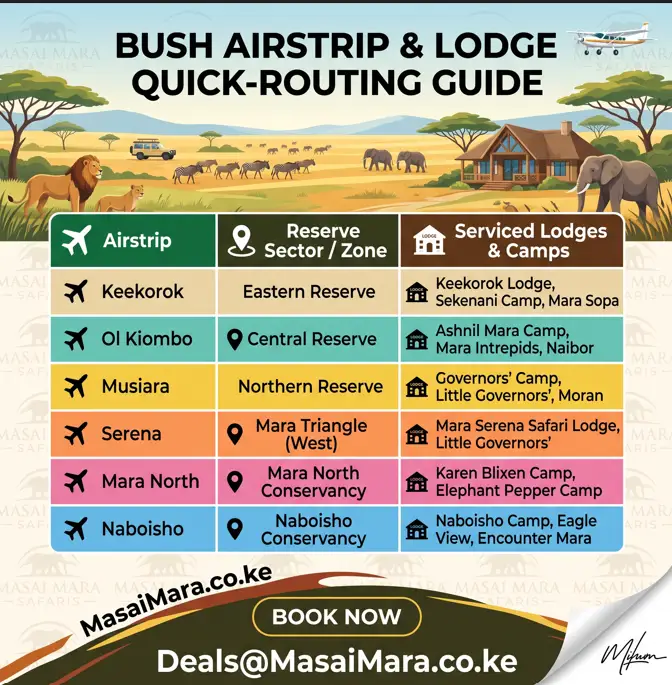
By air (fly-in safaris). Daily scheduled flights leave Nairobi’s Wilson Airport with carriers such as Safarilink and AirKenya. Flight time is 45 to 60 minutes. Planes land at bush airstrips near your lodge: Keekorok (eastern reserve), Ol Kiombo (central reserve), Musiara (northern reserve), Serena (Mara Triangle), or Ol Seki, Naboisho and Mara North (conservancies). Luggage is capped at 15 kg (33 lbs) in soft-sided bags. See our Nairobi to Masai Mara flights page.
By road (overland safaris). Driving from Nairobi takes 5 to 6 hours (about 225 km / 140 miles). The route follows the paved A104 highway past the Great Rift Valley viewpoint down to Mai Mahiu, continues through Narok Town, and turns onto the C12 to Sekenani Gate, which is tarmac all the way. For Talek, Musiara and the Mara Triangle, the last 50 to 100 km are unpaved, and a high-clearance 4×4 Land Cruiser is required. Full directions are on our Nairobi to Masai Mara by road page.
Vehicles and Gate Rules
I’m David Njunge, a TRA-licensed guide, and I’ve worked in the Mara for a little over ten years. Two things decide whether a Mara safari runs smoothly, and neither is the price of the tent.
The first is the vehicle. Cheap packages often use two-wheel-drive minivans.
One rain shower turns the black cotton clay into something like grease, and a minivan sinks to its axles. Then you sit in lion country waiting for a tractor, and the recovery bill wipes out whatever the package saved. Our Masai Mara camps page tells the story of one family it happened to. We run 4×4 Land Cruisers only, and every one carries hardwood jacking blocks and a spare. Nobody notices the blocks until the day they need them.
The second is the clock. Narok County tickets run from 6:00 AM to 6:00 PM, and vehicles must be in camp by 6:30 PM. If you sleep inside the reserve, you must be out of the gate by 10:00 AM on the day you leave. Stay with a sighting past ten and you pay a full extra day. We plan every departure around it. Our game drives page explains how a Mara day runs, and the Nairobi to Masai Mara guide covers the road and the flights in.
Indigenous Heritage: Maasai Manyatta Visits
The Maasai are semi-nomadic pastoralists who have lived alongside the region’s wildlife for centuries. A visit to a traditional homestead (an enkang or manyatta) outside the main reserve gates offers real cultural insight.
Community entry fee. KES 3,900 to KES 6,500 (USD 30 to USD 50) per person, paid directly to the village elders to support local schools and clean water projects.
What you will experience. The traditional adumu (jumping dance) welcome, a tour inside a mud-and-timber house (inkajijik) built by Maasai women, fire-making by friction, and traditional beadwork.
Etiquette. Always ask permission before taking portraits of villagers or children outside organized visits. Our Masai village visit and Masai culture pages have more.
Frequently Asked Questions
What is the best month to visit the Masai Mara?
July to October for the migration and the river crossings. January to March for uncrowded big cat viewing and clear light for photographs. There’s no bad month, because the lions, leopards and elephants live here all year.
How much does a Masai Mara safari cost in 2026?
A 3-day Masai Mara safari starts from KES 98,500 (USD 1,025) per person sharing in low season and a 5-day safari from KES 168,000 (USD 1,680). Multi-park circuits run up to KES 1,535,000 (USD 15,350) for 7 days with Amboseli at the top tier in peak season. Our Masai Mara safari cost page shows where the money goes.
How are park entrance fees paid?
Masai Mara National Reserve fees are paid to Narok County, and Mara Triangle fees to the Mara Conservancy, not through KWS. Non-resident adults pay USD 100 per day from January to June and USD 200 per day from July to December. A ticket covers 6:00 AM to 6:00 PM.
Is a 4×4 vehicle required in the Mara?
Yes. The tracks inside the reserve are unpaved, with rocky river crossings and black cotton clay that turns slick after rain. A high-clearance four-wheel drive is the only sensible vehicle.
Plan Your Route With Local Guides
If five days is too long, the 3-day and 4-day Masai Mara safaris in the table above are the popular choices. To see more of Kenya, there’s the Masai Mara, Amboseli and Lake Nakuru safari and the 6 days Masai Mara Amboseli safari. For the top end, see our luxury safari Masai Mara camps, and for how booking works with us, the Masai Mara booking guide.
Ready to start? Send us your dates on the inquiry form and our team at Sekenani will handle every detail from Nairobi to the plains.
Written by a TRA-licensed safari guide with over 10 years in the field. Edited by Cess Wambui, a travel consultant with a degree in Tourism and Hospitality Management.