
Masai Mara Lake Naivasha Hell's Gate – The Active Safari
Masai Mara Lake Naivasha Hell’s Gate is the trip for people who get restless sitting in a vehicle all day. You get the Mara game drives – lions, elephants, maybe a leopard – but also cycling through Hell’s Gate, hiking a gorge, walking among giraffes at Crescent Island. Four days runs KES 185,000 to 505,000 for Kenyans depending on lodges, or roughly USD 1,650 to 4,650 for visitors. Five days adds another KES 40,000 or so. The Mara now uses 12-hour tickets (the official language says 6 AM–6 PM validity, though I’ve heard some confusion about exactly how they enforce the clock at different gates). Hell’s Gate fees went up in late 2024 – now USD 50 for non-residents, KES 500 for citizens. KWS parks require pre-payment through the eCitizen system.
The Route
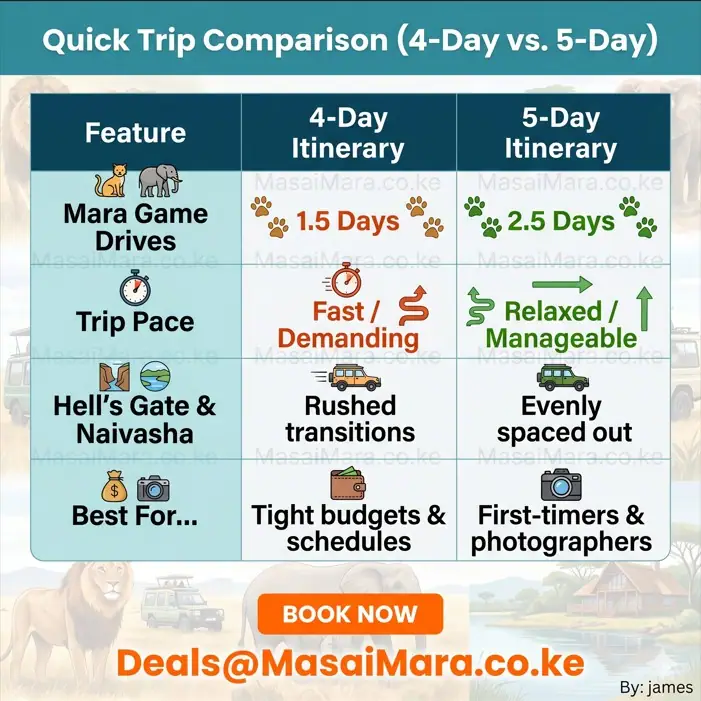
Feature | 4-Day Itinerary | 5-Day Itinerary |
Mara Game Drives | 1.5 Days | 2.5 Days |
Trip Pace | Fast / Demanding | Relaxed / Manageable |
Hell’s Gate & Naivasha | Rushed transitions | Evenly spaced out |
Best For… | Tight budgets & schedules | First-timers & photographers |
The extra day makes a difference. You’re not rushing through Hell’s Gate to make the Naivasha boat ride, and you get two full Mara days instead of one and a half. If this is your first time on safari, the 5-day option is easier to manage.
Prices
These are estimates for two people sharing a vehicle. Actual quotes depend on specific dates and availability.
4 Days – Kenyan Citizens (KES)
Lodges | Jan-June | July-Dec |
Naivasha Sopa + Jambo Mara | 185,000 | 265,000 |
Enashipai + Sentrim Mara | 228,000 | 318,000 |
Great Rift Valley Lodge + Mara Serena | 312,000 | 428,000 |
Loldia House + Angama Mara | 508,000 | 678,000 |
4 Days – International (USD)
Lodges | Jan-June | July-Dec |
Naivasha Sopa + Jambo Mara | 1,650 | 2,380 |
Enashipai + Sentrim Mara | 2,080 | 2,890 |
Great Rift Valley Lodge + Mara Serena | 2,840 | 3,880 |
Loldia House + Angama Mara | 4,680 | 6,180 |
5 Days – Kenyan Citizens (KES)
Lodges | Jan-June | July-Dec |
Naivasha Sopa + Jambo Mara | 228,000 | 318,000 |
Enashipai + Sentrim Mara | 278,000 | 388,000 |
Great Rift Valley Lodge + Mara Serena | 388,000 | 518,000 |
Loldia House + Angama Mara | 578,000 | 768,000 |
5 Days – International (USD)
Lodges | Jan-June | July-Dec |
Naivasha Sopa + Jambo Mara | 1,980 | 2,780 |
Enashipai + Sentrim Mara | 2,480 | 3,380 |
Great Rift Valley Lodge + Mara Serena | 3,480 | 4,680 |
Loldia House + Angama Mara | 5,280 | 6,980 |
What’s Included
Private Land Cruiser for the trip. Driver-guide. Fuel. Meals at the lodges. Mara park fees. Water. Emergency evacuation coverage.
Not Included
Hell’s Gate entry (USD 50 / KES 500 – pay through KWSPay). Bike rental, usually KES 500-800. Boat rides at Naivasha (KES 3,000-4,000 per boat). Crescent Island (USD 33). Tips. Drinks. Insurance.
Hell’s Gate
The cycling is about 7-8km each way on dirt road. There’s almost no shade, which matters more than you’d think. I tell people to be at the gate by 6:30 or 7 AM at the latest. By mid-morning it gets uncomfortable.
On weekends you’ll see groups from Nairobi – sometimes dressed up more than you’d expect for a hike, which can be surprising if you’re not used to it. The paths get busier and louder. Weekday mornings are quieter.
The rental bikes at the gate are basic. Hard seats. If you’re cycling the full distance, bring something to sit on – a folded towel, whatever. Some people bring padded shorts. The bikes from the camps nearby tend to be in better shape, though I can’t promise that’s always the case.
The Gorge
The Lower Gorge – Ol Njorowa – was closed for years after flash floods in 2019 killed several people. It reopened in late 2024 with KWS ranger guides required for entry.
The hike involves scrambling over rocks, some rope sections, a steep descent. It’s not a casual walk. If you have bad knees or don’t like heights, consider skipping the gorge and just doing the cycling portion.
There’s a spot partway through where the canyon walls create an echo effect – your voice comes back clear. Ask your ranger about it. And look up at the cliff faces for vultures. Rüppell’s Vultures nest on these walls, though you need binoculars to really see them.
When the sun is directly overhead – around midday – the light does something interesting in the narrow sections. The steam and the red rock walls catch it differently than in morning or afternoon. Most guides want to get you out before the heat, which makes sense, but if you’re interested in photography you might ask about timing.
If there’s been rain upstream recently, the gorge closes. The rangers make that call. The evidence of how high water gets is visible – debris caught in the walls well above your head.
The Spa
Ol Karia Geothermal Spa is inside the park. Turquoise water heated by volcanic activity. It’s nice after the gorge hike. Gets crowded midday with tour groups, quieter late afternoon. Around KES 2,600 for non-residents.
Fees
USD 50 non-residents, KES 500 citizens. You’re supposed to pay online through eCitizen before you arrive. The KWS website has current rates.
Cell service in the gorge is basically nonexistent, so have your tickets downloaded before you go in.
Lake Naivasha
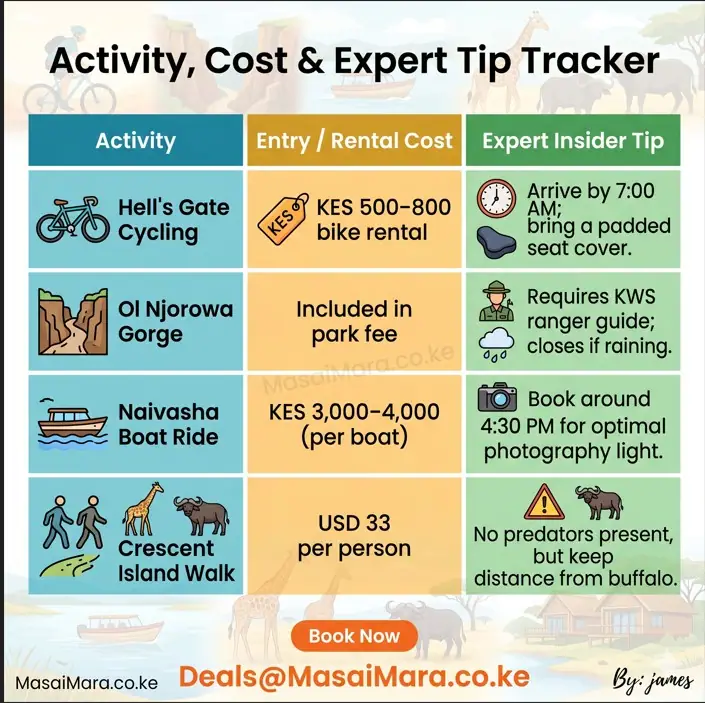
Activity | Entry / Rental Cost | Expert Insider Tip |
Hell’s Gate Cycling | KES 500–800 bike rental | Arrive by 7:00 AM; bring a padded seat cover. |
Ol Njorowa Gorge | Included in park fee | Requires KWS ranger guide; closes if raining. |
Naivasha Boat Ride | KES 3,000–4,000 (per boat) | Book around 4:30 PM for optimal photography light. |
Crescent Island Walk | USD 33 per person | No predators present, but keep distance from buffalo. |
No entry fee for the lake.
Boat Rides
KES 3,000-4,000 per boat – that’s the whole boat, not per person. Boats hold maybe 6-8 people.
Late afternoon is better than midday. The wind picks up on Naivasha most afternoons, and the water gets choppy. By 4:30 or 5 PM it usually calms down and the light is better anyway. The hippos start moving around dusk.
One thing to watch: the water hyacinth. It’s an invasive weed that floats around the lake. Wind pushes it. A jetty that’s clear in the morning might be blocked by afternoon. Before you commit to a boat ride, check if the weed is moving toward your departure point.
The boat captains throw tilapia to attract fish eagles for photos. It works, but the eagle dives fast. If you want a good photo, tell your captain to wait until you’re ready before throwing. Otherwise you’re still pointing your camera when the bird has already grabbed the fish.
Hippos at Night
The lodges on the lake – Sopa, Country Club, others – have hippos that come out of the water after dark to graze on the lawns. They’re hard to see and they’re dangerous. The lodges send someone to walk you to your room after dinner. This isn’t optional.
If you want to actually see them grazing, ask if someone can take you to a viewing spot around 9 PM. They know where the hippos go.
Crescent Island
Walking safari – you’re on foot among giraffes, zebras, waterbuck. No predators on the island, no vehicles. The animals are habituated and mostly ignore you. Entry is USD 33.
There are buffalo on the north end of the island. Keep distance from them.
Getting to the Mara
The drive from Naivasha takes 5-6 hours depending on traffic through Narok and the condition of the road. There’s been construction. Sometimes it’s fine, sometimes it’s slow.
Narok town is about the halfway point. Most drivers stop somewhere for bathrooms. The tourist-oriented gift shops are clean but expensive. If you want local prices for snacks or tea, ask to stop at one of the supermarkets in town instead – Naivas, Quickmart, places like that.
Sit on the left side of the vehicle for the escarpment views climbing out of the Rift Valley, though honestly the scenery is good on both sides for most of the drive.
The Mara
This is the main event. Lions, elephants, buffalo, the migration crossings if you’re here July through October. I’m not going to repeat everything about the Mara here – there’s plenty on the main Mara pages.
What’s relevant for this trip: you have either 1.5 days or 2.5 days in the reserve depending on whether you booked 4 or 5 days total. The longer option gives you better odds on the harder sightings.
The 12-Hour Ticket
The Mara ticket is valid for 12 hours. The official hours are 6 AM to 6 PM. What I’ve been told is that if you enter late in the day, your ticket still expires at 6 PM – you don’t get a full 12 hours from when you entered. So entering at 4 PM for an evening drive means you’ve used a full day’s ticket for two hours.
I should say – I’ve heard different things from different people about exactly how this is enforced, and the system has changed a few times. The safe approach is to enter early in the morning when you want a full day, and don’t count on carrying a ticket overnight.
Payment is through the KAPS portal. Non-residents pay USD 100 in low season, USD 200 in peak season. Kenyan citizens pay KES 1,500 or KES 3,000.
Finding the Harder Animals
Leopards are solitary and nocturnal. You might see one, you might not. More Mara time helps.
African Wild Dogs are the rarest predators in the ecosystem. They don’t stay in the open plains – they prefer the edges, the conservancies. If wild dogs are specifically what you’re after, you’d need to stay somewhere with access to the northern conservancies where they’ve been denning. That’s a different kind of trip than this one.
What to Bring
For Hell’s Gate specifically:
- Something to pad the bike seat
- Closed shoes with grip for the gorge
- Hat and sunscreen – there’s no shade
- Water, more than you think
- Clothes that dry fast if you’re doing the gorge
For the Mara:
- Binoculars
- Neutral colors (not blue or black – tsetse flies like those)
- A jacket for early mornings – it can be cold before sunrise
More details on what to expect in our Masai Mara safari tips guide.
General:
- Offline copies of your e-tickets
- Power bank – phone batteries drain faster in cold weather, and the Mara is cold at night
When to Go
January through March is dry and relatively uncrowded. Good cycling weather, good game viewing.
April and May are the long rains. The gorge at Hell’s Gate may close. Mara roads can flood. Prices are lower but there are real trade-offs.
July through October is wildebeest migration season. Crowded but spectacular if you catch a crossing.
November has short rains – unpredictable.
December is busy with holidays.
What This Trip Doesn’t Include
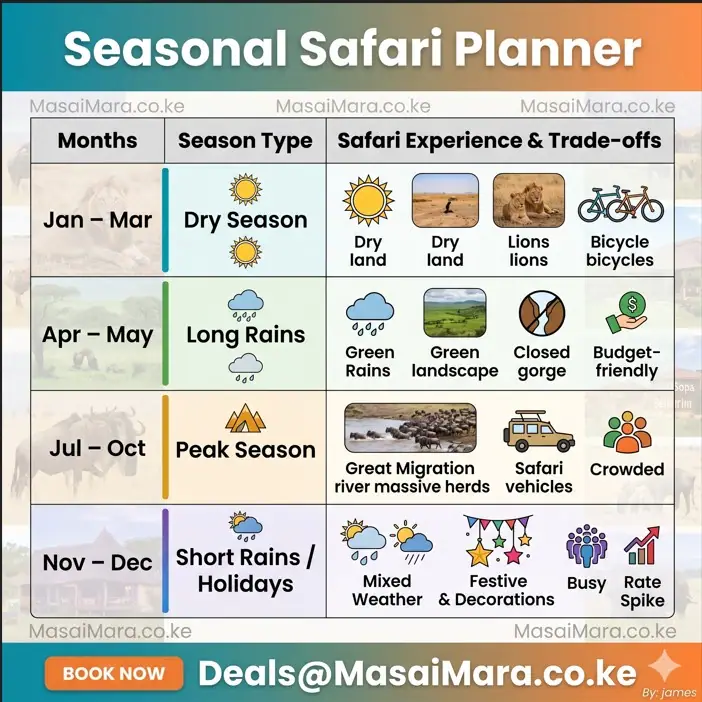
Months | Season Type | Safari Experience & Trade-offs |
Jan – Mar | Dry Season | Best overall: Great wildlife viewing & easy cycling weather. |
Apr – May | Long Rains | Budget friendly: Lower prices, but the gorge may close. |
Jul – Oct | Peak Season | Spectacular: Wildebeest migration crossings but heavy crowds. |
Nov – Dec | Short Rains / Holidays | Unpredictable: Festive season gets busy and rates spike. |
Rhinos. They’re rare in the Mara and not at Naivasha. If rhinos matter to you, add Lake Nakuru to the route.
Flamingos. Also Nakuru, or Lake Bogoria. Not Naivasha.
Kilimanjaro views. That’s Amboseli, different direction.
Questions
Is the gorge safe? With the mandatory ranger guides and weather monitoring, yes. They close it when there’s flooding risk. The 2019 incident happened before the current protocols.
How fit do I need to be? The cycling is manageable for most people – it’s flat, just long. The gorge is more demanding. Scrambling, climbing. If that doesn’t sound like fun, skip the gorge portion.
Can kids do this? Cycling yes. Gorge depends on the kid – there’s usually a minimum age, maybe 12. Crescent Island is fine for anyone. Mara game drives work for all ages.
What animals will I see? Hell’s Gate has zebras, giraffes, baboons, hyraxes, various birds. Naivasha has hippos, fish eagles, giraffes at Crescent Island. The Mara has the big cats, elephants, buffalo, and during migration season the wildebeest herds.
What if it rains? The gorge closes. Cycling isn’t pleasant in rain. Mara game drives happen in rain – animals don’t stop being active – but roads can get difficult. April-May has the highest risk of this.
Related: 3-day Mara trips | 5-day options | Budget safaris | Luxury
David Njunge. August 2026. Park fees and policies change – check KWS and the Mara portal for current information.
Welcome to Masaimara.co.ke
Thank you for visiting us! We're excited to help you plan an unforgettable safari adventure across Kenya.