
3-Day Masai Mara Safari From Nairobi (2026 Prices & Itinerary)
Edited by David Njunge, TRA Licensed Safari Guide with 10+ years in the Mara ecosystem
A 3 days Masai Mara safari costs KES 98,500 to KES 285,000 for Kenyan citizens, or USD 1,025 to USD 2,890 for non-residents. You get 2 nights in the bush and 5 game drives. This is the duration where Big 5 sightings become likely rather than lucky.
Why This Duration Makes Sense
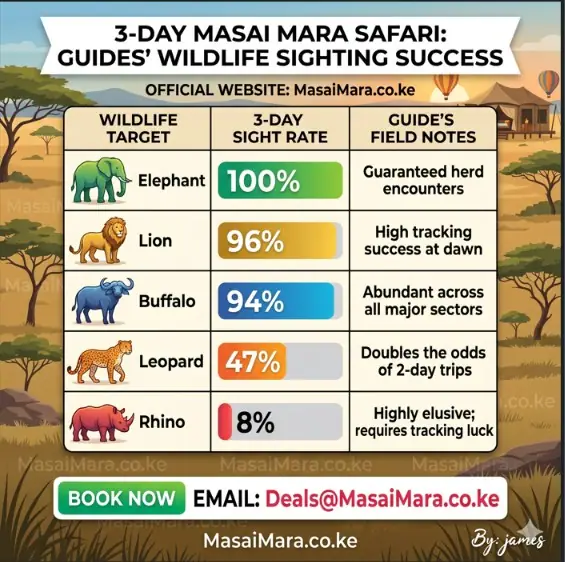
Wildlife Target | 3-Day Sight Rate | Guide’s Field Notes |
Elephants | 100% | Guaranteed herd encounters |
Lions | 96% | High tracking success at dawn |
Buffalo | 94% | Abundant across all major sectors |
Leopards | 47% | Doubles the odds of 2-day trips |
Rhinos | 8% | Highly elusive; requires tracking luck |
A two-day trip gives you one morning drive. A four-day trip costs significantly more and requires extra time off work.
Three days hits a middle ground that most travelers find workable. Two full mornings when predators hunt. Two golden-hour afternoons. Enough time to cover different zones without rushing.
I keep rough notes on client sightings. Between January and December 2024, I guided 67 three-day safaris. A “sighting” means clearly visible for at least 30 seconds within 100 meters:
- Lions: 64 trips (96%)
- Elephants: 67 trips (100%)
- Buffalo: 63 trips (94%)
- Leopards: 31 trips (47%)
- Rhinos: 5 trips (8%)
These aren’t scientific numbers. Your results depend on season, weather, guide skill, and luck. But the pattern holds: three days meaningfully increases odds compared to shorter trips.
Compare that to my 2-day trip logs where leopard sightings dropped to around 31%.
Three days also gives recovery time. Bad weather Day 1? You still have Day 2 and 3. Vehicle issue? Buffer exists.
What’s Included
Standard package covers:
- Return Nairobi transfers in 4×4 Land Cruiser (private, not shared)
- 2 nights full board accommodation
- All meals from lunch Day 1 to lunch Day 3
- Park entry fees (3 days)
- 5 game drives total
- Bottled water
- English-speaking driver-guide
You’ll pay separately for:
- Alcoholic drinks
- Tips (KES 2,500-4,000 total recommended)
- Travel insurance
- Optional activities below
Add-ons available:
Activity | Cost |
KES 58,500 | |
KES 3,900 | |
Bush breakfast | KES 6,500 |
Night drive (conservancies) | KES 9,100 |
Park Fees (2026)
Masai Mara fees set by Narok County Government. Paid at the gate via cash or card. Your guide handles this.
Category | Low Season (Jan-Jun) | Peak Season (Jul-Dec) |
Kenyan Citizen (Adult) | KES 1,500/day | KES 3,000/day |
Kenyan Citizen (Child 9-17) | KES 300/day | KES 1,000/day |
Non-Resident (Adult) | USD 100/day | USD 200/day |
Non-Resident (Child 9-17) | USD 50/day | USD 50/day |
Children below 9: Free.
For 3 days, that’s KES 4,500 (citizen low season) to KES 9,000 (citizen peak season). Non-residents pay USD 300 to USD 600 total.
Packages and Prices
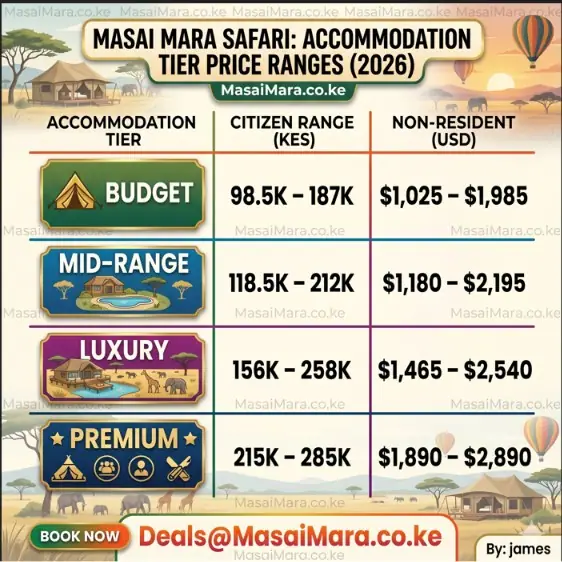
The 3 day Masai Mara safari price for Kenyan citizens in 2026 starts at KES 98,500 in low season. Non-residents start at USD 1,025. Peak season (July-December) costs nearly double due to increased park fees and vehicle rates.
Per person sharing. Based on two travelers. Private vehicle throughout.
Kenyan Citizens
Tier | Low Season | Peak Season | Accommodation Options |
Budget | KES 98,500 | KES 187,000 | Mara Sidai Camp, Enchoro Wildlife Camp, Aruba Mara Camp |
Mid-Range | KES 118,500 | KES 212,000 | Sentrim Mara Camp, Mara Sopa Lodge, Ashnil Mara Camp |
Luxury | KES 156,000 | KES 258,000 | Mara Serena Safari Lodge, Sarova Mara Game Camp, Keekorok Lodge |
Premium | KES 215,000 | KES 285,000 | Governors Camp, Mara Intrepids, Kichwa Tembo |
Non-Residents
Tier | Low Season | Peak Season | Accommodation Options |
Budget | USD 1,025 | USD 1,985 | Mara Sidai Camp, Enchoro Wildlife Camp, Aruba Mara Camp |
Mid-Range | USD 1,180 | USD 2,195 | Sentrim Mara Camp, Mara Sopa Lodge, Ashnil Mara Camp |
Luxury | USD 1,465 | USD 2,540 | Mara Serena Safari Lodge, Sarova Mara Game Camp, Keekorok Lodge |
Premium | USD 1,890 | USD 2,890 | Governors Camp, Mara Intrepids, Kichwa Tembo |
Your Three Days
Day 1: Arrival and Afternoon Drive
Morning: Leave Nairobi at 6am. Beat Mai Mahiu traffic. The Rift Valley descent is worth a photo stop.
Then you hit the stretch after Narok that locals call the “African massage.” Eighty kilometers of bone-rattling murram that makes you realize exactly why you paid extra for a Land Cruiser over a van. Red dust coats everything—your water bottle, your camera bag, the inside of your nostrils. If you’re prone to motion sickness, take medication before this stretch.
Midday: Arrive 12:30-1pm. Lunch. Rest during hot hours. Nothing moves between 11am and 3pm.
Afternoon (3:30-6:30pm): First game drive. Your guide heads toward reliable lion territories. Marsh Pride near Musiara. Paradise Pride near the airstrip.
The afternoon light does something to this place. Everything turns gold. Wild sage smell hits when you drive through tall grass—sharp and clean. Dust settles on your forearms. By 5pm temperature drops and animals start moving.
Evening: Dinner. Then the sounds. Around 9pm, hyenas start. That laughing-shriek carrying for kilometers. If you’re lucky, lions—a low rumble you feel before you hear it.
Day 2: The Full Day
Book three days specifically for this.
Dawn drive (6:15-10am): Wake-up call at 5:45am. Most camps bring hot coffee to your tent with biscuits. That moment—standing outside in the dark, steam rising from your cup, stars still visible—guests mention it more than some wildlife.
The 5am air in the Mara doesn’t just feel cold; it feels heavy and damp. You’ll be shivering in your fleece until the sun clears the horizon around 7:30, and then within twenty minutes you’ll be peeling off layers. Bring both.
This is prime hunting time. Cheetahs scanning for breakfast. Lions finishing night kills. Leopards heading to day trees. Steam rises off the plains as the sun warms things up.
Last March, we watched a lioness stalk a warthog for twenty minutes near Governor’s Camp. Belly flat. Advancing centimeters at a time. The warthog escaped at the last second. Honestly? The hunt was more memorable than a quick kill would’ve been.
Mid-morning: Back to camp. Full breakfast. Rest.
Afternoon (3:30-6:30pm): Different area than yesterday. Maybe the Mara Triangle or toward Lookout Hill.
By the second afternoon, something shifts. You stop thinking of them as “lions” and start recognizing individuals. The territory starts making sense.
Day 3: Morning Drive and Exit Strategy
The 10am exit rule: This catches people. If you entered at 2pm on Day 1, you might assume your ticket runs until 2pm on Day 3. Wrong. Narok County rangers now enforce a strict 10am checkout. Miss it, and you pay a full third-day fee (USD 200 in peak season).
Final drive (6:15am-9:30am): Plan your morning drive to end at the gate, not back at camp. Eat a breakfast box while your guide clears the exit paperwork. This maximizes game time without risking the extra charge.
Your guide will target whatever you haven’t seen. Leopard still missing? Focus on fig trees and riverine forest. Want better lion photos? Back to the prides.
10am: Through the gate. Begin drive to Nairobi.
5-6pm: Arrive Nairobi.
What Good Guides Do Differently
The windward approach: Amateur guides drive straight at sightings. The good ones check the wind first. Lions and leopards face into the wind to scent prey. If your guide parks at an odd angle that seems “too far,” don’t complain—they’re positioning you for face-on shots, not backsides.
Radio networking: Your guide talks to other guides constantly. This is why some vehicles find leopards in 20 minutes while others search all day.
Bush toilet protocol: Inside the reserve, real toilets are rare. When nature calls, guides park to block other vehicles’ view. It’s understood. Don’t be embarrassed to ask.
Zones to Cover
Three days lets you rotate areas. Don’t repeat the same sector.
Musiara Marsh: Marsh Pride territory. Home to BBC Big Cat Diary lion descendants.
Paradise Plain: Open grassland. Short grass. Best for cheetahs.
Mara Triangle: Western section. Fewer crowds.
Talek River: Leopard territory. Hippos and crocodiles.
Common Mistakes
Booking Camps Outside the Reserve
Budget camps near Sekenani Gate save money. But you lose 30-45 minutes each way passing through the gate. On a 3-day trip, that’s 2-3 hours of game time lost.
If it were my money and I wanted mid-range, I’d book Ashnil Mara Camp. The food is better than some luxury camps twice its price, and you’re inside the reserve—no gate queue at 6am.
If budget is genuinely tight, book one night inside and one night outside. Split the difference.
Skipping the Second Morning Drive
Some operators offer “flexible” itineraries. Sleep in on Day 2 if you want. Sounds nice.
Don’t do it.
The second morning drive is where 3-day trips separate from 2-day trips. It’s often the best drive of the whole safari. Animals are active. You’ve learned the terrain. Your guide has adjusted plans based on Day 1 sightings.
Every client who’s skipped a morning drive has regretted it.
Expecting Guaranteed River Crossings
During migration (July-October), people book 3-day trips expecting the wildebeest crossing. Reality: crossings are unpredictable. Herds might cross at 6am or not at all. People wait 8 hours and see nothing. Three days improves odds versus 2 days. Guaranteed? No.
Ignoring the Weather
November and April can flood roads. Check forecast before traveling.
When Things Go Wrong
Common Pitfall | Financial / Time Cost | Guide’s Pro-Active Fix |
10 AM Gate Rule | Extra day fee ($200+) | Have breakfast box at the gate |
Gate Card Failure | 2-hour delay to town | Carry hard cash as a local backup |
Tailing Researchers | $200 – $500 fine | Obey “Do Not Follow” vehicle signs |
Volcanic Dust | Destroys camera lenses | Seal body ports with electrical tape |

The card machine failure: July 2024. Couple at Sekenani Gate. Machine down. No cash. Lost two hours driving to Narok ATM and back. Fix: Carry cash backup for park fees.
The flat spare: September 2024. Puncture near Musiara. Spare was soft. Waited 80 minutes for replacement vehicle. Fix: Ask your guide to check the spare before departure.
The “Do Not Follow” fine: Vehicles with “Do Not Follow Me” signs have research permits. Tailing them off-road costs USD 200-500. Rangers enforce this strictly in 2026.
Vehicle Choice Matters
If you have any history of back pain, do not let an operator talk you into a safari van to save money. You will spend Day 2 in the camp bed with a heating pad instead of seeing lions. I’ve watched this happen.
Land Cruiser: Better suspension. Absorbs the worst of the murram. Pop-top roof for standing. This is what our packages use, and I won’t apologize for the cost difference.
Safari van: Cheaper, yes. But shakier. Noisier. Lower clearance means detours in wet season. I’d only recommend it if you’re young, healthy, and genuinely don’t care about comfort.
Electric 4x4s: Silent running. No engine vibration. Animals let you get closer because they don’t associate silence with vehicles. If photography matters to you, ask specifically for this option.
Practical Details Nobody Mentions
Fesh-fesh dust: The Mara’s volcanic dust is so fine it behaves like liquid. It bypasses weather sealing on professional cameras—I’ve seen USD 3,000 lenses ruined. Bring electrical tape. Seal your battery doors and SD card slots before you leave Nairobi.
Packed lunches: Budget camp lunches are depressing. Same dry sandwich every day. Same bruised apple. If you’re doing full-day drives, ask what’s in the box before booking, or upgrade to a camp that does proper bush picnics.
M-Pesa for tips: Download the Safaricom app and link your card before you arrive. Every guide prefers mobile money over cash now. Better exchange rate, safer, and you can tip kitchen staff directly.
Bean bag request: Tripods are useless in a vibrating vehicle. Email your operator asking for a bean bag for the window sill. It lets you stabilize telephoto lenses without fighting engine shake.
Camp facilities: Hot water takes 2-3 minutes (generator-heated). Budget camps may not set mosquito nets unless asked. Power is limited to 6-10pm—bring adapters and prioritize charging.
The Travelers’ Chapel: Everyone stops at the Rift Valley viewpoint. Ask your guide for the Travelers’ Chapel near Mai Mahiu instead. Italian-built in 1942, completely empty. Much better photos.
Joining a Group Safari
Not everyone wants a private vehicle. Joining safaris split costs among 4-6 strangers—sometimes cutting the price by half.
The social arc is predictable. Day 1: awkward silence. Day 2: sharing snacks, comparing photos, exchanging WhatsApp numbers. Some people hate this. Others call it a highlight.
The trade-off is real: you can’t linger at sightings if others are bored. Photography angles depend on where you’re seated. But for solo travelers or couples watching their budget, it works.
The Conservancy Trade-off
People often ask how to avoid crowds in Masai Mara during peak season. The honest answer: pay more for conservancy access. There’s no hack around this.
Main reserve during migration? Twenty vehicles circling one lion. Thirty at a crossing point. I’ve had clients nearly in tears from frustration.
Private conservancies (Mara North, Olare Motorogi): 3-5 vehicles max per sighting. Night drives allowed. Off-road driving permitted. You pay for it. It’s worth it.
If you’re visiting July-October and can stretch your budget, do it. January-June when the main reserve is quieter? Save your money.
Best Time for 3 Days
January-March: My recommendation. Short grass. Easy spotting. Calving season. Lower prices.
July-October: Migration. Highest prices. Biggest crowds. Possible crossings.
April-May: Long rains. Avoid.
November-December: Short rains. Hit or miss.
Full guide: Best time to visit Masai Mara
Alternative: Horseback Safari
If you’re an experienced rider, horseback safaris on the conservancy borders are extraordinary. Being on a horse removes the engine noise barrier—giraffes and zebras let you approach within meters because they see the horse, not the human. Not for beginners. But for those who qualify, it’s the Mara experience nobody talks about.
3 Days vs Other Options
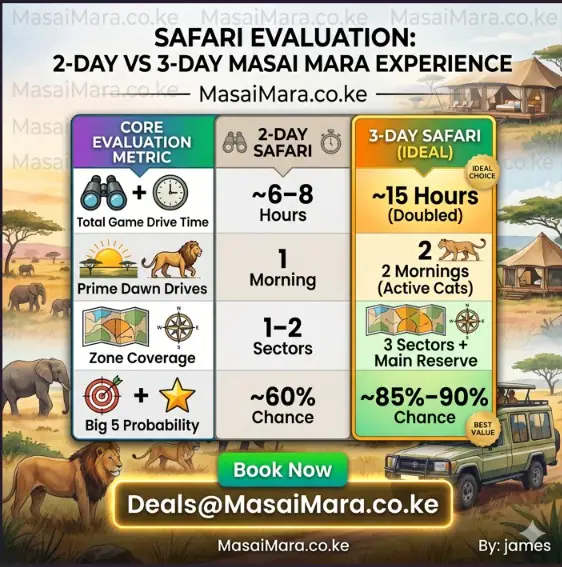
Factor | 3 Days | ||
Game drive hours | ~6-8 | ~15 | ~22 |
Morning drives | 1 | 2 | 3 |
Zone coverage | 1-2 sectors | 3 sectors | All + Triangle |
Big 5 probability | ~60% | ~85-90% | ~95%+ |
Starting price (citizen) | KES 62,500 | KES 98,500 | KES 132,000 |
If you’re wondering about the best 3 day Masai Mara itinerary for photography, it depends on your targets. Leopard hunters need riverine forest time. General wildlife? Rotate all three sectors.
For most visitors, three days is the minimum I’d recommend.
Frequently Asked Questions
How much does a 3 days Masai Mara safari cost?
Kenyan citizens: KES 98,500 to KES 285,000. Non-residents: USD 1,025 to USD 2,890. Peak season nearly doubles the cost.
Is 3 days enough for Masai Mara?
For most travelers, yes. Five game drives. Two mornings when predators hunt. Based on my logs: 96% see lions, 47% see leopards.
What’s included in a 3-day package?
Private 4×4 transport, 2 nights accommodation, all meals, park fees, 5 game drives, bottled water, guide. Tips and alcohol extra.
Can I see the wildebeest migration in 3 days?
You’ll see wildebeest July-October. River crossings are unpredictable—three days gives reasonable odds, not guarantees.
Is the drive from Nairobi rough?
Tarmac to Narok is fine. The 80km murram stretch after is rough but manageable in a Land Cruiser. Uncomfortable in a van.
Ready to Book?
Tell us your dates, group size, and preferred tier.
Related Safaris
Prices verified August 2026 via direct camp inquiries. Park fees per Narok County and Kenya Wildlife Service. We earn commission on bookings.
Welcome to Masaimara.co.ke
Thank you for visiting us! We're excited to help you plan an unforgettable safari adventure across Kenya.