
6-Day Masai Mara & Amboseli Safari: 2026 Routes & Prices

Edited by David Njunge, TRA Licensed Safari Guide (10+ years)
A 6 days Masai Mara Amboseli safari costs KES 328,000 to KES 945,000 per person sharing in 2026. You have enough time for 3 nights in the Mara, 2 nights in Amboseli, and real breathing room between destinations. Or you can add a third park—Lake Nakuru for rhinos, Lake Naivasha for boat rides and Hell’s Gate. Six days is where Kenya safaris stop feeling rushed.
Three Ways to Structure 6 Days
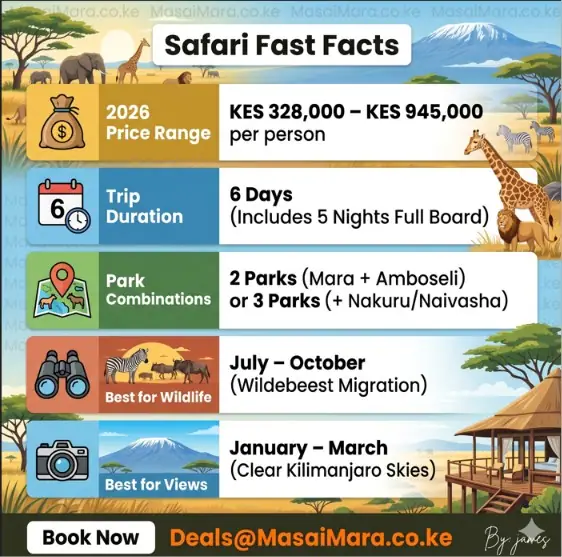
Detail | Safari Fast Facts |
2026 Price Range | KES 328,000 – KES 945,000 per person |
Trip Duration | 6 Days (Includes 5 Nights Full Board) |
Park Combinations | 2 Parks (Mara + Amboseli) or 3 Parks (+ Nakuru/Naivasha) |
Best for Wildlife | July – October (Wildebeest Migration) |
Best for Views | January – March (Clear Kilimanjaro Skies) |
Each route is logistically tested. No impossible drives, no overnight transfers.
Route A: Masai Mara (3N) → Amboseli (2N)
The purist’s choice. Maximum time in Kenya’s two flagship parks.
Day | Location | Highlights |
1 | Nairobi → Mara | Afternoon drive, first lion sighting |
2 | Mara (full day) | Morning + afternoon drives, river if migration |
3 | Mara (full day) | Balloon option, deep territory exploration |
4 | Mara → Amboseli | Morning drive, transfer, sunset at Amboseli |
5 | Amboseli (full day) | Kilimanjaro mornings, elephant families |
6 | Amboseli → Nairobi | Final drive, return home |
Transfer on Day 4: This is your long day. Flying takes 45-60 minutes. Driving takes 7-8 hours through Nairobi. If you drive, you lose the afternoon game viewing. If you fly, you keep it.
Route B: Masai Mara (3N) → Lake Nakuru (1N) → Amboseli (1N)
The classic Kenya circuit. Adds rhinos without sacrificing Mara time.
Day | Location | Highlights |
1 | Nairobi → Mara | Afternoon drive |
2 | Mara (full day) | Morning + afternoon drives |
3 | Mara (full day) | Full exploration, balloon option |
4 | Mara → Nakuru | Morning drive, transfer (4 hrs), afternoon at Nakuru |
5 | Nakuru → Amboseli | Morning drive, transfer via Nairobi (5-6 hrs) |
6 | Amboseli → Nairobi | Morning drive, return home |
The trade-off: You only get one night in Amboseli. If Kilimanjaro is cloudy that morning, you don’t get a second chance.
Route C: Masai Mara (3N) → Lake Naivasha (1N) → Amboseli (1N)
Adds variety without the park fee overhead of Nakuru.
Day | Location | Highlights |
1 | Nairobi → Mara | Afternoon drive |
2 | Mara (full day) | Morning + afternoon drives |
3 | Mara (full day) | Full exploration |
4 | Mara → Naivasha | Morning drive, transfer (5 hrs), boat ride/Crescent Island |
5 | Naivasha → Amboseli | Morning activity, transfer via Nairobi (4-5 hrs) |
6 | Amboseli → Nairobi | Morning drive, return home |
Why Naivasha over Nakuru: No park entry fee for the lake itself (boat rides and Crescent Island are separate charges). The experience is different—water-based, walking-based, less vehicle time.
Package Pricing 2026
Per person sharing. Based on two travelers. All prices in Kenya Shillings.
Route A: Mara + Amboseli Only (Flying Between Parks)
Tier | Low Season | Peak Season | Accommodation |
Mid-Range | KES 498,000 | KES 685,000 | Loyk Mara + Ol Tukai Lodge |
Luxury | KES 628,000 | KES 798,000 | Mara Serena + Amboseli Serena |
Premium | KES 798,000 | KES 945,000 | Governors Camp + Tortilis Camp |
Route A: Mara + Amboseli Only (Road Safari)
Tier | Low Season | Peak Season | Accommodation |
Budget | KES 328,000 | KES 525,000 | Mara Sidai + AA Lodge Amboseli |
Mid-Range | KES 398,000 | KES 585,000 | Sarova Mara + Kibo Safari Camp |
Luxury | KES 498,000 | KES 685,000 | Mara Sopa + Amboseli Serena |
Route B: Mara + Nakuru + Amboseli (Road Safari)
Tier | Low Season | Peak Season | Accommodation |
Budget | KES 358,000 | KES 545,000 | Mara Sidai + Lake Nakuru Lodge + AA Lodge |
Mid-Range | KES 428,000 | KES 615,000 | Sarova Mara + Saruni Nakuru + Kibo Safari |
Luxury | KES 528,000 | KES 715,000 | Mara Sopa + Lake Nakuru Sopa + Amboseli Serena |
Low season: January-June, November-mid December
Peak season: July-October, Christmas/New Year

Safari Tier | Road Safari (From) | Fly-In Safari (From) |
Budget Tier | KES 328,000 pp | Not Available |
Mid-Range Tier | KES 398,000 pp | KES 498,000 pp |
Luxury Tier | KES 498,000 pp | KES 628,000 pp |
Premium Tier | Not Available | KES 798,000 pp |
What’s Covered
A note on “6 days”: This means 5 nights of accommodation. Day 6 ends with your return to Nairobi, not another overnight. Check your quote carefully—some operators count differently.
Included: All transport (vehicle throughout or flights as specified), park entry fees for all parks visited, 5 nights full board accommodation, all meals, game drives as scheduled, bottled water, airport/airstrip transfers.
Not included: Alcoholic drinks, tips (budget KES 10,000-15,000 total for a 6-day trip), travel insurance, optional activities.
Add-ons:
Activity | Location | Cost |
Mara | KES 58,500 | |
Boat ride | Naivasha | KES 5,200 |
Crescent Island walk | Naivasha | KES 4,290 |
Mara | KES 3,900 | |
Sundowner | Amboseli | KES 5,200 |
Day-by-Day: Route A (Mara + Amboseli Only)
This is the flying version with 3 nights Mara and 2 nights Amboseli. Road version follows the same sequence but replaces the Day 4 flight with an 7-8 hour drive.
Day 1: Nairobi to Masai Mara
Catch the 7:30 AM flight from Wilson Airport. Land at your Mara airstrip around 8:15 AM.
The camp’s open-sided Land Cruiser meets you at the runway. In October 2025, I picked up guests at Olkiombo and we found a leopard in a sausage tree before we even left the airstrip perimeter. That’s not typical—but it’s possible. The airstrip areas are wildlife zones, not sterile transit points.
Check in. Lunch. The heat peaks around 1-2 PM. Most guests rest.
Afternoon drive from 3:30 PM. Your guide uses this first session to map the territory—where are the pride territories, which areas have good grass, what other vehicles have found today. This reconnaissance pays off over the next two days.
Overnight: Masai Mara
Day 2: Full Day in Masai Mara
This is why you came.
Morning drive leaves at 6:15 AM. The Mara’s lion prides are most active in the first two hours of light. Cheetahs hunt early. Your guide has overnight intel from camp watchmen who heard roaring—they know roughly where the males are.
Return for breakfast around 9:30 AM. Rest through midday.
Afternoon drive from 3:30-6:30 PM. If yesterday’s reconnaissance paid off, today you’re following up on specific animals—the lioness who was stalking zebra, the leopard your guide thinks will descend from her tree around 5 PM.
Overnight: Masai Mara
Day 3: Full Day in Masai Mara
Optional: Balloon safari this morning. Launches at 6 AM, lands around 8 AM with champagne breakfast in the bush. You’ll miss the morning game drive but gain an aerial perspective that’s worth it for some travelers.
Without the balloon: standard morning and afternoon drives. By Day 3, your guide knows which areas are producing and which are quiet. This is when the deep exploration happens—areas farther from camp, less-visited sections of the reserve.
During migration season (July-October), Day 3 might focus entirely on river crossings. Your guide positions you at likely crossing points based on herd movements. But crossings are unpredictable. In September 2025, I waited with guests at the Mara River lookout for 4 hours. Nothing. We gave up for lunch. The crossing happened 20 minutes after we left. That’s the reality—you can only be in position and hope.
Overnight: Masai Mara
Day 4: Masai Mara to Amboseli
Morning drive from 6:15-9:30 AM. Final Mara time. Your guide knows what you still want to see—this drive focuses on filling gaps.
The 10 AM exit rule (Narok County side): You must exit the reserve by 10 AM on departure day or pay another full day’s park fee. For flying guests, the airstrip counts as your exit point, giving you slightly more time.
Mara Triangle note: If your camp is in the Triangle (managed by Mara Conservancy rather than Narok County), the ticketing system works differently—closer to 24-hour validity in some cases. Confirm with your camp directly.
Catch the late morning flight to Amboseli. Flight time is 45-60 minutes depending on routing.
Confirm your routing: Some Mara-to-Amboseli flights go direct. Others route through Wilson Airport in Nairobi, adding 90 minutes. This affects your arrival time and whether you get a full afternoon drive in Amboseli. Ask specifically when booking through Masaimara.co.ke.
Land at Amboseli Airstrip around midday. Check in. Lunch.
Afternoon drive from 3:30 PM. The landscape shift is immediate. Amboseli is drier, dustier, more sparse than the Mara’s rolling grasslands. It can look harsh—almost barren in dry months. The payoff is elephants. Large family groups against the backdrop of Kilimanjaro when the mountain cooperates.
Overnight: Amboseli
Day 5: Full Day in Amboseli
Your guide knows this is Kilimanjaro day.
Early departure—5:45 AM if your lodge allows. The mountain is most likely clear before 8 AM. January-March tends to offer the best odds; in our experience, maybe 7 out of 10 mornings you’ll get some view. July-August is tougher—cloud builds earlier and stays.
Drive toward Observation Hill (Noomotio) for the combined swamp-and-mountain view. The elephants are already moving. Family groups heading from acacia groves toward the springs. The volcanic dust rises when they walk—fine grey powder that smells mineral and alkaline, like wet concrete curing.
Mid-morning back at the lodge. The mountain typically clouds over by 10 AM.
Afternoon drive from 3:30 PM. Different focus now—the Enkongo Narok swamp, hippos, buffalo, maybe the Amboseli lion prides. Watch for Long-toed Lapwings walking on lily pads—one of the few places you can photograph “the bird that walks on water” with Africa’s highest mountain behind it.
Overnight: Amboseli
Day 6: Amboseli to Nairobi
If Kilimanjaro didn’t show yesterday: Request an early drive. The mountain sometimes appears for 15-20 minutes around 6:30 AM then disappears.
Final morning drive until 8-9 AM. Amboseli is managed by KWS, not county government, so the exit timing is more flexible than the Mara.
Pack up. Depart for Nairobi.
Flying: Catch the 11 AM flight to Wilson. Arrive around 11:45 AM.
Driving: Leave by 9 AM to reach Nairobi around 1-2 PM. Factor in Athi River traffic if traveling on weekday afternoons.
The Third Destination Question
With 6 days, you face a choice that shorter safaris don’t offer: stick with two parks and go deeper, or add a third destination.
Option 1: Mara + Amboseli only (3+2 nights)
You’re not adding another park. Instead, you’re giving both parks the time they deserve. Three nights in the Mara means six game drives. Two nights in Amboseli means two mornings to wait for Kilimanjaro.
This works if: you want depth over breadth, you’re serious about wildlife photography, or you’ve already done Kenya’s other parks on previous trips.
Option 2: Mara + Nakuru + Amboseli (3+1+1 nights)
Lake Nakuru adds rhinos to your trip—both black and white. It’s the most reliable place in Kenya to see them. The lake itself draws flamingos (though numbers vary by water levels and algae). One night is enough.
This works if: rhinos matter to you, you want variety in landscapes, or you’re checking off the Big 5 and need rhino sightings to complete the list.
Option 3: Mara + Naivasha + Amboseli (3+1+1 nights)
Lake Naivasha isn’t a traditional safari park. You go for the boat ride—hippos at close range, fish eagles, and a break from the vehicle. Crescent Island lets you walk among zebra and giraffe. It’s a different pace entirely.
This works if: you want variety beyond game drives, you’re traveling with kids who need activity changes, or the boat ride appeals more than another savanna park.
My take: For first-time Kenya visitors, Route B (with Nakuru) gives the most complete wildlife experience. For repeat visitors or those who value depth over variety, Route A (Mara + Amboseli only) is hard to beat.
What Actually Goes Wrong
The Nakuru flamingo disappointment
Guests book Route B specifically for Lake Nakuru’s flamingos—those iconic pink shorelines. Then they arrive and find… a few hundred birds instead of hundreds of thousands.
The reality: Flamingo numbers depend on water levels and algae. Some years the lake is perfect and flamingos carpet the shore. Other years, they’ve moved to Lake Bogoria or Elementaita. There’s no way to guarantee numbers.
What to do: If flamingos are your primary Nakuru goal, check recent visitor photos before your trip. If numbers are low, you can still justify Nakuru for rhinos—both black and white rhino sightings are reliable here, which isn’t true of the Mara or Amboseli.
The Day 4/5 exhaustion wall
By Day 4 or 5 of a safari, some travelers hit a wall. Early mornings, bumpy roads, constant alertness. The novelty fades and fatigue sets in.
What to do: Build in rest. With 6 days, you have the luxury. Skip an afternoon drive. Sit by the pool. Read. The camps are designed for this—you don’t have to be in the vehicle every possible moment.
Pacing tip: Don’t book the balloon safari for Day 1 or Day 5. Day 2 or Day 3 is better—you’re warmed up but not yet tired.
The eCitizen gate chaos
In 2026, the KWS payment system (eCitizen portal) can be slow at park gates, especially during midday when multiple vehicles arrive simultaneously and connectivity drops.
What to do: Have your guide verify your payment confirmation and QR code before you leave Nairobi. I’ve seen families stuck at Meshanani Gate (Amboseli) for over an hour because the system was down. Pre-verification eliminates this.

The Disruption | The Guide’s Pivot (Expert Solution) |
Few Nakuru Flamingos | Shift focus to the park’s highly reliable black & white rhino tracking. |
Day 4 or 5 Fatigue | Leverage your 6-day flexibility to skip a drive and relax at the pool. |
eCitizen Portal Outages | Have your guide pre-verify all booking QR codes before leaving Nairobi. |
Park Fees 2026
Included in all packages. Listed for reference.
Masai Mara (per Narok County): USD 100/day (Jan-June) or USD 200/day (July-December) for non-residents. Citizens pay KES 1,500-3,000/day. Tickets valid for 12 hours (6 AM-6 PM).
Lake Nakuru (via eCitizen): USD 60/day for non-residents. Citizens pay approximately KES 515/day including gateway fee.
Amboseli (via eCitizen): USD 70/day for non-residents. Citizens pay approximately KES 1,030/day including gateway fee.
Lake Naivasha: No park entry fee for the lake itself. Crescent Island is approximately KES 4,290 per person. Boat rides are approximately KES 5,200 per person.
Practical Tips

Destination | Non-Resident Fee | Kenya Citizen Fee |
Masai Mara | USD 100 to 200 / Day | KES 1,500 to 3,000 / Day |
Lake Nakuru | USD 90 / Day | ~ KES 515 / Day |
Amboseli Park | USD 90 / Day | ~ KES 1,030 / Day |
Lake Naivasha | KES 0 (Free Entry) | KES 0 (Free Entry) |
The Lang’ata Road Problem (2026)
The road expansion near T-Mall has created a permanent bottleneck. If you’re staying in Westlands or the CBD and need to reach Wilson Airport for a 7:30 AM flight, take Mbagathi Way instead of Lang’ata Road. It adds 2km but saves 30-40 minutes.
Better yet: stay in Karen or Lang’ata the night before your flight.
Baggage for Flying Safaris
Per Safarilink’s policy: 15kg per person including hand luggage. Soft bags only—hard shells don’t fit in Cessna cargo pods.
The workaround: Wear heavy items (boots, jacket) onto the plane. Camera lenses go in jacket pockets. They weigh bags, not passengers.
The Dust Kit
Amboseli is extremely dusty in dry months. Pack: lens blower, microfiber cloths, ziplock bags for camera gear, and a bandana for your face. Open-sided vehicles are better for photos but worse for dust exposure.
Frequently Asked Questions
How much does a 6 days Masai Mara Amboseli safari cost?
KES 328,000 to KES 945,000 per person depending on route, accommodation tier, and whether you fly or drive between parks. Budget road safaris (Route A) start around KES 328,000. Premium flying packages reach KES 945,000.
Should I add Lake Nakuru or stick with two parks?
If you want the most complete Big 5 experience including reliable rhino sightings, add Nakuru. If you prefer depth over breadth and want maximum time in the Mara and Amboseli, stick with two parks.
What’s the best time for a 6-day Mara-Amboseli safari?
July-October for migration and peak predator activity in the Mara (but worst Kilimanjaro visibility). January-March for best Kilimanjaro odds and good wildlife throughout. April-May rains can make roads difficult.
Is 6 days too long for a safari?
No. Six days is where safaris stop feeling rushed. You have time for rest days, deeper exploration, and genuine immersion. Most guests find 6 days is actually ideal—any shorter feels hurried.
Can I combine this with a beach stay?
Yes. Fly from Amboseli or Nairobi to the coast (Diani, Mombasa, Malindi) for 2-4 nights. A 6-day safari + 3-night beach is a popular 9-day Kenya combination.
Will I see the Big 5?
With Route B (including Nakuru): very likely—Nakuru has reliable rhino sightings. With Route A: lions, elephants, and buffalo are almost certain; leopards are likely; rhinos are uncommon.
Ready to Plan?
Tell us your dates, which route interests you, and what matters most for your trip. We’ll put together options.
Related Safaris
- 5 Days Masai Mara Safari
- 7 Days Masai Mara Safari
- Masai Mara Lake Nakuru Safari
- Best Time to Visit Masai Mara
- Masai Mara National Reserve
Prices verified August 2026. Park fees per KWS and Narok County. Flight schedules per Safarilink and AirKenya.
Welcome to Masaimara.co.ke
Thank you for visiting us! We're excited to help you plan an unforgettable safari adventure across Kenya.