
7-Day Masai Mara & Amboseli Safari: 2026 Routes & Prices
Edited by David Njunge, TRA Licensed Safari Guide (10+ years)
A 7 days Masai Mara Amboseli safari costs KES 385,000 to KES 1,125,000 per person sharing in 2026. At seven days, safaris start to feel different. You stop counting game drives and start noticing how the light changes through the week. You learn the rhythm of specific lion prides. You have time to sit still.
Three Circuit Options

Circuit Option | Best For | Key Trade-Off |
Classic Kenya | First-time visitors tracking maximum wildlife variety. | 1-night stops offer less depth per park. |
Southern Focus | Photographers and repeat guests seeking deep animal tracking. | Misses out on rhino tracking and lake boat tours. |
Extended Mara | Maximizing Great Migration river crossing windows. | Limits Amboseli to 1 night (high Kilimanjaro risk). |
With 7 days, you’re not squeezing parks into a schedule. You’re designing a circuit. Here are the three that work best.
The Classic Kenya Circuit (Most Popular)
Route: Masai Mara (3N) → Lake Nakuru (1N) → Lake Naivasha (1N) → Amboseli (1N)
Kenya’s signature safari. The Mara for predators and migration. Nakuru for rhinos. Naivasha for boat rides. Amboseli for elephants and Kilimanjaro.
Who it’s for: First-time visitors wanting variety. Travelers completing the Big 5.
Trade-off: One night per stop after the Mara means less depth. If Kilimanjaro is cloudy that single Amboseli morning, no do-over.
About that Naivasha night: I used to think it was padding—an unnecessary stop between two flagship parks. Then I ran a group that skipped it. We hit traffic at Mai Mahiu, arrived at Amboseli after dark, missed the sunset drive entirely, and everyone was exhausted for the next two days. Now I tell people: that Naivasha night is your buffer. One delay without it cascades through everything.
Route clarification: This is Kenya-only. You’ll pass through Namanga (Tanzania border town) but don’t cross. If you’re seeing itineraries mentioning Serengeti or Ngorongoro, that’s a different (longer) trip.
The Southern Focus
Route: Masai Mara (3N) → Amboseli (3N)
Maximum time in Kenya’s two flagship parks. Six game drives per park. You’ll learn specific territories and recognize individual animals.
Who it’s for: Repeat visitors. Photographers who need time. Those who value depth over variety.
Trade-off: No rhinos. No lake experiences.
On splitting the nights: Some travelers prefer 4 nights Mara + 2 nights Amboseli. The thinking: Kilimanjaro visibility is unpredictable while the Mara delivers reliably. Two Amboseli mornings gives you two chances at the mountain. I’m not sure there’s a “right” answer here—depends on what you’re prioritizing.
Consider reversing the order: If your dates are flexible, ask your operator to start in Amboseli and finish in the Mara. Your trip ends with the highest-density predator sightings rather than tapering off. You’re also doing the longest drives when freshest. Not everyone agrees this is better, but it’s worth considering.
The Extended Mara
Route: Masai Mara (4N) → Lake Naivasha (1N) → Amboseli (1N)
Four nights in the Mara is unusual. But during migration (July-October), the extra night significantly increases crossing chances. Eight game drives instead of six.
Who it’s for: Migration-focused travelers. Serious photographers.
Trade-off: Only one Amboseli night. If Kilimanjaro matters, this isn’t the circuit.
Before You Book: A Few Things
Ask about guide continuity. In my experience—and from what guests tell me afterward—the individual guide matters more than the vehicle or lodge tier. Ask your operator whether you’ll have one guide throughout or regional handoffs. If there’s a handoff, get specifics: who meets you where, who’s responsible if something slips.
For group/joining safaris: ask about your seat. On shared vehicle formats, comfort and photography come down to seat position and window access. Before booking, ask: Do you have a dedicated seat for the week, or is there a rotation system? This rarely comes up in marketing.
Test their precision. When comparing operators, message them with 2-3 specific questions: Vehicle type? Same guide throughout? Seat rotation policy? How they answer tells you something about how the week will actually run. Vague answers aren’t necessarily a dealbreaker, but they’re a data point.
Package Pricing 2026
Per person sharing. Based on two travelers. All prices in Kenya Shillings.
Classic Kenya Circuit (Flying Mara, Driving Rest)
Tier | Low Season | Peak Season | Accommodation |
Mid-Range | KES 545,000 | KES 785,000 | Loyk Mara + Lake Nakuru Lodge + Enashipai + Ol Tukai |
Luxury | KES 698,000 | KES 925,000 | Mara Serena + Sarova Lion Hill + Enashipai + Amboseli Serena |
Premium | KES 898,000 | KES 1,125,000 | Governors + Lake Nakuru Sopa + Great Rift Valley Lodge + Tortilis |
Southern Focus (Flying Between Parks)
Tier | Low Season | Peak Season | Accommodation |
Mid-Range | KES 598,000 | KES 845,000 | Mara Leisure Camp + Ol Tukai Lodge |
Luxury | KES 758,000 | KES 985,000 | Mara Serena + Amboseli Serena |
Premium | KES 925,000 | KES 1,098,000 | Governors Camp + Tortilis Camp |
Classic Kenya Circuit (Road Safari Throughout)
Tier | Low Season | Peak Season | Accommodation |
Budget | KES 385,000 | KES 628,000 | Mara Sidai + Lake Nakuru Lodge + Naivasha Sopa + AA Lodge |
Mid-Range | KES 475,000 | KES 715,000 | Sarova Mara + Lake Nakuru Sopa + Enashipai + Kibo Safari |
Luxury | KES 598,000 | KES 845,000 | Mara Sopa + Sarova Lion Hill + Enashipai + Amboseli Serena |
Low season: January-June, November-mid December
Peak season: July-October, Christmas/New Year

Safari Tier | Road Safari (From) | Fly-In Safari (From) |
Budget Tier | KES 385,000 pp | Not Available |
Mid-Range Tier | KES 475,000 pp | KES 545,000 pp |
Luxury Tier | KES 598,000 pp | KES 698,000 pp |
Premium Tier | Not Available | KES 898,000 pp |
What’s Included
Note: “7 days” means 6 nights of accommodation. Day 7 ends with your return to Nairobi.
Covered: All transport, park fees, 6 nights full board, all meals, scheduled game drives, bottled water, boat ride at Naivasha (Classic Circuit), transfers.
Not covered: Alcoholic drinks, tips (budget KES 12,000-18,000), travel insurance, optional activities.
Optional: Hot air balloon (KES 58,500), Crescent Island walk (KES 4,290), Hell’s Gate cycling (KES 3,900), Maasai village (KES 3,900), night game drive (KES 7,800).
Day-by-Day: Classic Kenya Circuit
This is the most popular 7-day configuration. Fly into the Mara, drive the rest. Adjust timing based on your flight arrival in Nairobi.
Day 1: Nairobi to Masai Mara
Catch the 7:30 AM Safarilink flight from Wilson Airport. Land at your Mara airstrip around 8:15 AM.
The camp vehicle meets you on the runway. These open-sided Land Cruisers start the game drive immediately—the airstrip is inside the reserve. In August 2025, I picked up guests at Musiara and we found a cheetah stalking Thomson’s gazelle before we cleared the airstrip boundary. That first hour set the tone for their entire week.
Check in. Lunch. Rest through the midday heat.
Afternoon drive from 3:30-6:30 PM. Your guide uses this session to map the territory—pride locations, areas with good grass, what other vehicles found today.
Overnight: Masai Mara
Day 2: Full Day in Masai Mara
Morning drive at 6:15 AM. The Mara’s lions are most active in early light. Leopards hunt before retreating to trees. Your guide has overnight intel from camp watchmen who heard roaring.
By Day 2, you’re starting to understand the landscape. The Mara isn’t one uniform savanna—it’s a patchwork of micro-territories. The riverine forest along the Talek River. The open plains near Musiara. The rocky outcrops where leopards den.
If you need clothes washed, hand them in this morning—not evening. Most camps sun-dry laundry. Hand in clothes the night before a transfer day and they’ll still be damp when you leave at 7 AM. I learned this in 2023 when a client packed wet shirts and they smelled like mildew for the rest of the trip.
Afternoon drive from 3:30-6:30 PM.
If you’re staying in the North Mara (Musiara or Triangle area), you’ll hear a loud rhythmic “clack-clack-clack” at night. Sounds exactly like someone chopping wood outside your tent. Most guests call security thinking there’s illegal logging. It’s actually the Square-marked Toad.
Overnight: Masai Mara
Day 3: Full Day in Masai Mara
This is the day for optional activities. Balloon safari launches at 6 AM, lands around 8 AM with champagne breakfast in the bush. You’ll miss the morning game drive but gain a perspective that only aerial viewing provides.
Without the balloon: morning and afternoon drives as usual. By Day 3, your guide knows which areas are producing. This is when deeper exploration happens—sections farther from camp, places other vehicles skip.
Something about cheetahs on termite mounds: they use them as lookout posts and as “thermal heaters” in the morning. If your vehicle’s shadow hits the mound, you’re blocking the warmth. The cheetah will often leave. I’ve watched it happen—guide parks in the wrong spot, cat gets up and moves within two minutes. If you notice your shadow falling on the mound, ask to reposition.
In the thicker riverine areas, you’ll see blue and black cloths hanging from trees. These are Tsetse fly traps saturated with pheromones. Don’t let your guide park near one for a “photo op”—tourists sometimes think they’re markers. You’ll have a vehicle full of biting flies within minutes.
During migration (July-October), your guide may spend the entire day working river crossing positions. In September 2025, I sat with guests at the Mara River for nearly 5 hours. Thousands of wildebeest on the north bank, pacing but not crossing. We gave up for lunch. The crossing happened 25 minutes later—another guide sent photos. That’s the reality of crossings. You can position and wait, but you can’t force it.
One thing nobody mentions about crossings: the smell. During peak migration, the crossing points smell of ammonia from fear-urine and decay from carcasses lodged in rocks. If you have a sensitive stomach and plan to wait hours, pack Tiger Balm or Vicks. Dab some under your nose.
Overnight: Masai Mara
Day 4: Masai Mara to Lake Nakuru
Morning drive from 6:15-9:30 AM. Final Mara time.
On the Narok County side, you must exit by 10 AM or pay another day’s fee. The Mara Triangle has different ticketing—closer to 24-hour validity. Confirm with your camp.
If your itinerary uses the Triangle route via Purungat Bridge gate, it’s strictly cashless. Many international credit cards fail due to poor signal. Have your guide pre-load your entrance fee on their M-Pesa as backup.
Drive to Lake Nakuru through Narok town and across the Rift Valley escarpment. Total: 5-6 hours.
Don’t treat the Rift Valley viewpoint as just a bathroom stop. Ask your driver to time it for good light and give yourself 15-20 minutes. The view across what’s essentially a crack in the earth’s crust is one of Kenya’s most dramatic. I’ve rushed past it too many times and always regretted it.
Arrive Nakuru late afternoon. Short evening drive if time allows.
Overnight: Lake Nakuru
Day 5: Lake Nakuru to Lake Naivasha
Morning game drive in Nakuru. Focus on rhinos—both black and white species are reliable here. If completing the Big 5 matters to you, this is where it happens.
About the flamingos: numbers depend on water levels and algae. Some years the shoreline is carpeted pink. Other years, most have moved to Lake Bogoria. Check recent visitor photos before getting hopes up. I’ve had guests arrive expecting hundreds of thousands of flamingos and find maybe a few hundred. It’s disappointing when it happens.
Continue to Lake Naivasha after the morning drive. 2-3 hours. Afternoon boat ride on the lake. Hippos at close range—you’ll hear them grunt and blow, that deep mechanical sound that carries across the water.
Optional: Crescent Island walk. On foot among zebra, giraffe, wildebeest. After days in a vehicle, the change in perspective is striking.
Overnight: Lake Naivasha
Day 6: Lake Naivasha to Amboseli
Optional morning: Hell’s Gate cycling among zebra and giraffe. Or rest—by Day 6, some travelers need it.
Drive to Amboseli via Nairobi. Route through Mai Mahiu, Southern Bypass, Athi River, Namanga. Total: 5-6 hours.
Ask your guide about transiting through Kimana Sanctuary instead of driving straight into the main Amboseli gates. It’s a community-owned corridor where you can sometimes see super-tuskers in a lush, wooded setting rather than Amboseli’s dusty plains. Turns a boring transfer into something more interesting. Not every guide does this route, so you may need to request it specifically.
About entering Amboseli: the signal at Meshanani Gate is unreliable. Take a high-resolution screenshot of your QR code and payment confirmation from the KWS GavaPay portal. Rangers won’t let you through without a scannable code, and I’ve seen groups wait 30+ minutes for signal to load. Screenshots solve this.
Arrive late afternoon. Short sunset drive if timing works.
Overnight: Amboseli
Day 7: Amboseli to Nairobi
This is your Kilimanjaro morning. Early departure—5:45 AM if your lodge allows. The mountain is most likely clear before 8 AM.
In my experience, January-March offers the best visibility—maybe 7 out of 10 mornings you’ll see something. July-August is harder. The mountain creates its own weather and there’s no predicting it.
About Observation Hill (Noomotio): every guide suggests it for the combined swamp-and-mountain view. But it’s become crowded—40+ vehicles by 8:30 AM in peak season. You also have to park and walk up stairs, leaving the vehicle. Some guests prefer a “tailgate breakfast” at the Enkongo Narok swamp edge instead. Same elephant-and-mountain view, but you stay in the vehicle and can follow any action immediately.
[Photo placeholder: Noomotio at 6:52 AM—notice how the cloud sits lower than the peak]
The elephants are already moving toward the springs when you arrive. Family groups crossing from acacia groves through the alkaline dust—fine grey powder that smells mineral, like wet concrete curing.
Final game drive until 9 AM. Pack up. Drive to Nairobi (4-5 hours). Arrive early-to-mid afternoon depending on Athi River traffic.
Rest Days and the Week-Long Rhythm
Seven days is long enough that rest becomes strategic. If you’re feeling the cumulative effect of early mornings and bumpy roads—usually around Day 4 or 5—skip an afternoon drive. The camps are designed for this.
I’d avoid resting on Day 2 or Day 3 in the Mara though. This is prime time—you’re warmed up but not yet tired, and your guide is building momentum.
Some couples have different energy thresholds. One wants every game drive; the other needs downtime. This is fine. One goes on the afternoon drive while the other stays at camp.
Something shifts around mid-week. The initial adrenaline fades. Lions become… lions. This isn’t bad—it’s when safaris become interesting. You start noticing things: how coalition males interact, how zebra position relative to watering holes, how to read vulture flight patterns. Your guide can show you things that would’ve been lost in Day 1 excitement. This is what shorter safaris can’t offer.
What Actually Goes Wrong
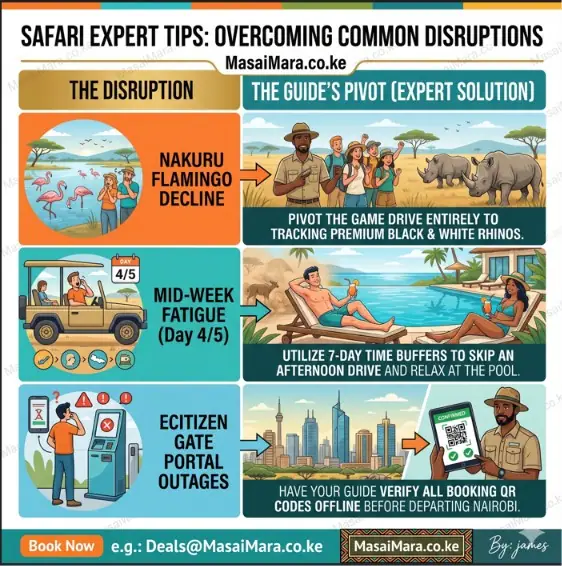
The Disruption | The Guide’s Pivot (Expert Solution) |
Nakuru Flamingo Decline | Pivot the game drive entirely to tracking premium black & white rhinos. |
Mid-Week Fatigue (Day 4/5) | Utilize 7-day time buffers to skip an afternoon drive and relax at the pool. |
eCitizen Gate Portal Outages | Have your guide verify all booking QR codes offline before departing Nairobi. |
The Day 6-7 energy crash: Some travelers hit a wall near the end. Early mornings accumulate. Build in rest, don’t book the balloon for Day 6, and accept that skipping a drive is okay.
The Nakuru flamingo disappointment: Guests arrive expecting pink-carpeted shorelines and find a few hundred birds instead. Flamingo numbers fluctuate with water chemistry—there’s no guarantee. Refocus on rhinos. Both black and white species are more reliable here than anywhere in Kenya.
Single nights mean single chances: The Classic Circuit gives you one night at each stop after the Mara. If Kilimanjaro is cloudy that single Amboseli morning, you don’t get a do-over. If mountain views are essential, consider the Southern Focus circuit instead.
Park Fees 2026
Included in all packages. Listed for reference.
Masai Mara (per Narok County): USD 100/day (Jan-June) or USD 200/day (July-December) for non-residents. Citizens pay KES 1,500-3,000/day. Tickets valid 12 hours (6 AM-6 PM).
Lake Nakuru (via eCitizen): USD 90/day for non-residents. Citizens ~KES 1500/day.
Lake Naivasha: No park entry fee for the lake. Crescent Island ~KES 4,290. Boat rides ~KES 5,200. Hell’s Gate ~KES 3,350.
Amboseli (via eCitizen): USD 90/day for non-residents. Citizens ~KES 1,500/day.
See KWS for current rates.
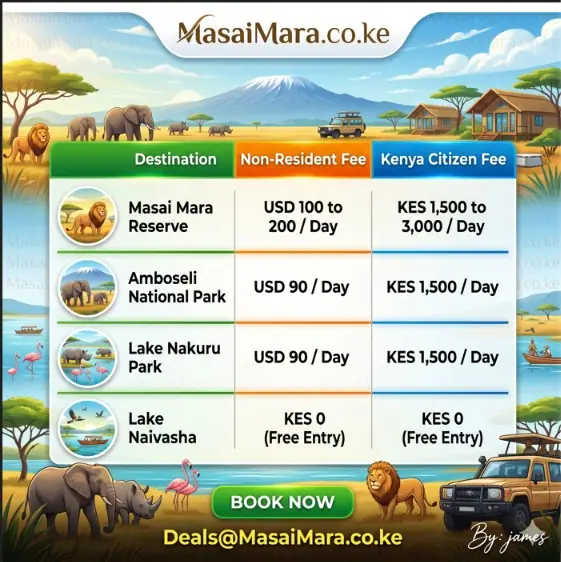
Destination | Non-Resident Fee | Kenya Citizen Fee |
Masai Mara Reserve | USD 100 to 200 / Day | KES 1,500 to 3,000 / Day |
Amboseli National Park | USD 90 / Day | KES 1,500 / Day |
Lake Nakuru Park | USD 90 / Day | KES 1,500 / Day |
Lake Naivasha | KES 0 (Free Entry) | KES 0 (Free Entry) |
Practical Notes
The Lang’ata Road expansion near T-Mall creates a permanent bottleneck. If staying in Westlands or CBD for a 7:30 AM flight, take Mbagathi Way instead—adds 2km, saves maybe 30 minutes most mornings.
Per Safarilink’s baggage policy: 15kg per person, soft bags only. Wear heavy items onto the plane. Camera lenses go in jacket pockets.
For Amboseli, pack a dust kit: lens blower, microfiber cloths, ziplock bags, bandana. Open vehicles are better for photos but worse for dust.
One more thing about 7-day trips specifically: seven days of sharing binoculars in Amboseli’s volcanic dust and the Mara’s red earth can cause eye irritation. Several guests have mentioned this over the years. Bring alcohol-free antibacterial wipes for the binocular eye-cups—not just lens wipes. A quick wipe each morning helps.
Frequently Asked Questions
How much does a 7 days Masai Mara Amboseli safari cost? KES 385,000 to KES 1,125,000 per person depending on circuit and accommodation tier.
Is 7 days too long for a Kenya safari? No. Seven days is where safaris stop feeling rushed and deeper immersion becomes possible.
Which circuit is best for first-time visitors? The Classic Kenya Circuit (Mara → Nakuru → Naivasha → Amboseli) offers the most variety and best Big 5 chances.
What’s the best time for a 7-day safari? July-October for migration. January-March for best Kilimanjaro visibility.
Can I add a beach extension? Yes. Fly to Diani, Mombasa, or Malindi. A 7-day safari + 3-night beach makes an ideal Kenya trip.
Ready to Build Your Week?
Tell us which circuit appeals, when you want to travel, and what matters most. We’ll put together a custom itinerary.
Related Safaris
- 5 Days Masai Mara Safari
- 6 Days Masai Mara Safari
- Masai Mara Lake Nakuru Safari
- Masai Mara Amboseli Safari
- Best Time to Visit Masai Mara
Prices verified August 2026. Park fees per KWS and Narok County.
Welcome to Masaimara.co.ke
Thank you for visiting us! We're excited to help you plan an unforgettable safari adventure across Kenya.