
Masai Mara Wildlife: What Lives Here and Where to Find It
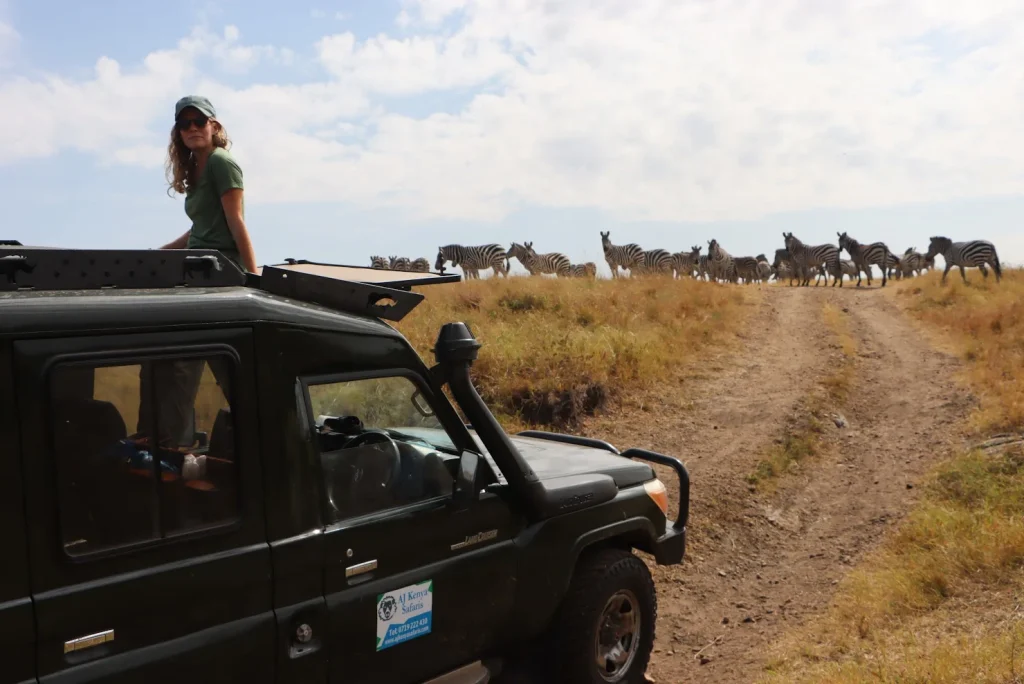
Masai Mara Wildlife at a Glance
The Masai Mara holds more than 90 mammal species and 470 bird species in 1,510 square kilometres, including the Big Five, one of Africa’s densest lion populations and the July to October wildebeest migration. This page covers each animal, where it lives, and the best months to see it.
What This Guide Covers
The Masai Mara is the northern end of the Serengeti ecosystem, and the animals treat the border as if it were not there. More than 90 mammal species live in the reserve and the conservancies around it, among them over 850 lions, a small guarded population of black rhino, and the 1.5 million wildebeest and 200,000 zebra that arrive from Tanzania each July. Add 470 recorded bird species and you have the reason the Mara fills up between July and October and still delivers in February.
What makes the Mara different from other Kenyan parks is density. The grass is short, the plains are open and the cats are used to vehicles, so a single morning drive from Sekenani Gate routinely produces lions, elephants, giraffes, hyenas and the plains herds without searching. Leopards and rhino take more work, and this page says where that work pays off.
Each section below gives the animal, where its territory sits, the months it is easiest to find, and a link to its own page with the detail. If you are planning around a particular sighting, the game drives page explains how a Mara day runs and the safari packages page has the trips that put you in the right sector.
The Big Five in the Masai Mara
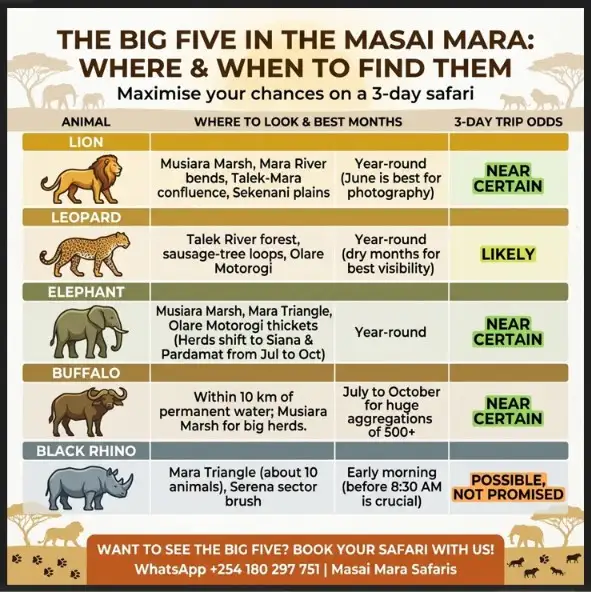
All five live here, but the odds are not equal. On a 3-day safari, lion, elephant and buffalo are close to certain, leopard is likely with a guide who knows the Talek, and black rhino is a matter of luck and sector.
Animal | Where to look | Best months | Odds on a 3-day trip |
Musiara Marsh, Mara River bends, Talek-Mara confluence, Sekenani plains | Year-round; June for photography | Near certain | |
Talek River forest, sausage-tree loops, Olare Motorogi | Year-round; dry months for visibility | Likely | |
Musiara Marsh, Mara Triangle, Olare Motorogi thickets | Year-round; herds shift to Siana and Pardamat Jul to Oct | Near certain | |
Within 10 km of permanent water; Musiara Marsh for the big herds | Jul to Oct for aggregations of 500+ | Near certain | |
Mara Triangle (about 10 animals), Serena sector brush | Early morning, before 8:30 AM | Possible, not promised |
The real count on rhino is that the whole ecosystem holds somewhere between 25 and 50 black rhinos, down from about 120 before the poaching crash of the 1980s, and they live in thick cover. The Mara Conservancy rangers in the Triangle track theirs daily, which is why a night on the west bank is the single best thing you can do for a rhino sighting. For a guaranteed rhino, Lake Nakuru is the answer, and our Mara and Lake Nakuru packages exist for exactly that reason. The Kenya-wide picture is on our Big Five animals in Kenya page.
Big Cats: Lions, Leopards and Cheetahs
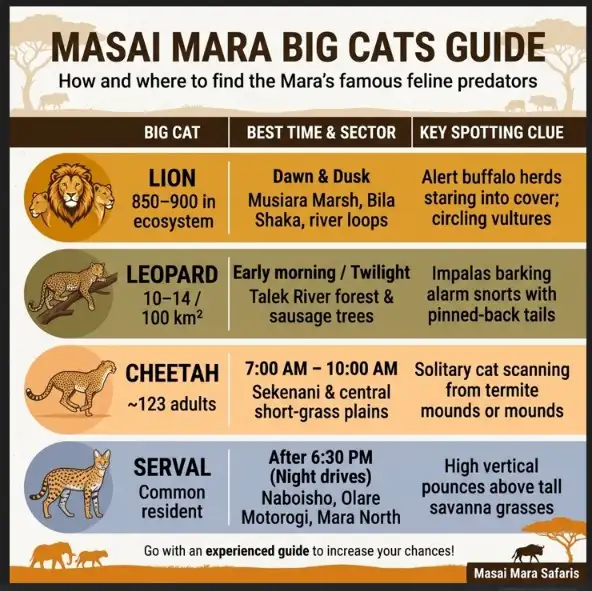
The Mara’s reputation rests on its cats. The density is high enough that the prides and individuals have names, and your guide will use them.
Lions. Between 850 and 900 lions live across the reserve and the conservancies. The Marsh Pride at Musiara is the most famous, currently held by a seven-male coalition known as the Topi Boys. The Paradise Pride works the Mara River bends, the Bila Shaka Pride the Talek-Mara confluence, and the Ilkisiusiu group in the east has grown to nearly 40 animals. Lions here hunt buffalo, and a standoff between a pride and a herd can run from 30 minutes to several hours. In the reserve a good sighting can draw 20 to 30 vehicles, while in the conservancies the cap is five.
Leopards. Density runs at 10 to 14 adults per 100 square kilometres, among the highest in Africa, but they are still the Big Five animal most people miss. The riverine forest along the Talek and the sausage-tree loops are the territories to work, and named individuals such as Bahati, Luluka and Kaboso have been followed for years. Watch the impala: pinned tails and fixed stares mean a leopard within about 100 metres.
Cheetahs. Around 123 adult cheetahs have been identified in the ecosystem from facial-spot photographs. The open short-grass plains between Sekenani Gate and the Talek River are their hunting ground, and they hunt in daylight, mostly between 7 and 10 AM, so a morning drive out of Sekenani is the best cheetah chance in the Mara. The famous Tano Bora coalition of five males has broken up. Females such as Kisaru, Imani and Nashipai are the ones guides follow now, and February is the month for cubs.
For the three cats together, with the current coalitions, prides and where each hunts, see our Masai Mara big cats guide.
Masai Mara Big Cats Guide
Big Cat | Best Time & Sector | Key Spotting Clue |
Lion
(850–900 in ecosystem) | Dawn & Dusk
Musiara Marsh, Bila Shaka, river loops | Alert buffalo herds staring into cover; circling vultures |
Leopard
(10–14 / 100 km²) | Early morning / Twilight
Talek River forest & sausage trees | Impalas barking alarm snorts with pinned-back tails |
Cheetah
(~123 adults) | 7:00 AM – 10:00 AM
Sekenani & central short-grass plains | Solitary cat scanning from termite mounds, fallen logs, or anthills. |
Serval
(Common resident) | After 6:00 PM (Night drives)
Naboisho, Olare Motorogi, Mara North | High vertical pounces above tall savanna grasses |
The Herds: Wildebeest, Zebra and Plains Game
Wildebeest. About 1.5 million wildebeest move through the Mara between July and October, though less than half the full Serengeti herd crosses into Kenya in any one year. They follow the rain, and herds will turn toward a storm 50 kilometres away. The crossings on the Mara River and the Sand River are the spectacle. Several thousand animals drown each season, and the crocodiles below are the reason. Calving happens on the Serengeti side in a two to three week window in February, so you will not see newborns here. The Masai Mara migration page has the month-by-month movement.
Zebras. Around 200,000 plains zebra travel with the wildebeest and arrive two to three weeks ahead of them, cropping the long grass down to the height the wildebeest prefer. A resident population stays all year. Family groups are one stallion with up to six mares. The lead mare chooses the route and the stallion guards the rear. The Grevy’s zebra you may have seen in Samburu does not occur here.
Giraffes. The Mara’s giraffe is the Masai subspecies, listed as Endangered with about 32,000 left, of which roughly 7,000 live in this ecosystem. You will see them on the first drive out of any gate. The Rothschild’s giraffe at Lake Nakuru is a different subspecies, which is one more reason the two parks pair well.
Hyenas. Between 400 and 450 adult spotted hyenas live in clans of 50 to more than 80. The Mara Hyena Project has studied them continuously since 1988 and found that about two-thirds of what they eat they kill themselves. A whoop carries more than five kilometres, and the clan dens near the Talek are the easiest place to watch cubs.
Topi, eland, impala, Thomson’s gazelle, warthog, waterbuck, hartebeest. The resident grazers that feed the cats. Topi stand sentinel on termite mounds across the Sekenani plains. Eland, the largest antelope, are common but shy. Impala herds along the Talek are the leopard’s main prey. None of them need searching for, and together they are why a Mara game drive never goes quiet.
The Rivers: Hippos and Crocodiles
The Mara River splits the reserve from the Mara Triangle, and with the Talek and Olare Orok it holds the animals that spend their days in the water.
Hippos. Pods of 20 to 40 occupy the deeper pools on the Mara, the Talek and the Olare Orok, where one stretch holds close to 40 animals. Each adult eats 35 to 40 kilograms of grass a night, walking several kilometres from the water to do it, which is why the riverbank paths are worn so deep. From June to October the pools shrink and the pods get crowded and short-tempered. This is the time to keep your distance on foot at picnic sites. The hippo pools at the Talek-Mara confluence are a standard stop on a full-day drive.
Crocodiles. The Mara River’s Nile crocodiles are the largest in Kenya, with the biggest individuals over five metres and 500 kilograms. For most of the year they bask on the sandbanks below the crossing points. From July to October they feed at the crossings, and Crossing Point 7 is the one guides name for predation. Females guard their nests for about 90 days, and the temperature of the nest decides the sex of the hatchlings.
The crossing points. The main crossings are strung along the Mara River between the Serena sector and the Talek confluence, with the Sand River crossings in the south-east taking the first herds in late June and early July. Expect to wait four to six hours for a crossing, usually between 10 AM and 3 PM, and expect 30 to 50 vehicles at the main point in August. The Mara River crossing page lists each point and how to pick one.
Birds and Rarer Sightings
Birds. More than 470 species have been recorded, with serious birders logging over 500, including 55 or more raptors. The lilac-breasted roller, secretary bird, grey crowned crane, ground hornbill and the Usambiro barbet, which lives only in the Mara-Serengeti, are the ones most guests want. Musiara Marsh is the best single site, and the forest pockets on the Siria Escarpment add montane species. Migrants from Europe and Asia are in from November to April, and a dedicated 6-day circuit can log 200 to 250 species. We run birding safaris with guides who know the calls.
The animals you need a night drive for. Aardwolf, serval, genet, white-tailed mongoose, bat-eared fox and spring hare are all common, and almost never seen from a reserve vehicle because they move after 6:00 PM. A night drive in Naboisho, Olare Motorogi or Mara North with a red-filtered spotlight is the way to see them, and it is one of the strongest arguments for spending at least one night in a Maasai Mara Wildlife Conservancies Association member conservancy.
Caracal and wild dog. Both occur here, but neither can be planned for. Caracal are resident but solitary and nocturnal. African wild dog packs pass through the conservancies from time to time, usually from the north, and when one does the news travels between camps within the hour.
Reptiles and the small things. Leopard tortoises on the tracks after rain, rock agamas on the kopjes, monitor lizards along the Talek, and the dung beetles rolling the migration’s leftovers across the road. A guide who stops for these is a guide worth keeping.
Where to See What: Reserve, Triangle and Conservancies
The Mara is three places under one name, and each one favours different animals.
Zone | Size | Strongest for | What you cannot do |
National Reserve (Narok side) | About 1,000 km² | River crossings, Marsh and Paradise prides, leopards on the Talek, cheetahs between Sekenani and Talek, hippo pods | No off-road driving, no night drives, out of the gate by 6:00 PM |
About 510 km² | Black rhino, large elephant herds, crossings at the Serena sector, fewer vehicles | No off-road driving; vehicles capped at five per sighting | |
Conservancies (Olare Motorogi, Mara North, Naboisho, Ol Kinyei) | About 1,450 km² combined | Night drives for aardwolf, serval and genet; walking safaris; off-road for cats; wild dogs when they pass through | No day-trip entry; fees are bundled into the camp rate |
Sekenani sector. The eastern reserve around Sekenani Gate, where we are based, is open short-grass plain. It is cheetah country and the quickest sector for a first-day drive: lions, giraffes, topi, eland and hyena clans within half an hour of the gate.
Talek and the central reserve. The Talek River’s riverine forest is the best leopard habitat in the Mara, and the Talek-Mara confluence holds big hippo pods and the Bila Shaka pride. Most mid-range camps sit along the Talek, so this is where most guests spend their full day.
Musiara and the north. Musiara Marsh is the Marsh Pride’s home and the most reliable place for elephants and buffalo year-round. Governors’ Camp and the Mara North conservancy border it.
Mara Triangle and the west. Between the Mara River and the Oloololo Escarpment. The graded tracks, the vehicle cap and the rhino are the reasons to cross the river, and the main crossing points on the Serena stretch face it.
For a visual of these sectors, see the Masai Mara map and where is Masai Mara located.
Best Time to See Wildlife
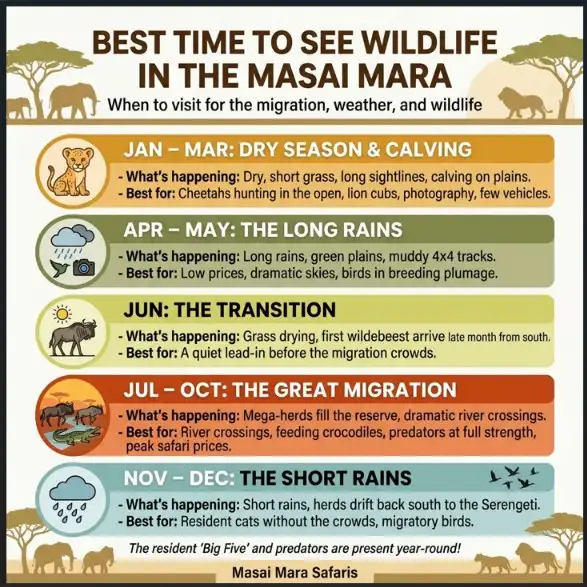
The resident animals do not leave, so there is no month without lions, elephants, giraffes and hyenas. What changes is the grass, the crowds and whether the migration herds are in.
Months | What is happening | Best for |
January to March | Dry, short grass, long sightlines, calving on the plains | Cheetahs hunting in the open, lion cubs, photography, few vehicles |
April to May | Long rains, green plains, black cotton tracks turn to mud | Low prices, dramatic skies, birds in breeding plumage, 4×4 essential |
June | Grass drying, first wildebeest arrive from the south late in the month | Quiet lead-in before the crowds |
July to October | Migration in the reserve, river crossings on the Mara and Sand rivers | Crossings, crocodiles feeding, predators at full strength, highest prices |
November to December | Short rains, herds drift back to the Serengeti | Resident cats without the crowds, migratory birds arrive |
Three rules shape what you see on any given day. Narok County tickets run 6:00 AM to 6:00 PM, so the first light hour, when the cats are still active, belongs to guests staying inside or next to a gate. Off-road driving is banned in the reserve, so a leopard 200 metres into the croton thicket stays there. In the conservancies your guide can follow it. And vehicles must be out of the reserve by 6:00 PM, which means the hyena and serval activity after dark is only on offer on conservancy night drives. The month-by-month trade-offs are on the best time to visit page, and the migration timing in detail is on the Masai Mara migration page.
Frequently Asked Questions
What animals can I see in the Masai Mara? The Big Five (lion, leopard, elephant, buffalo, black rhino), cheetah, spotted hyena, Masai giraffe, hippo, Nile crocodile, wildebeest, plains zebra, topi, eland, impala, Thomson’s gazelle, warthog and more than 470 bird species. Over 90 mammal species live in the ecosystem.
Can I see the Big Five in the Masai Mara? Yes, but rhino is the hard one. Lion, elephant and buffalo are near certain on any 3-day trip, leopard is likely with a good guide, and black rhino depends on a visit to the Mara Triangle and an early start. Lake Nakuru is the place for a guaranteed rhino.
How many lions are in the Masai Mara? Between 850 and 900 across the reserve and the surrounding conservancies, one of the highest lion densities in Africa. The Marsh Pride, Paradise Pride and Bila Shaka Pride are the best known.
When is the best time to see wildlife in the Masai Mara? July to October for the wildebeest migration and river crossings. January to March for cheetahs and lion cubs on short grass with few vehicles. The resident animals are present in every month.
Are there wild dogs in the Masai Mara? Occasionally. Packs pass through the northern conservancies but do not hold permanent territory in the reserve, so a sighting cannot be planned.
Is the Masai Mara better than the Serengeti for wildlife? The Serengeti is larger and holds the calving season. The Mara is smaller, denser and has the river crossings. For a short trip the Mara delivers more sightings per hour. Our Mara and Serengeti packages cover both.
Can I see animals at night? Only in the conservancies. The National Reserve closes to vehicles at 6:00 PM. Night drives in Naboisho, Olare Motorogi and Mara North are where you see aardwolf, serval, genet and bat-eared fox.
Ready to Experience the Mara’s Wildlife?
Our TRA-licensed driver-guides are based at Sekenani Gate and track resident prides and cheetah coalitions daily. Tell us your travel dates, target species, and group size, and our team will prepare a custom, itemized itinerary with all gazetted park fees, private 4×4 Land Cruiser transport, and camp bookings included.
- Email: [email protected]
- WhatsApp: +254 180 297 751
- Online Booking: Get a Quote
Written by David Njunge, a TRA-licensed safari guide with over 10 years in the Mara. Edited by Cess Wambui, travel consultant, BSc Tourism and Hospitality Management. Wildlife ranges, conservation statuses, and gate regulations verified for the 2027 season. Park conservation fees and boundaries are governed by the Narok County Government (Masai Mara National Reserve) and the Mara Conservancy (Mara Triangle). Conservancy bylaws managed under the Maasai Mara Wildlife Conservancies Association (MMWCA). Scheduled domestic bush flights operated by Safarilink and AirKenya.
Welcome to Masaimara.co.ke
Thank you for visiting us! We're excited to help you plan an unforgettable safari adventure across Kenya.