
7 Days Masai Mara Safari: The Ultimate 2026 Circuit Guide
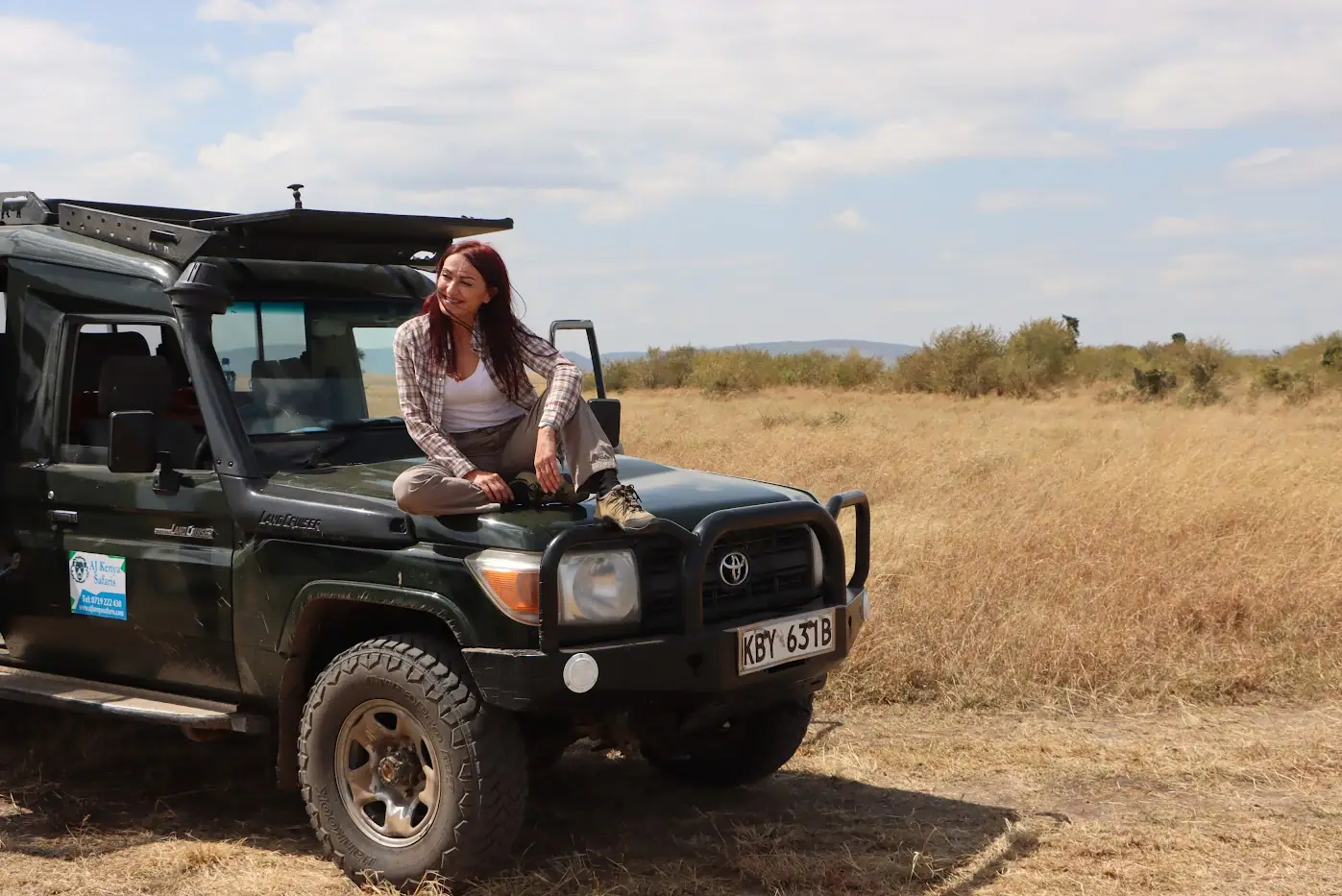
Edited by David Njunge, TRA Licensed Safari Guide
7 Days Masai Mara Safari: Seven days gives you time for either deep Mara immersion or a proper Kenya circuit combining multiple parks. Budget KES 228,000-985,000 depending on route and accommodation. Most first-timers do better with a circuit; photographers often want Mara-only.
The Basic Question
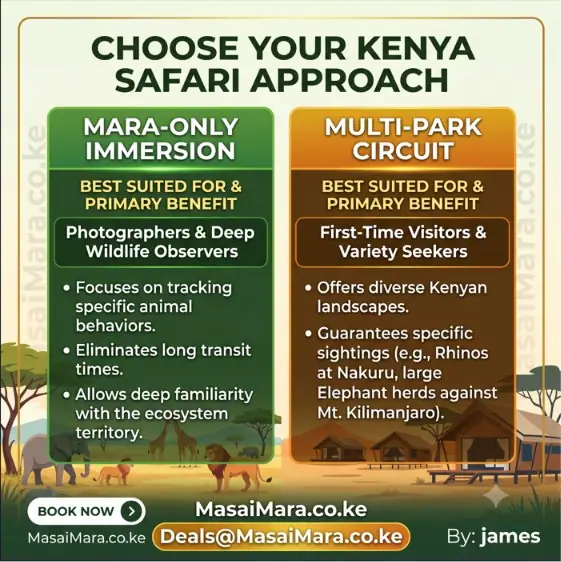
Safari Approach | Best Suited For & Primary Benefit |
Mara-Only Immersion | Photographers & Deep Wildlife Observers • Focuses on tracking specific animal behaviors. • Eliminates long transit times. • Allows deep familiarity with the ecosystem territory. |
Multi-Park Circuit | First-Time Visitors & Variety Seekers • Offers diverse Kenyan landscapes. • Guarantees specific sightings (e.g., Rhinos at Nakuru, large Elephant herds against Mt. Kilimanjaro). |
Do you spend all seven days in the Mara, or split time between parks?
I’ve guided both. The answer depends on what you’re after. If you’re a photographer with a specific shot list—say, you want lion cubs in golden hour light and you’re willing to wait three mornings for the right moment—seven days in one ecosystem makes sense. You learn the territory. You recognize individual animals. You build on each day’s sightings.
If you’re visiting Kenya for the first time and want variety, a circuit usually delivers more. Amboseli has Kilimanjaro backdrops and elephant herds you won’t find in the Mara. Samburu has species that don’t exist anywhere else in Kenya. Lake Nakuru nearly guarantees rhinos, which are rare in the Mara.
The cost difference between approaches is minimal. Maybe KES 30,000-50,000 depending on routing. The question is really about what you want from the week.
Circuit Pricing
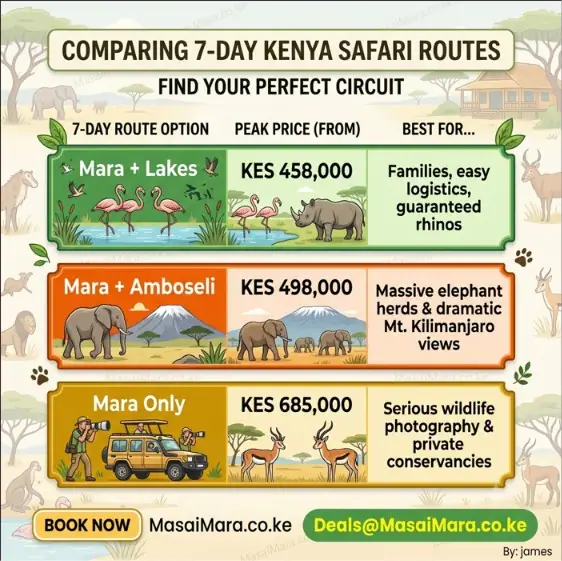
7-Day Route Option | Peak Price (From) | Best For… |
Mara + Lakes | KES 458,000 | Families, easy logistics, guaranteed rhinos |
Mara + Amboseli | KES 498,000 | Massive elephant herds & dramatic Mt. Kilimanjaro views |
Mara Only | KES 685,000 | Serious wildlife photography & private conservancies |
Here’s what the standard combinations cost. All prices per person sharing, includes vehicle, accommodation, park fees, game drives.
Mara + Lakes (Nakuru, Naivasha)
The classic loop. Easiest logistics. Good for families.
Tier | Low Season | Peak Season | Camps |
Budget | KES 228,000 | KES 458,000 | Naivasha Sopa + Flamingo Hill + Mara Sidai |
Mid-Range | KES 298,000 | KES 545,000 | Enashipai + Sarova Lion Hill + Mara Leisure |
Luxury | KES 425,000 | KES 698,000 | Great Rift Valley Lodge + Lake Nakuru Sopa + Sarova Mara |
Mara + Amboseli
Kilimanjaro backdrops plus big cat populations.
Tier | Low Season | Peak Season | Camps |
Budget | KES 248,000 | KES 498,000 | Amboseli Sopa + Mara Explorer |
Mid-Range | KES 328,000 | KES 598,000 | Ol Tukai + Loyk Mara |
Luxury | KES 478,000 | KES 758,000 | Amboseli Serena + Mara Engai |
Premium | KES 698,000 | KES 985,000 | Tortilis + Angama Mara |
The Photographer’s Approach
If you’re serious about wildlife photography—not iPhone snapshots, actual photography—seven days in the Mara ecosystem can make sense. But you need to split between the main reserve and private conservancies.
The main reserve has open grasslands, river crossings, the classic shots. It also has vehicle crowds. I’ve seen 40 Land Cruisers at a lion kill. Your guide can’t reposition for better light because there’s nowhere to go.
Private conservancies (Olare Motorogi, Naboisho, Mara North) limit vehicles to five per sighting. They allow off-road driving. Night drives. Walking safaris. You pay more, but you can actually work.
I usually recommend three nights reserve, three nights conservancy. You get both experiences.
What That Costs
Tier | Low Season | Peak Season |
Mid-Range | KES 385,000 | KES 685,000 |
Luxury | KES 528,000 | KES 845,000 |
Premium | KES 745,000 | KES 1,185,000 |
Includes 10 game drives, two night drives, one walking safari, one balloon safari. Add KES 19,500 for horse riding if that interests you.
Sample 7-Day Circuit (Mara + Amboseli)
Day 1. Nairobi to Amboseli. Leave by 6:30am. Arrive around noon. Afternoon drive toward Observation Hill—Kilimanjaro shots are better in morning light before cloud builds.
Day 2. Full day Amboseli. Dawn drive into Enkongo Narok swamp. The sound of elephants feeding carries across the water. Back issues with the volcanic dust—it’s finer than regular dirt, gets into everything.
Day 3. Amboseli to Mara. Long drive. The Rotian Bypass skips Narok gridlock if your guide knows it. Arrive late afternoon.
Days 4-6. Core Mara time. I usually do Musiara Marsh and central plains first day, Mara Triangle second day (they enforce vehicle limits there), then focus on whatever’s been hardest to find.
Day 7. Final morning drive. Back to Nairobi, 5-6 hours depending on traffic.
A Few Things I’ve Learned
The fog gamble. February 2024, Musiara sector. Fog so thick we couldn’t see five meters. I pushed out at 6am anyway because that’s what you do. Drove blind for forty minutes, saw nothing.
Next foggy morning, I waited until maybe 6:45. The sun was hitting the mist when we reached the plains. Soft, diffused light. Found the Marsh Pride in that light. Best shots of the trip. I don’t know if waiting always works—sometimes the fog just lifts and you’ve lost time—but it’s worth considering.
The 2pm salt licks. I used to drive guests back to camp for lunch every day because that’s the routine. One afternoon someone asked to skip lunch and keep driving. We ended up at the salt licks near Sand River around 2pm. Empty. Not a single vehicle. Giraffes and zebras congregating. Now I offer this as an option, though honestly most people still want lunch.
The hot springs nobody visits. Most circuits drive past Maji Moto settlement on the Loita Plains without stopping. There are natural hot springs there—where Maasai warriors traditionally bathed. Maybe five tourists a month see them. I started stopping after a colleague mentioned it. Whether it’s worth the detour depends on your interests.
Practical Notes
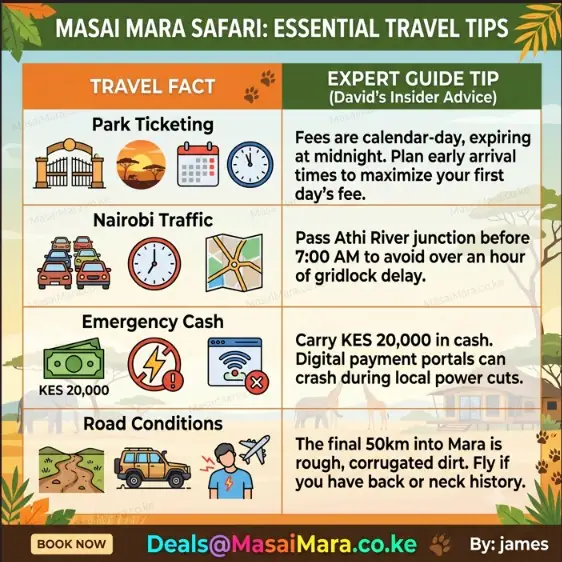
Travel Factor | Expert Guide Tip (David’s Insider Advice) |
Park Ticketing | Mara fees run on a calendar-day basis expiring at midnight, not a 24-hour cycle. Plan early arrival times to maximize your first day’s fee. |
Nairobi Traffic | Pass the Athi River junction before 7:00 AM. Missing this window can cost you over an hour of gridlock delay. |
Emergency Cash | Carry KES 20,000 in cash. Digital payment portals (eCitizen/Narok County) are prone to intermittent network crashes during local power cuts. |
Road Conditions | The final 50km into the Mara is rough, corrugated dirt. If you have back or neck history, skip the road and book a flying segment instead. |
Mara fees work differently. The Mara uses calendar-day fees per Narok County—your ticket expires at midnight, not 24 hours after entry. If you arrive at 4pm, you’ve paid for a partial day. Plan arrival times accordingly.
The road is better now. The Narok-Sekenani stretch is fully paved as of late 2024. What isn’t paved is the last 50km from the junction—still corrugated dirt, still rough enough to cause problems for guests with back issues.
Traffic leaving Nairobi. The Rironi-Mau Summit highway expansion is causing delays on the Nairobi side. Pass Athi River junction before 7am or you’ll lose an hour. Maybe more on Fridays.
Electric vehicles exist now. Emboo River Camp offers silent EV game drives. Cheetahs tolerate closer approaches without diesel engine noise. I’m not sure how widespread this will become, but it’s worth knowing about.
Carry cash backup. The Mara uses Narok County’s payment system—cash or card at the gate. KWS parks (Nakuru, Amboseli) use the eCitizen portal. Both systems occasionally crash during power cuts. KES 20,000 in cash covers you.
Driving vs Flying
The full Mara + Amboseli circuit by road involves 18-20 hours of driving over seven days. That’s a lot of time in a vehicle that isn’t looking at wildlife.
Flying between parks costs KES 65,000-85,000 per segment through Safarilink or AirKenya. Saves maybe 12 hours of road time over the week—equivalent to two extra game drives.
A compromise I sometimes suggest: drive Nairobi to Amboseli (shorter distance, better road), then fly Amboseli to Mara. You save the worst driving day without the full flight cost.
One thing about the 6am departures: the wind chill in an open Land Cruiser runs colder than weather apps suggest. I’ve seen guests shivering in fleeces they thought would be plenty. A beanie helps. Proper layers matter.
When to Go
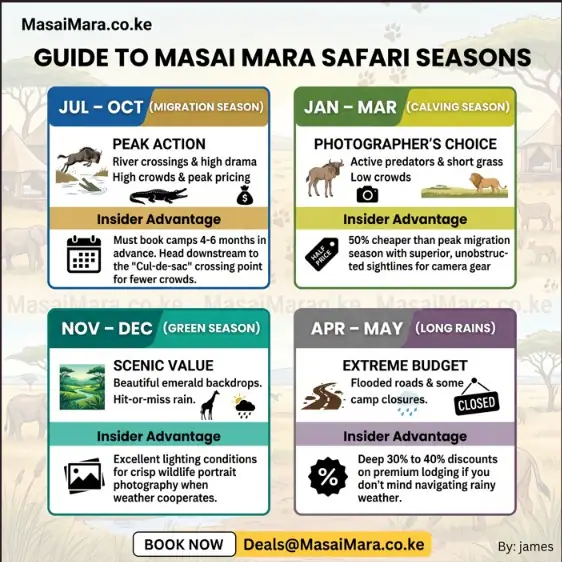
Season / Months | Travel Experience | Insider Advantage |
Jul – Oct (Migration Season) | Peak Action • River crossings & high drama. • High crowds & peak pricing. | Must book camps 4–6 months in advance. Head downstream to the “Cul-de-sac” crossing point for fewer crowds. |
Jan – Mar (Calving Season) | Photographer’s Choice • Active predators & short grass. • Low crowds. | 50% cheaper than peak migration season with superior, unobstructed sightlines for camera gear. |
Nov – Dec (Green Season) | Scenic Value • Beautiful emerald backdrops. • Hit-or-miss rain. | Excellent lighting conditions for crisp wildlife portrait photography when weather cooperates. |
Apr – May (Long Rains) | Extreme Budget • Flooded roads & some camp closures. | Deep 30% to 40% discounts on premium lodging if you don’t mind navigating rainy weather. |
July-October is migration season. River crossings are the draw. Expect peak prices and book camps 4-6 months ahead. The “Paradise Crossing” point near Mara Serena gets mobbed; the “Cul-de-sac” crossing downstream is quieter.
January-March is when photographers who know what they’re doing come. Calving season. Predators active. Grass shorter. Half the price of migration season, half the crowds.
April-May is long rains. Roads flood. Some camps close. But 30-40% discounts if weather doesn’t bother you.
November-December is hit or miss. Can be excellent value. The green season light photographs beautifully when the rain cooperates.
Things That Go Wrong
The last 50km. Corrugated dirt into the Mara is rough enough that I’ve had guests arrive too sore to enjoy their first afternoon. If you have back problems, consider flying in.
Camera dust. Amboseli’s volcanic dust gets into SD card slots and battery compartments. Bring lens cleaning supplies. Keep gear in sealed bags when not shooting.
Camp location. Some lodges near Sekenani Gate are 30-40 minutes from prime wildlife areas. That’s over an hour of commuting daily. When booking, ask specifically how far the camp is from main game-viewing zones.
The crowd question. When a sighting gets crowded, what does your guide do? Good ones wait for vehicles to leave, reposition for better light, or move on. Others push in and add to the problem. Ask operators about this before booking.
Questions
How much does a 7-day Masai Mara safari cost?
KES 228,000-985,000 depending on route, season, and accommodation. Photographer packages with conservancy time run KES 385,000-1,185,000.
Should I spend all 7 days in the Mara?
Depends. Photographers and repeat visitors often want this. First-timers wanting variety usually do better with a circuit.
What’s the best combination?
I can’t answer that without knowing what you want. Elephants and Kilimanjaro: Amboseli. Wildlife variety: Samburu. Easy logistics and rhinos: the lakes. See our 7 days Kenya safari page.
Will I see the Big Five?
With a circuit including Nakuru: almost certainly. The Mara handles lions, elephants, buffalo. Rhinos are rare there but common at Nakuru. Leopards require luck regardless of duration.
Related
- 5 Days Masai Mara Safari
- Best Time to Visit Masai Mara
- Masai Mara Flying Packages
- Budget Masai Mara Safari
- Mara accommodation options
- Masai Mara National Reserve
- Wildlife in the Mara
- Mara River crossing
Book Through Masaimara.co.ke
Tell us what matters—photography, variety, ease of travel, budget—and we’ll suggest the right combination. Not sure? Most first-timers do well with Mara + Lakes (easiest) or Mara + Amboseli (most dramatic).
Prices verified August 2026. Park fees per Narok County and Kenya Wildlife Service. Circuit routes based on current road conditions.
Welcome to Masaimara.co.ke
Thank you for visiting us! We're excited to help you plan an unforgettable safari adventure across Kenya.