
1-Day Masai Mara Safari From Nairobi (2026 Day Trip Packages)
A 1 day Masai Mara safari from Nairobi costs KES 42,900 to KES 189,000 per person. Road trips take 5-6 hours each way. Flying cuts travel to 45 minutes. Either option gives you 4-5 hours of game viewing. Best for travelers with tight schedules or JKIA layovers.
A 1 day Masai Mara safari works for exactly two types of people: those stuck with a JKIA layover who refuse to waste it in a Nairobi hotel, and business travelers squeezing wildlife into an already packed week. If you have three days, book a 3 days Masai Mara safari instead. You’ll thank me later. But if one day is genuinely all you have, keep reading.
I ran a day trip last March for a pilot on a 14-hour layover. We left Nairobi at 4:45am, hit Sekenani Gate by 10:20am, and he photographed a cheetah mother teaching her cubs to stalk a Thomson’s gazelle before noon. By 9pm he was back at JKIA with 200 photos on his camera. That’s what’s possible.
I also ran one in August where we sat in gate traffic for 40 minutes because the family ahead of us couldn’t get their eCitizen payment to process. By the time we entered, the morning light was gone and the lions were sleeping in tall grass. That’s also what’s possible.
Ready to book your day trip?
1 Day Masai Mara Safari Prices 2026
Package Tier | Road Trip Cost (KES) | Fly-In Cost (KES) |
Budget (Low Season) | 43,000 (Picnic Lunch) | N/A |
Mid-Range (Low Season) | 49,000 – 52,000 | 143,000 |
Peak Season (July–Dec) | 56,000 – 65,000 | 156,000 – 170,000+ |

If you’re on a tight budget, you’re looking at about KES 43,000 for a road trip with a packed picnic lunch. But here’s my honest take: if you’re coming all this way, the extra KES 6,500 for a lodge lunch at Keekorok is the best money you’ll spend. The designated picnic sites near Sekenani are swarming with black kites that will literally dive-bomb your sandwich. I’ve watched tourists spend more time defending their food than enjoying it. Not exactly the safari experience you imagined.
For mid-range, budget KES 49,000 to KES 52,000. This gets you lunch at Keekorok Lodge or Sarova Mara Camp, which means you’re eating at a proper restaurant instead of swatting flies off your sandwich.
Flying changes everything but costs accordingly. A luxury fly-in with lunch at Mara Serena runs about KES 143,000 in low season, jumping to KES 156,000 from July through December. Premium options at Governors Camp or Angama Mara push past KES 170,000. Expensive? Yes. Worth it if time matters more than money? Absolutely.
High season (July to December) adds KES 13,000 to every package because park fees double from USD 100 to USD 200.
What’s Included and Excluded
Included in Road Packages:
- Hotel pickup and drop-off in Nairobi (CBD or Westlands only; Gigiri or Karen pickups add KES 1,500)
- Transport in a pop-top 4×4 Land Cruiser
- Services of a licensed English-speaking guide
- Masai Mara park entry fees
- Full-day game drive
- Lunch (venue depends on package)
- Bottled water
Excluded:
- Tips for guide (KES 1,300-2,600 suggested)
- Alcoholic drinks
- Personal expenses
- Travel insurance
- Optional Maasai village visit at KES 3,900 per person
About that village visit: it eats 45 minutes of your game drive time. On a multi-day safari, fine. On a day trip where every minute counts, I’d skip it. The villages near the gate are geared for tourists, and you’ll get better cultural interaction by chatting with your Maasai guide during the drive.
Looking for a longer adventure? Consider a 2 days Masai Mara safari for a more relaxed experience.
Should You Drive or Fly?
Feature / Metric | Road Trip Safari | Fly-In Safari |
Total Travel Time | 10 to 12 hours | 1.5 hours (45 mins each way) |
Game Viewing Time | 4 to 5 hours | 8+ hours |
Photography Light | Misses morning golden hour | Catches both golden hours |
Same-Night JKIA Flight? | No (Returns at 9:30 PM) | Yes (Returns at 5:15 PM) |

This choice defines your entire experience.
Driving means 12 hours in a vehicle for 4-5 hours of game viewing. You leave Nairobi at 5am, reach the park around 10:30am, and must exit by 4pm to get back at a reasonable hour. The road to Sekenani is a bone-shaker that will make you regret that third cup of coffee in Narok. By the time you reach the park, your lower back is already complaining. By afternoon, when the light gets good again, you’re too tired to care about composition.
The stretch past Narok is the worst. Eighty kilometers of murram that coats everything in red dust. I keep my camera in a sealed bag until we pass the gate. The dust feels like flour on your skin. It gets in your ears, your nose, between your teeth. Last trip, I blew my nose after the drive and the tissue came out orange.
Flying costs three times as much but gives you nearly double the game time. You report to Wilson Airport at 6:30am, and by 8:15am you’re watching elephants at Musiara Marsh while road trippers are still bouncing through potholes near Narok. The Cessna Caravan climbs over the Ngong Hills, and on clear mornings you can see Kilimanjaro floating above the clouds to the south. You land, step into an open-sided Land Cruiser, and you’re on safari before 9am.
If you’re connecting through JKIA tonight, flying is the only realistic option. Road trips return around 9:30pm. By the time you clear Nairobi traffic and reach the airport, you’ve missed most evening departures.
The eCitizen Nightmare (Read This Before Booking)
Do not show up at Sekenani Gate expecting to pay with cash or card. Kenya moved to digital payments through eCitizen in 2024, and the transition has been rough.
Here’s what happens: you reach the gate, join the queue, hand over your documents, and the ranger asks for your eCitizen payment confirmation. If you don’t have it, you’ll need to create an account, navigate a clunky portal, enter payment details, and wait for confirmation. The gate Wi-Fi runs on a solar-powered router that drops signal every few minutes. I’ve watched visitors spend an hour trying to complete a payment that takes 3 minutes on hotel Wi-Fi.
The fix is simple: complete your payment the night before from your Nairobi hotel. We handle this for all our clients, but if you’re booking independently, do not skip this step. The frustration of watching your game drive window evaporate while staring at a loading screen is not worth the procrastination.
One more thing: confirm that vehicle entry fees are bundled into your quote. Some operators list per-person park fees separately from the KES 1,300 vehicle charge. That’s a sneaky way to make prices look lower.
What Actually Happens at Sekenani Gate
Most first-timers have no idea what to expect, so here’s the sequence.
Your guide parks in the vehicle queue. During peak season (July through October), expect 15-30 vehicles ahead of you. The line moves slowly. Each vehicle requires document verification: eCitizen confirmation, vehicle registration, passenger manifest.
The rangers check everything against their system. If your payment shows “pending” instead of “confirmed,” you’re stuck. I’ve seen families pulled aside to sort out payment issues while the queue moves on without them.
Once cleared, you receive a printed ticket stamped with your entry time. The 12-hour validity rarely matters for day trips since the park closes at 6:30pm anyway. The whole process takes 10-20 minutes when everything works. Budget 40 minutes if there’s any payment issue.
Sample Day Trip Itinerary
By Road (what actually happens, not the brochure version):
You’ll get picked up around 5am. If you’re staying in Westlands, expect 4:45am. The city is quiet, street lights still on, matatus not yet clogging the roads. We take Waiyaki Way to the Southern Bypass, then drop into the Rift Valley at Mai Mahiu.
The Mai Mahiu descent is where day trips succeed or fail. If you’re past the turnoff by 6:15am, you’re golden. If not, you’ll crawl behind fuel trucks heading to Uganda for 45 minutes. I’ve seen this delay cut game viewing time by an hour.
Coffee stop happens around 6:30am at one of the roadside hotels in Mai Mahiu or Narok. Quick bathroom break, stretch your legs, grab a mandazi if you’re hungry.
The Great Rift Valley viewpoint comes around 8am. Worth a 10-minute stop for photos. On clear days, you can see Lake Magadi shimmering in the distance. The escarpment drops away beneath you, and for a moment the scale of Kenya hits you.
Sekenani Gate by 10:30am if everything goes well. 11am if it doesn’t. Game drive until 1pm, lunch break, back out until 4pm, then the long drive home. You’ll reach Nairobi around 9:30pm, exhausted but (hopefully) with a memory card full of wildlife.
By Flight:
Report to Wilson Airport by 6:30am. The terminal is small but efficient. Baggage limit is 15kg in soft-sided bags only. Hard suitcases won’t fit in the cargo holds. They weigh everything.
Takeoff at 7:30am. The Cessna climbs over Langata, banks west, and suddenly Nairobi disappears behind you. Forty-five minutes later you’re descending toward Keekorok or Musiara airstrip. A guide meets you on the tarmac with a Land Cruiser already running.
By 8:30am you’re watching hippos yawn at the Mara River while road trippers are still two hours from the gate. That’s the advantage you’re paying for.
How to Actually Find Animals (What Guides Know)
The Reverse Loop
Every day-trip vehicle enters Sekenani and heads straight for the Talek River tracks. By 11:30am, these areas become a circus. Twenty minibuses crowded around one sleeping lion, engines running, tourists shouting.
Tell your guide you want the Reverse Loop. Head toward the Oloololo Escarpment or western boundaries first. You’ll have quieter sightings while everyone else fights for position near the gate. Then hit the main areas around 3pm when the morning crowd heads back to Nairobi.
David Njunge, our lead guide, does this automatically for day-trip clients. He monitors radio chatter and deliberately avoids wherever the minibus convoy is heading. Last month he found a leopard in a sausage tree near Ololaimutiek while 30 vehicles were clustered around a lion 5 kilometers away.
The Short Grass Advantage
If you can choose your dates, February and March offer the best visibility. The grass is short after the rains. You can spot a cheetah’s ears from 500 meters. During peak season (July through September), the grass grows waist-high. Lions disappear 5 meters from your vehicle.
I know everyone wants migration season. But for a day trip specifically, short-grass months give you significantly better odds.
The Radio Code
Guides communicate sightings over high-frequency radio. What tourists don’t realize: experienced guides use coded Maa or Swahili to avoid alerting unprofessional drivers who’ll swarm sensitive sightings like a leopard with cubs.
If your guide suddenly accelerates without explanation, don’t ask “Where are we going?” Instead say “Did you hear something on the radio?” This signals you understand the protocol. The guide is more likely to share high-priority sightings that aren’t broadcast openly.
The Ranger Tip
Near the main gates, there are small Ranger Outposts that tourists ignore. Ask your guide to “drop a soda” (a small gift of drinks) to the rangers.
Why this works: Rangers track black rhinos for security. They know locations that aren’t shared on general frequencies. A friendly gesture can unlock a tip that transforms your day trip.
The Musiara Marsh Warning
Guides love taking clients to Musiara Marsh for elephants. Great herds, dramatic photos, reliable sightings.
Here’s what they don’t mention: if it rained in the last 48 hours, Musiara becomes a trap. Black cotton soil that looks solid until your Land Cruiser sinks to its axles. Multi-day clients can afford to wait two hours for a tractor. You cannot.
Tell your guide upfront: “Prioritize hard-ground sightings only.” It sounds paranoid, but it guarantees you won’t spend your precious 4 hours watching the driver dig out a tire while elephants walk past in the distance.
Where Animals Actually Are
The animals in Masai Mara cluster in predictable zones. For a day trip, this knowledge matters.
Lions: The Marsh Pride (BBC’s Big Cat Diary fame) territories around Musiara. Paradise Pride roams near Talek River. Bila Shaka males rest near the Talek-Mara confluence. Ask your guide for current locations. They track pride movements daily.
Elephants: Musiara Marsh (dry conditions only), areas around Fig Tree Camp, and the main river crossings. Best in morning.
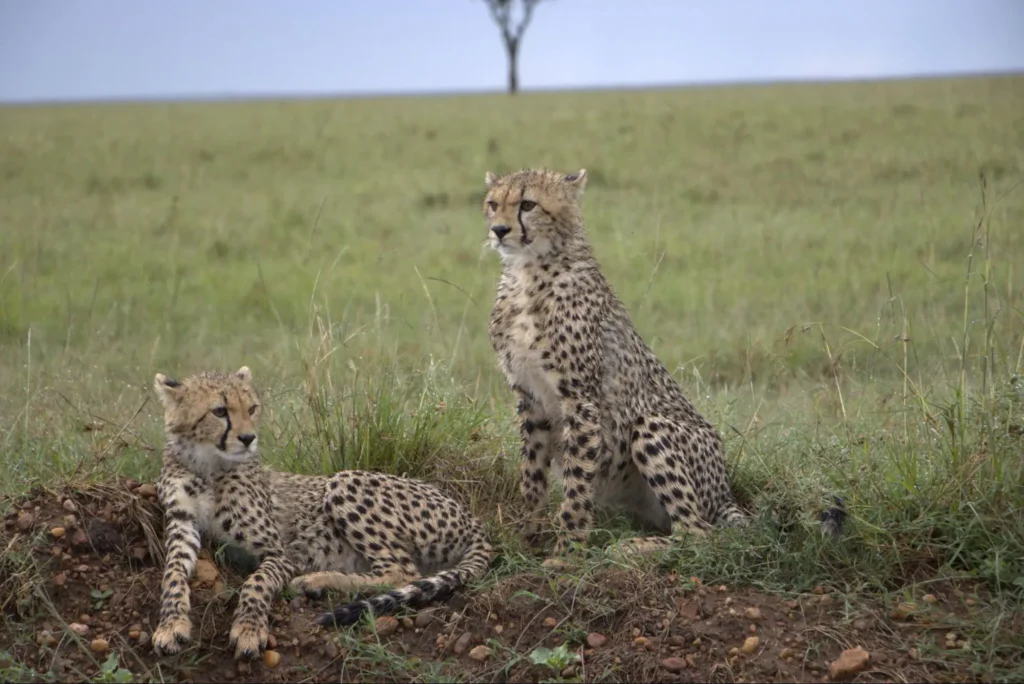
Cheetahs: Open plains between Sekenani and the Talek junction. They hunt at dawn. The short-grass months multiply your odds.
Leopards: Talek River corridor, especially near fallen trees and overhanging branches. Early morning or late afternoon. Hardest Big 5 to find on a day trip.
Black Rhinos: Mara Triangle, western side of the reserve. A day trip from Sekenani doesn’t reach this area. If rhinos are your priority, you need a different itinerary through Mara Triangle.
Hippos and Crocodiles: Guaranteed at any Mara River viewpoint. Every trip stops here.
Photography Reality Check
The light in the Mara follows predictable patterns.
6:30am to 9:00am: Golden hour. Warm tones, long shadows, animals active. This is when professionals get their shots. If you’re driving from Nairobi, you miss this entirely. You’re bouncing through Narok while the light is perfect.
10:00am to 3:00pm: Harsh overhead sun, washed-out colors, animals sleeping in shade. This is when day-trippers arrive. Frustrating for photography.
3:30pm to 6:00pm: Golden hour returns. Animals start moving. Predators begin hunting. Your best window if you drove.
Fly-in clients get both golden hours. Road clients get one, maybe. That’s the real cost difference.
Practical notes: bring a lens cloth because dust coats everything. Charge all batteries the night before. There’s no power in the bush. Shoot burst mode for moving animals. Tell your guide you care about photography. He can position the vehicle for better angles if he knows it matters to you.
Gear That Actually Matters
Forget generic packing lists. This is what you need for 16 hours on the road.
Power bank (10,000mAh minimum). Your phone will die by 2pm because it constantly searches for signal in the Mara. Don’t rely on the vehicle’s USB ports. They’re usually broken or too weak.
Dust protection. A Buff neck gaiter or N95 mask for the Narok stretch. You’ll feel ridiculous putting it on until you spend the next four hours coughing red dust.
Neck pillow. The road from Narok (locals call it “the safari massage”) continues for 80 kilometers. Your spine will remember every bump.
Light jacket. Mornings are cool, especially with the roof hatch open. Temperature drops to 15°C at dawn.
Binoculars. If your guide doesn’t provide them, bring your own. They transform distant dots into identifiable animals.
Water beyond what’s provided. The altitude and wind through open hatches are dehydrating. Ask for a cool-box in the front specifically for drinks, not just lunch storage.
When Things Go Wrong
Last February, I had German guests who booked a road trip during what should have been dry season. Rain hit at 3am. By the time we reached the Sekenani turnoff, roads were flooding. We detoured through Ololaimutiek, adding two hours. They got three hours of game viewing instead of five. Elephants, zebras, giraffes. But no cats.
Another time, a Canadian couple had their eCitizen payment show “processing” at the gate. They spent 50 minutes trying different cards while the ranger’s phone kept losing signal. By the time they entered, the morning game drive window was gone.
Both groups asked me afterward: would an overnight trip have been better? Yes. Obviously yes. Day trips compress everything into a window with no buffer. Weather, traffic, payment issues, vehicle problems. Any single delay cascades.
I recommend extending to two days whenever schedules allow even slight flexibility. The experience difference is enormous.
Plan B: Rain Contingency
Heavy rain near Narok can block roads entirely. If this happens, your guide may pivot to Mara North Conservancy instead of the main reserve. Better-maintained tracks, fewer vehicles, and the conservancy rarely closes.
Confirm before booking that your operator has conservancy access as backup. Some don’t.
Is This Trip Right For You?
Book a road day trip if: You have around KES 50,000, you want to see the Kenyan countryside and Rift Valley, long drives don’t bother you, and you’re traveling with someone who gets airsick on small planes.
Book a fly-in day trip if: You have an international flight from JKIA tonight or early tomorrow, you want maximum game time, motion sickness is a concern, or budget isn’t your main constraint.
Don’t book a day trip if: You hate long drives and can’t afford to fly, you expect guaranteed river crossings (those require multi-day trips), or rain is forecast (reschedule if possible).
Want to explore your options? Get a customized quote for your preferred dates.
Best Time to Visit Masai Mara for Day Trips
Months | Wildlife Visibility | 1-Day Trip Verdict |
Feb – March | Excellent (Short grass, easy tracking) | 🟢 Best Choice (Low fees, high visibility) |
July – October | Moderate (Tall grass hides predators) | 🟡 Okay (Crowded, double park fees) |
Nov – December | Unpredictable (Short rains) | 🟡 Hit-or-Miss (Weather dependent) |
April – May | Poor (Flooded, muddy tracks) | 🔴 Do Not Book (High risk of getting stuck) |
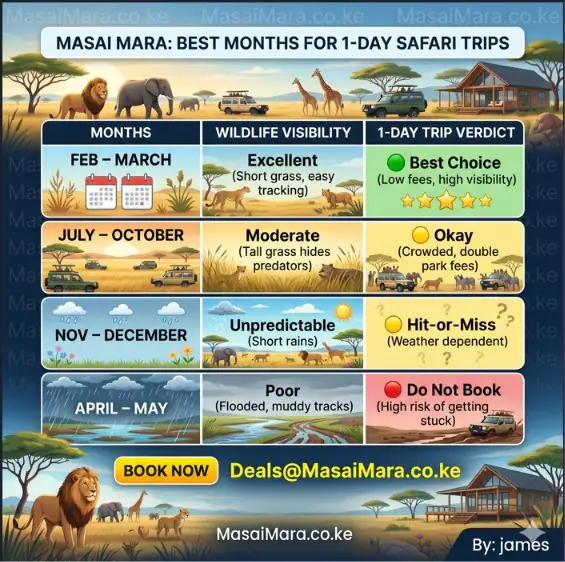
February-March: My recommendation for day trips specifically. Short grass, maximum visibility, fewer tourists, lower park fees, active predators. You sacrifice migration spectacle but gain everything else.
July-October: Peak season. Mara River crossings possible but unpredictable. Highest fees (KES 26,000 per person). Crowded. Tall grass limits visibility. Great for multi-day trips. Frustrating for single-day visits.
April-May: Long rains. Some roads become impassable. Do not book a day trip during this period. If you get stuck, your whole itinerary collapses.
November-December: Short rains. Hit-or-miss weather. Migration herds leaving for Tanzania.
Cost Breakdown
Your day trip price splits roughly like this:
Road package (low season): Vehicle and guide at KES 24,700, park fees at KES 13,000, lunch at KES 3,900, gate levies at KES 1,300. Total around KES 43,000.
Fly-in package (low season): Return flights at KES 104,000, airstrip transfers at KES 6,500, game drive vehicle at KES 19,500, park fees at KES 13,000. Total around KES 143,000.
High season adds KES 13,000 across the board because park fees double.
Tipping Your Guide
Not mandatory, but customary. KES 1,300 to KES 2,600 per person works for a day trip.
If your guide found cats, positioned the vehicle well for photography, kept you comfortable through a long day, and didn’t drive like a maniac chasing radio calls, tip toward the higher end. If service was merely adequate, the lower amount is fine.
Hand the tip directly to your guide at the end. Not through an intermediary.
Frequently Asked Questions
How much does a 1 day Masai Mara safari cost?
Between KES 42,900 (budget road trip) and KES 189,000 (luxury fly-in) per person sharing. Prices include transport, park fees, guide, and lunch.
Is one day enough for Masai Mara?
Enough to see elephants, zebras, and possibly lions. Not enough to guarantee Big 5 or river crossings. Two or three days significantly improves your odds.
Can I do a 1-day trip and catch a flight at JKIA the same night?
Only if you fly back from the Mara. You’ll land at Wilson by 5:15pm, giving time to transfer to JKIA for evening departures. Road trips return around 9:30pm. Too late for most connections.
What is the latest time a vehicle can leave the Masai Mara?
6:30pm strict. Overstaying triggers penalties. Your guide will start heading toward the gate by 4pm on road trips.
Can I pay park fees at the gate with cash?
No. eCitizen digital payment only since 2024. Complete this before arriving. Gate Wi-Fi is unreliable.
What vehicle will I be in?
Standard packages use a 4×4 Toyota Land Cruiser with pop-up roof. Confirm before booking. Some budget operators use minivans with significantly worse viewing angles.
Is phone signal available in the Mara?
Spotty. Safaricom has the best coverage, but expect dead zones. Download offline maps. Tell family you’ll be unreachable.
Related Safari Packages
- 2 Days Masai Mara Safari – Weekend getaway
- 3 Days Masai Mara Safari – Our most popular package
- Masai Mara Flying Packages – Skip the drive
- Hot Air Balloon Safari – Dawn flight over the savannah
- Budget Masai Mara Safari – Affordable options
About the Author
This guide was written by our safari planning team and edited by David Njunge, a licensed safari guide specializing in wildlife tracking and photography safaris with over a decade of experience in the Mara ecosystem.
Last updated: August 2026. Prices and park fees subject to change. Confirm current rates when booking.
External Authority Links:
Welcome to Masaimara.co.ke
Thank you for visiting us! We're excited to help you plan an unforgettable safari adventure across Kenya.