
Migration Safari Masai Mara: The Honest 2026 Planning Guide
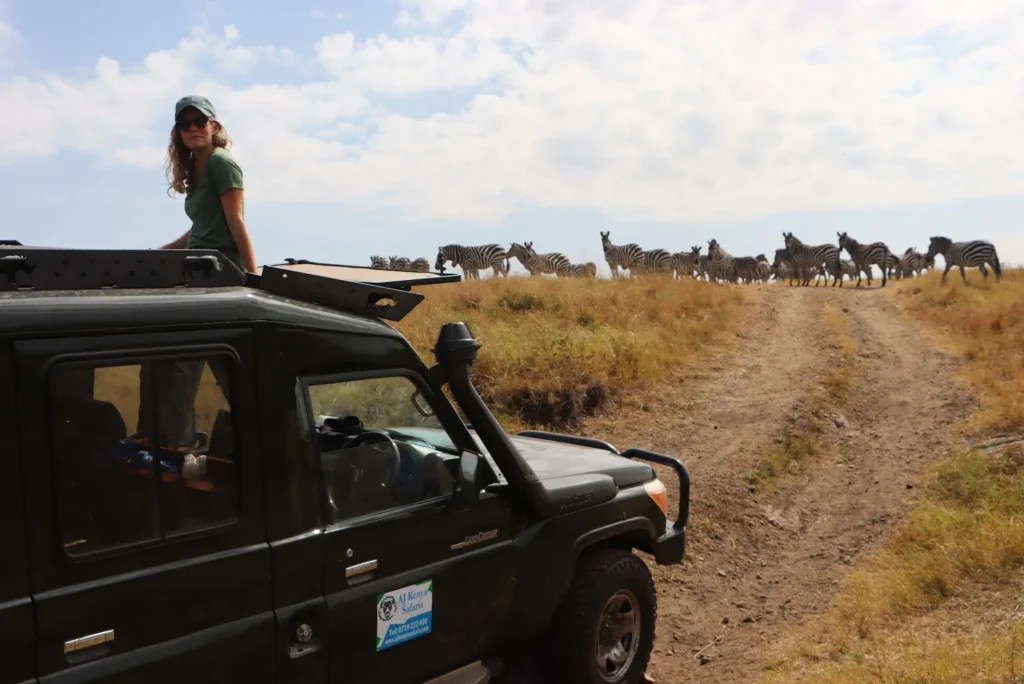
A migration safari in the Masai Mara is the most sought-after wildlife experience in Africa and the one most likely to disappoint guests who plan it wrong. The herds don’t follow a calendar. Some years they cross the Mara River in June, others not until late August. Drought years can produce no crossings at all. The plains experience of hundreds of thousands of animals spread to the horizon is worth the trip on its own, but guests who build the entire safari around a single river crossing set themselves up for frustration. This guide covers what a working guide knows about timing, booking, and what the migration actually feels like on the ground. For wildebeest behaviour and biology, see the wildebeest guide. For crossing mechanics and specific crossing points, see the Mara River crossing guide. For the 2026/2027 season, all-inclusive 5-day itineraries range from KES 252,200 ($1,940) to KES 1,348,100 ($10,370) per person sharing. Reserve entry is $100–$200/day. Conservancy fees ($80–$150/night) are included in camp rates.
Safari Costs (2026/2027)
All-inclusive prices per person sharing, based on two people in a private 4×4 Land Cruiser. Conservancy fees are included in camp rates.
5-Day All-Inclusive Rates (Per Person Sharing)
Package Tier | Camps (Nakuru + Mara) | Regular Season (KES) | Peak Season (KES) |
Budget | Lake Nakuru Lodge / Ol Kinyei Adventure | KES 252,200 | KES 447,200 |
Mid-Range | Sarova Lion Hill / Karen Blixen Camp | KES 304,200 | KES 538,200 |
Luxury | The Cliff Nakuru / Porini Lion Camp | KES 529,100 | KES 828,100 |
Luxury Plus | The Cliff Nakuru / Mara Plains Camp | KES 867,100 | KES 1,348,100 |
Note: Conservancy fees included. Reserve entry is extra ($100–$200/day). For a luxury safari or flying packages, request a custom quote.
What’s Covered
- A private 4×4 Safari Land Cruiser for the full trip.
- A TRA-licensed guide who monitors the crossing points and herd movements daily.
- All conservancy conservation fees and Lake Nakuru entry fees.
- Night drives, off-road tracking, and guided walking safaris with Maasai trackers.
- One-way return flight from the conservancy airstrip to Nairobi Wilson (flight details). Soft-sided duffel bags only, 15 kg limit strictly enforced.
- Full board, 3 meals daily. Packed bush lunches for full-day river stakeouts.
- AMREF Flying Doctors emergency air evacuation insurance.
What’s Excluded
- Kenya eTA (~$30).
- Tips (KES 3,000/day for guide).
- Alcohol and premium drinks.
- Hot air balloon ($450–$500). Book 6–12 months ahead during migration.
- Main reserve entry fees if crossing into the public park ($100–$200/day extra).
- International flights.
The 5-Day Migration Itinerary
Day 1: Nairobi to Lake Nakuru
Leave Nairobi early. Afternoon at Lake Nakuru tracking rhinos. Stay at your selected lodge.
Day 2: Nakuru to the Mara
Drive through the Rift Valley or fly in. Herds are often visible within minutes of entering the ecosystem during migration season. Late afternoon drive along the river corridors. Stay at your chosen camp.
Day 3–4: Full Days
Two full days. Request a packed lunch the night before. At least one day should be a full-day commitment at the river, staying out from early morning until late afternoon. The other day covers lions, leopards, cheetahs, and general game. Predators concentrate near the herds during migration, so the big cat sightings are at their peak in these months. Night drives in the conservancies add hyena-lion confrontations and leopard hunting after dark.
Day 5: Departure
Early morning drive. Fly back to Nairobi from the conservancy airstrip (fly-in options).
When to Go and What to Expect
Migration Phase / Window | Expert Field Interpretation & Sensory Reality |
Late June Window | Advance columns enter southern zones; slashes entry fees by half before peak rates apply. |
July & August Peak | Peak herd numbers match the highest crossing odds, but vehicle congestion peaks heavily. |
September Shift | Provides prime herd numbers and intense predator action with notably smaller crowds. |
October Return Wave | Columns push south to Tanzania; features empty banks and highly aggressive crocodiles. |
Drought Anomalies | Dry cycles stall herds in the Serengeti; builds empty banks until rain triggers movement. |
Mega-Herd Acoustics | Continuous low grunting creates an exhausting acoustic wall that vibrates through the floor. |
The migration is not an event with a start date. It’s a continuous, circular movement across the Serengeti-Mara ecosystem driven by rainfall and grass growth. The herds arrive when the rain tells them to, and no operator can guarantee the timing.
Late June is when the advance columns sometimes enter the southern conservancies. Peak park fees don’t start until July 1, so the last week of June is the strongest budget window in the migration calendar. Half the entry cost, early herd sightings, almost no vehicles.
July and August are the peak months. The largest concentrations of wildebeest and zebra are in the Mara, the river crossings are most likely, and the vehicle congestion is at its worst. August is the most marketed month. Book river-edge camps 6 to 12 months in advance for this window. Properties like Entim Mara, Governors’ Camp, and the Mara Triangle camps sell out first.
September has the same migration with smaller crowds. The herds are still present, crossings still happen, and predator activity is intense. Noticeably fewer vehicles at the main crossing points.
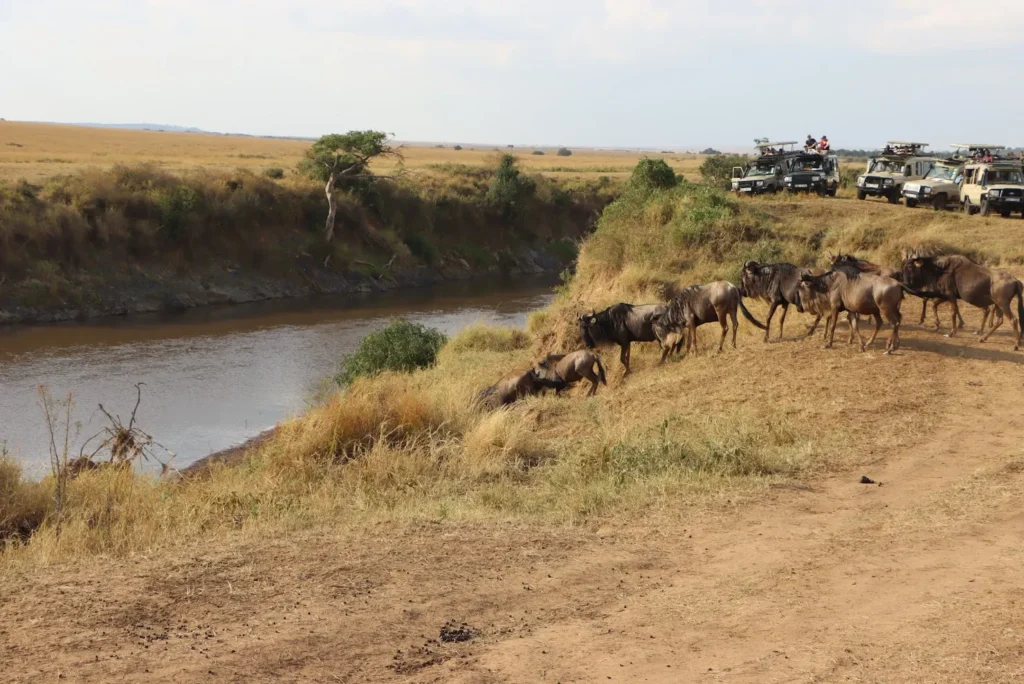
October is when the herds begin moving south toward Tanzania. Late October crossings are the same spectacle with a fraction of the audience. Crocodiles are hungrier after months of feeding. Two or three vehicles at a crossing point instead of forty.
Drought years change everything. In 2024, the Serengeti retained enough grass that the herds barely crossed into Kenya. Guests who flew in specifically for August crossings saw empty riverbanks. The first September rains finally triggered movement. Building flexibility into the itinerary matters more than locking in a specific week.
Less than half the total Serengeti wildebeest population actually crosses into Kenya in any given year. The migration splits, with a large portion remaining in the northern Serengeti. The animals that do cross are still numbered in hundreds of thousands.
What Migration Actually Feels Like
The migration is unpredictable and the crossing is never guaranteed. I’ve had guests arrive on the right week, sit at the right crossing point, and watch 2,000 animals enter the river before lunch. I’ve had guests arrive on the same week the following year and see nothing but empty banks for four days. The difference wasn’t the planning. It was the rain.
But the crossing is three minutes. The migration is every day for three months, and no photograph or video captures what it’s actually like to be inside it. The sound of hundreds of thousands of animals grunting produces a wall of noise that carries for kilometres. The dust coats the dashboard. The smell of the herds fills the vehicle. The ground vibrates through the floor when they move. Every guest who has been inside a mega-herd says the same thing: they were not prepared for how physical it is.
After several hours the sound causes genuine fatigue. It fills the hearing completely and drowns out the subtle cues I normally listen for, like an impala alarm snort or a leopard rasping in the bush. I tell guests to bring musician-style earplugs that lower the volume without blocking conversation. It makes a long day at the river bearable. Wear khaki, olive, or stone. Dark blue and black attract stable flies that swarm around the herds. These flies hunt by sight and heat, not by smell, so insect repellent doesn’t help.
The guests who leave happy are the ones who came for the migration and got it, crossing or not. Thousands of wildebeest and zebra spread across the savannah, predators working the margins, the constant braying. That happens every day during the season. Guests who treat the plains as filler while waiting for a crossing miss what they actually came to see.
What to Consider When Booking
The first question I ask any guest planning a migration trip is whether they’re joining a shared vehicle or booking a private one. In a shared van with six to eight people, the group votes with their feet. If most of them want to photograph sleeping lions, the driver leaves the crossing point regardless of what the herd is doing. I’ve watched shared vehicles pull away from a bank where the herd was narrowing into a line because two guests in the back wanted lunch. A private 4×4 with a dedicated guide is the only setup that lets a guest commit an entire day at the river without compromise.
The second question is where to stay. The crossing points are inside the public reserve, not the conservancies. A conservancy camp gives night drives, fewer vehicles, and off-road access, but the drive to the river adds an hour each way. Guests whose main goal is a crossing need a camp inside the reserve or directly on the river. Guests who want the broader experience with less crowding are better off in a conservancy for everything except the river itself.
Three to four nights is the minimum for a migration trip. Anything shorter and the drive time eats into the field time. Five nights gives a realistic window for a crossing attempt plus enough flexibility for the days when the herds don’t cooperate.
If a balloon flight is on the list, book it 6 to 12 months ahead. During migration the seats fill fast. The launch location matters more than the price because some companies launch near the active herds and others don’t. The flight requires a 4:30 AM pickup, and getting into the basket means sliding in and lying flat until launch. It’s worth checking the physical requirements before committing.
The best river-edge camps sell out by January for the following August. Waiting until March or April for a peak-season booking usually means settling for a camp far from the water.
One last thing worth knowing: the Mara is not just a migration destination. January to March is warm, dry, and nearly empty of tourists. All resident wildlife is present, including all three big cats. The only thing missing is the migratory herds. Guests on a budget or those who don’t enjoy vehicle crowds often get a better overall safari outside migration season than inside it.
Planning Metric / Variable | On-The-Ground Protocol & Booking Logic |
Private 4×4 Cruiser | Essential asset; shared vans frequently vote to abandon active river lines for lunch. |
Camp Location Choice | Reserve stays secure fast river access; conservancies offer night drives but add travel hours. |
Safari Day Minimum | Allocate a minimum of 3 to 4 nights; 5 nights provides a highly realistic crossing window. |
Clothing Palette Code | Stick to khaki, olive, or stone; dark blue and black actively draw aggressive stable flies. |
Off-Season Alternative | January to March brings warm weather, rock-bottom prices, and all resident cats without crowds. |
Luggage Restrictions | Soft-sided duffel bags are mandatory for fly-in hops; a 15 kg limit is strictly enforced. |
Questions Guests Ask
When is the best month for a migration safari?
Late July through mid-October. August has the highest concentrations and the most vehicles. September is nearly as good with fewer crowds. Late June is the best budget option. The migration guide covers the full cycle month by month.
Can I guarantee seeing a river crossing?
No. Some guests wait days. Others see one within minutes. A 5-day stay with at least two full days at the river gives the best odds. The Mara River crossing guide covers crossing mechanics and which points to choose. The wildebeest page covers herd behaviour.
Is the migration worth seeing even without a crossing?
Yes. The plains herds, the predator activity, the sound, the scale. The crossing is three minutes. The migration is every day for three months.
How far in advance should I book?
Six to twelve months for August. Three to six months for September or October. Get in touch and we’ll check availability for the preferred dates.
Is the Mara worth visiting outside migration season?
Yes. All resident wildlife stays year-round. The big cats are easier to photograph in the short dry-season grass. January to March is warm, quiet, and half the price. Fees and logistics are on the booking page.
If migration is the priority, a 5-day safari gives enough time for crossing attempts alongside the full Mara experience. The 3-day and 4-day trips reduce the odds. For Amboseli alongside the Mara, the 6-day circuit or three-park loop add Kilimanjaro. Everything from luxury lodges to fly-in transfers is on the packages page, or send us your dates and we’ll build a route around the best available river-edge camps.
This guide was authored by David Njunge, a TRA-licensed safari guide with over 10 years of experience, and edited by Cecilia Wambui, a travel consultant with a degree in Tourism and Hospitality Management.
Related Reading:
- Wildebeest in Masai Mara
- Mara River Crossing
- Lions in Masai Mara
- Leopards in Masai Mara
- Cheetahs in Masai Mara
- Elephants in Masai Mara
- Rhinos in Masai Mara
- Buffalo in Masai Mara
- Hippos in Masai Mara
- Crocodiles in Masai Mara
- Giraffes in Masai Mara
- Zebras in Masai Mara
- Hyenas in Masai Mara
- Masai Mara Big Cats
- Birding Safari Masai Mara
- Masai Mara Conservancies
- Conservancy vs National Reserve
- Olare Motorogi Conservancy
- Mara North Conservancy
- Ol Kinyei Conservancy
- Siana Conservancy
- Lemek Conservancy
- Ol Chorro Conservancy
- Enonkishu Conservancy
- Pardamat Conservation Area
- Masai Mara Entrance Gates
- Best Time to Visit Masai Mara
- Wildebeest Migration Kenya
- Masai Mara Migration
- Photography Safari Masai Mara
- Walking Safaris Masai Mara
- Night Game Drive Masai Mara
- All Inclusive Masai Mara Safari
- Masai Mara Amboseli Nakuru Safari
- 6 Days Masai Mara Amboseli Safari
- 5 Days Masai Mara Safari
- 4 Days Masai Mara Safari
- 3 Days Masai Mara Safari
- Luxury Safari Masai Mara
- Masai Mara Packages
- Masai Mara Flying Packages
- Masai Mara Booking
- Official KWS Park Fee Portal
- Kenya Wildlife Service
Welcome to Masaimara.co.ke
Thank you for visiting us! We're excited to help you plan an unforgettable safari adventure across Kenya.