
4 Days Masai Mara Lake Nakuru Safari
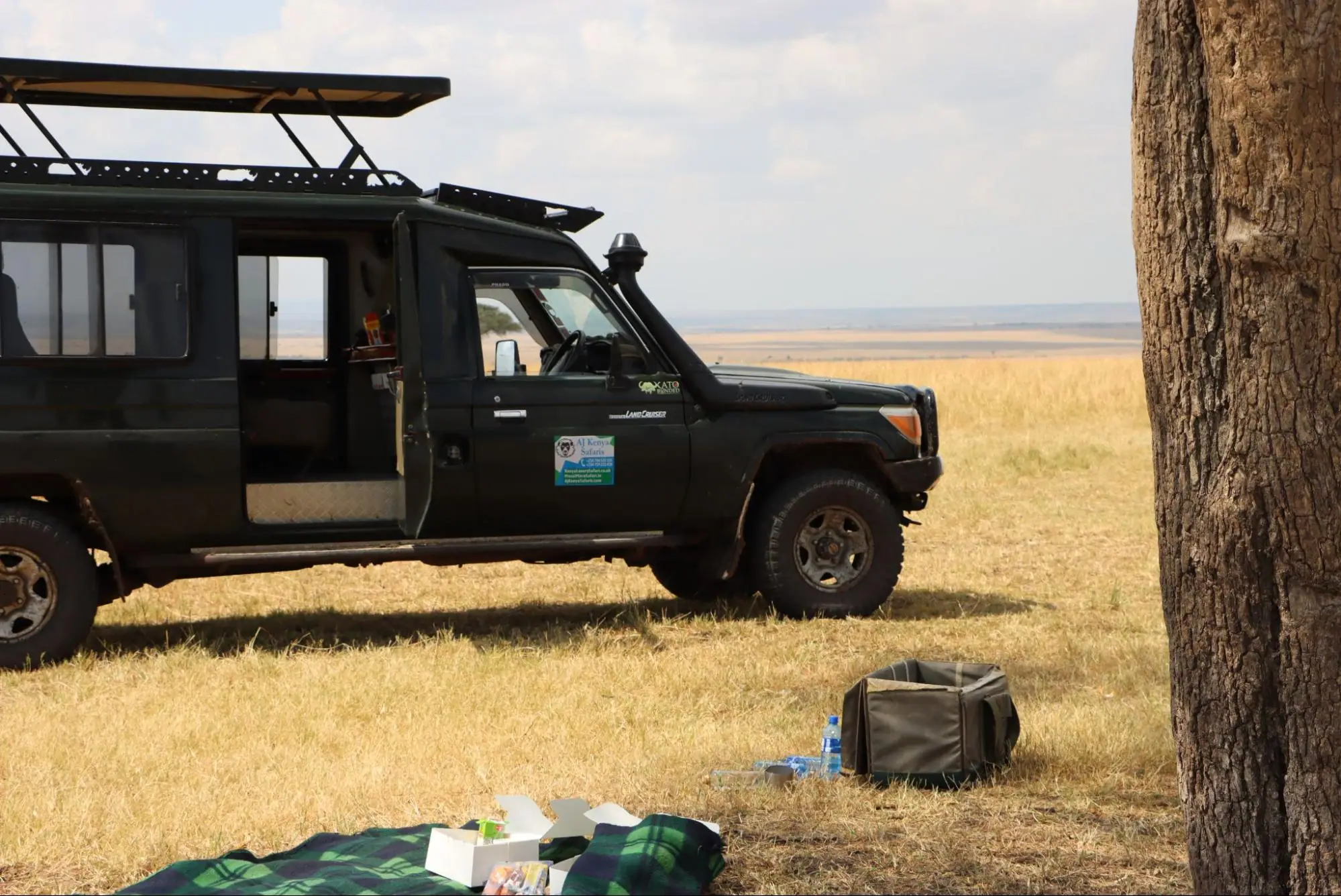
4 Days Masai Mara Lake Nakuru Safari: Four days is the comfortable minimum to see both parks without the brutal schedule of a 3-day trip. One night Nakuru for rhinos, two nights Mara for big cats. Budget KES 167,700-298,600 per person. This guide includes the 2026 gate timing rules that can cost you an extra USD 200 if you don’t know them.
The 2026 Logistics You Need to Know
Before I get into the itinerary, there are two things your booking agent probably won’t mention.
The 10:00 AM gate rule. The Mara has shifted toward 12-hour ticket validity in some sectors (6am-6pm). If you’re inside the reserve and don’t pass through the gate by 10:00 AM on your final day, rangers will charge you a full additional day’s fee. That’s up to USD 200 in peak season. I’ve seen grown men have meltdowns at Sekenani over a five-minute delay. Tell your guide upfront: gate by 9:45, no exceptions.
The eCitizen problem. For KWS parks like Nakuru, entry must be paid through the eCitizen portal. Gate Wi-Fi is unreliable. The portal crashes constantly. I’ve watched guests lose two hours of game drive time sitting at Lanet Gate waiting for payments to process. Create your eCitizen account and pre-load your wallet the night before at your Nairobi hotel where Wi-Fi actually works.
What You’ll Pay
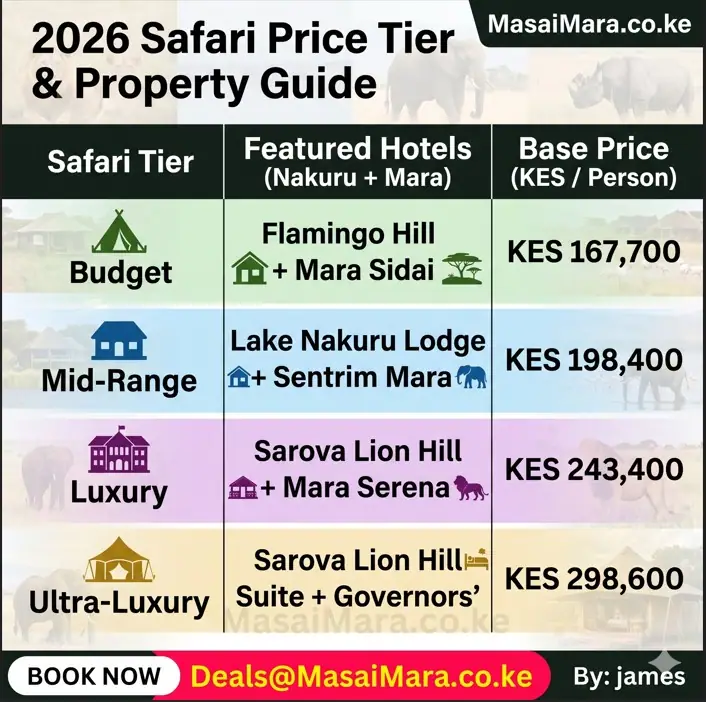
Tier | Hotels | Per Person (KES) | |
Budget | Flamingo Hill + Mara Sidai | 167,700 | |
Mid-Range | Lake Nakuru Lodge + Sentrim Mara | 198,400 | |
Luxury | Sarova Lion Hill + Mara Serena | 243,400 | |
Ultra-Luxury | Sarova Lion Hill Suite + Governors’ | 298,600 |
Jan-June 2026. July-October add 35-50%.
Price covers vehicle, driver-guide, fuel, full-board accommodation, park fees, water on drives, and emergency evacuation insurance. You handle your Kenya eTA (KES 6,500), tips (KES 2,600-3,900/day), and drinks beyond meals.
Honestly, Flamingo Hill is technically “budget,” but I’d choose it over a luxury lodge outside the park boundary any day. Why? Because you’re already inside. No 30-car queue at Lanet Gate at 6am while the “luxury” guests are still fumbling with paperwork. You’re hearing hyenas while they’re idling in diesel fumes.
Mara Sidai is basic—I won’t pretend otherwise—but the staff have been there for over a decade. They know the guides, they know the territory, and their 5:30am coffee is genuinely the best in the Talek area. I don’t know what they do differently.
Governors’ Camp is for people who want the real experience. Canvas tents. Kerosene lamps. Hippos wandering through at 2am. It’s expensive. It’s also what safari felt like before Instagram.
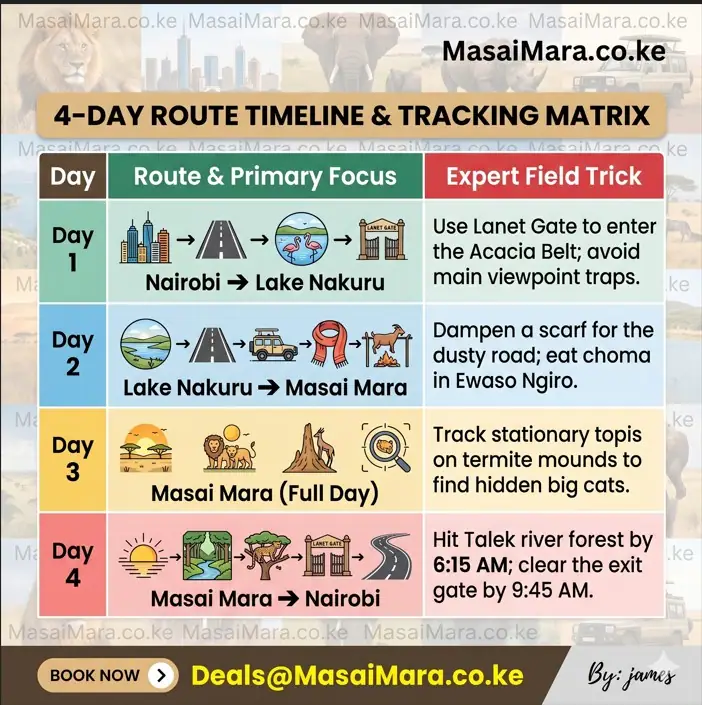
Day | Route & Primary Focus | Expert Field Trick |
Day 1 | Nairobi ➔ Lake Nakuru | Use Lanet Gate to enter the Acacia Belt; avoid main viewpoint traps. |
Day 2 | Lake Nakuru ➔ Masai Mara | Dampen a scarf for the dusty road; eat choma in Ewaso Ngiro. |
Day 3 | Masai Mara (Full Day) | Track stationary topis on termite mounds to find hidden big cats. |
Day 4 | Masai Mara ➔ Nairobi | Hit Talek river forest by 6:15 AM; clear the exit gate by 9:45 AM. |
Day 1: Nairobi to Nakuru
Leave by 7:30am. Skip the main Rift Valley viewpoint—it’s become a tourist trap, hawkers everywhere, no peace. Ask instead for the Mai Mahiu Catholic Church. Built by Italian prisoners of war in 1942. Seats maybe 12 people. East Africa’s smallest church. Takes five minutes and nobody else will be there.
Enter Nakuru through Lanet Gate around 11am. The main gate near town gets congested with school buses. Lanet puts you straight into the Acacia Belt—leopard territory that most visitors miss entirely.
Afternoon drive from 3pm. Focus on the southern Nderit loop for white rhinos. They graze the open grasslands; I can usually find them within an hour. Black rhinos are harder—they hide in thickets. Maybe you’ll see one, maybe not.
About Baboon Cliff: yes, go for the view, but listen—those baboons have learned to recognize the sound of safari vehicle roof latches. They don’t just reach in. They jump into the car while the roof is up. I’ve seen guests lose cameras, prescription glasses, lunch. If you want a panoramic view without the theft risk, ask for the Out of Africa Lookout or Lion Hill Ridge instead. Same lake views, far fewer primates trying to steal your stuff.
If flamingos are sparse (and they often are—water levels have changed the lake chemistry), ask about Makalia Falls at the south end. A hidden waterfall where you can actually get out of the car and walk with a ranger. Most tours skip it because it adds 40 minutes. Their loss.
Day 2: Nakuru to Mara
6am game drive. You’ve got maybe two hours before checkout.
One thing about fees: Nakuru tickets are valid 24 hours from entry. If you came in at 11am yesterday, your ticket expires at 11am today. Some guides rush you out early to avoid paying a second day. If you want a longer morning—and the early light at Nakuru is genuinely beautiful—offer to cover the extra entry yourself. About USD 90 for non-residents. Worth it for another hour with the rhinos.
Head for the northern ridges before leaving. Leopards have shifted up there lately because invasive cactus is pushing prey into smaller pockets. The rocky terrain near Baboon Cliff has better sightings now than the traditional southern routes.
By 8:30am you’re driving toward the Mara. The road from Narok to Sekenani—some people call it the “African Massage”—is brutal. The dust is alkaline, especially after Nakuru. It gets inside closed windows, dries out your nasal membranes, leads to what I call “safari headache.” Bring a buff or lightweight scarf. Dampen it, breathe through it. A saline nasal spray at night helps too.
Stop in Ewaso Ngiro, last town before Sekenani. Cleanest restrooms between Narok and the Mara. Buy the local honey if you see it—dark, smoky flavor, sold in recycled bottles. Better than anything in Nairobi supermarkets. And skip the tourist buffets in Narok; ask your guide for a local nyama choma spot instead. Cheaper, better kachumbari, no other safari vehicles.
Enter the Mara around 3pm. Your guide already knows where the big cats were spotted that morning.
You’ll know you’ve hit the Mara when the air stops smelling like diesel and starts smelling like dry oat-grass. If you’re lucky, you catch the metallic, dusty scent of a rainstorm hitting black cotton soil ten miles away. It’s a smell that sticks to your skin until you shower at camp.
Day 3: Full Day in the Mara
5:45am. It’s freezing. You’ll wonder why you paid for this until the sun hits the horizon and the entire savannah turns the color of burnt orange. That’s when you see them—a pride of lions finishing a kill while mist is still rising off the grass. It’s quiet, bloody, and perfect.
Your guide will take you to the Mara River sector for hippo pools, crocodile basking spots, and—if you’re visiting July-October—potential wildebeest crossings. Outside migration season, the river areas still concentrate wildlife.
Midday break at camp. Some guests nap. Others sit by the pool. Nothing much happens between 11am and 3pm—animals hide in shade. No point burning fuel.
Afternoon drive from 4pm. The Sand River corridor along the Tanzania border is quieter than the main tourist circuits. On good days it feels almost private.
One tracking tip: most tourists look for cats. Local guides look at topis—the antelopes with blue-grey patches on their legs. If you see a topi standing perfectly still on a termite mound, staring intensely in one direction, don’t keep driving. It’s spotted a predator. Tell your guide: “What’s that topi looking at?” It’s guide-speak that signals you know what you’re doing. They’ll slow down and track more carefully.
Day 4: Final Drive and Return
5:45am again. Last sunrise.
Remember the 10am gate rule. Your Mara entry from Day 2 expires based on the 12-hour system in most sectors. If you’re not through that gate by 10:00, you’ll pay another full day’s fee. I’ve seen it happen. It’s ugly. Tell your guide the night before: gate by 9:45, no exceptions. If they try to squeeze in a “final game drive” on the way out, remind them.
If you want a leopard, be at the Talek riverine forest by 6:15am. That’s where they drag kills into trees before the sun climbs too high. Any later and they’re just spots in a tree you’ll need a telescope to see.
Back at camp for breakfast by 9am. Then the drive to Nairobi.
One more thing: if your return falls on a Sunday, insist on leaving the Mara by 8:00am. The trucks from Uganda and Rwanda bottleneck at Maai Mahiu junction. Your “six-hour drive” becomes ten hours. I’ve had guests miss evening flights from JKIA because of this.
Will You See a Leopard?
Maybe. Probably 50/50 on a 4-day trip. If a guide promises you a leopard, they’re lying. But if you watch the topis—see one standing like a statue on a termite mound—stop. They’ve seen something you haven’t.
Lions, elephants, hippos: you’ll see them. White rhinos at Nakuru: almost certainly. Cheetah: decent odds over two full Mara days. Leopard requires luck regardless of how long you stay.
2026 Park Fees
Already included in package prices.
Lake Nakuru: USD 90/day non-resident adults (approximately KES 11,700). Paid via KWS portal.
Masai Mara: KES 13,000/day low season (Jan-June), KES 26,000/day peak (July-Dec). Paid via KAPS.
Current rates on KWS website.
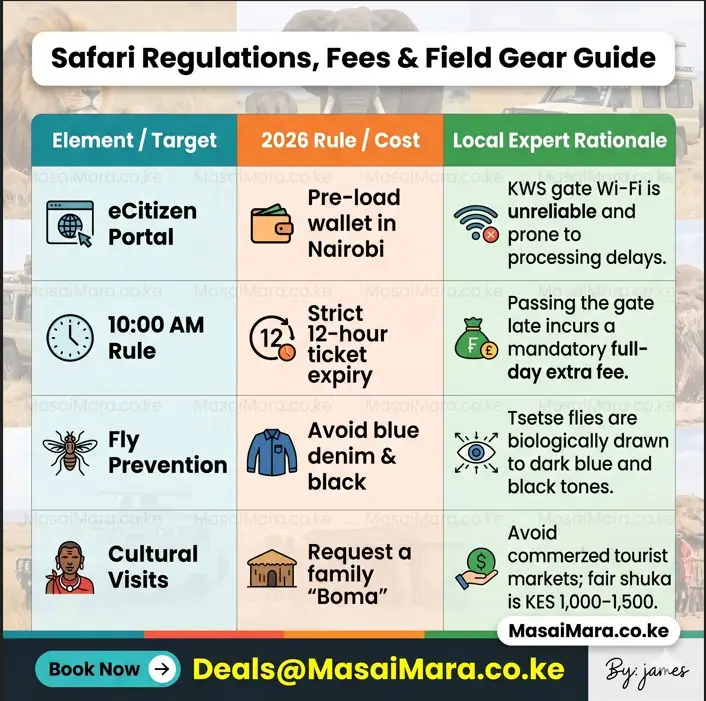
Element / Target | 2026 Rule / Cost | Local Expert Rationale |
eCitizen Portal | Pre-load wallet in Nairobi | KWS gate Wi-Fi is unreliable and prone to processing delays. |
10:00 AM Rule | Strict 12-hour ticket expiry | Passing the gate late incurs a mandatory full-day extra fee. |
Fly Prevention | Avoid blue denim & black | Tsetse flies are biologically drawn to dark blue and black tones. |
Cultural Visits | Request a family “Boma” | Avoid commercialized tourist markets; fair shuka is KES 1,000–1,500. |
Tsetse Flies and What to Wear
Skip the blue denim jeans. Tsetse flies—common in Nakuru’s acacia forests and the Mara’s thickets—are biologically attracted to dark blue and black. They bite through thin fabric. Wear thick canvas-style khakis or olive drab.
Maasai Village vs Boma
If your itinerary includes a “Maasai village visit,” ask your guide to clarify. The “villages” outside Sekenani Gate are tourist markets—pressure to buy, rehearsed dancing.
Ask for a boma instead. A family homestead. More intimate, fewer people, actual conversation. If you buy a shuka (blanket), the starting price is usually 4x the real value. Fair price: KES 1,000-1,500.
Phone and Wi-Fi
Don’t rely on lodge Wi-Fi for anything important. Safaricom has significantly better 4G coverage than Airtel or Telkom in both parks. Buy a Safaricom SIM at JKIA; the tourist data packs work even in the middle of the Mara where lodge Wi-Fi gives up.
Questions
How much does a 4-day Masai Mara Lake Nakuru safari cost?
KES 167,700-298,600 per person sharing, depending on accommodation tier.
Is 4 days better than 3 days?
Significantly. The 3-day version feels rushed and exhausting. Four days is the minimum I recommend for this route.
Best time to visit?
January-March for dry conditions. July-October for migration (higher prices, more crowds). April-May is green season—lower prices, muddy roads.
Can I extend to 5 days?
Yes. We can add Lake Naivasha (boat ride, Crescent Island walking safari) or give you an extra night in the Mara. Tell us your dates.
Related Safaris
- 3-day Mara-Nakuru — tighter schedule
- 5-day with Naivasha — adds boat rides
- Fly-in safari — skip the roads
- Budget Masai Mara
- Luxury Masai Mara
- Best time to visit
- Masai Mara National Reserve
- Mara accommodation options
Book Through Masaimara.co.ke
I’ve been running this corridor since 2014. I know which roads flood first, which cooks make decent chapati, and where the leopards have been moving lately. Tell us your dates. We’ll build something that works.
For current park fees, check Kenya Wildlife Service and KAPS. Page updated August 2026.
Welcome to Masaimara.co.ke
Thank you for visiting us! We're excited to help you plan an unforgettable safari adventure across Kenya.