
5-Day Masai Mara & Amboseli Safari: 2026 Pricing & Itinerary
Edited by David Njunge, TRA Licensed Safari Guide (10+ years)
A 5 days Masai Mara Amboseli safari costs KES 278,000 to KES 785,000 per person sharing in 2026. You’ll spend 2-3 nights in the Mara and 2-3 nights in Amboseli depending on your priorities. The fifth day is the difference between rushing through both parks and actually absorbing them.
The Night Split Decision
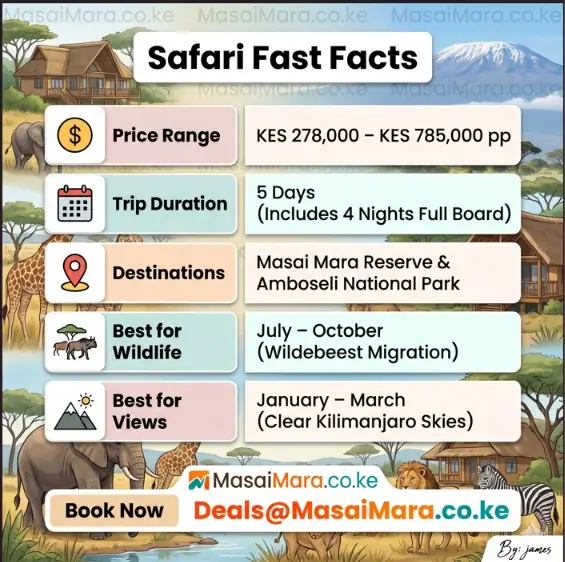
Detail | Safari Fast Facts |
2026 Price Range | KES 278,000 – KES 785,000 pp |
Trip Duration | 5 Days (Includes 4 Nights Full Board) |
Destinations | Masai Mara Reserve & Amboseli National Park |
Best for Wildlife | July – October (Wildebeest Migration) |
Best for Views | January – March (Clear Kilimanjaro Skies) |
Five nights means four nights in camps/lodges (you leave on Day 5). The question: how do you divide them between parks?
Option A: 3 Nights Mara + 1 Night Amboseli
This works for predator-focused travelers, migration season visitors, or photographers chasing lion/leopard/cheetah shots. You get two full days of Mara game drives plus a morning on Day 3 before your transfer.
The downside: only one morning and one afternoon in Amboseli. If Kilimanjaro hides behind clouds, you don’t get another chance.
Option B: 2 Nights Mara + 2 Nights Amboseli
The balanced option. You’ll have meaningful time in both parks without feeling like you’re just passing through either one.
What you give up: less time for the Mara’s predator density. During migration, you might miss river crossings that happen on your transfer day. But outside migration season (November-June), this split makes the most sense.
Option C: 1 Night Mara + 3 Nights Amboseli
Honestly, this only makes sense for specific travelers—elephant researchers, photographers who’ve already done extensive Mara time, or guests specifically wanting multiple Kilimanjaro sunrise attempts.
The Mara deserves more than one night. You’ll arrive, do an afternoon drive, a morning drive, then leave. It’ll feel incomplete.
My recommendation: Option A (3+1) during July-October when the Mara is at its peak. Option B (2+2) the rest of the year when both parks offer comparable experiences.
Package Pricing 2026

Safari Tier | Road Safari (From) | Fly-In Safari (From) |
Budget Tier | KES 278,000 pp | Not Available |
Mid-Range Tier | KES 345,000 pp | KES 445,000 pp |
Luxury Tier | KES 445,000 pp | KES 545,000 pp |
Premium Tier | Not Available | KES 685,000 pp |
Per person sharing. Based on two travelers. All prices in Kenya Shillings.
Road Safari Packages (Drive Throughout)
Tier | Low Season | Peak Season | Nights | Accommodation |
Budget | KES 278,000 | KES 445,000 | 3 Mara + 1 Amboseli | Mara Sidai + AA Lodge |
Mid-Range | KES 345,000 | KES 525,000 | 2 Mara + 2 Amboseli | Loyk Mara + Kibo Safari |
Luxury | KES 445,000 | KES 628,000 | 3 Mara + 1 Amboseli | Sarova Mara + Amboseli Serena |
Fly-In Packages (Flights Between Parks)
Tier | Low Season | Peak Season | Nights | Accommodation |
Mid-Range | KES 445,000 | KES 598,000 | 2 Mara + 2 Amboseli | Mara Leisure + Ol Tukai |
Luxury | KES 545,000 | KES 698,000 | 3 Mara + 1 Amboseli | Mara Serena + Amboseli Serena |
Premium | KES 685,000 | KES 785,000 | 3 Mara + 1 Amboseli | Governors Camp + Tortilis |
Low season: January-June, November-mid December
Peak season: July-October, Christmas/New Year
What’s in the Price
Important: A “5-day safari” typically means 4 nights of accommodation. Day 5 is usually a morning game drive, breakfast, then transfer home. Some first-time travelers assume 5 days = 5 nights and are surprised when the final night isn’t included. Check your itinerary carefully—look for “4 nights full board” or similar language.
Covered: Transport (vehicle or flights as per package), all park entry fees, 4 nights full board accommodation, all meals, game drives as scheduled, bottled water, airstrip/airport transfers.
You pay separately: Alcoholic drinks, tips (budget KES 8,000-12,000 total), travel insurance, visa fees, personal items.
Bring a dust kit for Amboseli: The park is extremely dusty in dry months—fine volcanic powder that gets into everything. Pack a lens blower, microfiber cloths, ziplock bags for camera gear, and a bandana or buff for your face. Open-sided vehicles are better for photography, but in peak dust season some travelers prefer vehicles with closable windows.
Add-ons available:
Experience | Cost |
KES 58,500 | |
Amboseli sundowner at Observation Hill | KES 5,200 |
KES 3,900 | |
Night game drive (conservancy only) | KES 7,800 |
Bush breakfast | KES 6,500 |
Sample Itinerary: 3 Nights Mara + 2 Nights Amboseli
This is our most popular 5-day configuration. Fly-in version shown. Road version follows the same sequence but replaces flights with drives.
Day 1: Nairobi to Masai Mara
Catch the 7:30 AM flight from Wilson Airport. Land at your designated Mara airstrip (Keekorok, Musiara, or Olkiombo) around 8:15 AM.
The camp vehicle meets you—usually an open-sided Land Cruiser. That first drive from airstrip to camp is technically a transfer, but you’re already inside the reserve. I’ve had guests photograph their first lion pride before reaching their tent.
Check in. Lunch. The afternoon stretches ahead without pressure.
Afternoon drive from 3:30 PM. Your guide spends these first hours reading the landscape—where are the territorial males, which areas have good grass, where did other vehicles cluster this morning. This reconnaissance pays off on Days 2 and 3.
Overnight: Masai Mara
Day 2: Full Day in Masai Mara
This is the day that justifies the 5-day trip.
Morning drive leaves at 6:15 AM. Cheetahs hunt in the first hour of light. Leopards are still active before retreating to shade. Your guide has yesterday’s intel plus overnight radio chatter from night watchmen who heard roaring.
Return for breakfast around 9:30 AM. The middle hours are yours. Sleep. Read. Sit by the river if your camp overlooks one. Some guests book the balloon safari for this morning—launches at 6 AM, lands around 8 AM with champagne breakfast in the bush.
Afternoon drive from 3:30-6:30 PM. This is when you follow up on the morning’s “almosts.” The lioness who was stalking zebra but got spotted. The leopard your guide thinks might descend from her tree around 5 PM.
Overnight: Masai Mara
Day 3: The Transfer Question
Here’s where the 5-day trip reveals its structure.
Flying option: Morning drive from 6:15-9:30 AM. Return, pack, catch the 11 AM flight to Amboseli. Land around 11:45 AM. Afternoon game drive from 3:30 PM.
Driving option: Early breakfast, depart by 7 AM. Drive through Narok—stop at The Narok Mall (the one with Artcaffe) for the only Western-standard restrooms between the parks. Continue through Nairobi’s Southern Bypass to Amboseli. Arrive around 4 PM for a sunset drive.
The drive takes 7-8 hours including stops. You lose the day to transit but save roughly KES 90,000 on flights. For some travelers, that’s worth it. For others, the flight preserves what makes a 5-day trip valuable.
The road option’s hidden advantage: You pass through the eastern Rift Valley. If you’ve never seen the escarpment from the ground, it’s worth experiencing once. The descent into the valley—that moment when the land drops away and Lake Magadi shimmers in the distance—sticks with people.
Don’t treat the Rift Valley viewpoint as a toilet stop. Ask your driver to time it for good light (morning is best) and give yourself a proper 15-20 minutes. The view from the escarpment edge—looking out over what’s essentially a crack in the earth’s crust—is genuinely one of Kenya’s most dramatic sights. Too many itineraries rush past it.
Overnight: Amboseli
Day 4: Full Day in Amboseli
Set your expectations: Amboseli can look harsh—dry lake beds, sparse vegetation, swirling dust. It’s not the lush savanna of the Mara. Some visitors find it stark, almost barren-looking in dry spells. The payoff is elephant density and, when conditions align, Africa’s highest mountain rising directly behind them.
Your guide knows this is your Kilimanjaro day.
Early start—5:45 AM departure if your lodge allows. The mountain is most likely clear before 8 AM. Drive toward Observation Hill (Noomotio) where you can see both the swamps and Kilimanjaro in one frame.
The elephants are already moving. Family groups heading from the acacia groves where they spent the night toward the springs and swamps. The volcanic dust rises when they walk—grey powder that smells mineral and alkaline, like wet concrete curing. Against a clear Kilimanjaro, this is the shot that sells Amboseli.
Mid-morning back at the lodge. The mountain typically clouds over by 10 AM. Rest.
Afternoon drive from 3:30 PM. Different focus now—the swamps at Enkongo Narok, hippos, buffalo, maybe the Amboseli lion prides (they’re fewer than the Mara’s, but they exist). Watch for Long-toed Lapwings in the shallow water—one of the few places you can photograph birds walking on lily pads with Africa’s highest mountain behind them.
Overnight: Amboseli
Day 5: Amboseli to Nairobi
If Kilimanjaro didn’t show yesterday: Request an early drive. Sometimes the mountain appears for 20 minutes around 6:30 AM then disappears. Worth trying.
The 10 AM Amboseli reality: Unlike the Mara’s strict exit rules, Amboseli (managed by KWS) is more flexible about departure timing. Your park fee covers the full day. That said, you need to reach Nairobi by late afternoon if you have an evening international flight.
Final morning drive until 8-9 AM. Pack up. Depart for Nairobi.
Flying: Catch the 11 AM flight to Wilson. Arrive around 11:45 AM. Plenty of time for afternoon flights home.
Driving: Leave by 9 AM to reach Nairobi around 1-2 PM. Factor in Athi River traffic—worse on weekday afternoons.
Why the Fifth Day Matters
Four days covering two parks means constant movement. Pack, drive or fly, unpack, squeeze in an afternoon drive. Do it again the next day.
With five days, you’re not always rushing to the next thing. You get at least one full day in each park where you can actually settle in.
In the Mara, that means morning and afternoon drives with genuine rest between them. Time to sit by the Talek River watching hippos—that deep, almost mechanical grunting that carries across the water. Time for your guide to follow up on morning sightings instead of watching the clock.
In Amboseli, it means two mornings to wait for Kilimanjaro. The mountain shows itself when it wants to. With one morning, you’re hoping. With two, you’ve got a real chance.
Things That Go Wrong

The Disruption | The Guide’s Pivot (Expert Solution) |
Kilimanjaro is Cloudy | Shift focus to Amboseli’s 60+ year old elephant families. |
Missed River Crossing | Use a 3-night Mara split to secure 5 separate drive windows. |
Stuck in Black Mud | Track gravel routes post-rain; keep a recovery tractor on radio. |
“Kilimanjaro never showed”
It happens. The mountain creates its own weather. Guests visit for two full days in Amboseli and never see the summit.
What we do: If clouds persist, we pivot to what Amboseli does better than anywhere—elephant observation. The Amboseli Trust has tracked individual elephants here since 1972. Some matriarchs are over 60 years old. Guides know their names, their family histories. The mountain would be nice, but the elephants are guaranteed.
In our experience: January-March tends to offer the clearest Kilimanjaro mornings—maybe 7 out of 10 days you’ll get some view. July-August is tougher; cloud cover rolls in earlier and stays longer. In August 2025, I had a family at Ol Tukai for three mornings straight without a clear summit view. On their transfer day to the airstrip, the clouds parted for about 15 minutes around 6:40 AM. We stopped the vehicle on the tarmac and they finally got their shot. That’s sometimes how it works.
“We missed the river crossing”
Mara River crossings during migration (July-October) are unpredictable. Herds can wait on the bank for days, then cross while you’re at lunch.
What we do: Your guide positions you near likely crossing points based on herd movements. But there’s no guarantee. In September 2025, I had guests at the Mara River lookout near Serena for nearly 4 hours. Thousands of wildebeest on the north bank, refusing to move. We finally gave up for lunch. The crossing happened 20 minutes after we left—another guide sent photos. That’s sometimes the reality.
We’ve also stumbled onto crossings by accident while driving to something else entirely. There’s no formula.
The 5-day advantage: With 3 nights in the Mara during migration, you have 5 game drives. That’s 5 chances to be in the right place at the right time. A 3-day trip gives you 3 chances. Longer stays improve your odds, but nothing guarantees a crossing.
“The black cotton soil trapped our vehicle”
This happens after rain—especially in Amboseli. The soil near the swamps turns to glue. A 4×4 can sink to its axles.
What we do: Experienced guides know which routes to avoid after rain. If your guide takes the “boring” gravel road instead of the scenic swamp-side track, trust them. The alternative is a 4-hour wait for a tractor while your safari day evaporates.
Park Fees 2026
Included in all packages above. Listed for transparency.
Amboseli (via eCitizen): USD 70/day for non-residents. Citizens pay approximately KES 1,030/day including the 5% gateway fee.
Masai Mara (per Narok County): USD 100/day (January-June) or USD 200/day (July-December) for non-residents. Citizens pay KES 1,500-3,000/day depending on season. Tickets are valid for 12 hours (6 AM-6 PM), not 24 hours.
The Mara exit rules (Narok vs Mara Triangle): This gets confusing because the reserve has two management zones with different ticketing systems.
The Narok County side (Sekenani, Talek, Musiara gates) moved to 12-hour tickets in 2023—valid from 6 AM to 6 PM. On your departure day, you must exit by 10 AM or pay another full day’s fee.
The Mara Triangle (Oloololo Gate, managed by Mara Conservancy) still operates closer to a 24-hour model in some situations, though this has been inconsistent in 2026. If your camp is in the Triangle, confirm the current exit rules directly with them before your trip.
For flying guests on either side, the airstrip counts as your exit point—giving you slightly more morning time than road travelers.
Flying vs Driving: The Real Trade-Off
Factor | Flying | Driving |
Transfer time | 45-60 mins | 7-8 hours |
Cost difference | +KES 90,000-130,000 | — |
Game drives gained | 2 additional drives | — |
Scenic value | Aerial views | Rift Valley escarpment |
Baggage limit | 15kg soft bags only | No limit |
Flexibility | Fixed flight times | Stop anywhere |
For a 5-day trip, flying makes sense if you’re optimizing for wildlife time. The extra KES 90,000 buys you roughly 6-8 more hours of game viewing.
Driving makes sense if: you want to see the Rift Valley from the ground, you’re traveling with heavy camera gear, or budget is the priority.
The flight routing nuance: Confirm whether your Mara↔Amboseli leg is direct or routes through Wilson Airport in Nairobi. Direct triangle flights exist, but they don’t run daily. A Wilson connection adds 90 minutes to your transfer and changes your checkout timing. Ask specifically when booking.
The Wilson arrival trick: When you fly into Amboseli from Wilson, ask your operator if the pickup vehicle is a game-drive vehicle and whether the route to camp counts as a drive. On some routings, your guide can turn the 30-minute airstrip transfer into an hour-long game drive through the elephant corridor—folding wildlife viewing into what would otherwise be dead time.
The hybrid approach: Some guests drive Nairobi→Mara (5-6 hours), then fly Mara→Amboseli→Nairobi. This saves one flight while avoiding the brutal cross-country Mara-to-Amboseli drive.
Practical Details
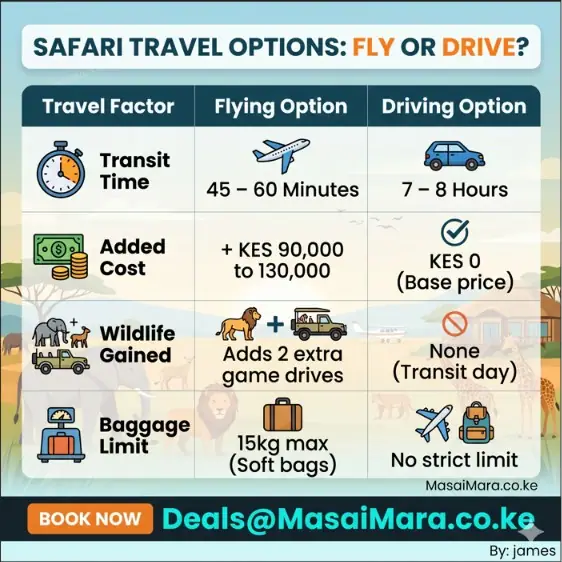
Travel Factor | Flying Option | Driving Option |
Transit Time | 45 – 60 Minutes | 7 – 8 Hours |
Added Cost | + KES 90,000 to 130,000 | KES 0 (Base price) |
Wildlife Gained | Adds 2 extra game drives | None (Transit day) |
Baggage Limit | 15kg max (Soft bags) | No strict limit |
Getting to Wilson Airport (2026 Reality)
As of early 2026, the Lang’ata Road expansion near T-Mall has created a permanent bottleneck. If you’re staying in Westlands or the CBD for a 7:30 AM flight, tell your driver to take Mbagathi Way instead—it adds 2km but saves 30-40 minutes of stop-and-go exhaust fumes.
Stay the night before in Karen or Lang’ata if possible. The morning rush from Westlands to Wilson is unpredictable.
Baggage for Flying Safaris
Per Safarilink’s policy: 15kg per person including hand luggage. Soft-sided bags only—hard shells don’t fit in Cessna cargo pods.
The workaround: Wear your heaviest items (boots, jacket) onto the plane. Camera lenses go in jacket pockets, not camera bags. They weigh luggage, not passengers.
Wilson Airport storage: Both Safarilink and AirKenya offer secure luggage storage at Wilson if you’re continuing to other destinations after your safari.
Guide Radio Codes
If you want real-time intel, learn the lingo. Guides use Swahili code words on VHF radio:
- “Madoadoa” = spots (leopard)
- “Simba mwekundu” = red lion (fresh kill)
- “Kifaru” = rhino
- “Duma” = cheetah
When your guide says “Madoadoa” into the radio, get your camera ready before they tell you what’s happening.
The Mara Simba Restroom Tip
If you’re on a road safari and need facilities between parks, the public restrooms at Sekenani gate are often overwhelmed. Mara Simba Lodge (near Talek gate) allows non-guests to use their facilities for a coffee fee—maybe KES 500. Much cleaner option.
The Washboard Track Warning
The 4km access road from Keekorok airstrip toward the Talek camps is in rough shape after the 2025 rains. Corrugated “washboard” surface that rattles cameras loose and aggravates back problems. If you have spine issues, ask your camp manager specifically for a vehicle with upgraded suspension (some camps have “Old Man Emu” shock absorbers) for the airstrip pickup.
The eCitizen Friction (Amboseli)
In 2026, the KWS payment system at Amboseli gates can be slow during midday—the park’s connectivity drops when everyone’s trying to process payments simultaneously. Have your guide verify your eCitizen QR code and payment confirmation before you leave Nairobi. I’ve seen families stuck at Meshanani Gate for over an hour because the system was down.
Frequently Asked Questions
How much does a 5 days Masai Mara Amboseli safari cost?
KES 278,000 to KES 785,000 per person depending on accommodation tier, season, and whether you fly or drive between parks. Budget road safaris start around KES 278,000. Premium flying packages reach KES 785,000.
Is 5 days enough for both Masai Mara and Amboseli?
Yes—5 days is the minimum for a meaningful experience in both parks. You can do 4 days, but it feels rushed. With 5 days, you get at least one full day in each park without transit.
Should I start in Amboseli or Masai Mara?
Start in the Mara. It’s closer to Nairobi (5-6 hours vs 4-5 for Amboseli), but more importantly, the Mara is the more intense experience. Ending in Amboseli—with its slower pace and mountain views—provides a natural wind-down.
What’s the best time for this safari?
July-October for migration and peak predator activity (but worst Kilimanjaro visibility). January-March for best Kilimanjaro odds and good wildlife throughout. April-May rains can make roads difficult.
Will I see the Big 5?
Lions, elephants, and buffalo are almost certain. Leopards are likely in the Mara. Rhinos are uncommon in both parks—if rhinos matter, consider adding Lake Nakuru.
Can I combine this with a beach extension?
Yes. Many guests add 2-3 nights in Diani or Mombasa after their safari. Fly from Amboseli or Nairobi to the coast. Ask Masaimara.co.ke about combined bush-and-beach packages.
Questions? Let’s Figure Out Your Dates
Every 5-day trip is slightly different depending on when you travel, what you want to prioritize, and how you want to move between parks. Send us your dates and we’ll map out the options.
More Kenya Safaris
- 3 Days Masai Mara Safari
- 4 Days Masai Mara Safari
- 7 Days Masai Mara Safari
- Best Time to Visit Masai Mara
- Masai Mara National Reserve
Prices verified August 2026. Park fees per KWS and Narok County. Flight schedules per Safarilink and AirKenya.
Welcome to Masaimara.co.ke
Thank you for visiting us! We're excited to help you plan an unforgettable safari adventure across Kenya.