
3-Day Masai Mara & Lake Nakuru Safari: 2026 Itinerary & Rates
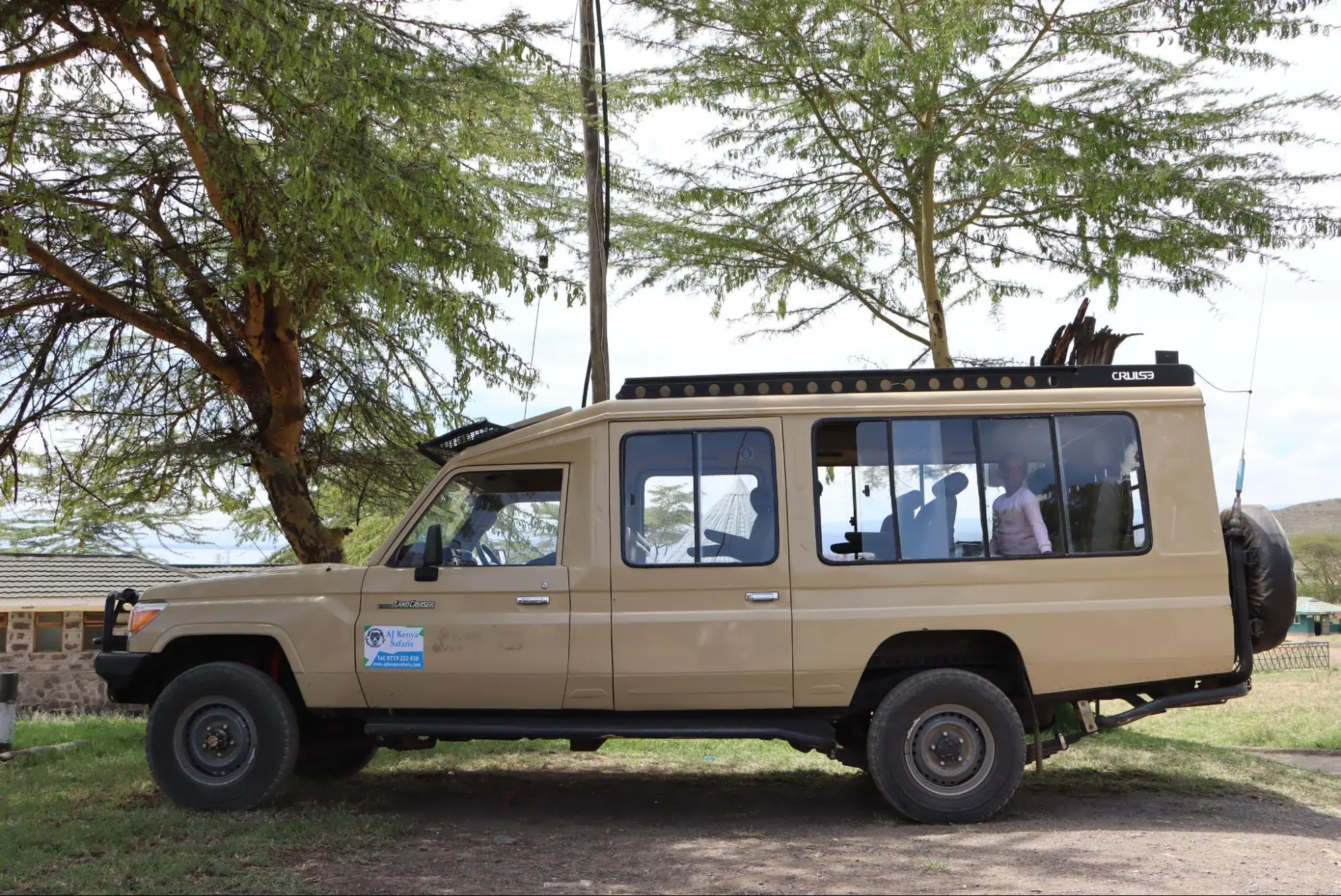
3 Days Masai Mara Lake Nakuru Safari: Three days is the absolute minimum to visit both parks. You’ll see rhinos at Nakuru and big cats in the Mara, but you’ll spend significant time on roads. Budget KES 120,200-245,600 per person. This guide covers whether it’s worth it, plus exact itineraries and costs.
Day 1: Nairobi to Lake Nakuru
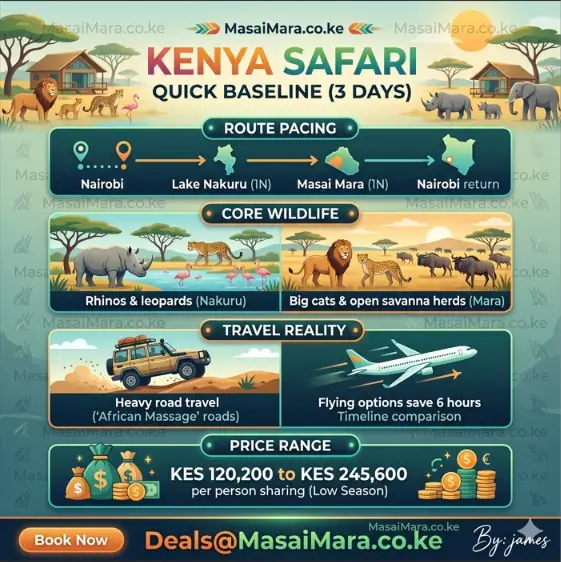
Trip Element | 3-Day Quick Baseline |
Route Pacing | Nairobi → Lake Nakuru (1N) → Masai Mara (1N) → Nairobi return. |
Core Wildlife | Rhinos & leopards (Nakuru); Big cats & open savanna herds (Mara). |
Travel Reality | Heavy road travel (“African Massage” roads). Flying options save 6 hours. |
Price Range | KES 120,200 to KES 245,600 per person sharing (Low Season). |
Leave Nairobi around 7:30am. Most guides skip the main Rift Valley viewpoint now because it’s become a bit of a tourist trap—hawkers everywhere, not much peace. Instead, ask your driver to stop at the Mai Mahiu Catholic Church. Built by Italian prisoners of war in 1942, it seats maybe 12 people. East Africa’s smallest church. Takes five minutes, fascinating history, quiet.
By 11am you’re entering Nakuru through Lanet Gate. The main gate near town gets congested with day-trippers and school buses, so Lanet saves you maybe 30-40 minutes of queuing.
Lunch at your lodge, then afternoon game drive starts around 3pm. This is your one real shot at Nakuru wildlife. Focus on the southern loop for rhinos—white rhinos graze the open grasslands, black rhinos hide in the thickets. I can usually find white rhinos within an hour. Black rhinos are harder; maybe 50/50 depending on luck.
One thing about Baboon Cliff: yes, go for the view, but don’t leave anything loose in the vehicle. Sunglasses, water bottles, cameras—baboons reach through open roof hatches in seconds. I’ve seen guests lose prescription glasses that way. If you want a quieter panoramic spot without the baboon drama, ask for the Out of Africa Lookout instead. Similar views of the lake’s southern end, far fewer animals trying to steal your stuff.
Sunset around 6:30pm. If flamingos are sparse (and they often are now due to rising water levels changing the lake’s chemistry), don’t panic. Ask about Makalia Falls at the south end of the park instead. Most 3-day tours skip it because it adds 40 minutes, but it’s beautiful and you’ll likely have it to yourself.
Day 2: The Hard Day
6am game drive in Nakuru. You’ve got maybe two hours before you need to leave. Head straight for the northern ridges—leopards have shifted up there lately because of invasive cactus pushing prey animals into smaller pockets.
Here’s something nobody mentions: park entry fees are valid for 24 hours from the moment you enter. If you came in at 4pm on Day 1, your ticket expires at 4pm on Day 2. On a tight 3-day trip, guides sometimes rush you out of the park early on Day 2 to avoid paying a second day’s fees. If you want a longer morning drive, offer to cover the extra entry fee yourself—around USD 90 for non-residents at Nakuru. Worth it for another hour with the rhinos.
By 8:30am you’re checked out and driving toward the Mara. The C12 through Narok is the only sensible route. But here’s the thing: if it’s rained recently and your guide suggests going “the long way” back through Mai Mahiu instead of the Njoro/Mau Narok shortcut, don’t argue. They’re avoiding black cotton soil on the Mau Escarpment. I’ve seen vehicles stuck there for six hours.
Stop in Ewaso Ngiro, the last town before Sekenani Gate. Cleanest restrooms between Narok and the Mara. Also, buy the local honey if you see it—dark, smoky flavor, sold in recycled bottles. Better than anything in Nairobi supermarkets.
The road from Narok to the Mara—some people call it the “African Massage”—is brutal. Dust gets inside closed windows. Bring a buff or lightweight scarf; dampen it and breathe through it. Otherwise you’ll have what I call “safari cough” for the next two days.
If everything goes well, you enter Sekenani Gate around 3pm. One sunset game drive. Your guide already knows where the big cats were spotted that morning.
Day 3: Why You Came
5:45am departure. Cold air, gold light, shadows stretching long across the savannah. Lions still active. Cheetahs hunting. Leopards haven’t climbed their trees yet.
I had guests once who spotted a cheetah kill within 20 minutes of leaving camp. The mother had been waiting all trip for exactly that moment. She cried. Not sad crying—just overwhelmed. Three days of exhaustion suddenly worth it.
Here’s the ticket thing again: your Mara entry from Day 2 expires 24 hours after you entered. If you came in at 3pm, you’re fine until 3pm on Day 3. But if you entered at, say, 1pm, your ticket runs out at 1pm. Some guides rush you back to camp early to avoid re-entry fees. If you want to stay out longer—and on Day 3 you really should—budget an extra KES 13,000-26,000 for the additional day’s entry. Tell your guide upfront. It changes the whole morning.
By 9:30am you’re back at camp for breakfast. Then six hours to Nairobi. You’ll arrive exhausted.
What You Pay (and What It Covers)

Tier | Hotels | Per Person (KES) | |
Budget | Flamingo Hill + Mara Sidai | 120,200 | |
Mid-Range | Sarova Lion Hill + Sentrim Mara | 148,900 | |
Luxury | Sarova Lion Hill + Mara Serena | 189,400 | |
Fly-in | Sarova Lion Hill + Governors’ | 245,600 |
Jan-June 2026. July-October add 35-50%. Two people sharing.
The price covers your vehicle (Land Cruiser with driver-guide), fuel, full-board accommodation, park fees, water during drives, and emergency evacuation insurance. You’ll need to sort your own Kenya eTA visa (KES 6,500 via etakenya.go.ke), tips for the guide and lodge staff—I’d budget maybe KES 2,600-3,900 per day for that—and any drinks beyond water or juice at meals.
The fly-in option skips that brutal Day 2 road transfer. Forty-five minute flight from Nakuru’s Naishi Airstrip to the Mara instead of six hours on murram roads. If you can afford the extra KES 55,000-60,000, it’s worth considering.
2026 Park Fees
Already included in package prices.
Lake Nakuru: USD 90/day for non-resident adults (approximately KES 11,700 at current exchange rates). Payment via KWS ecitizen portal.
Masai Mara: KES 13,000/day low season (Jan-June), KES 26,000/day high season (July-Dec). Payment via KAPS portal.
Fees change occasionally. Current rates are published on the KWS website.
The Tsetse Fly Thing
General safari advice says wear neutral colors. Here’s the specific reason for this route: the acacia forests of Nakuru and the Mara’s thickets have tsetse flies, and they’re biologically attracted to dark blue and black. If you’re sensitive to bites, skip the blue denim jeans. Tsetse flies bite through thin fabric. Wear thick canvas-style khakis or olive drab, especially on Days 2 and 3.
When 3 Days Works
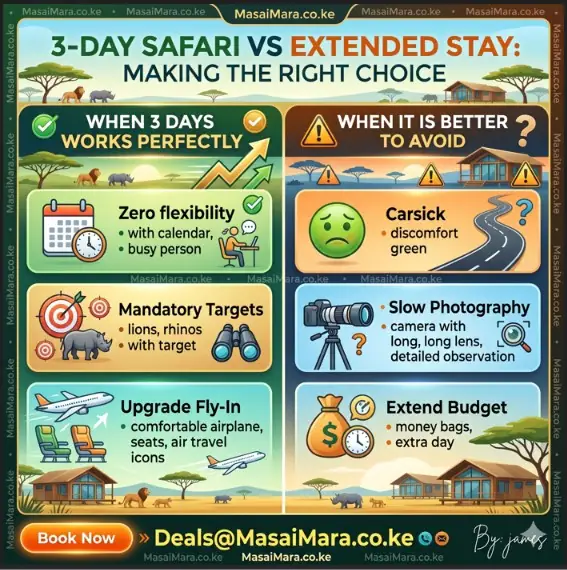
When 3 Days Works Perfectly | When It Is Better to Avoid |
• You have absolute zero schedule flexibility.
• Rhinos + Big Cats are both mandatory targets.
• You upgrade to fly-in to bypass road fatigue. | • You or your kids get carsick easily.
• Your primary goal is slow wildlife photography.
• You can easily stretch your budget to 4 days. |
If you have exactly three days, no flexibility, and you want both rhinos and big cats on the same trip. If you can afford the flying option. If you’re the kind of person who doesn’t mind feeling rushed.
It doesn’t really work if you get carsick, if you want time for photography, or if you could possibly add a fourth day. Four days changes everything. You actually get to breathe.
I had a couple in 2024 who fell asleep in the vehicle before we even left the Mara on Day 3. They woke up near Narok, confused and irritable, and barely spoke to each other for the rest of the drive. They’d wanted to save a day. They ended up miserable. She told me afterward she wished she’d listened when I suggested four.
Maasai Village vs. Maasai Boma
If your itinerary includes a “Maasai village visit,” ask your guide to clarify. The “villages” right outside Sekenani Gate are essentially tourist markets. Lots of pressure to buy, rehearsed dancing, not particularly authentic.
Ask instead for a boma—a family homestead. More intimate. Fewer people. You’ll actually sit with a family. If you buy a shuka (Maasai blanket), know that the starting price is usually 4x the actual value. A fair price is KES 1,000-1,500.
Phone and Wi-Fi
Don’t rely on lodge Wi-Fi for anything important—eTA applications, flight check-ins, work emails. In both Nakuru and the Mara, Safaricom has significantly better 4G coverage than Airtel or Telkom. Buy a Safaricom SIM at Jomo Kenyatta Airport; the tourist data packs are cheap and work even in the middle of the Mara plains where lodge Wi-Fi gives up.
Questions I Get Asked
Is 3 days enough?
Barely. You’ll see wildlife in both parks, but you’ll spend almost as much time driving as game viewing. I usually recommend four unless you’re genuinely out of options.
Which park matters more?
The Mara. More wildlife diversity, more predator action, bigger landscapes. If you had to choose one park, choose the Mara. Nakuru is worth visiting for rhinos and Rothschild’s giraffes, but it’s the smaller experience.
Best time of year?
January-March for dry conditions and short grass. July-October if you want migration herds in the Mara—but prices increase 35-50% and it gets crowded.
Book Through Masaimara.co.ke
We run this route weekly. Vehicles are maintained in our Nairobi workshop. Guides are full-time employees—Daniel Kimani has been doing this corridor since 2014—who know both parks well enough to improvise when conditions change.
If you’re set on 3 days, we’ll make it work. But I’ll also tell you honestly if you should add a day.
Other Options
- 3 Days Masai Mara Only — skip Nakuru, deeper experience
- 4-5 Day Mara-Nakuru — comfortable pacing
- Fly-in Safari — maximum wildlife, minimum roads
- Budget Masai Mara — cost-focused
- Luxury Masai Mara — premium lodges
- Full Nakuru-Mara breakdown
For updated park fees, check Kenya Wildlife Service and KAPS. Page updated August 2026.
Welcome to Masaimara.co.ke
Thank you for visiting us! We're excited to help you plan an unforgettable safari adventure across Kenya.