
Masai Mara Wildebeest Migration 2027: When It Arrives, Where It Crosses and How to See It
Masai Mara Migration at a Glance
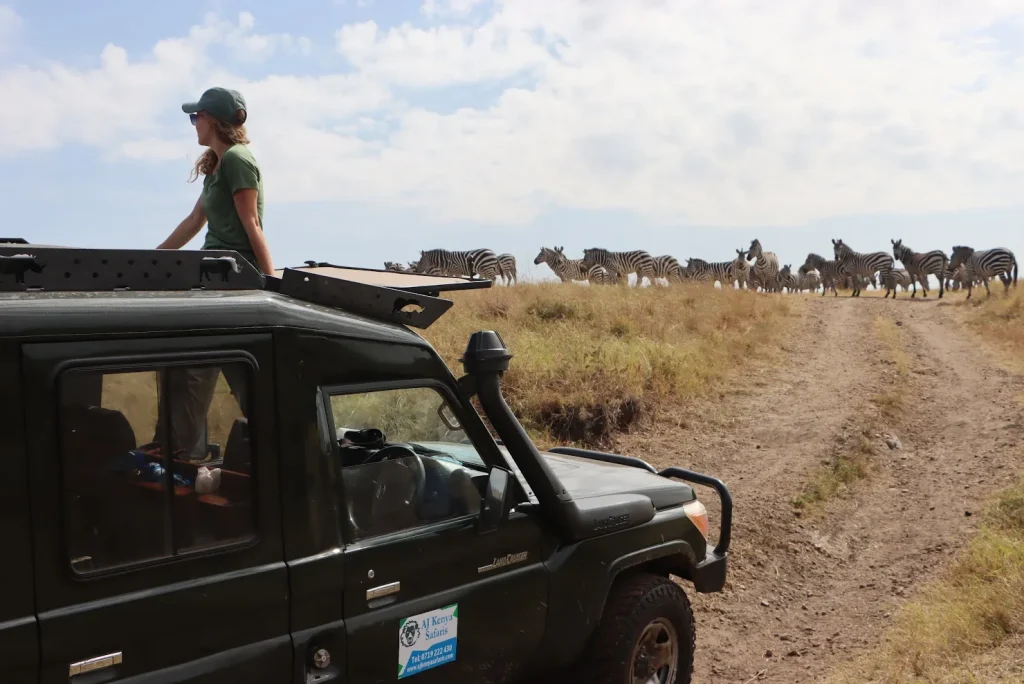
About 1.5 million wildebeest and 200,000 zebra cross from the Serengeti into the Masai Mara between late June and October, with the Mara River crossings peaking from late July to September. The herds turn south again with the November rains. The 2026 season has ended, and the next herds reach the Sand River in late June 2027, so river-bank camps for August 2027 need booking now.
The wildebeest migration is a year-long loop around the Serengeti-Mara ecosystem, and the Masai Mara is its northern turn. The herds spend January to May on the short-grass plains of the southern Serengeti, calve there in February, and move north as the plains dry. By late June the first columns reach the Sand River on the Mara’s southern boundary. Through July and August they push into the reserve, cross and recross the Mara River as the rain and the grass dictate, and by late October the rains in Tanzania pull them back south.
The Kenyan leg is the one people travel for because it has the rivers. The Mara River runs north to south through the western reserve, deep, fast and lined with crocodiles, and the herds have to cross it to reach the grazing on the Triangle side. A crossing is a few thousand animals committing to the water at once, and it is as close to the old idea of Africa as anything you can still buy a ticket for.
This page gives the calendar, the crossing points, the camps that sit beside them, the packages we run in the season, and the rules that decide whether you see it. If you only want the trip, the migration safari page has the itineraries, and the safari packages page has every price.
The Migration Month by Month
The herds follow rain, not a calendar, so every year shifts by two or three weeks. This is the pattern the last decade has held.
Month | Where the herds are | What you see in the Mara |
January to March | Southern Serengeti and Ndutu, calving in February | Resident game only. Dry, short grass, few vehicles, lowest prices |
April to May | Moving north-west through the central Serengeti in the long rains | Green plains, storms, camps at their cheapest. A 4×4 is essential |
June | Western Serengeti and the Grumeti. Lead columns reach the Sand River in the last week | First herds in the south-east of the reserve near Sand River Gate |
July | Crossing the Sand River, filling the eastern plains, first Mara River crossings in the last ten days | Herds everywhere east of the Talek. Crossings begin, crowds build |
August | Peak. Repeated Mara River crossings in both directions between the reserve and the Triangle | The main crossing points run most days. 30 to 50 vehicles at the busiest |
September | Herds spread across the reserve, Triangle and northern conservancies. Crossings continue | Still peak, slightly fewer vehicles than August, best predator action |
October | Grass thinning, herds drifting south. Crossings become sporadic | Last crossings, then columns heading for the Sand River |
November to December | Short rains pull the herds back into the Serengeti | Reserve empties of wildebeest. Residents remain, prices drop |
If you can only choose one window, the last week of July to the second week of September gives the highest chance of a river crossing. If you want the herds without the crowds, the first half of July or the first half of October has them on the plains with half the vehicles. The month-by-month view of weather, prices and crowds is on the best time to visit page.
The River Crossings
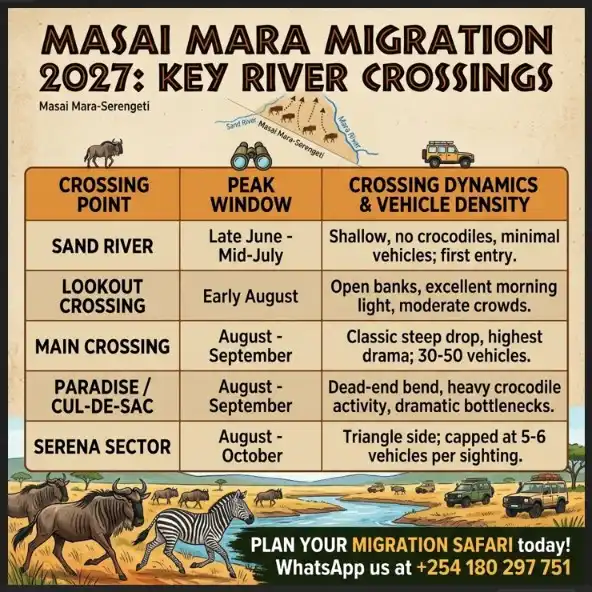
Two rivers matter. The Sand River on the southern boundary is shallow, has no crocodiles and takes the first herds in late June and early July. The Mara River, deep and crocodile-lined, is where the famous crossings happen from the last ten days of July into October.
Crossing | Where | When it runs | What to expect |
Sand River crossings | South-east reserve, near Sand River Gate | Late June to mid July | Quiet, shallow, the herds’ first entry into Kenya. Few vehicles |
Lookout Crossing | Mara River, central reserve below the Lookout Hill | Best in early August | Open banks, good light, mid-size crowds |
Main Crossing (Crossing Point 7) | Mara River, Musiara-Talek corridor | August to September, peak | The classic crossing. 30 to 50 vehicles in August, over 40 at the busiest |
Cul-de-Sac and the Paradise bends | Mara River, between Paradise Plains and the Triangle | August to September | Herds bunch in the dead-end bend before committing. Strong crocodile activity |
Serena sector crossings | Mara River, Triangle side | August to October | Same river, fewer vehicles. The Mara Conservancy caps sightings at five or six |
How a crossing happens. The herds gather on the bank, sometimes for hours, pressing closer until one animal goes in and the rest follow in a column. Most crossings run between 10 AM and 3 PM, so a crossing day is a full day out with a packed lunch. False starts are normal. A herd can approach the water and turn away three or four times before it goes, and some guests wait four days and see nothing. In a drought year, as in 2024, the herds can stay in the Serengeti for weeks longer than usual.
Crowds. In August the Main Crossing draws 30 to 50 vehicles and the Musiara-Talek corridor can hold more than 40 at a single point. By late October the same spot has two or three. The Triangle side, with its vehicle cap, is the way to watch the same river with a tenth of the traffic.
The toll. Several thousand wildebeest die in the river each season, most of them drowned in the crush or against the steep banks rather than taken by crocodiles. The vultures, marabou storks and hyenas that follow are part of the scene, and so are the crocodiles feeding below the crossing for days after.
The crossing points in detail, with how to choose one for your dates and which camps sit beside them, are on the Mara River crossing page.
Where to Stay and Watch
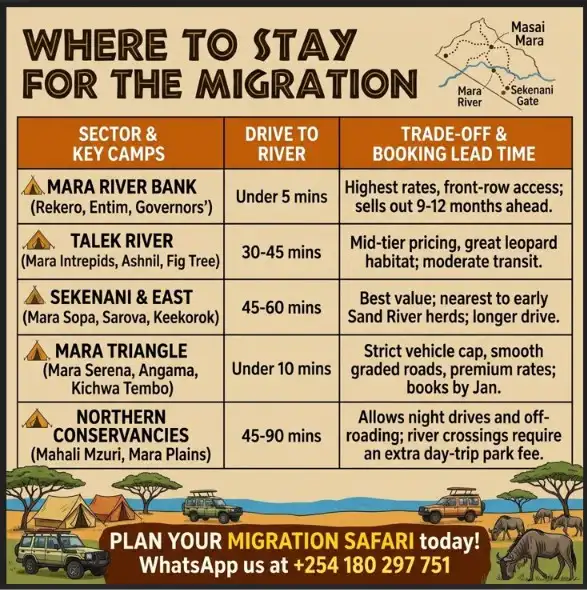
In migration season the question is how far your bed is from the river. Every camp in the Mara will get you to a crossing, but the ones on the bank get you there before the herds decide.
Area | Distance to the main crossings | Camps | Trade-off |
Mara River bank, central reserve | Minutes. Rekero is about 150 m from a crossing point, Hammerkop about 200 m | Rekero, Entim Mara, Hammerkop, Governors’ Camp and Little Governors’ at Musiara | Sell out first, highest rates, in the thick of the August traffic |
Talek River camps | 30 to 45 minutes | Mara Intrepids, Ashnil Mara, Fig Tree Camp, Basecamp Masai Mara | Mid-range prices, leopard country, easy reach of the Talek-Mara confluence |
Sekenani and the east | About 45 minutes to Musiara, less to the Sand River | Best value in peak season. First to the Sand River herds in July | |
Mara Triangle | On the west bank, minutes from the Serena sector crossings | Vehicle cap of five or six, graded roads, rhino, fewer crowds. The Triangle lodges sell out by January | |
Northern conservancies | 45 to 90 minutes to the river | Night drives and off-road for the predators that follow the herds. The crossings are a day trip with the park fee on top |
If you have three days, stay on the Talek or at Sekenani and give one full day to the river. If you have five, split the nights: two on the reserve side and two in the Triangle or a conservancy, so you see the crossings from both banks and get a night drive. The full comparison of sectors, with timings from each gate, is on the best place to see the migration page, and the camps themselves are on the Masai Mara camps directory.
Migration Safari Packages
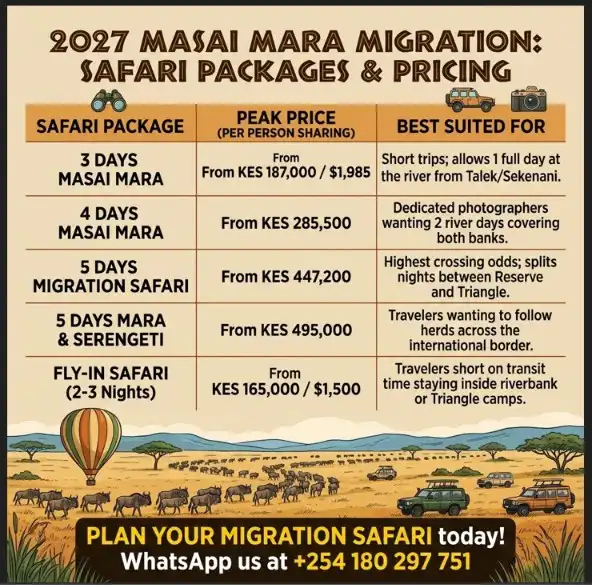
Peak-season prices for the 2027 season, per person, two sharing a private 4×4 Land Cruiser, with park fees at the July to December rate, full board and a TRA-licensed guide included. Camps confirm their 2027 rates in stages, and we re-quote if a rate moves before you pay.
Package | Nights | Budget tier from | Premium tier up to | Who it suits |
2 | KES 187,000 / USD 1,985 | KES 285,000 / USD 2,890 | One full day at the river from a Talek or Sekenani camp | |
3 | KES 285,500 | Ask for quote | Two river days, one on each bank | |
4 | KES 447,200 | KES 1,348,100 / USD 10,370 | Reserve plus Triangle or conservancy. The best odds of a crossing | |
4 | KES 495,000 | Ask for quote | Follow the herds across the border | |
2 to 3 | KES 325,000 / USD 2,500 | Ask for quote | Short on time, or staying in a river-bank or Triangle camp |
A 3-day trip in the window will see the herds, because they are in the reserve for about four months. A crossing on a given day is never promised, which is why the 5-day package exists: four full days near the river more than doubles the chance. Add a hot air balloon flight at USD 450 to 500 for the one view of the herds you cannot get from a vehicle. Every route, tier and low-season price is on the safari packages page.
Predators and the Rest of the Show
The crossings get the attention, but the migration changes the whole reserve for four months.
Lions. The Mara’s 850 or so lions do not follow the herds, because every pride is tied to a territory. What changes is that the food comes to them. Prides along the Mara River and the Talek gorge for the season, cubs born in the previous year get fat, and a full-day drive in August will find a pride on a kill without trying. Our lions page has the prides by sector.
Crocodiles. For most of the year, the Mara River’s Nile crocodiles bask quietly on the sandbanks. During the migration they feed heavily, with large specimens exceeding four to five metres ambushing animals in the shallows. While drowning and steep riverbank stampedes claim more lives than predators do, the crocodiles patrol the crossing points continuously and feed on carcasses downstream for days.
Hyenas, vultures and marabou storks. Clans of 50 or more spotted hyenas work the plains behind the herds, and the river below a crossing point fills with vultures and storks for days afterwards. This is the part of the migration that photographers underrate and children remember.
Cheetahs and leopards. Cheetahs on the Sekenani plains take wildebeest calves and the Thomson’s gazelles that travel with the herds. Leopards along the Talek stay with their usual impala, but the extra traffic along the river makes them easier to find.
The zebras. Around 200,000 plains zebra move ahead of the wildebeest by two to three weeks and cross the same points. A zebra crossing is quieter and more orderly than a wildebeest one, and often the first crossing you will see in July.
Planning a Migration Safari
Park fees double. Narok County charges non-residents USD 200 per person per day from 1 July to 31 December, against USD 100 for the rest of the year. The Mara Triangle, run by the Mara Conservancy, charges the same. Our packages include the fee at the season’s rate, so a quote for August already has it in. Full rates for citizens, residents and children are on the park fees page.
Book early. Camps inside the reserve and on the Mara River sell out for August by the previous November, and the Triangle lodges by January. Six to nine months ahead is normal for peak dates. Shoulder weeks in early July and October can be booked two to three months out.
The vehicle matters more in this season. The tracks to the crossing points cross black cotton soil, and a rain shower in September turns it into grease. Every migration safari we run is in a 4×4 Land Cruiser with a pop-up roof. A minivan that sinks to its axles in lion country is the fastest way to miss a crossing.
The gate clock. Tickets run 6:00 AM to 6:00 PM. Vehicles must be off the plains and back in camp by 6:00 PM sharp, and if you sleep inside the reserve you must exit through the gate by 10:00 AM on your last day or pay another full day’s fee. A crossing that starts at 9:45 AM on departure day is the hardest thing a guide has to walk away from, and we plan departures so you are not the one making that call.
A crossing day. You leave camp at 6:00 AM for a normal morning drive, arriving at your chosen crossing point by 9:30 AM with a packed picnic lunch. The herds bunch on the bank, often for hours, waiting for a single animal to commit before the rest follow. Guides communicate continuously via VHF radio, so when one point begins to run, nearby vehicles know. Expect to wait four to six hours and share the primary crossing points with 30 to 50 vehicles during August. The quieter bends and the Triangle side experience noticeably less traffic. You will be back in camp by 6:00 PM. The game drives page explains how a normal Mara day runs.
Pack for it. Dust in August, mud in September, cold at 6:00 AM in both. A 15 kg soft bag if you are flying in. Full list on the packing list page.
Frequently Asked Questions
When is the wildebeest migration in the Masai Mara? The 2027 season runs from late June through October. The Mara River crossings run from the last ten days of July to early October, peaking through August and September. Exact dates shift by two to three weeks each year depending on the timing of regional rainfall.
What is the best month to see the migration in Kenya? August for the most crossings, September for crossings with slightly fewer vehicles and the strongest predator activity, and early July or early October if you want the herds on the plains without the crowds.
Is a river crossing guaranteed? No. The herds are in the reserve for about four months, so seeing them is near certain in the window. A crossing on a particular day is not. Four days near the river gives the best odds, and a guide who listens to the radio helps.
How much does a migration safari cost? A 3-day Masai Mara safari in peak season starts at KES 187,000 (USD 1,985) per person sharing, and a 5-day migration safari from KES 447,200. Park fees for non-residents are USD 200 per person per day from July to December and are included in our prices.
How far ahead should I book? River-bank and Triangle camps for August are usually full six to nine months ahead, and the most popular ones sell out by the previous January. Shoulder weeks in early July and October can be booked two to three months out.
Do the wildebeest cross the river more than once? Yes. Through August and September the herds cross and recross the Mara River between the reserve and the Triangle as they follow the grass, and a single herd can cross several times in a week.
Can I see the migration in the Serengeti instead? The same herds are in the Serengeti from November to June, with calving in February. The Kenyan side has the Mara River crossings. Our Mara and Serengeti packages cover both ends.
Which is better for the migration, the reserve or the Mara Triangle? The reserve side has more crossing points and more camps. The Triangle has the same river with a vehicle cap of five or six per sighting and graded roads. Two nights on each side is the answer if you have five days.
Ready to Plan Your 2027 Migration Safari?
Camps along the Mara River and inside the Mara Triangle book out 6 to 9 months ahead for July, August, and September. Tell us your travel dates, group size, and preferred accommodation tier, and our team at Sekenani Gate will build a custom, itemized itinerary with all gazetted Narok County park fees, private 4×4 Land Cruiser transport, and camp bookings included.
- Email: [email protected]
- WhatsApp: +254 180 297 751
- Online Booking: Get a Quote
Written by David Njunge, a TRA-licensed safari guide with over 10 years in the Mara. Edited by Cess Wambui, travel consultant, BSc Tourism and Hospitality Management. Prices, crossing calendars, and gate regulations verified for the 2027 season. Park conservation fees are governed by the Narok County Government (Masai Mara National Reserve) and the Mara Conservancy (Mara Triangle). Domestic flight schedules courtesy of Safarilink and AirKenya. Masaimara.co.ke is an authorized safari operator partner.
Welcome to Masaimara.co.ke
Thank you for visiting us! We're excited to help you plan an unforgettable safari adventure across Kenya.