
3-Day Masai Mara & Amboseli Flying Safari
Edited by David Njunge, TRA Licensed Safari Guide (10+ years)
At a Glance
A 3 days Masai Mara Amboseli safari costs KES 185,000 to KES 385,000 per person for a fly-in package. You’ll spend one night in Amboseli with Kilimanjaro views and one night in the Mara seeing big cats.
Flying between parks saves 6-8 hours compared to driving. For a 3-day trip covering two parks, this isn’t optional—it’s the only approach that makes sense.
Quick Comparison: Amboseli vs Mara
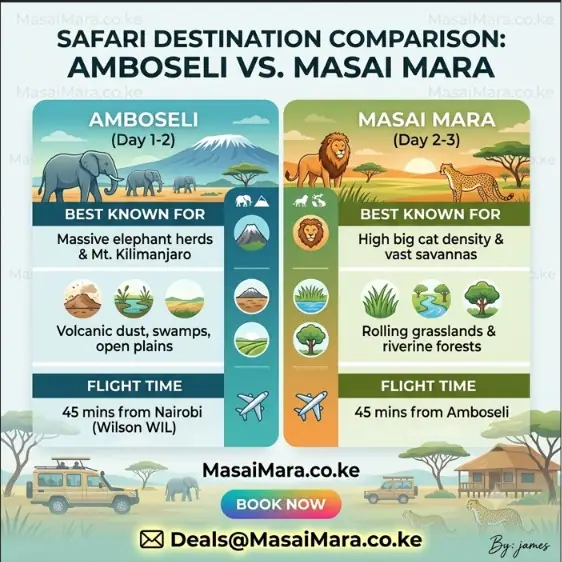
Feature | Amboseli (Day 1-2) | Masai Mara (Day 2-3) |
Best For | Elephants, Kilimanjaro views | Big cats, vast savanna |
Landscape | Volcanic dust, swamps, open plains | Rolling grasslands, riverine forest |
Visibility | Wide open, easy spotting | Taller grass, more terrain variety |
Crowd Level | Moderate year-round | High July-October, moderate otherwise |
Flight Time | 45 mins from Nairobi | 45 mins from Amboseli |
Monthly Visibility Guide
Month | Kilimanjaro Visibility | Mara River Crossings | Overall |
Jan-Feb | 85% (best) | 0% | Great for Amboseli |
Mar | 75% | 0% | Good balance |
Apr-May | 40% (rains) | 0% | Not recommended |
Jun | 60% | 10% (early herds) | Good |
Jul-Aug | 35% (cloud) | 80% (peak) | Best for Mara |
Sep-Oct | 30% | 90% | Peak migration |
Nov-Dec | 55% | 20% (late crossings) | Variable |
Bottom line: For a 3-day trip, January-March gives you the best Kilimanjaro odds. July-October maximizes Mara wildlife but Kilimanjaro is often cloudy.
Why Flying Makes Sense
The drive from Amboseli to Masai Mara takes 7-10 hours depending on traffic. On a 3-day trip, that’s your entire Day 2 gone.
Flying takes 45-60 minutes.
The math is simple: drive and you get maybe 5 hours of actual game viewing across three days. Fly and you get 12+ hours. For the extra KES 80,000-100,000 in flight costs, you’re essentially buying back a full day of safari.
The “Fly-Drive” option: Some guests drive Nairobi to Amboseli (4 hours, decent road) then fly Amboseli to Mara. This saves money on one flight while avoiding the brutal cross-country transfer. Talk to Masaimara.co.ke about this hybrid approach if budget matters.
2026 Flight Schedule
Flights operate from Wilson Airport (WIL) in Nairobi—not JKIA. Both Safarilink and AirKenya run daily services.
Nairobi to Amboseli
Departure | Arrival | Airline |
7:30 AM | 8:15 AM | Safarilink |
10:30 AM | 11:15 AM | AirKenya |
Amboseli to Masai Mara
Departure | Arrival | Airline |
9:15 AM | 10:30 AM | Safarilink (triangle route) |
11:00 AM | 12:15 PM | AirKenya |
Masai Mara to Nairobi
Departure | Arrival | Airline |
11:00 AM | 11:45 AM | Safarilink |
2:00 PM | 2:45 PM | AirKenya |
Window seat tip: On the Wilson-Amboseli leg, sit on the left side of the aircraft for a pilot’s-eye view of Kilimanjaro as you descend. On the Amboseli-Mara leg, sit on the right side to see the Great Rift Valley escarpment.
2026 Packages and Pricing

Per person sharing. Based on two travelers. All flights and transfers included.
Flying Package Options
Tier | Low Season | Peak Season | Accommodation |
Mid-Range | KES 185,000 | KES 285,000 | Ol Tukai Lodge + Mara Leisure Camp |
Luxury | KES 248,000 | KES 345,000 | Amboseli Serena + Mara Serena Lodge |
Premium | KES 328,000 | KES 385,000 | Tortilis Camp + Governors Camp |
Low season: January-June, November-mid December Peak season: July-October, Christmas/New Year
What’s Included
All internal flights (Nairobi-Amboseli, Amboseli-Mara, Mara-Nairobi), airstrip transfers in open 4×4 vehicles, 2 nights full board accommodation, all meals, park fees for both Amboseli and Mara, game drives as listed, and bottled water.
You pay separately: Drinks beyond water, tips (KES 5,000-8,000 suggested), travel insurance, and optional activities.
Optional add-ons:
Activity | Cost |
Hot air balloon (Mara) | KES 58,500 |
Sundowner (Amboseli) | KES 5,200 |
KES 3,900 |
Park Fees (2026)
These are included in your package, but for transparency:
Amboseli (via eCitizen): KES 4,635 per adult citizen per day as per KWS.
Masai Mara (per Narok County): KES 1,500/day (January-June) or KES 3,000/day (July-December) for adult citizens. The fee operates on a 12-hour basis—valid from 6am to 6pm, not 24 hours.
The 10 AM Exit Rule
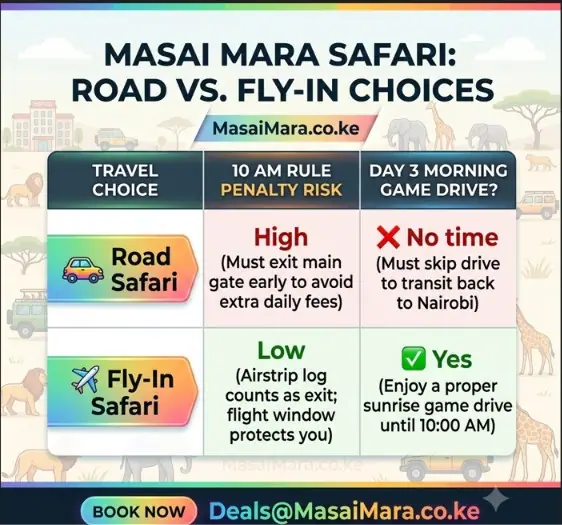
Travel Choice | 10 AM Rule Penalty Risk | Day 3 Morning Game Drive? |
🚘 Road Safari | High (Must exit main gate early to avoid extra daily fees) | ❌ No time (Must skip drive to transit back to Nairobi) |
✈️ Fly-In Safari | Low (Airstrip log counts as exit; flight window protects you) | Yes (Enjoy a proper sunrise game drive until 10:00 AM) |
This is the detail most safari websites miss.
In 2026, Narok County enforces a 10 AM exit rule for the Mara. If you’re leaving the reserve—whether by road or air—you must exit by 10 AM on your departure day. Exit after 10 AM and you pay an additional full day’s park fee.
The fly-out loophole: For air departures, your “exit” is recorded at the airstrip, not the main gate. If your flight is at 11 AM, you can do a final morning game drive until 10:30 AM as you move toward the airstrip. This is a significant advantage over road travelers who must leave much earlier.
Practical impact: On Day 3 of a flying package, you get a proper morning game drive from 6:15 AM until around 10 AM before heading to the airstrip. Road travelers leaving for Nairobi need to skip this drive entirely to avoid the extra fee.
Day-by-Day Itinerary
Day 1: Nairobi to Amboseli
Pre-flight tip: Stay the night before in Karen or Lang’ata, not Downtown or Westlands. The Nairobi Expressway helps, but the Wilson-JKIA corridor is still a bottleneck during morning rush hour.
The Mbagathi Way hack: If you’re coming from the city center or Westlands for a 7:30 AM flight, avoid Langata Road entirely. Take Mbagathi Way instead—it runs parallel but handles a fraction of the traffic. Most hotel drivers don’t know this route because it’s not on Google’s default suggestions. Tell your driver specifically: “Mbagathi Way to Wilson, not Langata Road.” You’ll save 20-30 minutes on a bad traffic day.
Wilson Airport now has Starlink in the Safarilink and AirKenya lounges—arrive 60 minutes early to download offline maps before hitting the bush.
Catch the 7:30 AM flight to Amboseli. You land at Amboseli Airstrip (ASV) around 8:15 AM—immediately in the “elephant corridor.”
Start your game drive from the runway. I’ve seen guests spot lion prides within 200 meters of the airstrip. Since you’re not exhausted from a 5-hour drive, Day 1 is 100% safari, 0% transit.
Mid-morning drive through the Enkongo Narok swamp. The sound of elephants feeding—tearing vegetation, mud suction—carries across the water. Lunch at your lodge with Kilimanjaro views (if the mountain cooperates).
Afternoon drive from 3:30 PM toward Observation Hill. Close at 6 PM sharp.
Day 2: Amboseli to Masai Mara
Optional sunrise drive from 6-7:30 AM. The swamps are most active at dawn—elephants, hippos, buffalo.
Return for breakfast. Pack up. Catch the 9:15 AM triangle flight to the Mara.
You land around 10:30 AM at Keekorok, Musiara, or Olkiombo airstrip depending on your camp location. Your camp’s vehicle meets you—these are usually open-sided 4x4s, not the enclosed vehicles you see on road safaris.
Dust tip: Open vehicles mean more dust exposure on the airstrip transfer. Bring a lightweight buff or scarf for the first 15 minutes until you’re past the unpaved sections.
Check in. Lunch. Rest if needed—or skip rest and ask for an early afternoon drive from 2 PM.
Main afternoon drive from 3:30-6:30 PM. Your guide will have gathered intel from the morning—where are the prides, which leopard is in which tree, whether any cheetahs were spotted near the airstrip.
Day 3: Masai Mara to Nairobi
Early start. Gates open at 6:15 AM.
This is your main Mara time. Focus on whatever matters most to you—big cats, the Mara River if it’s migration season, or just absorbing the landscape.
Pilot intel trick: On your flight in, the pilot may have spotted large herds or dust plumes from the air. They see the landscape from 5,000 feet and notice things guides on the ground don’t. Ask your guide if they got any intel from the pilots that morning—sometimes it leads to unexpected sightings.
Drive until 10 AM. Head to the airstrip. Catch your 11 AM or 2 PM flight back to Wilson.
Baggage Reality: The 15kg Rule
Safari flights use small Cessna Caravans with tiny cargo pods. The limit is 15kg per person including hand luggage—and they enforce it.
Hard-shell suitcases: They’ll make you leave them in a locker at Wilson Airport. Pack in soft-sided duffel bags only.
The weight hack: They weigh the bags, not the people. Wear your heaviest gear (safari boots, jacket) onto the plane. Put your heavy camera lens in your jacket pocket instead of your camera bag.
Dimensions matter too: Bags should not exceed 90 x 65 x 35cm.
Airstrip-to-Camp Reality
In fly-in packages, the camp provides the vehicle, not a Nairobi-based operator. These are usually open-sided 4x4s—no windows, no air conditioning.
The benefit: better visibility and photography angles. The cost: dust is 2x more intense than enclosed vehicles, especially on the first 15 minutes from the airstrip.
The washboard track warning: The access roads from Mara airstrips to camps haven’t been graded since the long rains. Between Keekorok airstrip and camps toward Talek, there’s a 4km stretch of corrugated “washboard” track that shakes cameras loose from straps and rattles fillings. Hold your gear—don’t let expensive lenses bounce on the seat. Some guests get motion sick on this section specifically, not from the flight. If you’re prone to car sickness, take your medication before landing, not after.
The transfer from airstrip to camp is technically a game drive. You’re immediately in wildlife territory. Don’t put your camera away thinking “this is just transit.”
What You’ll Actually See
In Amboseli
Elephants are the main draw. Large family groups moving against Kilimanjaro’s backdrop when visible. The volcanic dust rises when they walk—fine grey powder that smells mineral and alkaline.
Beyond elephants: lions (less common than Mara), hippos in the springs, buffalo herds, excellent birding. The swamp areas attract fish eagles and various herons.
Kilimanjaro reality: Unpredictable. Early morning before 9 AM is your best window. January-March offers clearest conditions. Don’t count on it—but if conditions align, the elephant-with-Kilimanjaro shot is iconic.
In Masai Mara
You have roughly 6-7 hours of game driving. That’s enough to see lions—the Mara has Africa’s densest lion population. Elephants, buffalo, zebra, wildebeest common throughout.
Leopards and cheetahs are possible. River crossings during migration (July-October) require luck and timing.
The flying package gives you meaningfully more Mara time than driving—enough to actually work a sighting rather than rushing between photo ops.
Common Concerns
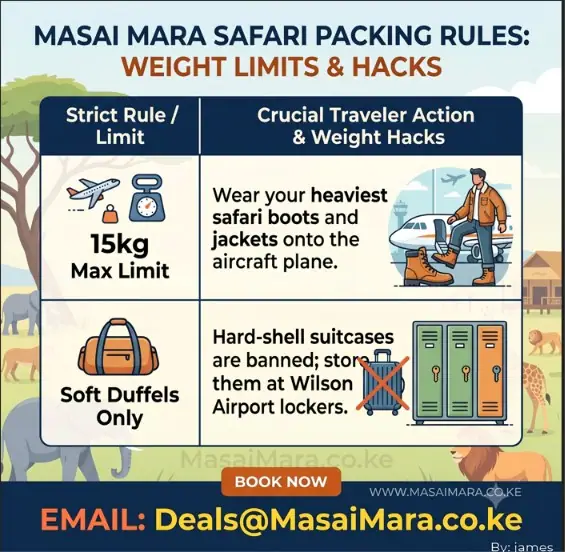
Strict Rule / Limit | Crucial Traveler Action & Weight Hacks |
15kg Max Limit | Wear your heaviest safari boots and jackets onto the aircraft plane. |
Soft Duffels Only | Hard-shell suitcases are banned; store them at Wilson Airport lockers. |
Lenses & Cameras | Slide heavy camera lenses into your jacket pockets during weigh-in. |
“Is flying safe?”
Safarilink and AirKenya have excellent safety records. Both are IATA certified. The pilots know the routes and weather patterns intimately. That said, small planes do bounce in turbulence more than jets. If you’re a nervous flyer, the 45-minute flights may feel longer.
“What if Kilimanjaro is cloudy?”
It often is. If Kilimanjaro views matter most to you, visit January-March and request the earliest possible morning drive. I’ve had guests visit Amboseli multiple times before getting a clear view—and others who got lucky on their first morning.
“Will I see the Big 5?”
Lions, elephants, and buffalo are very likely. Leopards are possible. Rhinos are rare in both parks—if rhinos matter, add Lake Nakuru to a longer itinerary.
“Can I do this trip by road instead?”
You can, but you’ll spend 7-10 hours driving between parks. On a 3-day trip, that wipes out Day 2 entirely. We don’t recommend road transfers for 3-day Amboseli-Mara combinations. If budget requires driving, consider a 3-day Mara-only or 3-day Amboseli-only trip instead.
Frequently Asked Questions
How much does a 3 days Masai Mara Amboseli flying safari cost?
KES 185,000 to KES 385,000 per person depending on accommodation tier and season. This includes all flights, transfers, accommodation, meals, and park fees.
Is 3 days enough for Masai Mara and Amboseli?
With flights, yes—you get meaningful time in both parks. By road, no—Day 2 becomes a transfer day with minimal wildlife viewing.
What’s the 10 AM exit rule in Masai Mara?
Narok County requires all visitors to exit the reserve by 10 AM on departure day. Exit later and you pay an additional day’s park fee. For fly-out guests, the airstrip counts as your exit point—giving you a final morning drive until 10-10:30 AM.
What airlines fly between Amboseli and Masai Mara?
Safarilink and AirKenya operate the “triangle” route (Nairobi-Amboseli-Mara-Nairobi). Book via their websites or through Masaimara.co.ke.
What’s the baggage limit on safari flights?
15kg per person including hand luggage. Soft-sided bags only—hard suitcases aren’t allowed. Dimensions must not exceed 90 x 65 x 35cm.
Which park should I prioritize if weather forces changes?
If you must choose one: the Mara has more wildlife variety and higher predator density year-round. Amboseli depends more heavily on Kilimanjaro visibility for its “wow factor.”
Ready to Book?
Tell us your dates and preferences. We’ll confirm flight availability and build your custom quote.
Related Safaris
- 4 Days Masai Mara Safari
- 5 Days Masai Mara Safari
- 3 Days Masai Mara Safari
- Masai Mara Amboseli Safari
- Best Time to Visit Masai Mara
- Last Minute Holidays Kenya
Prices verified August 2026. Park fees per KWS and Narok County. Flight schedules per Safarilink and AirKenya—confirm current times when booking.
Welcome to Masaimara.co.ke
Thank you for visiting us! We're excited to help you plan an unforgettable safari adventure across Kenya.