
Keekorok Lodge: Rooms, Rates & 2027 Safari Guide
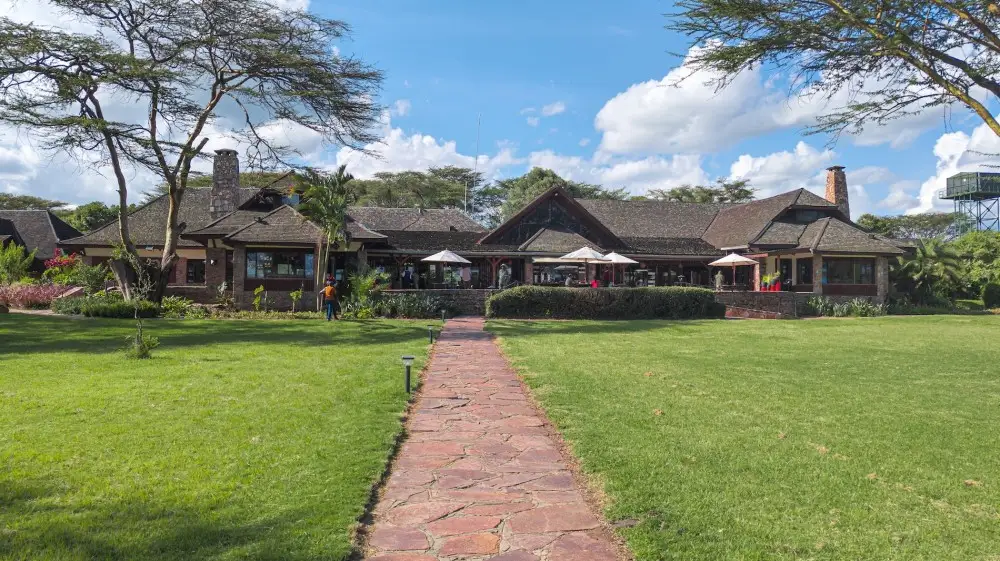
Keekorok means “dark trees” in the Maasai language — named for the dense riverine foliage around the permanent springs that run through the property. The lodge opened in 1962, the first inside the Masai Mara. 99 rooms. An on-site hippo pool with roughly 50 hippos and several Nile crocodiles nobody talks about. Unfenced. Wildlife grazes through the grounds at night.
The lodge changed hands a few years back. MGM Muthu Hotels took over, and with that came changes — particularly to the food, which now skews heavily Indian and Asian. That’s a corporate supply chain decision, not a local chef’s choice. Worth knowing before you book.
Packages (2027 Rates)
3-day/2-night safari from Nairobi, per person, two people sharing.
Included: Nairobi pickup, private 4×4 Land Cruiser with guide, 2 nights full board at Keekorok Lodge, game drives, park fees, Flying Doctor cover.
Not included: Kenya eTA (USD 32), drinks, balloon safari (USD 550), tips (USD 15-20/day), room upgrades.
Season | Standard Room | Premium (+USD 50/night) |
Off-Peak (Jan-Jun) | USD 1,090 | USD 1,190 |
Peak (Jul-Oct) | USD 1,980 | USD 2,080 |
Shoulder (Nov-Dec) | USD 1,360 | USD 1,460 |
Room upgrades:
- Chalet: +USD 40/night
- Luxury Room: +USD 80/night
- Executive Suite: +USD 130/night
Park Fee Math
If you book your safari package with us, all gazetted Narok County park fees are itemized and prepaid in your invoice. However, if you book room-only directly with Muthu Hotels, you will be hit with this fee at the gate: a family of four staying three nights in August faces USD 2,400 in park fees alone ($200 X 4 guests X 3 days), plus an extra full day’s fee if exiting after 10:00 AM on departure day.
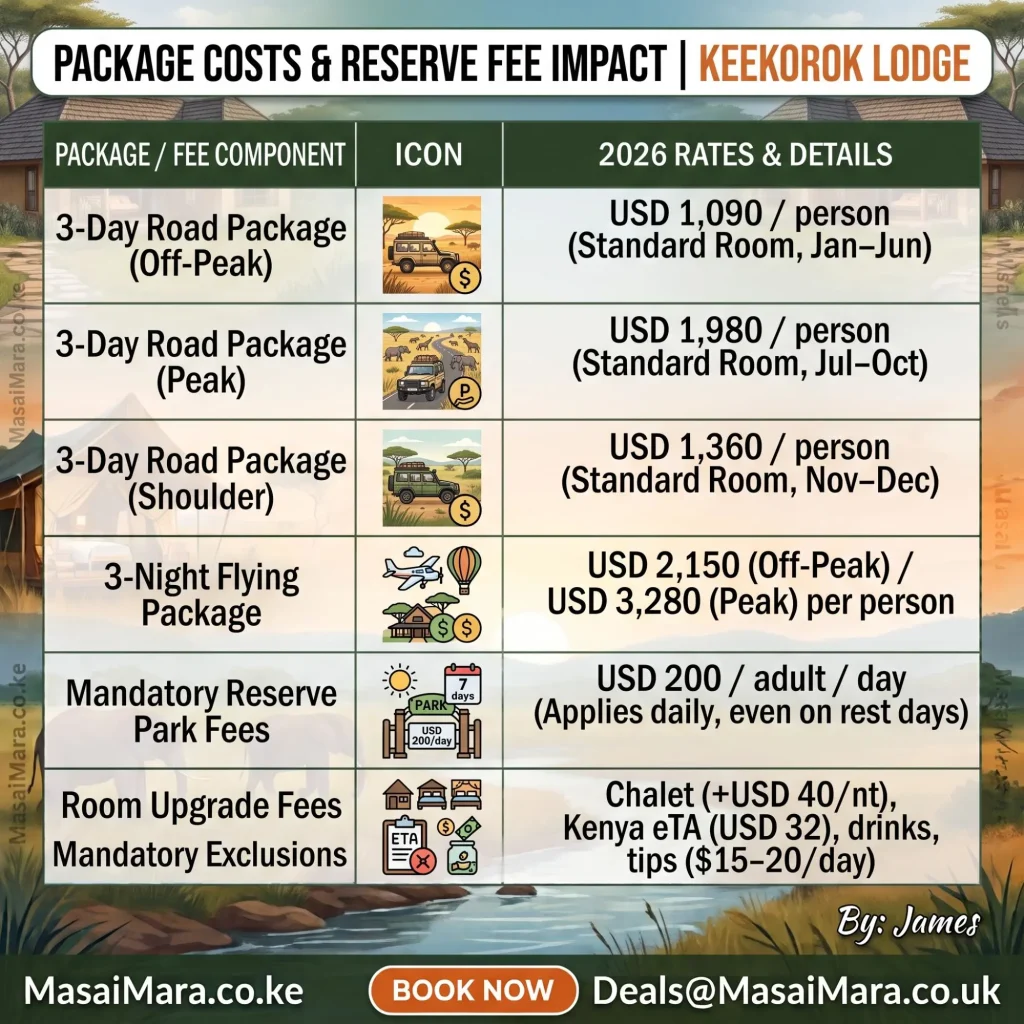
Package Costs & Reserve Fee Impact Table
Planning a stay at Keekorok Lodge requires budgeting for both your package choice and mandatory daily reserve fees. Because the lodge sits inside the Masai Mara National Reserve, park entry fees apply for every day of your stay. Use the table below to compare package options against total estimated costs.
Package / Fee Component | 2027 Rates & Details |
3-Day Road Package (Off-Peak) | USD 1,090 / person (Standard Room, Jan–Jun) |
3-Day Road Package (Peak) | USD 1,980 / person (Standard Room, Jul–Oct) |
3-Day Road Package (Shoulder) | USD 1,360 / person (Standard Room, Nov–Dec) |
3-Night Flying Package | USD 2,150 (Off-Peak) / USD 3,280 (Peak) per person |
Mandatory Reserve Park Fees | USD 200 / adult / day (Applies daily, even on rest days) |
Room Upgrade Fees | Chalet (+USD 40/nt), Luxury (+USD 80/nt), Suite (+USD 130/nt) |
Mandatory Exclusions | Kenya eTA (USD 32), drinks, tips ($15–20/day) |
Room Selection
The 99 rooms spread across stone bungalows and standalone chalets. The category names don’t tell you everything.
The Sound Bleed Problem
Standard rooms are built as connected stone bungalows. Sound travels through the walls. If your neighbour is up early for a game drive, you’ll know about it.
The fix: Request a chalet. They’re standalone units with proper walls. Chalets 1287 through 1290 specifically sit closest to the main building — shortest walk to meals.
The Hippo Pool Smell
Rooms near the hippo pool get the best wildlife views. They also get the smell. Fifty hippos in standing water produce a particular odor, especially at night when temperatures drop.
If you’re sensitive to smells, request an A-frame bungalow or a room on the opposite side of the property, facing the outer savanna boundary.
The Charging Problem
Some older rooms have weak bedside sockets. Charging phones and cameras overnight can be unreliable. Bring a power bank. The generator also has reliability issues in some recent stays — another reason for backup power.
Specific Room Notes
Room 60 gets mentioned for particularly good wildlife views. The back-row upper-level standard units facing the outer boundary offer more privacy and less foot traffic noise than rooms near the pool and main walkways.
Some rooms have both ceiling fans and floor fans. The metal keys are old-style, not keycards.
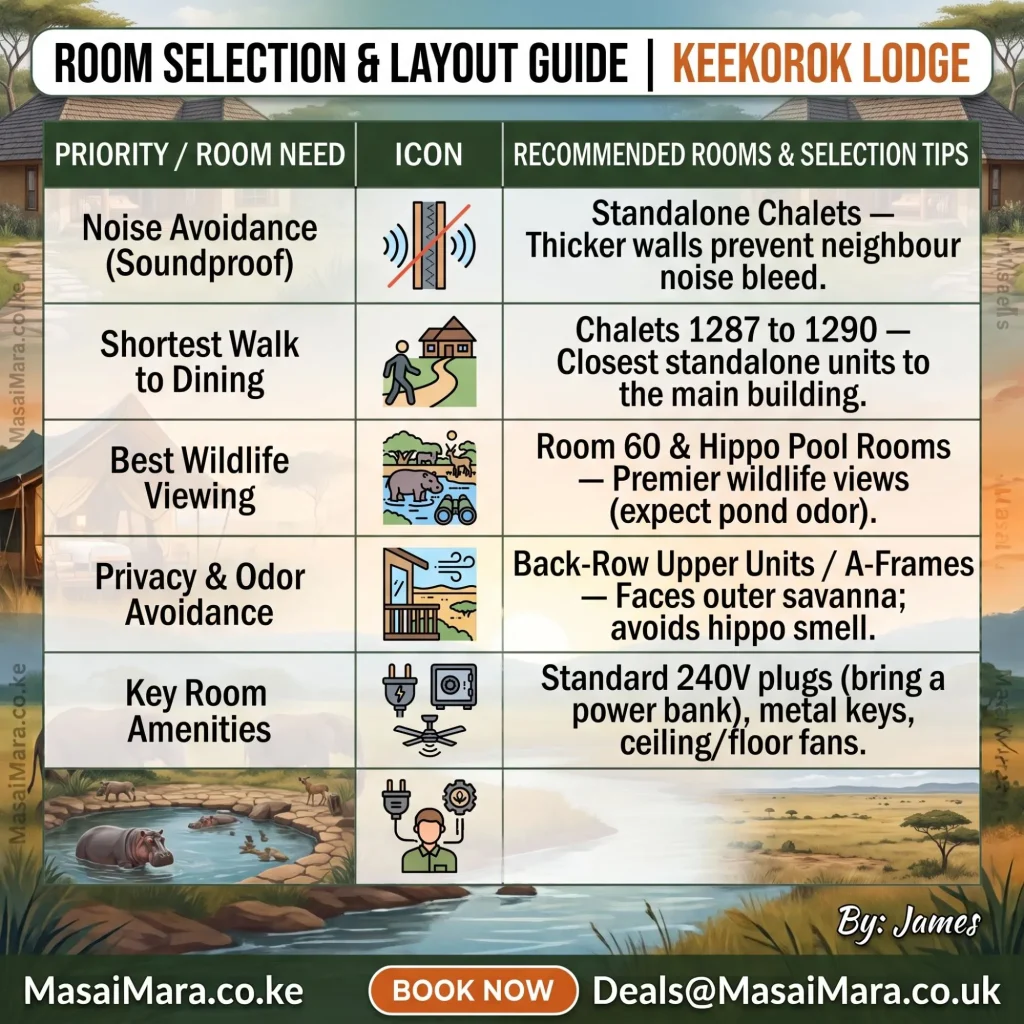
Room Selection & Layout Guide Table
With 99 rooms ranging from connected stone bungalows to standalone chalets, room location significantly impacts your comfort, noise levels, and overall view. Review the room selection matrix below to request the best room category for your trip.
Priority / Room Need | Recommended Rooms & Selection Tips |
Noise Avoidance (Soundproof) | Standalone Chalets — Thicker walls prevent neighbour noise bleed. |
Shortest Walk to Dining | Chalets 1287 to 1290 — Closest standalone units to the main building. |
Best Wildlife Viewing | Room 60 & Hippo Pool Rooms — Premier wildlife views (expect pond odor). |
Privacy & Odor Avoidance | Back-Row Upper Units / A-Frames — Faces outer savanna; avoids hippo smell. |
Key Room Amenities | Standard 240V plugs (bring a power bank), metal keys, ceiling/floor fans. |
The Hippo Bar
A 300-metre wooden boardwalk connects the main lodge to the Hippo Bar, which sits on an elevated deck over the hippo pool.
What most descriptions skip: several large Nile crocodiles live in the reed beds directly underneath the viewing deck. They look like floating logs at the muddy water’s edge. Mostly motionless during the day. Active at dusk. Look carefully before you dismiss that “log.”
The bar itself opens inconsistently. I’ve had clients walk the full 300 metre to find it closed for refurbishment or simply unstaffed. Confirm operating hours at reception before making the trek.
When it is open, sunset is the time. The grunting, splashing, occasional territorial roar. Cold Tusker in hand. Crocodiles below.
The Baboon Problem
The baboons on this property have learned to operate the exterior door handles.
Sliding the balcony door shut isn’t enough. They’ve figured out how to press down on the lever handles. You must physically turn the interior secondary thumb-bolt lock every time you step away from the room. Every time.
If they get in, they go for sugar packets, fruit, anything edible. They will also rummage through bags looking for shiny objects.
This isn’t theoretical. It happens.
The Night Escort System
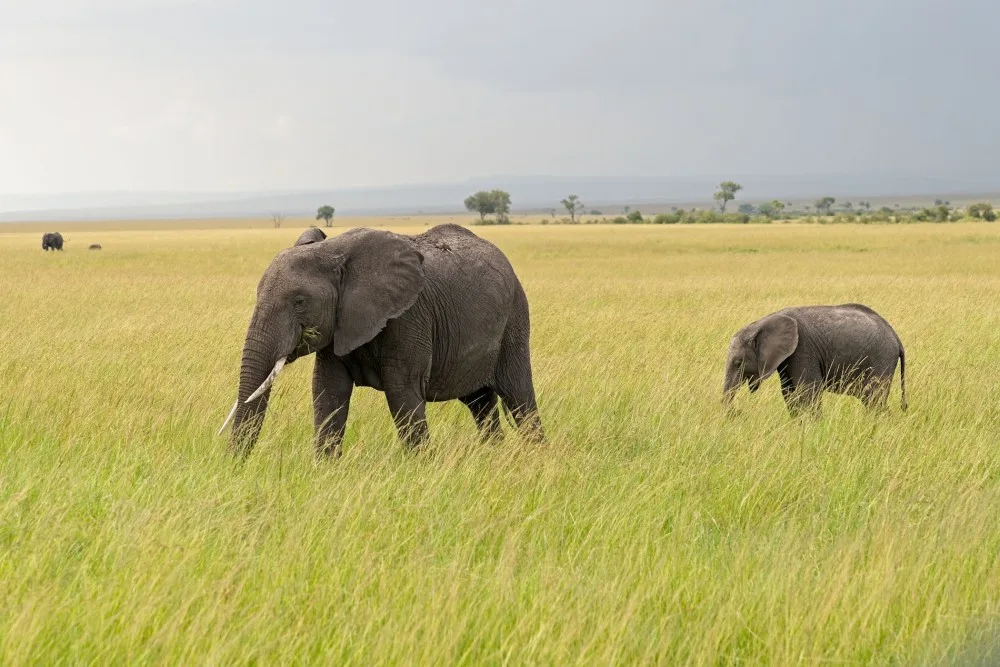
Keekorok is unfenced. Hippos, buffalo, elephants walk the grounds after dark.
After sunset and before sunrise, Maasai askaris escort you between your room and the main building with flashlights. The system works. They know where the animals are.
If you need something from your room late at night — extra blankets, medication — getting an escort takes time. Ask housekeeping for extra shukas before dinner rather than trying to sort it out at midnight.
The Breakfast Bottleneck
Morning game drives depart at 6:00 AM sharp to catch first light. The dining room breakfast buffet also opens around 6:00 AM, creating a direct clash. If you wait in line for the live cooking stations (omelettes and pancakes), you will lose the best hunting window of the day.
The guide’s workaround: Grab a quick coffee from the 24/7 tea station, request a packed breakfast box from reception the evening before, and leave at 6:00 AM. Enjoy your breakfast in the field at a designated picnic site along the Sand River, or return to the lodge around 9:30 AM for a late meal once the dining room clears out.
The Food Situation (And Why It Changed)
The buffet skews heavily Indian and Asian. This isn’t subtle. Multiple meals, same pattern.
Why this happened: When MGM Muthu Hotels acquired the property, they brought corporate supply chain decisions. The cuisine shifted to align with their core international tour demographics — primarily Indian and Chinese tour groups who book blocks of rooms.
If you want variety, state your preferences at booking and again at check-in. Ask for Judy specifically if you have dietary requirements — coeliac, gluten-free, allergies. Her name comes up repeatedly as the person who actually handles special meals properly.
The live Italian pasta station at dinner offers an alternative to the Asian-dominant buffet.
Bush dinners on the Elephant Deck are available with advance request. Packed lunches for full-day drives are substantial — some guests return to the lodge for lunch instead of carrying boxes when their itinerary allows it.
The Tea Charlie
A vintage service from the lodge’s 1962 origins. The Tea Charlie is an afternoon trolley service in the lounge — hot Kenyan tea, coffee, fresh pastries — before the evening game drive. Full-board guests only. Not advertised loudly. Worth asking about.
Flying In: The Runway Clearance Ritual
Keekorok Airstrip sits just 2 to 3 km from the lodge. Scheduled 45- to 60-minute bush flights operate daily from Nairobi Wilson Airport via Safarilink and AirKenya. For travelers combining a safari with the Kenya coast, Mombasa Air Safari operates direct daily connections between Keekorok and Diani Beach (Ukunda Airstrip) or Mombasa (Moi International Airport).
What nobody tells you: zebras, impalas, and topis rest on the dirt airstrip. Aircraft frequently circle while the lodge’s shuttle drivers race a 4×4 down the runway to clear wildlife. Your arrival time depends on how quickly they move.
The balloon safari advantage: The hot-air balloon launch site sits right near the property. If you’re doing a balloon safari, staying at Keekorok means a 5:30 AM wake-up. Guests at camps outside Sekenani Gate wake at 4:00 AM for a freezing, bumpy night drive to make the same launch window.
Flying package (3 nights):
Season | Price/Person |
Off-Peak | USD 2,150 |
Peak | USD 3,280 |
Staff Who Actually Help
Some names appear consistently across guest experiences.
Judy (Restaurant): The person to ask for with dietary requirements. Handles coeliac, gluten-free, special meals properly.
John Lemurt (Guide): Specifically noted for tracking skills.
Peter and Neemoh (Reception): Handle logistics and room issues.
George, Moses, Lawrence, Grace (Restaurant): Mentioned for attentive service during meals.
The spa offers massage after long drives. At least one guest singled it out as worthwhile — a detail most reviews skip.
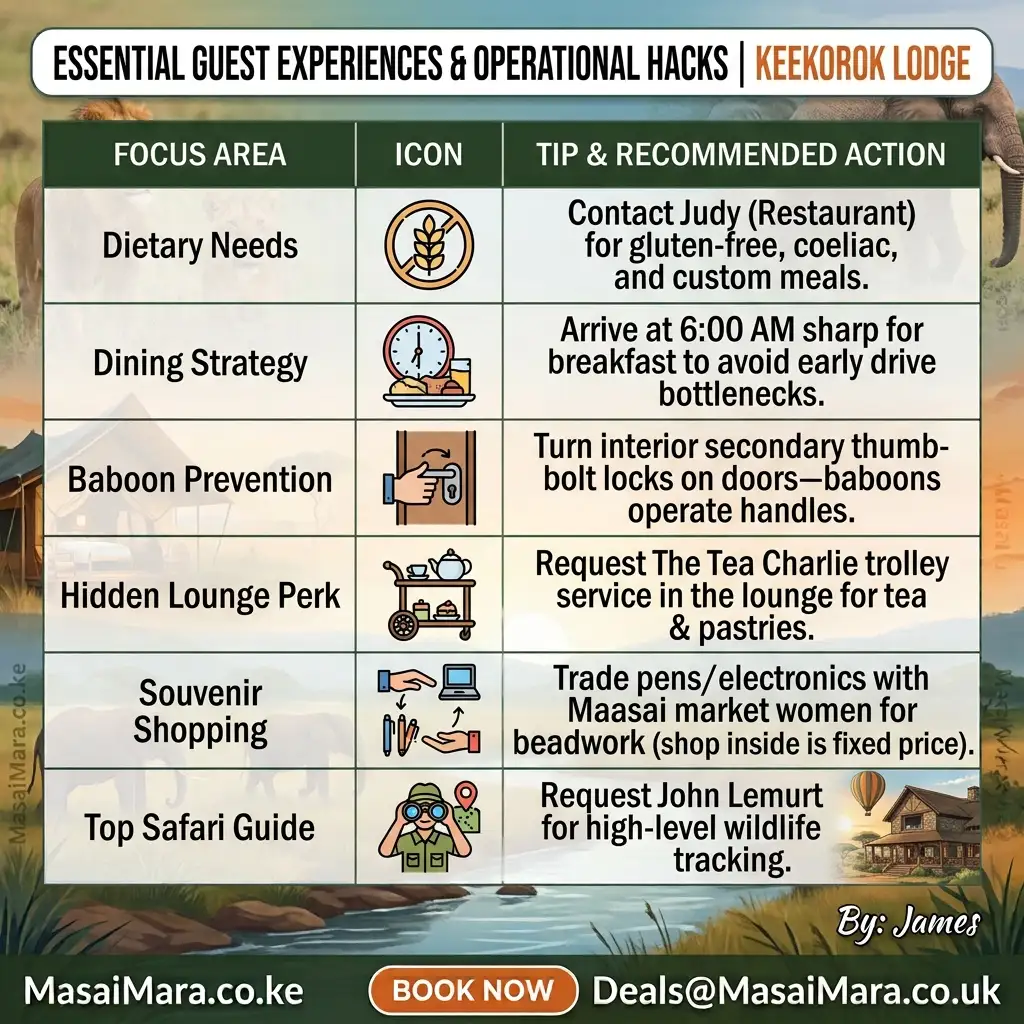
Essential Guest Experiences & Operational Hacks Table
Staying inside the reserve offers unique perks, like close proximity to hot air balloon launch sites, but also requires navigating safari logistics. Use this quick reference guide to make the most of your meals, safety, local shopping, and key lodge staff.
Focus Area | Tip & Recommended Action |
Dietary Needs | Contact Judy (Restaurant) for gluten-free, coeliac, and custom meals. |
Dining Strategy | Arrive at 6:00 AM sharp for breakfast to avoid early drive bottlenecks. |
Baboon Prevention | Turn interior secondary thumb-bolt locks on doors—baboons operate handles. |
Hidden Lounge Perk | Request The Tea Charlie trolley service in the lounge for tea & pastries. |
Souvenir Shopping | Trade pens/electronics with Maasai market women for beadwork (shop inside is fixed price). |
Top Safari Guide | Request John Lemurt for high-level wildlife tracking. |
The Maasai Market
The main indoor gift shop has fixed, high prices.
The local Maasai women who set up the daily outdoor market operate differently. Prices are negotiable. Local guides advise bringing items you no longer need — working pens, specific clothing, small electronics — as trade leverage for handmade beadwork.
One caution: the Maasai village visits offered as add-ons can feel pushy and commercialized. Ask your guide for their honest assessment before committing.
When to Visit
July-October: Peak migration passes directly through this section of the reserve. Highest prices. Book months ahead.
January-March: Fewer crowds. Good wildlife. Reasonable prices.
April-June: Long rains. Cheapest rates. Some roads challenging.
November-December: Short rains. Newborn animals. Good value.
Questions People Ask
Is Keekorok Lodge safe at night?
Yes. The mandatory Maasai escort system works effectively. Because the property is unfenced and wildlife roams after dark, staff physically guide you to and from your room. Never walk alone after sunset.
Why does the food at Keekorok lean so heavily Indian?
Corporate decision. When MGM Muthu Hotels acquired the lodge, they shifted the cuisine to align with their international tour demographics. The previous management had a more varied African-international menu.
Which rooms at Keekorok have the best views?
Rooms near the hippo pool have excellent wildlife views but come with the smell. Room 60 specifically gets mentioned for views. For privacy and quiet, request back-row upper-level units facing the outer savanna.
Are there crocodiles at Keekorok?
Yes. Several Nile crocodiles live in the reed beds of the hippo pool, directly under the Hippo Bar viewing deck. They’re easy to miss during the day. Look for what appears to be floating logs at the muddy water’s edge.
Plan Your Keekorok Safari with Local Experts
Avoid unexpected gate fees and secure the best standalone chalets. Tell us your travel dates, group size, and preferred room tier. Our team at Sekenani Gate will prepare a fully inclusive, itemized quote with all gazetted Narok County park fees, private 4×4 Land Cruiser transport, and Keekorok room reservations included.
- Email: [email protected]
- WhatsApp: +254 180 297 751
- Online Booking: Get a Quote
Related Pages
- Masai Mara Safari from Nairobi
- Park Fees 2027
- Where is Masai Mara Located
- Mara River
- Weather in Masai Mara
- Masai Mara Booking
- Mara Simba Lodge
Written by David Njunge, TRA-licensed safari guide with over 10 years in the Mara. Edited by Cess Wambui, travel consultant, BSc Tourism and Hospitality Management. Lodge rates, room inventories, and park gate regulations verified for the 2027 season. Reserve entry permits and fees are governed by the Narok County Government (Masai Mara National Reserve).
Welcome to Masaimara.co.ke
Thank you for visiting us! We're excited to help you plan an unforgettable safari adventure across Kenya.