
4-Day Masai Mara & Amboseli Safari
Edited by David Njunge, TRA Licensed Safari Guide (10+ years)
4 Days Masai Mara Amboseli Safari costs KES 245,000 to KES 648,000 per person sharing in 2026. The trip covers two of Kenya’s most different landscapes—elephants against Kilimanjaro in Amboseli, big cats hunting across open plains in the Mara. Four days gives you roughly 2 nights in one park and 1 night in the other. Most guests spend 2 nights in the Mara because predator density is higher.
Two Ways to Do This Trip
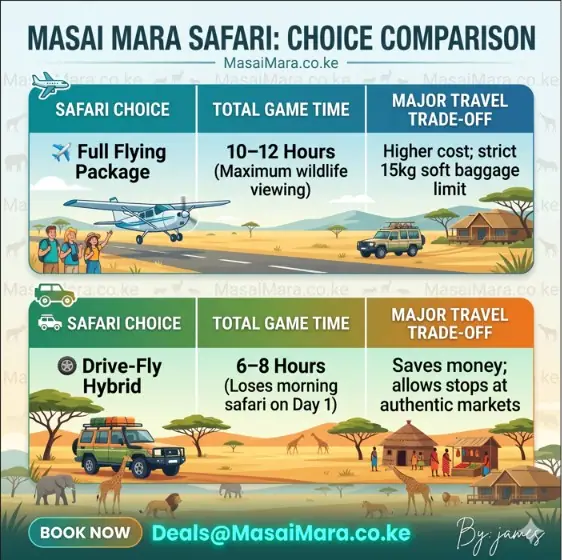
Safari Choice | Total Game Time | Major Travel Trade-Off |
✈️ Full Flying Package | 10–12 Hours (Maximum wildlife viewing) | Higher cost; strict 15kg soft baggage limit |
🛞 Drive-Fly Hybrid | 6–8 Hours (Loses morning safari on Day 1) | Saves money; allows stops at authentic markets |
You’ve got two realistic options for combining Amboseli and the Mara in 4 days. Neither is perfect—both involve trade-offs.
Option A: Full Flying Package
Fly Nairobi to Amboseli, fly Amboseli to Mara, fly Mara back to Nairobi.
Pros: Maximum game time. Roughly 10-12 hours of actual wildlife viewing across four days. You arrive at each park fresh, not road-weary.
Cons: Adds KES 150,000-200,000 to your trip. The 15kg baggage limit means soft bags only and creative packing.
Option B: Drive-Fly Hybrid
Drive Nairobi to Amboseli (4-5 hours), fly Amboseli to Mara, fly Mara back to Nairobi.
Pros: Saves one flight. The Nairobi-Amboseli road via Namanga is decent—paved most of the way. You get flexibility to stop at Maasai markets along the route.
Cons: You lose 4-5 hours on Day 1 that could be safari time. The drive passes through Athi River and Kajiado, which means hitting Nairobi’s southeastern sprawl during morning rush.
My recommendation: If budget allows, fly the whole thing. With only 4 days covering two parks, every hour matters. But if you need to trim costs, the drive-fly hybrid works—just leave Nairobi by 6:30 AM to reach Amboseli for a late morning drive.
2026 Package Prices
Per person sharing. Based on two travelers. All prices in Kenya Shillings.
Full Flying Packages
Tier | Low Season | Peak Season | Accommodation |
Mid-Range | KES 328,000 | KES 445,000 | Ol Tukai Lodge + Mara Leisure Camp |
Luxury | KES 425,000 | KES 545,000 | Amboseli Serena + Mara Serena |
Premium | KES 528,000 | KES 648,000 | Tortilis Camp + Governors Camp |
Drive-Fly Hybrid Packages
Tier | Low Season | Peak Season | Accommodation |
Budget | KES 245,000 | KES 385,000 | AA Lodge Amboseli + Mara Sidai Camp |
Mid-Range | KES 285,000 | KES 398,000 | Kibo Safari Camp + Loyk Mara |
Luxury | KES 365,000 | KES 478,000 | Amboseli Serena + Sarova Mara |
Low season: January-June, November-mid December
Peak season: July-October, Christmas/New Year

What’s Covered
Included: All internal flights (as per package type), airport/airstrip transfers, 3 nights full board accommodation, all meals, park entry fees for both Amboseli and Masai Mara, game drives as listed, bottled water throughout.
Not included: Drinks beyond water, tips (KES 5,000-10,000 suggested total), travel insurance, items of personal nature, optional activities.
Optional Add-Ons:
Activity | Cost |
KES 58,500 | |
Amboseli sundowner | KES 5,200 |
KES 3,900 | |
Bush breakfast | KES 6,500 |
A note on village visits: The villages closest to Sekenani and Talek gates are “cultural manyattas” created specifically for tourists—they can feel staged. If you’re driving back to Nairobi on Day 4 (drive-fly hybrid), ask your guide about villages near Majimoto instead. These are authentic living communities where beadwork costs half the gate-village prices and the experience feels less rehearsed.
Day-by-Day Breakdown
This itinerary assumes the full flying option with 1 night in Amboseli and 2 nights in the Mara. The drive-fly hybrid follows the same structure but replaces Day 1’s flight with a road transfer.
Day 1: Nairobi to Amboseli
Flying option: Catch the 7:30 AM Safarilink flight from Wilson Airport. You land at Amboseli Airstrip around 8:15 AM.
The airstrip sits inside the park’s elephant corridor. I’ve had guests spot their first elephants before we reached the vehicle. That grey volcanic dust—fine as talcum powder—kicks up when anything large moves. You smell it before you see it: mineral, alkaline, almost like wet concrete drying.
Check into your lodge. Lunch. Rest if needed—the early start catches up with some people.
Afternoon game drive from 3:30 PM. Focus on the Enkongo Narok swamp where elephant families gather. If Kilimanjaro cooperates (it often doesn’t), the afternoon light on the mountain is better than morning. Gates close at 6 PM sharp—this is enforced per KWS operating hours.
The Black Cotton Soil trap: If it rained even slightly the night before, the shortcuts between Amboseli’s swamps and the main road turn into “black cotton soil”—a glue-like mud that can trap even a Land Cruiser. If your guide takes the longer gravel road instead of the scenic swamp-side track, don’t pressure them to go closer. I’ve seen 4-day trips derailed by a 6-hour wait for a tractor.
For drive-fly guests: Leave Nairobi by 6:30 AM. Avoid the Mombasa Road route through Industrial Area—take the Southern Bypass to Athi River instead. You’ll reach Amboseli around 11:30 AM if traffic behaves. Late morning game drive, lunch, then the full afternoon drive.
The Observation Hill breakfast hack: If you’re staying a second morning in Amboseli (on a 5-day version), pack a bush breakfast and head to Noomotio (Observation Hill) at exactly 6:45 AM. While everyone else drives around looking for lions (which are uncommon here), you get the only 360-degree view of the swamps. Look for Long-toed Lapwings and African Jacanas—birds that literally walk on lily pads. Amboseli is one of the few places where you can photograph “the bird that walks on water” with Kilimanjaro in the frame.
Overnight: Amboseli (1 night)
Day 2: Amboseli to Masai Mara
Optional sunrise drive from 6-7:30 AM. The swamps are most active at dawn—hippos returning to water, elephants emerging from the palm groves where they spent the night. Worth the early alarm.
Return for breakfast. Pack up.
Catch the 9:15 AM triangle flight to the Mara. Flight time is about 45-60 minutes depending on routing. The pilot may stop briefly at Wilson to pick up other passengers before continuing to the Mara.
When the triangle flight gets delayed: Last November, fog grounded our 9:15 AM departure until 11:30 AM. We landed at Musiara at 12:45 PM—missing the morning drive entirely. The camp rearranged our schedule: late lunch, extended afternoon drive until 6:30 PM, and an earlier start the next morning. Point being, your operator should flex when weather interferes. If they can’t, that’s a red flag.
The window seat trick: On the Amboseli-Mara leg, sit on the right side of the aircraft. You’ll see the Great Rift Valley escarpment—lakes Magadi and Natron, the fault lines cutting through the earth. On a clear day, it’s geography textbook material made real.
Land around 10:30-11:00 AM at your designated airstrip (Keekorok, Musiara, or Olkiombo depending on your camp).
The camp vehicle meets you. These are usually open-sided 4x4s—better for photography but dustier. The 4km washboard track from Keekorok airstrip toward Talek hasn’t been graded since the long rains. Hold your camera gear. Some guests get motion sick on this section specifically, not from the flight.
Check in. Lunch. Your camp manager will have morning sighting reports from other vehicles.
Guide radio codes: If you want real-time intel, learn the lingo. Guides use code words on VHF radio so tourists don’t get excited then disappointed:
- “Mbweha” = Jackal (nothing exciting)
- “Nyati” = Buffalo
- “Madoadoa” = “Spots” (this is code for leopard)
- “Simba mwekundu” = “Red lion” (a lion that just made a kill)
If you hear your guide say “Madoadoa” into the radio, get your camera ready before they even tell you what’s happening.
Afternoon drive from 3:30-6:30 PM. The Mara feels different from Amboseli immediately—taller grass, more terrain variation, and predators actually hunting instead of just resting.
Overnight: Masai Mara (first of 2 nights)
Day 3: Full Day in Masai Mara
This is your main Masai Mara day. Two drives: morning (6:15 AM-10:30 AM) and afternoon (3:30-6:30 PM).
The morning drive catches predators when they’re still active. Lions often make kills in the early hours. By 9 AM, they’ve usually fed and found shade. The trick is being in the right area when the action happens—and that’s largely down to your guide’s network and experience.
Midday is yours. Lunch at camp. Some people nap. Some sit by the Mara River (if your camp overlooks it) watching hippos grunt and roll. The sound carries—deep, almost industrial.
Afternoon drive focuses on whatever you missed or want to see more of. If you’re here during migration season (July-October), your guide may try for a river crossing—but crossings are unpredictable. I’ve sat at crossing points for 3 hours with nothing happening, then missed a crossing 20 minutes after leaving.
Overnight: Masai Mara (second night)
Day 4: Masai Mara to Nairobi
Early start. Final morning game drive from 6:15 AM.
The 10 AM exit rule: Narok County requires all visitors to exit the reserve by 10 AM on departure day. Exit after 10 AM and you pay an additional day’s park fee—which is KES 3,000 in low season, KES 6,000 in peak season for non-residents.
For flying guests, the airstrip counts as your exit point. If your flight is at 11 AM, you can drive until 10-10:30 AM, heading toward the airstrip as you go. This is the advantage over road travelers who must leave much earlier.
Catch your return flight. Land at Wilson Airport around 11:45 AM or 2:45 PM depending on your booking.
The Rules That Catch People Out
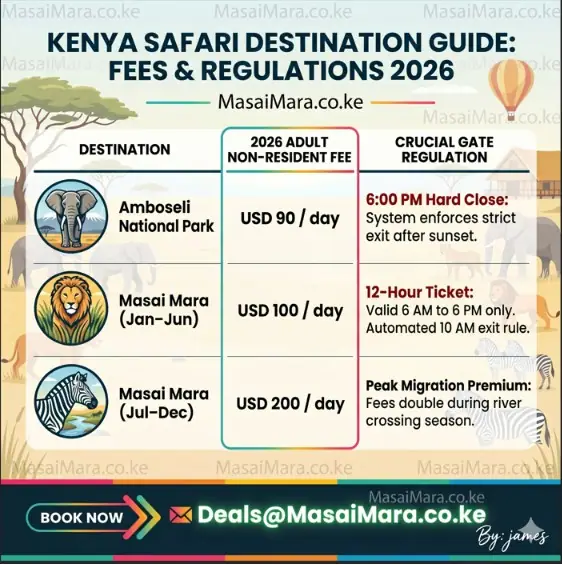
Destination | 2026 Adult Non-Resident Fee | Crucial Gate Regulation |
🐘 Amboseli National Park | USD 90 / day | 6:00 PM Hard Close: System enforces strict exit after sunset. |
🦁 Masai Mara (Jan–Jun) | USD 100 / day | 12-Hour Ticket: Valid 6 AM to 6 PM only. Automated 10 AM exit rule. |
🦓 Masai Mara (Jul–Dec) | USD 200 / day | Peak Migration Premium: Fees double during river crossing season. |
Masai Mara’s 12-Hour Ticket
Mara park fees are valid for 12 hours, not 24. Your ticket runs from 6 AM to 6 PM regardless of when you entered. If you arrive at 3 PM, you don’t get 12 hours from that point—you get until 6 PM.
This matters for afternoon-arrival guests. Flying in at 11 AM gives you the full afternoon. Arriving at 4 PM after a long drive means you’re paying the same fee for 2 hours of game viewing.
The Exit Timing Trap
Road travelers must exit the Mara by 10 AM on departure day or pay another full day’s fee. Fly-out guests get slightly more flexibility since the airstrip is inside the reserve—your “exit” is recorded at the airstrip gate, not the main road gate.
How gates actually log your exit: The attendant scans your ticket barcode and timestamps it. If that timestamp shows 10:03 AM and you’re departing by road, the system flags you for an additional day’s fee. There’s no discretion—it’s automated now. For fly-out guests, the airstrip has its own checkpoint where the timestamp is recorded when you enter the airstrip grounds, not when the plane departs.
I’ve had guests refuse to believe this rule exists until the gate attendant explained it. It’s enforced. Budget accordingly.
The Mara Simba restroom tip: If you’re on a budget safari using a shared vehicle, the public restrooms at Sekenani gate are often overwhelmed. Mara Simba Lodge (near Talek gate) allows non-guests to use their facilities for a small “coffee fee”—maybe KES 500. Much cleaner, much calmer than the gate chaos.
Amboseli’s 6 PM Hard Close
Amboseli National Park gates close at 6 PM. No exceptions. If you’re at Observation Hill at 5:45 PM, you need to leave immediately—not “one more photo.” The drive from Observation Hill to most lodges outside the park takes 15-20 minutes. Inside lodges have more flexibility, but game viewing still ends at sunset.
Park Fees (2026)
Amboseli (via eCitizen): USD 90 per adult non-resident per day. Kenyan citizens pay approximately KES 1,030 per day. Both rates include the 5% gateway fee. See KWS for current rates.
Masai Mara (per Narok County): USD 100/day (January-June) or USD 200/day (July-December) for non-residents. Citizens pay KES 1,500-3,000 per day depending on season.
Park fees are included in all packages above. These amounts are for reference only.
What You’ll Actually See
In Amboseli
Elephants. Large family groups—sometimes 50+ animals moving together. The Amboseli Trust for Elephants has tracked individuals here since 1972. Some of the matriarchs are over 60 years old, and researchers know them by name.
The volcanic dust rises when they walk. In late afternoon light, it catches the sun and turns gold. It’s the kind of image that ends up in documentaries—elephants silhouetted against Kilimanjaro with dust clouds swirling.
Beyond elephants: hippos in the permanent springs, buffalo herds, zebra, wildebeest. Lions are present but harder to find than in the Mara. Leopards are rare here.
Kilimanjaro reality: January-March offers the clearest skies. Morning before 9 AM is your best window. I’ve had guests visit three times before getting a clear view of the summit. Don’t plan your entire trip around one photo—you may be disappointed.
What we do when Kili doesn’t show: On cloudy days, we pivot. The swamps become the focus—elephant families bathing, hippos submerging and surfacing. Last February, a couple was frustrated that Kilimanjaro stayed hidden for their entire Amboseli stay. On the drive to the airstrip the final morning, the clouds parted for maybe 12 minutes. We stopped the vehicle on the tarmac, they got their shot, and the mountain disappeared again before we reached the terminal. Sometimes that’s how it works.
In Masai Mara
The Mara delivers on predators. Lion prides, cheetahs in the open grasslands, leopards in the riverine forest along the Mara and Talek rivers. During a 4-day trip with 2 nights in the Mara, most guests see at least two of the big three cats.
The Big 5 are all present: lion, leopard, elephant, buffalo, and rhino (though rhino sightings are uncommon).
During migration season (July-October), you may witness wildebeest and zebra crossing the Mara River—one of nature’s most dramatic events. But crossings are weather-dependent and unpredictable. We can position you near likely crossing points, but there’s no guarantee.
Who Should Book This Trip
Good fit:
- First-time safari visitors wanting Kenya’s two signature parks
- Photographers who want both elephant portraits (Amboseli) and predator action (Mara)
- Travelers with 4 full days between international flights
- Those willing to fly between parks to maximize wildlife time
Consider alternatives:
- If you’re on a tight budget, a 4-day Mara-only safari costs significantly less
- If Kilimanjaro views are essential, add an extra night in Amboseli (makes this a 5-day trip)
- If you’re visiting July-October and migration is your priority, spend all 4 days in the Mara
Practical Flying Tips
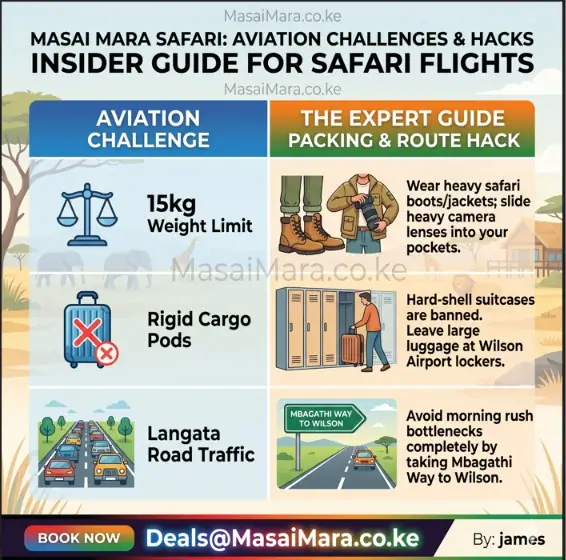
Aviation Challenge | The Expert Guide Packing & Route Hack |
⚖️ 15kg Weight Limit | Wear heavy safari boots/jackets; slide heavy camera lenses into your pockets. |
🧳 Rigid Cargo Pods | Hard-shell suitcases are banned. Leave large luggage at Wilson Airport lockers. |
🚗 Langata Road Traffic | Avoid morning rush bottlenecks completely by taking Mbagathi Way to Wilson. |
The Baggage Reality
Safari flights use Cessna Caravans with 15kg per person limits including hand luggage—this is per Safarilink’s baggage policy. Hard-shell suitcases won’t fit in the cargo pod—pack in soft duffels only.
The weight hack: They weigh bags, not passengers. Wear your heaviest items (safari boots, jacket) onto the plane. Slip your heavy camera lens into your jacket pocket.
Getting to Wilson Airport
Flights leave from Wilson (WIL), not JKIA. The airport is on Langata Road, about 30 minutes from the CBD without traffic, potentially 90 minutes during morning rush.
The Mbagathi Way hack: If you’re coming from Westlands or the CBD for a 7:30 AM flight, skip Langata Road entirely. Take Mbagathi Way—it runs parallel but handles a fraction of the traffic. Most hotel drivers don’t know this route. Tell yours specifically: “Mbagathi Way to Wilson.”
Starlink is now available in the Safarilink and AirKenya lounges. Arrive 60 minutes early to download offline maps and content before heading into the bush.
Ask the Pilot (And Listen to the Radio)
Small plane pilots are in constant radio contact with camp managers. They see the landscape from 5,000 feet—dust plumes from large herds, vehicles clustered around sightings.
Sit as close to the cockpit as possible. In these small Cessna Caravans, you can often hear the radio chatter. If you hear “Kifaru” (rhino) or “Chui” (leopard), the pilot might slightly bank to give passengers a view. Before takeoff, ask: “Any reports of migration crossings from this morning’s flights?” Pilots often have the most current aerial picture of where the herds are moving.
Pass whatever you learn to your guide the moment you land.
Wilson Airport Luggage Storage
If you’re doing this 4-day safari as part of a longer trip, don’t drag your big suitcases to Wilson. Both Safarilink and AirKenya offer secure luggage storage at their Wilson terminals—usually free or around KES 650/day. Leave the hard-shell cases behind and fly light.
The soft-bag tolerance: If your soft duffel is 2-3kg over the 15kg limit and the plane isn’t full, most bush pilots won’t make an issue of it. But don’t test this with a hard-shell suitcase—it physically won’t fit in the cargo pod regardless of weight.
Frequently Asked Questions
How much does a 4 days Masai Mara Amboseli safari cost?
KES 245,000 to KES 648,000 per person depending on whether you fly or drive, accommodation tier, and season. Flying packages cost more but save 8-10 hours of road travel.
Can I drive between Amboseli and Masai Mara?
Technically yes, but it takes 7-10 hours through Nairobi. On a 4-day trip, that’s nearly a full day lost to driving. We don’t recommend it unless budget is the primary concern.
What’s the best time for this safari?
January-March for the best Kilimanjaro visibility. July-October for migration and peak predator activity in the Mara. Both parks work year-round, but April-May (long rains) can make roads difficult.
Will I see the Big 5?
Lions, elephants, and buffalo are very likely. Leopards are possible, especially in the Mara. Rhinos are uncommon in both parks—if rhino sightings matter, consider adding Lake Nakuru to a longer itinerary.
Is 4 days enough for both parks?
With flights, yes—you get meaningful time in each park. By road, 4 days is tight. You’ll spend too much time in transit. Consider a 5-day version if you’re driving.
What if my international flight arrives late and I miss the morning flight?
Book an afternoon flight instead (usually around 10:30 AM). You’ll arrive at Amboseli around 11:15 AM—still time for an afternoon game drive. Or stay overnight in Nairobi near Wilson Airport and catch the early flight the next day.
Want to talk through your options?
Send us your travel dates. We’ll check what’s available and put together a quote that fits what you’re looking for.
Related Safaris
- 3 Days Masai Mara Safari
- 5 Days Masai Mara Safari
- Masai Mara Amboseli Safari
- Best Time to Visit Masai Mara
- Last Minute Holidays Kenya
Prices verified August 2026. Park fees per KWS and Narok County. Contact Masaimara.co.ke for current availability.
Welcome to Masaimara.co.ke
Thank you for visiting us! We're excited to help you plan an unforgettable safari adventure across Kenya.