
Masai Mara & Lake Naivasha Safari: 2026 Itinerary & Price Guide
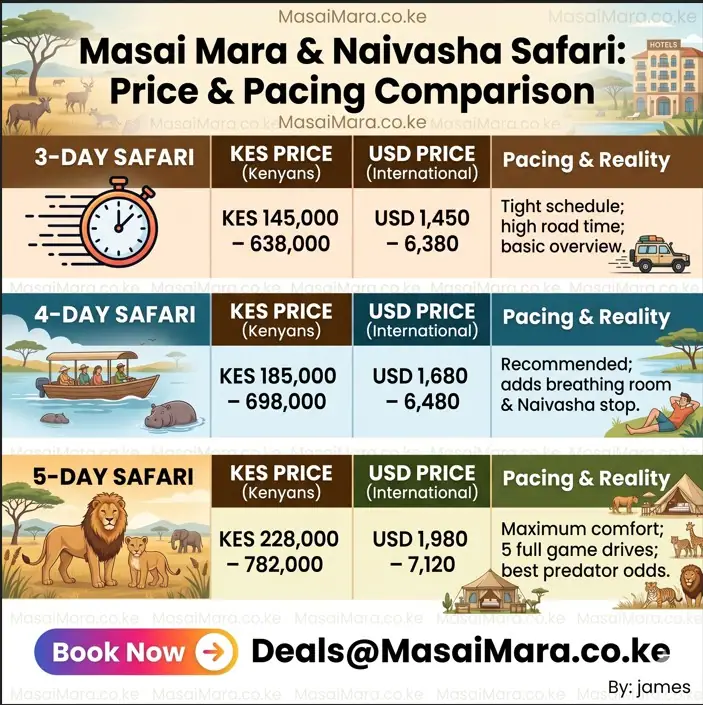
Masai Mara and Lake Naivasha Safari is probably the most popular combination in Kenya. The Mara gives you big cats and the migration. Naivasha gives you hippos, boat rides, and breaks up what would otherwise be a long drive. Most people do 3 to 5 days. Prices start around KES 145,000 for Kenyans on a budget 3-day trip, going up to KES 780,000 or more for luxury 5-day options. International visitors typically pay USD 1,450 to USD 7,000+ depending on duration and lodges.
2026 Prices
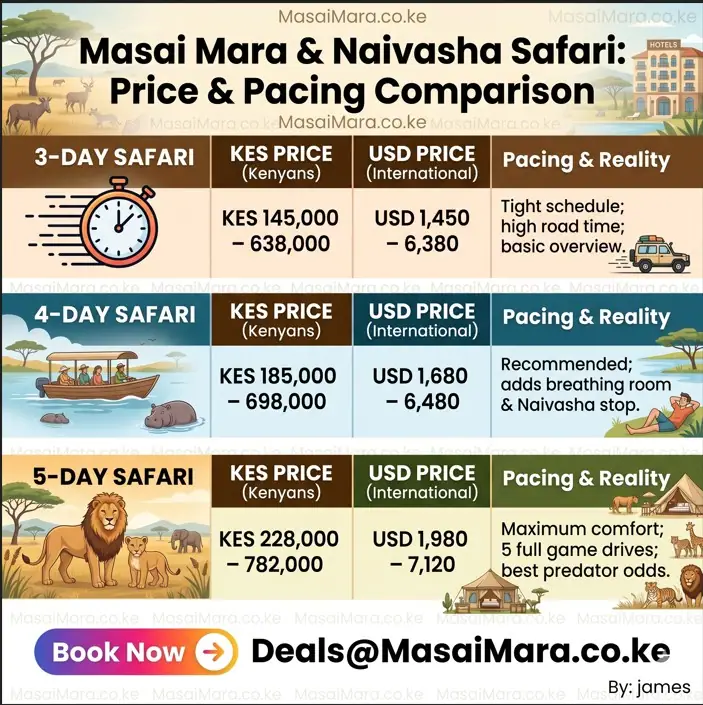
These are the packages we quote most often – two people sharing a private Land Cruiser. Your actual price depends on specific dates, which lodges have space, and whether you’re traveling during migration season when everything costs more. Ask us for a quote if you want exact numbers for your dates.
3-Day Safari – Kenyan Citizens (KES)
Lodges | Jan-June | July-Dec |
Jambo Mara + Naivasha Sopa | 145,000 | 198,000 |
Sentrim Mara + Enashipai | 188,000 | 258,000 |
Mara Serena + Great Rift Valley Lodge | 268,000 | 368,000 |
Angama Mara + Loldia House | 478,000 | 638,000 |
3-Day Safari – International Travellers (USD)
Lodges | Jan-June | July-Dec |
Jambo Mara + Naivasha Sopa | 1,450 | 1,980 |
Sentrim Mara + Enashipai | 1,880 | 2,580 |
Mara Serena + Great Rift Valley Lodge | 2,680 | 3,680 |
Angama Mara + Loldia House | 4,780 | 6,380 |
4-Day Safari – Kenyan Citizens (KES)
Lodges | Jan-June | July-Dec |
Naivasha Sopa + Jambo Mara (2n) | 185,000 | 258,000 |
Enashipai + Sentrim Mara | 232,000 | 318,000 |
Great Rift Valley Lodge + Mara Serena | 318,000 | 438,000 |
Loldia House + Angama Mara | 518,000 | 698,000 |
4-Day Safari – International Travellers (USD)
Lodges | Jan-June | July-Dec |
Naivasha Sopa + Jambo Mara (2n) | 1,680 | 2,380 |
Enashipai + Sentrim Mara | 2,120 | 2,920 |
Great Rift Valley Lodge + Mara Serena | 2,880 | 3,980 |
Loldia House + Angama Mara | 4,780 | 6,480 |
5-Day Safari – Kenyan Citizens (KES)
Lodges | Jan-June | July-Dec |
Naivasha Sopa + Jambo Mara (3n) | 228,000 | 318,000 |
Enashipai + Sentrim Mara | 282,000 | 392,000 |
Great Rift Valley Lodge + Mara Serena | 392,000 | 532,000 |
Loldia House + Angama Mara | 582,000 | 782,000 |
5-Day Safari – International Travellers (USD)
Lodges | Jan-June | July-Dec |
Naivasha Sopa + Jambo Mara (3n) | 1,980 | 2,820 |
Enashipai + Sentrim Mara | 2,520 | 3,420 |
Great Rift Valley Lodge + Mara Serena | 3,520 | 4,820 |
Loldia House + Angama Mara | 5,320 | 7,120 |
What’s Included
Private 4×4 Land Cruiser for the trip. Driver-guide. Fuel. Full board at lodges. Masai Mara park fees. Water. AMREF evacuation.
Not Included
Naivasha activities – boat ride usually KES 3,000-4,000 per boat, Crescent Island around USD 33 last I checked, Hell’s Gate around USD 50 for non-residents (verify at KWSPay as fees change). Tips. Drinks. Insurance.
Optional
Hot air balloon: USD 450-550. Maasai village: USD 20-30. Night drives in conservancies.
Land Cruiser or Safari Van?
This comes up constantly.
Safari vans are cheaper – maybe KES 30,000-40,000 less for a 4-day trip, depending on the operator. But they sit lower, they don’t have pop-up roofs (just sliding windows), and they get stuck in mud. The Mara has something called “black cotton soil” – looks fine when dry, turns to slippery clay when wet. I’ve seen vans stuck within twenty minutes of light rain starting. It happens.
Land Cruisers have 4×4, higher clearance, pop-up roofs for photography. The extra cost is usually worth it in my experience, especially if you’re coming during the wetter months. Though I’m obviously biased – we run Land Cruisers.
All the prices in this article assume a Land Cruiser.
Which Trip Length
3 days is the minimum that makes sense. Drive to Mara day one, full game drives day two, drive back through Naivasha day three with a quick boat ride. It’s tight. You spend a lot of time in the vehicle. But it works for people with limited leave or tight budgets.
4 days adds breathing room. Naivasha first, then two nights in the Mara, three game drives instead of two. This is what I’d usually recommend for first-timers who can’t do a full week – though it depends on your priorities.
5 days is comfortable. Three nights Mara, five game drives. Time to follow up on sightings, try different areas of the reserve.
More days generally means better odds on leopards and cheetahs. No guarantee – I’ve had guests see a leopard on day one and others who didn’t see one in five days – but statistically, more time helps.
The Drive – What Nobody Mentions
The route from Nairobi goes over the Mai Mahiu escarpment before dropping into the Rift Valley. Heavy trucks use this road. A single broken-down lorry can cause a 4-hour standstill – I’m not exaggerating.
Before leaving Nairobi, ask your driver to check traffic on Waze or X. If there’s an accident, they can take the Limuru/Kijabe alternative. It’s longer but at least you’re moving.
The main road from Narok to the Mara (Sekenani Gate) is paved now. That wasn’t always true. But the tracks inside the reserve are dirt, and that black cotton soil I mentioned becomes a problem fast when it rains.
Lake Naivasha – More Than a Pit Stop
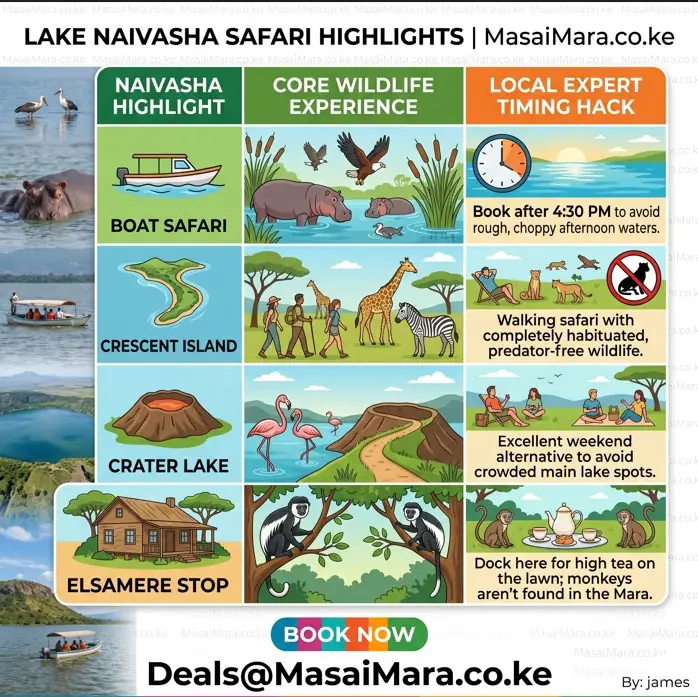
Naivasha Highlight | Core Wildlife Experience | Local Expert Timing Hack |
Boat Safari | Hippos, fish eagles, papyrus | Book after 4:30 PM to avoid rough, choppy afternoon waters. |
Crescent Island | Walking among wild giraffes/zebras | Walking safari with completely habituated, predator-free wildlife. |
Crater Lake | Flamingos, volcanic crater rim walking | Excellent weekend alternative to avoid crowded main lake spots. |
Elsamere Stop | Black-and-White Colobus monkeys | Dock here for high tea on the lawn; monkeys aren’t found in the Mara. |
Most itineraries treat Naivasha as a bathroom break with hippos. It can be more than that if you want.
The Boat Ride
Usually runs KES 3,000-4,000 for the whole boat (prices vary by captain and season). Hippos, fish eagles, papyrus reeds. African Fish Eagles are common here – you’ll hear them before you see them, that distinctive high-pitched call that carries across the water. Saddle-billed Storks show up sometimes, which is a big deal if you’re into birds.
Wind picks up most afternoons – not always, but often enough that I’ve stopped scheduling midday boat rides. Last March I had a family from Nairobi who insisted on going out at 2 PM. Within twenty minutes the lake turned choppy, the kids were getting splashed, nobody could hold a camera steady. We cut it short. Now I tell people: 4:30 PM or later, when it usually settles and the light gets that soft golden quality anyway.
The boat captains throw tilapia to attract the fish eagles. Tell yours to wait until you’re focused before throwing – the eagles dive fast and you’ll miss the shot otherwise.
Elsamere
Instead of just circling the lake, ask your boat captain to dock at Elsamere – Joy Adamson’s old house, the Born Free author. You can have traditional high tea on the lawn. There are Black-and-White Colobus monkeys in the trees, which you won’t see in the Mara. It’s a nice break from the standard boat circuit.
Crescent Island
Walking safari. No vehicles, no predators, just you and the giraffes and zebras. Entry was around USD 33 last time I checked – they adjust prices occasionally. The animals are habituated and mostly ignore you, which is the whole point.
Hell’s Gate
If you have time, this is where The Lion King animators reportedly got their inspiration – the volcanic towers, the canyon. You can cycle through the park and hike a gorge. Entry runs around USD 50 for non-residents plus bike rental (check KWSPay for current fees). It adds half a day but it’s something different from the usual safari routine.
Crater Lake
If Crescent Island sounds too busy (it can be, especially weekends), ask about Crater Lake Game Sanctuary on the western side of Naivasha. Jade-green alkaline lake in a volcanic crater, walking safaris on the rim, almost no other tourists. Sometimes flamingos show up, which you won’t get at the main lake.
Camp Carnelley’s
If you’re tired of lodge buffets, this is the local hangout – wood-fired pizzas, cushions on the ground, Colobus monkeys overhead. It caters more to Kenyan expats and off-duty guides than international tour groups. Good for lunch if you have time.
The Altitude Thing
Naivasha sits at about 1,880 meters. The Mara isn’t much lower. People expect African safari heat and then freeze on morning game drives. Bring a fleece or light jacket. I see this catch people off guard constantly.
The Mara – Main Reserve vs. Triangle vs. Conservancies
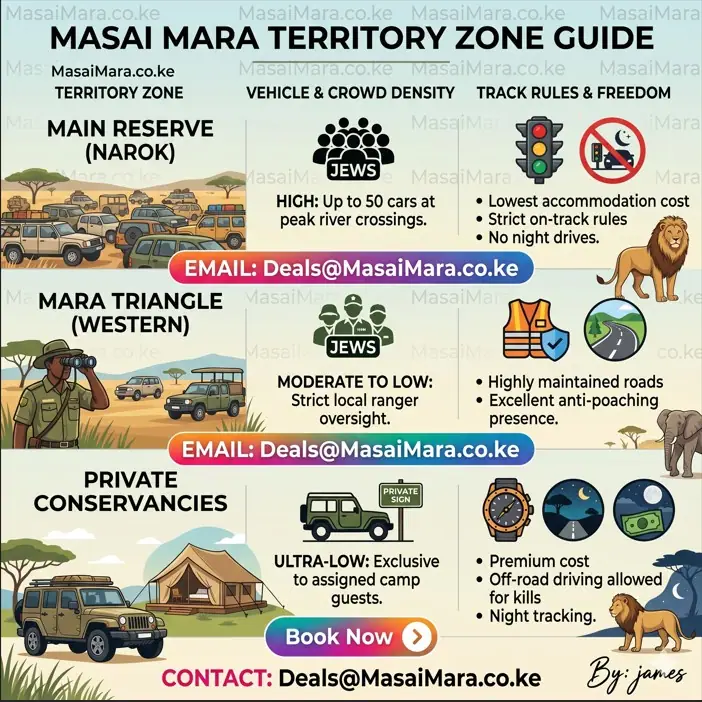
Mara Territory Zone | Vehicle & Crowd Density | Track Rules & Freedom |
Main Reserve (Narok) | High; up to 50 cars at peak river crossings. | Lowest accommodation cost; strict on-track rules; no night drives. |
Mara Triangle (Western) | Moderate to low; strict local ranger oversight. | Highly maintained roads; excellent anti-poaching presence. |
Private Conservancies | Ultra-low; exclusive to assigned camp guests. | Premium cost; off-road driving allowed for kills; night tracking. |
This matters more than most people realize.
Main Reserve (Narok Side)
This is where most budget and mid-range camps are. More vehicles, more tourists. During migration you might share a crossing with 50 Land Cruisers. Off-road driving and night drives are prohibited – you stay on the tracks.
Mara Triangle (Western Side)
Managed by the Mara Conservancy, not Narok County. Stricter rules for guides, better road maintenance, visible anti-poaching patrols. Fewer vehicles. You enter through Oloololo Gate or cross via Purungat Bridge. Some people think it’s worth the extra effort.
Conservancies (Mara North, Naboisho, Olare Motorogi)
Private land surrounding the reserve. Night drives allowed. Off-road driving allowed – your guide can leave the tracks to get close to a cheetah kill. Walking safaris with Maasai guides. Lower vehicle density. More expensive, but the experience is different.
If photography is your priority, conservancies are worth considering.
Wildlife Expectations
You’ll almost certainly see lions, elephants, buffalo, zebras, wildebeest, hippos, giraffes – these are reliably there year-round. Probably some of the big nine (lions, leopards, elephants, buffalo, rhinos, cheetahs, hippos, giraffes, zebras), though I can’t promise all of them on any given trip.
Leopards and cheetahs are harder. Some trips you see three leopards; some trips you see none. More time in the Mara improves your odds, but wildlife doesn’t follow scripts. Rhinos are genuinely rare in the Mara now – maybe one or two sightings per week across all the vehicles in the reserve, if that. If rhinos matter to you, add Lake Nakuru to the route.
During migration (roughly July-October, though timing shifts year to year), add the wildebeest herds and river crossings. The crossings are chaotic and unpredictable – you might wait hours and nothing happens, or you might stumble into one.
If the main crossing points are mobbed with vehicles, ask your guide about the Sand River area to the south, near the Tanzania border. Often fewer tourists, sometimes crossings in relative peace.
Problems
The Drive
6-7 hours total from Nairobi with stops. If you have back problems, consider flying. Flights take 45 minutes from Wilson Airport. If you fly, pack in soft-sided duffel bags only – hard suitcases don’t fit in the small aircraft cargo holds. There’s a 15kg luggage limit.
The 12-Hour Ticket
Mara tickets are now valid 6 AM to 6 PM – at least that’s how it’s been enforced since mid-2024. If you enter at 4 PM, your ticket expires at 6 PM. You don’t get 12 hours from entry time.
I learned this the hard way with a couple from Germany last September. They wanted to check into their camp, freshen up, then do an evening drive. We entered at 3:45 PM, saw some elephants, and were back at camp by 6. Next morning, the gate wanted another full day’s fee. That 2-hour drive cost them an extra USD 400 between them. Now I tell everyone: if you’re arriving in the afternoon, either stay at a camp inside the reserve where you’re already in, or skip the evening drive entirely and enter fresh at 6 AM.
Bush Toilets
On full-day game drives, actual bathrooms are rare – mainly at gates and the Mara River bridge. At some point you’ll probably use the “bush toilet” – your driver finds a spot, you go behind the vehicle, they watch for lions. Bring your own toilet paper and wet wipes. The vehicle’s supply runs out.
The Maasai Village Question
The villages right outside the main gates (Sekenani, Oloolaimutia) are set up for tourists. You pay to enter, watch some dancing, then face high-pressure selling of beadwork. Some people find it interesting, others feel cornered. If you want something more genuine, ask your guide to take you somewhere less commercialized, or skip it entirely.
Tsetse Flies
They’re in the Mara. Normal insect repellent doesn’t work well on them – they bite through thin shirts. Some guides swear by Avon Skin So Soft bath oil, which sounds ridiculous but apparently works better than DEET. Avoid blue and black clothing.
USD Bills
If you’re bringing US dollars for tips or extras, they need to be crisp, printed after 2013, no tears or ink marks. Older or damaged bills get rejected everywhere.
Photography Notes
Leave your tripod at home. It’s useless in a vibrating Land Cruiser with other people moving around.
Better option: bring an empty canvas bag from home. At Narok, buy two kilos of dried beans or rice at the supermarket. Fill the bag. It makes a moldable, stable rest for heavy lenses on the vehicle’s window sill or roof.
If you’re buying binoculars for this trip, 8×42 is the sweet spot. Higher magnification (10x, 12x) amplifies the vehicle’s vibration and gives you motion sickness.
Naivasha First or Last?
Logistical Threat | The Hidden Trap | Local Expert Field Solution |
12-Hour Ticket Rule | Mara tickets expire strictly at 6:00 PM, not 24 hours. | Skip late afternoon arrivals; enter the gates fresh at 6:00 AM instead. |
Escarpment Traffic | Broken trucks cause sudden 4-hour road standstills. | Have your driver check Waze/X early; use the Limuru alternative. |
Tsetse Flies | They bite aggressively through standard thin denim. | Avoid wearing solid blue or black; use Avon Skin So Soft oil. |
USD Cash Acceptance | Local banks reject old or un-crisp bills completely. | Bring pristine US dollar bills printed strictly after 2013. |
On 4-5 day trips, you choose.
Naivasha first means you’re fresh for the boat ride, not exhausted from game drives. You end the trip with maximum Mara time. That’s my preference, though I’m not sure it’s objectively better.
Naivasha last means the Mara is your highlight, not followed by anything. Some people find Naivasha anticlimactic after lions. Others appreciate the decompression.
I lean toward Naivasha first, but I’ve had guests who strongly preferred the other way and I can see their point.
Best Time
January-March: Usually dry and clear, fewer tourists. Good for predator viewing because the grass is shorter.
April-May: Long rains. Cheaper, but roads can get difficult and some lodges close. It’s a gamble.
July-October: Migration season. Peak prices, peak crowds, peak wildlife – if you time it right. The herds don’t move on a schedule, so there’s always some uncertainty.
November-December: Short rains (unpredictable), then holiday crowds.
There’s no perfect answer. I’ve had stunning trips in every month. More details in our safari tips guide.
Questions
Cost? KES 145,000 to 780,000 for Kenyans, USD 1,450 to 7,000+ for visitors, depending on duration and lodges.
How many days? Minimum 3. I’d recommend 4 if you can.
What’s included? Vehicle, driver-guide, fuel, accommodation with meals, Mara fees, water, emergency evacuation.
What wildlife? Lions almost guaranteed. Elephants yes. Leopards and cheetahs possible. Rhinos rare.
Lake Naivasha worth it? Yes, for most people. Breaks up the drive, hippos are impressive, Crescent Island is unique.
Private or shared safari? Private means your own vehicle on your own schedule. Shared means joining others – cheaper but less flexible. All prices here are for private.
Is Lake Naivasha safe for walking? Yes, at Crescent Island and Crater Lake – no predators. Don’t walk on your own at night near lodges because of hippos.
What about the eTA? Kenya now uses an Electronic Travel Authorisation instead of visas for most nationalities. Apply online before you travel – etakenya.go.ke.
Masaimara.co.ke handles the logistics. Tell us how many days, what accommodation level, and we’ll quote it.
Related: 3-Day Safari | 4-Day Safari | 5-Day Safari | Budget | Luxury | All Packages
David Njunge. August 2026. Park fees change – check KWS and the Mara portal.
Welcome to Masaimara.co.ke
Thank you for visiting us! We're excited to help you plan an unforgettable safari adventure across Kenya.