
Mara River Crossing: The Honest 2026 Guide

The Mara River crossing is the most dramatic wildlife event in East Africa and the reason most migration-season visitors come to the Masai Mara. It is also the sighting most likely to disappoint guests who don’t understand how it works. A crossing is never guaranteed. The herds can hesitate on the bank for hours or days without entering the water. Some visitors wait four days and don’t see one. Others arrive at a crossing point and watch 2,000 animals enter the river within minutes. The difference is almost always about where the guest stays, how the guide reads the herd, and whether the guest is willing to commit a full day at the river with a packed lunch instead of returning to camp at noon. For the 2026/2027 season, all-inclusive 5-day itineraries range from KES 252,200 ($1,940) to KES 1,355,900 ($10,430) per person sharing. Reserve entry is $100–$200/day. Conservancy fees ($80–$150/night) are included in camp rates.
Safari Costs (2026/2027)
All-inclusive prices per person sharing, based on two people in a private 4×4 Land Cruiser. Conservancy fees are included in camp rates.
5-Day All-Inclusive Rates (Per Person Sharing)
Package Tier | Camps (Nakuru + Mara) | Regular Season (KES) | Peak Season (KES) |
Budget | Lake Nakuru Lodge / Ol Kinyei Adventure | KES 252,200 | KES 455,000 |
Mid-Range | Sarova Lion Hill / Karen Blixen Camp | KES 304,200 | KES 546,000 |
Luxury | The Cliff Nakuru / Porini Lion Camp | KES 529,100 | KES 825,500 |
Luxury Plus | The Cliff Nakuru / Mara Plains Camp | KES 867,100 | KES 1,355,900 |
Note: Conservancy fees included. Reserve entry is extra ($100–$200/day). For a luxury safari or flying packages, request a custom quote.
What’s Covered
- A private 4×4 Safari Land Cruiser for the full trip.
- A TRA-licensed guide who knows the crossing points and herd behaviour.
- All conservancy conservation fees and Lake Nakuru entry fees.
- Night drives, off-road tracking, and guided walking safaris with Maasai trackers.
- One-way return flight from the conservancy airstrip to Nairobi Wilson (flight details).
- Full board, 3 meals daily. Packed bush lunches for full-day crossing stakeouts.
- AMREF Flying Doctors emergency air evacuation insurance.
What’s Excluded
- Kenya eTA (~$30).
- Tips (KES 3,000/day for guide).
- Alcohol and premium drinks.
- Hot air balloon ($450–$500).
- Main reserve entry fees if crossing into the public park ($100–$200/day extra).
- International flights.
The 5-Day Migration Itinerary
Day 1: Nairobi to Lake Nakuru
Leave Nairobi early. Afternoon at Lake Nakuru tracking rhinos. Stay at your selected lodge.
Day 2: Nakuru to the Mara
Drive through the Rift Valley or fly in. Late afternoon drive along the river corridors to check where the herds are building. The guide reads the radio and the landscape to plan the next morning. Stay at your chosen camp.
Day 3–4: Full Days at the River
Two full days. At least one morning should be spent at a crossing point. Request a packed lunch the night before so the vehicle can stay out the entire day. Returning to camp at noon is when most guests miss the crossing. The rest of the time covers lions, leopards, cheetahs, and general game. Predators position near the river during migration, so the crossing area produces big cat sightings too.
Day 5: Departure
Early morning drive. Fly back to Nairobi from the conservancy airstrip (fly-in options).
How a Crossing Develops
Herd Shape / Line Signal | Expert Field Interpretation & Scout Realities |
Wide Circular Milling | Herd is cycling under immense tension along the upper ridge; they will not enter the water yet. |
Single-File Compression | The chaotic circular mass tightens into a single line pointing downhill; a river plunge is imminent. |
Head-Snap Drinking | Impatient frontline scouts sip while quickly jerking their heads up to scan; flags a false alarm. |
Sustained Muzzle Hold | A scout keeps its snout fully submerged without looking up; the stampede follows within 60 seconds. |
Immediate River U-Turns | Trapped front columns hit a far-bank obstacle or predator scent and turn back into incoming herd pressure. |
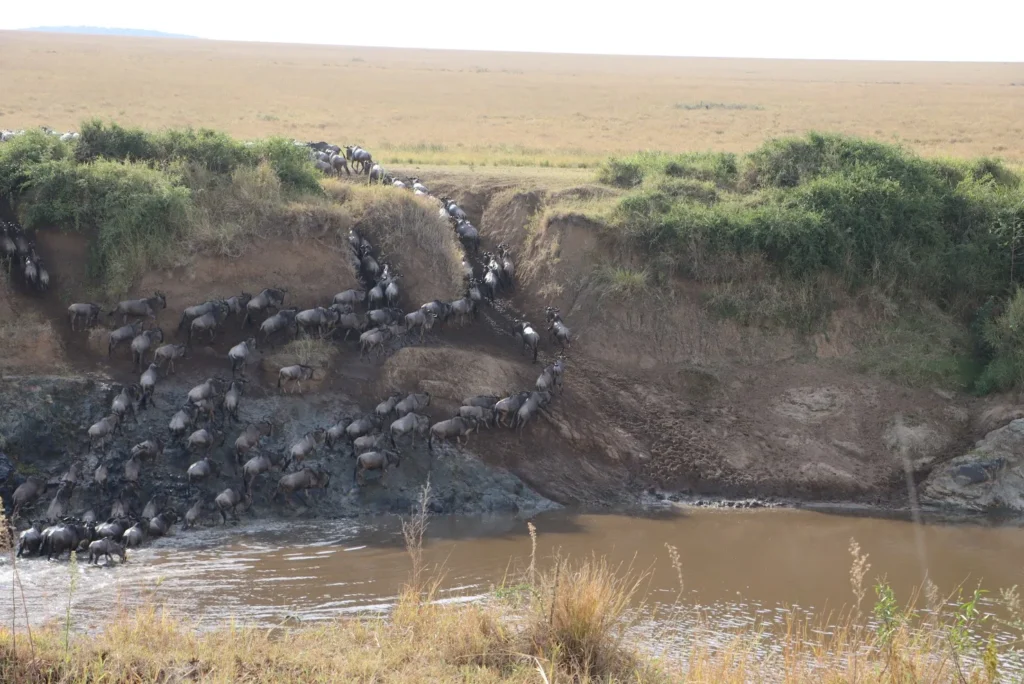
A crossing stakeout means hours in the vehicle. The herd gathers on the bank, approaches the water, turns back, gathers again. False starts are normal. Most guests who leave early miss the crossing because they didn’t know what to watch for.
The shift from hesitation to commitment happens in stages. As long as the herd is milling in a wide, circular block along the upper ridge, they won’t cross. They’re cycling under tension, reacting to wind and shadows. The moment that block compresses into a tight single-file line pointing downhill toward the water, the crossing is close. I watch the first animals to reach the waterline. If they drink while snapping their heads up to scan, it’s a false alarm. When one animal drops its muzzle and holds it in the water without looking up, the internal alarm has switched off. The stampede follows within a minute.
During that wait, vehicles are arriving. In 2025, congestion at the main crossing points became a serious industry problem. At the public points during August, forty vehicles at a single crossing is not unusual. They block animal paths. They disrupt the herd’s approach. A vehicle that edges too close to the bank before the herd commits can panic the vanguard and push the entire column five kilometres to a different crossing point. I’ve watched it happen. Three hours of waiting, wiped out by one driver who wanted a closer angle.
I’ve sat through three-hour waits where guests asked to leave and I talked them into staying. Every time, the crossing happened after the patience ran out and then came back. The guides who produce crossings are the ones who read the shape of the herd, hold the vehicle back from the bank, and refuse to drive away.
The Mara Triangle and private river-edge camps have fewer vehicles. Entim Mara’s private stretch is the most extreme example, but any camp positioned on the river inside the reserve gives the guide a head start over camps outside the gates. Staying outside the park or in Narok town wastes 90 minutes each way on rough roads. During migration, location matters more than the camp’s star rating.
The herds sometimes cross and then immediately turn around and swim back. Guests assume the animals are stupid. What’s happening is that the front animals hit an obstacle on the far bank, a mud wall or the scent of a predator, and try to stop. But the back of the herd is still pushing into the water. The animals in the middle get crushed between the incoming pressure and the blocked front. They flee the only way that’s open, back through the water.
The Crossing Points
Guides refer to crossing points by name or number. Each has different bank geometry that changes what the guest sees and photographs.
Crossing Point #7 is the most famous and the most crowded. Steep banks on both sides produce dramatic entry shots and pile-ups. During August this point can have 40 or more vehicles.
Main Governor’s Crossing is popular with the camps in that area. More gradual slopes than Point #7.
The Lookout offers an elevated vantage point with a wider view of the approach.
Purungat Bridge has a different angle and is less crowded.
Entim Mara Camp sits directly on a private stretch of river where crossings happen. Only camp guests can access this section. Twelve tents total. Request Tent 3 or 4 for a slightly elevated angle on the crossing from the veranda. During the 2025 migration, a guest photographed a full crossing sequence without leaving the porch. The camp is now difficult to book during migration season.
Which bank the guide parks on changes the experience. The deeper side produces the crocodile action. The steep-bank side shows the most dramatic entry. A guide who has worked the points knows which bank to choose depending on what the guest wants.
What Most Guests Get Wrong
Tactical Tracking Variable | On-The-Ground Reality & Migration Insight |
September Return Wave | Herds cross south back to Tanzania; offers an identical spectacle with hungrier crocodiles and fewer crowds. |
Late October Window | Delivers highly exclusive viewing conditions with just two or three vehicles present instead of forty. |
Drought-Year Halts | Severe dry cycles stall herds in the Serengeti, leaving riverbanks empty until early rains trigger movement. |
Non-Wildebeest Triggers | Vocalizing zebra harems or bold topis routinely break the hesitation loop and lead the initial plunge. |
Post-Crossing Carnage | The morning after a major event brings massive vulture, stork, and crocodile scavenging assemblies downstream. |
Guests build the entire trip around seeing a crossing and treat everything else as filler. This is the single biggest mistake. A crossing is never guaranteed. Drought years can produce no crossings at all. During the 2024 drought, the herds stayed in the Serengeti because there was still enough grass, and guests who flew in specifically for crossings saw empty riverbanks. The first September rains finally triggered movement.
The herds cross in both directions throughout the season. North-to-south crossings back toward Tanzania start in September. The spectacle is identical, the audience is smaller, and the crocodiles are hungrier after months of feeding. Late October produces crossings with two or three vehicles present instead of forty.
Multiple crossings can happen on consecutive days at the same point. The herds don’t cross once and leave. A large concentration can trigger crossings on back-to-back mornings. Guides who stay in position rather than relocating after one crossing sometimes produce a second sighting within 24 hours.
The aftermath is its own sighting. The day after a major crossing, the downstream banks are lined with carcasses. Vultures, marabou storks, and crocodiles feed in the open. Most guests don’t visit the crossing point the morning after, but the post-crossing scavenging scene concentrates more species in one place than most game drives produce all day.
There are no facilities at the crossing points. No toilets, no shade, no vendors. A full-day stakeout means the vehicle is the only resource. Water, sun protection, and a packed lunch are practical necessities.
Zebras sometimes trigger the crossing. Zebras on the far bank calling to their group on the near bank can break the hesitation cycle. Topis have also been documented joining a hesitant herd at the bank edge and leading the first animals down the slope. The crossing isn’t always started by wildebeest.
Questions Guests Ask
When is the best time to see a crossing?
Late July through mid-October. August and September have the highest concentrations. Late October has fewer herds but almost no vehicles. The migration guide covers the full cycle.
Can I guarantee a crossing?
No. Some guests wait days and don’t see one. Others see one within minutes. A 5-day stay with at least two full days at the river gives the best odds. Build the trip around the full Mara experience and let the crossing be a bonus.
Which crossing point is best?
It depends on what matters. Point #7 is the most dramatic but the most crowded. Entim Mara’s private stretch has no other vehicles. The Mara Triangle points are quieter than the main reserve. Get in touch and we’ll suggest a camp based on the crossing priority.
Do the herds only cross north?
No. They cross back and forth throughout the season. The return crossings toward Tanzania in September and October are the same spectacle with a fraction of the audience. The wildebeest migration page covers the full directional pattern.
How many vehicles will be there?
At the main public points during August, dozens to hundreds. Late October or Mara Triangle locations may have single digits. Fees and logistics are on the booking page.
The Wait Is the Crossing
The crossing everybody photographs is three minutes of chaos. The part nobody talks about is what happens before it. The herd gathers. The first animals approach the edge. They turn back. They gather again. This cycle can repeat for hours. Guests get restless. They ask to leave. The guide watches the shape of the herd and says not yet.
The guests who see crossings are the ones who committed the full day. They packed a lunch, they brought water, they accepted that the morning might produce nothing. And then the herd narrows into a line, one animal drops its head to the water, and the bank erupts. The whole thing lasts a few minutes. Afterwards, every guest says the same thing: the wait was harder than the crossing was long.
I’ve never had a guest who saw a crossing say it wasn’t worth the wait. I’ve had plenty who left at noon and heard on the radio that it happened an hour later.
If migration crossings are the priority, a 5-day safari gives enough time for multiple attempts. The 3-day and 4-day trips reduce the odds because fewer days mean fewer chances at the river. For Amboseli alongside the Mara, the 6-day circuit or three-park loop cover both parks. Everything from luxury lodges to fly-in transfers is on the packages page, or send us your dates and we’ll find a camp on the river.
This guide was authored by David Njunge, a TRA-licensed safari guide with over 10 years of experience, and edited by Cecilia Wambui, a travel consultant with a degree in Tourism and Hospitality Management.
Related Reading:
- Lions in Masai Mara
- Leopards in Masai Mara
- Cheetahs in Masai Mara
- Elephants in Masai Mara
- Rhinos in Masai Mara
- Buffalo in Masai Mara
- Hippos in Masai Mara
- Crocodiles in Masai Mara
- Giraffes in Masai Mara
- Zebras in Masai Mara
- Wildebeest in Masai Mara
- Hyenas in Masai Mara
- Masai Mara Big Cats
- Birding Safari Masai Mara
- Masai Mara Conservancies
- Conservancy vs National Reserve
- Olare Motorogi Conservancy
- Mara North Conservancy
- Ol Kinyei Conservancy
- Siana Conservancy
- Lemek Conservancy
- Ol Chorro Conservancy
- Enonkishu Conservancy
- Pardamat Conservation Area
- Masai Mara Entrance Gates
- Best Time to Visit Masai Mara
- Wildebeest Migration Kenya
- Masai Mara Migration
- Photography Safari Masai Mara
- Walking Safaris Masai Mara
- Night Game Drive Masai Mara
- All Inclusive Masai Mara Safari
- Masai Mara Amboseli Nakuru Safari
- 6 Days Masai Mara Amboseli Safari
- 5 Days Masai Mara Safari
- 4 Days Masai Mara Safari
- 3 Days Masai Mara Safari
- Luxury Safari Masai Mara
- Masai Mara Packages
- Masai Mara Flying Packages
- Masai Mara Booking
- Official KWS Park Fee Portal
- Kenya Wildlife Service
Welcome to Masaimara.co.ke
Thank you for visiting us! We're excited to help you plan an unforgettable safari adventure across Kenya.