
6-Day Masai Mara Safari: Packages & 2026 Pricing
Edited by David Njunge, TRA Licensed Safari Guide
The Short Answer
A 6 days Masai Mara safari runs KES 198,000 to KES 827,000 for Kenyan citizens. Non-residents pay USD 1,980 to USD 8,270. You get five nights, eight or nine game drives, and enough time to genuinely learn the reserve rather than just visit it.
But here’s the honest question nobody asks: should you spend all six days in the Mara, or split your time?
What the Price Covers
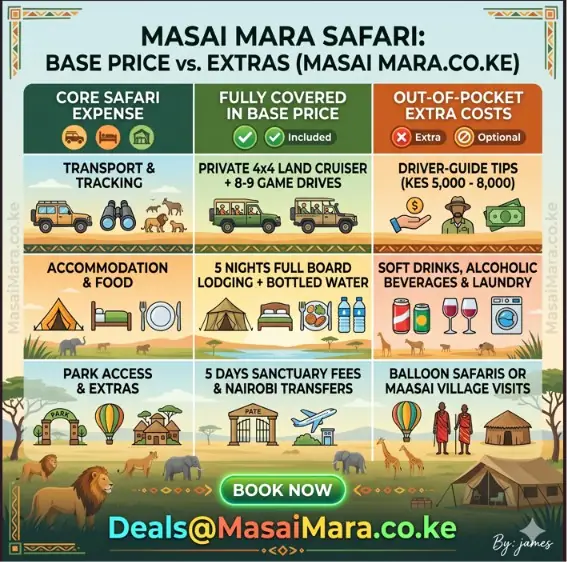
Core Safari Expense | Fully Covered in Base Price | Out-of-Pocket Extra Costs |
Transport & Tracking | Private 4×4 Land Cruiser + 8-9 Game Drives | Driver-Guide Tips (KES 5,000 – 8,000) |
Accommodation & Food | 5 Nights Full Board Lodging + Bottled Water | Soft Drinks, Alcoholic Beverages & Laundry |
Park Access & Extras | 5 Days Sanctuary Fees & Nairobi Transfers | Balloon Safaris or Maasai Village Visits |
Included:
- Return Nairobi transport (private 4×4 Land Cruiser)
- 5 nights full board accommodation
- All meals
- Park fees (5 days inside reserve)
- 8-9 game drives
- Bottled water
- English-speaking driver-guide
Not included:
- Alcohol and soft drinks
- Tips (KES 5,000-8,000 suggested for guide)
- Travel insurance
- Optional extras below
The Actual Decision You Need to Make
Six days is a long time in one place. Most people don’t think about this until they’re there.
Days 1-4 are usually great. Everything’s new. You’re photographing every zebra. The early mornings still feel like adventure.
Day 5 is where people split. Maybe a third of my guests start looking at the same grasslands and feeling… done. They’ve seen lions. Multiple times. The thrill has settled.
The other two-thirds? They love it. The Mara becomes familiar. They recognize individual animals. The termite mound where that cheetah scouts. The fig tree near Bila Shaka where the leopard sleeps. It stops being tourism.
Which one are you? I can’t answer that. But picking the wrong itinerary—six days when you wanted variety, or multi-destination when you wanted depth—is a waste of money either way.
Option 1: Six Days Mara-Only
All five nights in the Mara ecosystem. Best for photographers, repeat visitors, or anyone who wants depth over breadth.
Kenyan Citizens
Tier | Low Season | Peak Season | Camps |
Budget | KES 198,000 | KES 385,000 | Mara Explorer Camp, Sekenani Camp, Acacia Camp |
Mid-Range | KES 268,000 | KES 465,000 | Fig Tree Camp, Mara Leisure Camp, Saruni Mara |
Luxury | KES 398,000 | KES 598,000 | Mara Serena Lodge, Mara Engai Lodge, Olonana |
Premium | KES 598,000 | KES 827,000 | Angama Mara, Cottar’s 1920s Camp, Mara Plains |
Non-Residents
Tier | Low Season | Peak Season | Camps |
Budget | USD 1,980 | USD 3,850 | Mara Explorer Camp, Sekenani Camp, Acacia Camp |
Mid-Range | USD 2,680 | USD 4,650 | Fig Tree Camp, Mara Leisure Camp, Saruni Mara |
Luxury | USD 3,980 | USD 5,980 | Mara Serena Lodge, Mara Engai Lodge, Olonana |
Premium | USD 5,980 | USD 8,270 | Angama Mara, Cottar’s 1920s Camp, Mara Plains |
Option 2: Multi-Destination (Recommended for First-Timers)

Safari Luxury Tier | Citizen Base Cost (5 Nights) | Non-Resident Base (5 Nights) |
Budget Tier | KES 198,000 | USD 1,980 |
Mid-Range Tier | KES 268,000 | USD 2,680 |
Luxury Tier | KES 398,000 | USD 3,980 |
Premium Tier | KES 598,000 | USD 5,980 |
Four nights Mara. One night Lake Nakuru or Lake Naivasha. Different landscapes. Different wildlife. Breaks up the drive back to Nairobi.
With Lake Nakuru (Rhinos + Flamingos)
Nakuru adds black and white rhinos—nearly guaranteed. The Mara’s rhino population is sparse. If completing the Big 5 matters, Nakuru solves that problem.
Additional Nakuru fees via eCitizen: KES 4,635 citizens, USD 60 non-residents.
Tier | Low Season | Peak Season |
Budget | KES 218,000 | KES 412,000 |
Mid-Range | KES 295,000 | KES 498,000 |
Luxury | KES 432,000 | KES 645,000 |
With Lake Naivasha (Boat Rides + Hell’s Gate)
Naivasha adds hippo boat rides, Crescent Island walking safari, and optional Hell’s Gate cycling. More activity variety. Good if traveling with kids or non-wildlife enthusiasts.
Hell’s Gate fees: KES 2,575 citizens, USD 35 non-residents.
Tier | Low Season | Peak Season |
Budget | KES 212,000 | KES 398,000 |
Mid-Range | KES 285,000 | KES 478,000 |
Luxury | KES 418,000 | KES 625,000 |
Sample 6-Day Itinerary
Day 1. Leave Nairobi at 5:30 or 6am. Any later and you’ll hit the truck convoy on Mai Mahiu—forty minutes of crawling behind diesel fumes.
The C12 from Narok is fully tarmac now (as of 2026). Smooth until Sekenani Gate. Gate paperwork takes 15-20 minutes depending on the queue.
Arrive camp around noon. Lunch. Rest. First drive at 3:30pm heads toward Musiara Marsh—about 25 minutes from Sekenani area camps. Good for Marsh Pride lions and general orientation.
Days 2-3. Core Musiara and central plains. Dawn drives leave at 6:15am when the gate opens. The Bila Shaka loop near Paradise Plain takes roughly 2 hours if you’re not stopping constantly—but you will be.
By Day 3, you’ve probably seen lions multiple times. The question becomes whether to keep working the same area or reposition.
Day 4. The bridge strategy. Cross to the Mara Triangle via Purungat Bridge. The drive takes about 40 minutes from central Mara. Different management, different pride territories, fewer vehicles usually.
Or head south toward Talek River for leopard habitat. The riverine forest along Talek is dense—fig trees, sausage trees, good cover. Different feel from the open plains.
Day 5. If Mara-only: full day exploring whichever sector you didn’t cover yet. The Lookout Hill area in the south gives decent views across the reserve—worth the detour if you have time.
If multi-destination: morning drive, then transfer. Mara to Nakuru takes about 5-6 hours including a lunch stop near Narok. You’ll arrive late afternoon, catch sunset at the lake.
Day 6. Final activity. Back to Nairobi by evening.
Add-ons:
Activity | Cost |
KES 58,500 | |
KES 3,900 | |
Bush breakfast | KES 6,500 |
Night drive (conservancy) | KES 9,100 |
What Six Days Actually Does to You
The wake-up calls don’t get easier. Day 5, that 5:30am knock still drags you out of deep sleep. You stop pretending it’s “refreshing.” It’s just… necessary.
Your camera roll tells on you. Day 1: 400 photos of the same zebra herd because what if one does something interesting. Day 4: maybe 80 shots, but you’re actually thinking about composition. You wait instead of spray.
The dust gets into everything. Your socks. The threads of your camera bag zipper. Somehow inside your water bottle cap. You stop caring around Day 3.
Couple from Mombasa, last September. Day 4, they asked to skip the afternoon drive. I figured they were exhausted. Turned out they wanted to sit on their tent deck and watch the hippos in the Mara River below. No camera. No itinerary. Just watching.
We sat there maybe three hours. They said later it was the best part of the whole trip.
Six days makes room for that. You can’t plan it. You just need enough days for it to happen.
When 6 Days Makes Sense
Book 6 days if:
You’re a serious photographer. More time means more opportunities for that perfect shot. Light conditions vary. Animal behavior varies. You need days to get lucky.
You’ve done shorter Mara trips before. You know you love it. You want to go deeper.
You’re visiting during migration (July-October) and want realistic odds at river crossings. Crossings are unpredictable. More days, better chances.
You want to split between reserve and conservancy. Spend three nights in the main Mara, then two nights in Olare Motorogi or Naboisho for night drives and off-road access.
Maybe reconsider if:
This is your first Kenya safari and you want variety. Consider 4 days Mara plus Amboseli or Nakuru instead.
You get restless staying in one place. Six days is a commitment.
Budget is tight. The jump from 5 days to 6 days adds another KES 35,000-50,000 minimum. That money might go further adding a second destination.
Why We Don’t Use Safari Vans for 6-Day Trips
Safari vans cost less. I get it. But after 30+ hours on Mara roads, the difference matters.
Land Cruiser advantages:
- Independent suspension absorbs ruts without rattling your spine
- Higher clearance for black cotton soil after rain
- Pop-top roof lets you stand while shooting (vans have sliding windows only)
- Engine noise is lower—animals stay calmer
The real issue: Van seats are bolted to the floor. Cruiser seats have actual cushioning. Day 1, you won’t notice. Day 4, your lower back will remind you every bump.
I stopped offering vans for anything longer than 3 days after too many guests spent their final days popping ibuprofen instead of enjoying drives.
Which Month Works Best
Month | What’s Happening | Crowds | Price Level |
Jan-Feb | Calving season in southern Serengeti spills north. Predators active. Short grass = easy viewing. | Low | Budget |
Mar | Long rains starting. Hit or miss. Some years dry until April. | Low | Budget |
Apr-May | Heavy rain. Roads flood. Most camps offer 30-40% discounts. | Very Low | Cheapest |
Jun | Rains ending. Herds arriving from Tanzania. Grass still green. | Medium | Mid |
Jul-Aug | Peak migration. River crossings possible. Book 4-6 months ahead. | High | Highest |
Sep-Oct | Migration continues. Crossings still happening. Slightly fewer tourists than August. | High | High |
Nov | Short rains. Unpredictable. Can be excellent value if weather cooperates. | Medium | Mid |
Dec | Holiday season. Families. Higher prices despite variable weather. | High | High |
For six days specifically: January-March gives you time to really explore without fighting crowds. July-September justifies the length if you’re chasing river crossings—you need the extra days because crossings don’t happen on schedule.
2026 Updates Worth Knowing
Electric vehicles. Emboo Camp and a few others now run EV safari vehicles. Silent approach means cheetahs don’t bolt. No engine vibration means sharper photos. Ask specifically when booking—supply is still limited.
Starlink connectivity. Camps like Emboo and Oldarpoi have it now (as of January 2026). Reliable enough for video calls most days. Useful if you’re working remotely or uploading large photo files.
Park fee payment. The e-Citizen portal changed URLs recently. It’s now kwspay.ecitizen.go.ke for KWS parks like Nakuru. Mara fees are still paid at the gate—cash or card, your guide handles it. Don’t stress about this.
Park Fees (2026)
Masai Mara fees per Narok County. Paid at gate. Cash or card.
Category | Low Season (Jan-Jun) | Peak Season (Jul-Dec) |
Kenyan Citizen Adult | KES 1,500/day | KES 3,000/day |
Kenyan Child (9-17) | KES 300/day | KES 1,000/day |
Non-Resident Adult | USD 100/day | USD 200/day |
Non-Resident Child | USD 50/day | USD 50/day |
Under 9: Free.
Six-day trip = 5 days inside reserve. Citizens pay KES 7,500-15,000 total. Non-residents pay USD 500-1,000.
Practical Notes

2026 Operational Factor | The Hard Ground Reality | Expert Survival Tip |
The 10 AM Gate Exit Rule | Passing the road gate late triggers a full extra day charge | Clear the gate early or fly out from an inside airstrip |
Safari Van vs. 4×4 Cruiser | Vans have rigid seats; Cruisers use heavy cushioning | Avoid van options for trips over 3 days to protect your back |
Bush Tech & Connectivity | Safaricom 5G drops to patchy 3G deep in the reserve | Download offline navigation maps before leaving Nairobi |
Temperature swings. The Mara is highland. 10°C at 6am, sometimes colder with wind chill. 28°C by noon. Pack layers, not just “safari clothes.” A proper fleece, not a light jacket.
Power situation. Generator hours are usually 6pm-10pm. Six nights means six rounds of competing for outlets. Bring two power banks if you’re shooting video.
Laundry. Use the camp service. You didn’t pack enough for six days of dust. Nobody does.
The 10am gate rule. If driving out on Day 6, clear the gate by 10am or pay another full day’s park fee—that’s KES 3,000 or USD 200 in peak season (per Narok County tariff, January 2026). Your guide knows this. Just don’t plan a “quick morning drive” on departure day.
Frequently Asked Questions
How much does a 6 days Masai Mara safari cost?
Kenyan citizens: KES 198,000 to KES 827,000. Non-residents: USD 1,980 to USD 8,270. Multi-destination options add KES 20,000-35,000.
Is 6 days too long for Masai Mara?
Depends on you. Photographers and repeat visitors love it. First-timers wanting variety might prefer splitting time between parks.
What’s the difference between 5 and 6 days?
One extra night, one or two extra game drives. The real difference is psychological—six days feels less rushed, more immersive.
Should I do Mara-only or multi-destination?
First-timers: consider adding Nakuru (rhinos) or Naivasha (activities). Repeat visitors or photographers: Mara-only makes more sense.
Will I see the Big 5 in 6 days?
Lions, elephants, buffalo: almost guaranteed. Leopards: good odds with six days. Rhinos: add Nakuru if this matters.
Ready to Plan?
Tell us what you’re looking for. Mara-only or multi-destination. Budget or luxury. We’ll build something that makes sense.
Related Reading
- 5 Days Masai Mara Safari
- 4 Days Masai Mara Safari
- 3 Days Masai Mara Safari
- Masai Mara Flying Packages
- Best Time to Visit Masai Mara
Prices verified August 2026. Park fees per Narok County and Kenya Wildlife Service. Masaimara.co.ke earns commission on bookings.
Welcome to Masaimara.co.ke
Thank you for visiting us! We're excited to help you plan an unforgettable safari adventure across Kenya.