
Masai Mara Entrance Gates: The Honest 2026 Guide
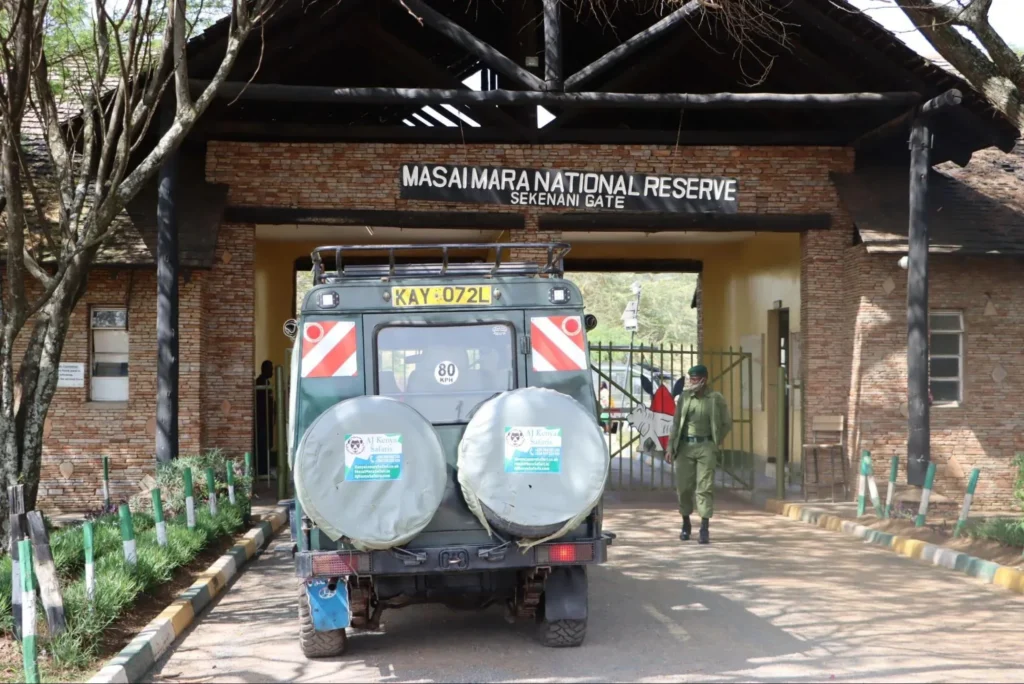
The Masai Mara has six entrance gates split between two separate managements. Five gates (Sekenani, Talek, Musiara, Ololaimutiek, and Sand River) enter the Narok County sector. One gate (Oloololo) enters the Mara Triangle, managed by the Mara Conservancy. Tickets are not interchangeable between the two sides. Non-resident park fees are $100/day (January–June) and $200/day (July–December). Children under 9 are free. Ages 9–17 pay $50 year-round. Tickets run on a fixed 12-hour calendar window from 6 AM to 6 PM, not 12 hours from entry. The Mara uses the KAPS payment system, not eCitizen (which is for KWS parks like Amboseli and Nakuru). Choosing the right gate determines how long you drive to reach the wildlife, what you pay, and how crowded your first game drive will be.
The Six Gates
Sekenani Gate
The busiest gate. Closest to Nairobi (229 km, 5–6 hours). Best road access via the tarmacked C12 from Narok. Handles the highest volume of vehicles. Morning gridlock between 7:30–9:00 AM during peak season. Direct access to central wildlife areas. Most lodges and camps are accessible from here. Read the full Sekenani Gate guide.
Talek Gate
Second-busiest gate, popular with budget and mid-range safaris. Sits alongside the Talek River. The narrow bridge is vulnerable to flash floods (swept away May 2024, March 2026). Cash is not accepted — card or M-Pesa only. Baboons on the gatehouse roof will raid open vehicles. The riverine forest right inside the gate holds resident leopards. Read the full Talek Gate guide.
Musiara Gate
The quietest gate on the Narok side. Handles mostly private 4x4s and fly-in guests. Direct access to the Musiara Marsh and Paradise Plains — the Marsh Pride’s core territory. Musiara Airstrip is 10 minutes from nearby camps. Elephants feed on Warburgia fruit along the tracks right at the gate. Colobus monkey alarm calls in the canopy signal leopard movement. Read the full Musiara Gate guide.
Ololaimutiek Gate
The budget gate. Highest density of affordable camps outside the boundary. Heavy morning bottleneck between 6:30–7:30 AM. The track immediately inside climbs a steep rocky ridge that traps vehicles in wet weather. The Oloolaimutia Hills hold leopard territory that most vehicles drive past. Cattle from nearby Maasai homesteads graze inside the reserve near the gate. Read the full Ololaimutiek Gate guide.
Sand River Gate
Currently closed to regular tourist traffic. Sits on the Tanzania border near the Bologonja gate into the Serengeti. The border crossing has been closed since 1977. The Sand River sector is where the wildebeest migration first enters Kenya (June–July) and returns to Tanzania (October). Crossings here are wider, shallower, and far less crowded than the Mara River. Read the full Sand River Gate guide.
Oloololo Gate
The only gate into the Mara Triangle (western side). Managed separately by the Mara Conservancy. Cashless only — Visa, Mastercard, or M-Pesa. No cash. The escarpment descent requires a 4×4 in low range. The Triangle has a 7 PM driving buffer (one hour later than Narok gates), a 5-vehicle limit at sightings, and ranger patrol vehicles that enforce fines on the spot. Read the full Oloololo Gate guide.
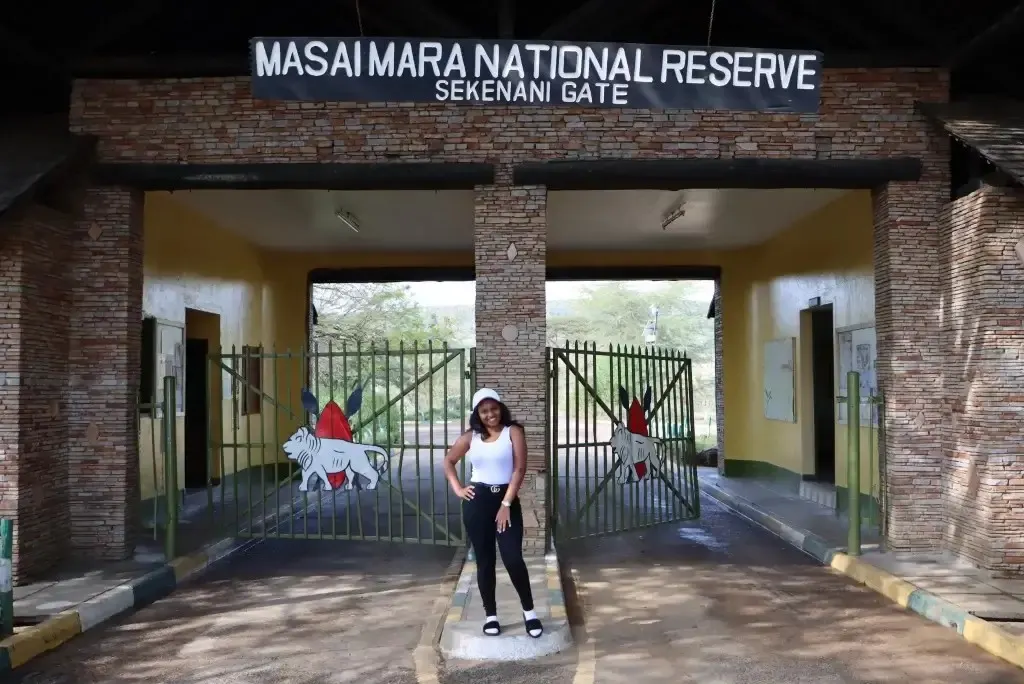
Narok County vs Mara Triangle
Management Sector | System & Ticket Boundary | Transit Loop Warning |
Narok County | Operates eastern gates via the local digital KAPS framework. | Eastern tickets are completely invalid for game drives in the Triangle. |
Mara Triangle | Managed separately by the Mara Conservancy under stricter rules. | Features a 5-vehicle limit at sightings and an extended 7 PM gate curfew. |
Purungat Bridge | Acts as the single internal river checkpoint between both sectors. | Cross-sector transit transfers are limited to a strict, timed 2-hour pass. |
The reserve is split down the middle by the Mara River into two separately managed sectors.
The eastern two-thirds (Sekenani, Talek, Musiara, Ololaimutiek, Sand River) is managed by Narok County. The western third (Oloololo, Purungat Bridge) is managed by the Mara Conservancy. The fees are the same dollar amount on both sides, but the ticketing systems are separate. A ticket bought at Sekenani is valid only on the Narok side. A ticket bought at Oloololo is valid only in the Triangle.
Purungat Bridge is the only vehicle crossing between the two sides. If your camp is in the Triangle but you enter through a Narok gate, you get a free 2-hour transit pass to drive across. Rangers at the bridge check timestamps strictly. Exceed 2 hours and you pay the full Narok fee on top of your Triangle fee.
This happens more often than it should. Last September I picked up a couple at Sekenani whose driver had entered through the wrong gate — their camp was in the Triangle but the driver didn’t know the Oloololo road. They got the 2-hour transit pass at Sekenani and started driving west. About 40 minutes in, they found a cheetah with four cubs on a kill and stopped. Nobody was watching the clock. By the time they reached Purungat Bridge, the rangers looked at the timestamp and charged the full Narok fee on top of what they still owed at their Triangle camp. The driver could have called the bridge warden before the 2 hours ran out and asked for an extension. He didn’t know that was an option.
The Triangle operates under stricter conservation rules: a 5-vehicle limit at sightings, ranger patrol vehicles, immediate fines for off-road driving, and a 7 PM gate closure (one hour later than Narok’s 6 PM). Many guides who work both sides call the Triangle “the real Masai Mara” because of the lower vehicle density and better-maintained tracks.
2026 Park Fees
The Mara uses the KAPS payment system, managed by Narok County. This is not the same as eCitizen, which handles KWS parks like Amboseli, Nakuru, and Tsavo. Your eCitizen QR code will not work at Mara gates.
Fee Detail | Low Season (Jan–Jun) | High Season (Jul–Dec) |
Non-Resident Adults | $100/day | $200/day |
Non-Resident Children (9–17) | $50/day | $50/day |
Children Under 9 | Free | Free |
Kenyan Citizens (Adults) | KES 1,500 | KES 3,000 |
East African Residents (Adults) | KES 2,500 | KES 5,000 |
Payment methods vary by gate. Narok-side gates (Sekenani, Talek, Musiara, Ololaimutiek) accept cash (USD or KES), card, and M-Pesa. Talek is an exception — cash is not accepted there since July 2024. The Mara Triangle (Oloololo, Purungat Bridge) is cashless only — Visa, Mastercard, or M-Pesa.
Pay in USD by card or cash for the best exchange rate. The gate’s internal KES conversion typically uses around KES 140 per dollar when the market rate is closer to KES 129. On a $200 ticket, paying in KES costs roughly $17 extra per person.
Pre-payment is available through the KAPS office at the KATO building in Nairobi (Longonot Road, Upper Hill). A Masai Mara booking through a registered operator pre-validates your entry permit and avoids the morning server queues.
The 12-Hour Ticket Rule
Rule Metric | Fixed Field Constraint | Cost Avoidance Strategy |
Calendar Window | Tickets run strictly from 6 AM to 6 PM, never 24 hours from entry. | Afternoon arrivals expire at dusk; plan arrival windows accordingly. |
Morning Exit | Vehicles must clear outer gates before 10 AM on departure day. | Delays trigger an automatic full-day entry penalty ($400 per couple). |
Lodge Location | Properties outside require a paid re-entry ticket every single morning. | Prioritize inside-the-park camps to eliminate redundant daily fees. |
Since July 2023, Mara tickets run on a fixed 12-hour calendar window from 6 AM to 6 PM. This is not 12 hours from the time you enter. If you enter at 3 PM, your ticket still expires at 6 PM that same day.
On departure day, exit before 10 AM or the system charges you a full extra day. For a couple in peak season, that’s an instant $400 penalty.
Guests staying at lodges inside the reserve don’t pay additional fees for nighttime hours. Guests staying outside the reserve (most budget camps) pay the full daily entry fee every single day they re-enter. On a 4-day safari, staying inside the park can save you an entire extra day’s fee compared to staying outside.
Choosing the Right Gate
First-time visitors from Nairobi: Sekenani has the best road, the shortest drive, and the most reliable payment processing. It’s the default for a reason.
Budget travellers: Ololaimutiek has the cheapest camps and the most self-drive-friendly approach. But it’s the furthest from the prime wildlife zones. Talek offers a better balance of budget accommodation and central location.
Migration river crossings (July–October): Musiara Gate (eastern bank) and Oloololo Gate (western bank) give the fastest access to the Mara River crossing points. Sekenani and Talek require 30–45 minutes of driving inside the reserve to reach them. The Sand River sector sees the migration’s first entry into Kenya in June–July and the return to Tanzania in October, with almost no other vehicles.
Photographers and repeat visitors: Musiara Gate puts you in the Marsh Pride’s core territory within minutes. The Oloololo escarpment gives the most dramatic landscape. The Sand River sector provides private crossing viewing.
Luxury travellers: Oloololo Gate accesses the Triangle’s premium camps (Angama, Kichwa Tembo, Serena, Olonana). Musiara Gate accesses the Governors’ Camp cluster.
Western Kenya visitors (Kisumu, Kericho, Migori): Oloololo Gate is the natural entry point, bypassing Narok entirely via the C14.
Safari Packages via the Masai Mara Gates
All-inclusive prices per person sharing, based on two people in a private 4×4 Land Cruiser.
5-Day All-Inclusive Rates (Per Person Sharing)
Package Tier | Camps (Nakuru + Mara) | Regular Season (KES) | Peak Season (KES) |
Budget | Lake Nakuru Lodge / Talek Bush | KES 224,900 | KES 429,000 |
Mid-Range | Sarova Lion Hill / Ashnil Mara | KES 276,900 | KES 494,000 |
Luxury | The Cliff Nakuru / Mara Serena | KES 456,300 | KES 738,400 |
Luxury Plus | The Cliff Nakuru / Angama Mara | KES 742,300 | KES 1,102,400 |
Note: Regular season at $100/day park fees. Peak season at $200/day. For a luxury safari upgrade or flying packages, request a custom quote.
What’s Covered
- A private 4×4 Safari Land Cruiser for the full trip.
- A TRA-licensed guide who knows the gate logistics and sector tracks.
- All 2026 Mara reserve entry fees and Lake Nakuru fees paid through the correct system (KAPS for Mara, eCitizen for Nakuru).
- One-way return flight to Nairobi Wilson via Masai Mara flying packages.
- Full board, 3 meals daily.
- AMREF Flying Doctors emergency air evacuation insurance.
What’s Excluded
- Kenya eTA (~$30).
- Tips (KES 3,000/day for guide).
- Alcohol and soft drinks.
- Hot air balloon ($450–$500).
- International flights.
Frequently Asked Questions
How many gates does the Masai Mara have?
Six: Sekenani, Talek, Musiara, Ololaimutiek, and Sand River on the Narok County side, plus Oloololo on the Mara Triangle side. Purungat Bridge is an internal crossing between the two sides, not a public entry gate.
Can I enter through one gate and exit through another?
Yes, on the Narok side. Your ticket is valid at all five Narok gates within the 12-hour window. You cannot cross into the Triangle without a separate ticket or a 2-hour transit pass.
Can I pay cash at the gates?
Depends on the gate. Most Narok-side gates accept cash. Talek and the Triangle gates do not. The fee section above has the full breakdown by gate.
Is eCitizen used for the Mara?
No. The Mara uses KAPS. eCitizen is for KWS parks (Amboseli, Nakuru, Tsavo). Your eCitizen QR code will not work here.
Which gate is best for the migration?
Musiara and Oloololo give the fastest access to the Mara River crossing points. The Sand River sector sees the migration’s first entry and October return with almost no vehicles. See our Masai Mara migration page.
Is a 4×4 mandatory?
A 4×4 is strongly recommended at all gates. It’s essential at Ololaimutiek (steep ridge), Oloololo (escarpment descent), and Musiara (black cotton soil). In mid-2024, Narok County banned non-safari-standard vehicles from game drives inside the reserve.
What happens if I exit after 10 AM on departure day?
You pay for an extra full day. The 12-hour section above explains how to avoid this.
What the Gates Give You
Each gate enters a different part of the reserve. Sekenani handles the most traffic and has the best road from Nairobi, which is why most first-time visitors use it. Talek puts you in the predator heartland but the bridge floods when it rains upstream. The Marsh Pride lives within minutes of the Musiara barrier, making it the quietest and most rewarding gate on the Narok side. Budget travellers cluster around Ololaimutiek on the hilly eastern edge. The Sand River border crossing is closed, but the sector sees the migration’s first entry into Kenya with almost nobody watching. Oloololo drops you down the escarpment into the Triangle, where the rules are stricter and the tracks are calmer.
Our 3-day and 4-day trips are the shortest viable options. The 5-day adds Nakuru. The 6-day Amboseli circuit adds Kilimanjaro views. The Mara-Amboseli-Nakuru loop covers all three. Browse everything on our Masai Mara packages page.
Fill out our booking form at Masaimara.co.ke below here and tell us your dates.
This guide was authored by David Njunge, a TRA-licensed safari guide with over 10 years of experience, and edited by Cecilia Wambui, a travel consultant with a degree in Tourism and Hospitality Management.
Related Reading:
- Sekenani Gate Masai Mara
- Talek Gate Masai Mara
- Musiara Gate Masai Mara
- Ololaimutiek Gate Masai Mara
- Sand River Gate Masai Mara
- Oloololo Gate Masai Mara
- Best Time to Visit Masai Mara
- Wildebeest Migration Kenya
- Masai Mara Migration
- Lions in Masai Mara
- Leopards in Masai Mara
- Elephants in Masai Mara
- Rhinos in Masai Mara
- Birding Safari Masai Mara
- Photography Safari Masai Mara
- Walking Safaris Masai Mara
- Night Game Drive Masai Mara
- All Inclusive Masai Mara Safari
- Masai Mara Amboseli Nakuru Safari
- 6 Days Masai Mara Amboseli Safari
- 5 Days Masai Mara Safari
- 4 Days Masai Mara Safari
- 3 Days Masai Mara Safari
- Luxury Safari Masai Mara
- Masai Mara Packages
- Masai Mara Flying Packages
- Masai Mara Booking
- Official KWS Park Fee Portal
- Kenya Wildlife Service
Welcome to Masaimara.co.ke
Thank you for visiting us! We're excited to help you plan an unforgettable safari adventure across Kenya.