
Masai Mara, Amboseli and Lake Nakuru Safari: 2027 Prices
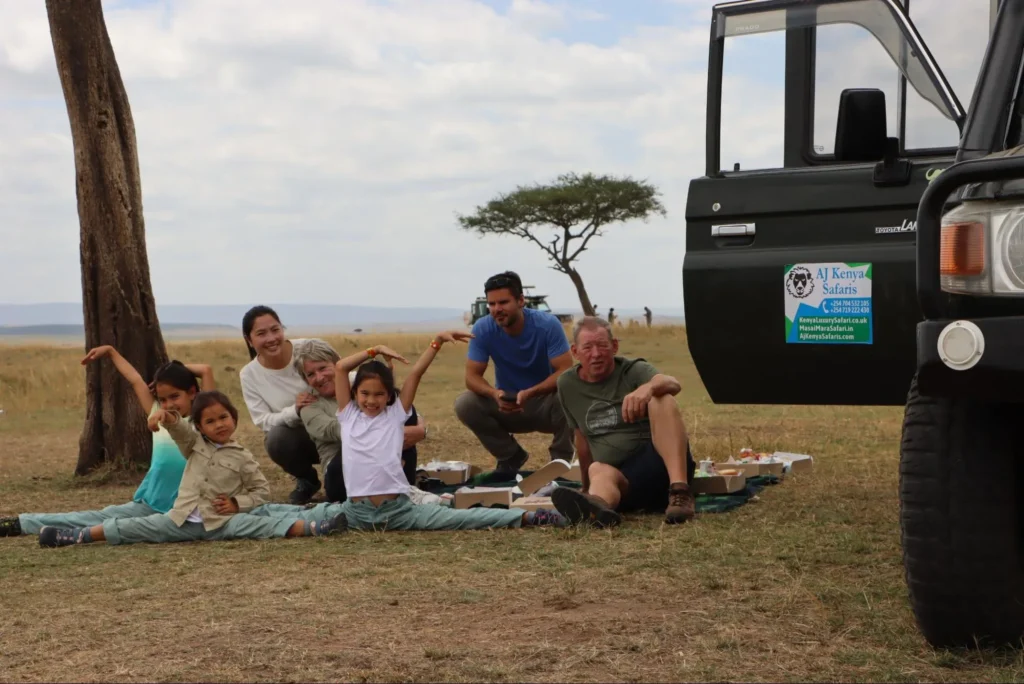
A Masai Mara, Amboseli and Lake Nakuru safari is Kenya’s three-park circuit: big cats on the Mara savanna, rhinos in the woodland around Lake Nakuru, and elephants walking under Kilimanjaro in Amboseli. Our classic 7-day version runs from KES 191,000 for Kenyan citizens or USD 2,660 for international visitors per person sharing, all by road in a private 4×4 Land Cruiser, with park fees and full board included.
Choose Your Duration
This is the main page for the Masai Mara, Amboseli and Lake Nakuru circuit. We run it at several lengths.
- 5 days: the shortest version. It works, but it means long road days and only one night in some parks.
- 6 days: more breathing room, with two nights in the Mara.
- 7 days: our classic circuit, with three nights in the Mara, one at Lake Nakuru and two in Amboseli. The day-by-day below is this version.
- 8 days: adds more time at Nakuru to enable for a relax safari, making it 2 nights Nakuru, 2 nights at Amboslei, and 3 nights at Mara
The clearest pattern from our guests is that people on 5-day trips wish they had booked 6. People on 7 or 8 days never say they had too much time.
If your group includes young children, older travelers or anyone with a bad back, choose the 8-day version. Day 5 on the 7-day circuit is the hardest day of the trip, close to eight hours on the road with no enough time for rest.
2027 Masai Mara, Amboseli And Lake Nakuru Safari Prices
Per person, two people sharing a private 4×4 Land Cruiser, for our 7-day classic circuit: 3 nights in the Mara, 1 at Lake Nakuru and 2 in Amboseli. All transfers are by road. Kenyan prices are worked out on citizen park fees and resident lodge rates, so they are not the dollar price converted. That matters on this circuit: a non-resident pays up to USD 870 in park fees, while a Kenyan citizen pays KES 9,000 to 13,500.
International Visitors (USD)
| Tier | Lodges (Mara + Nakuru + Amboseli) | Jan-June | July-Dec |
|---|---|---|---|
| Budget | Mara Sidai + Ziwa Bush Lodge + AA Lodge Amboseli | 2,660 | 3,270 |
| Mid-Range | Mara Sopa + Lake Nakuru Sopa + Kibo Safari Camp | 3,120 | 3,920 |
| Luxury | Sarova Mara + Sarova Lion Hill + Amboseli Serena | 4,130 | 5,520 |
Kenyan Citizens (KES)
| Tier | Lodges (Mara + Nakuru + Amboseli) | Jan-June | July-Dec |
|---|---|---|---|
| Budget | Mara Sidai + Ziwa Bush Lodge + AA Lodge Amboseli | 191,000 | 213,000 |
| Mid-Range | Mara Sopa + Lake Nakuru Sopa + Kibo Safari Camp | 226,000 | 259,000 |
| Luxury | Sarova Mara + Sarova Lion Hill + Amboseli Serena | 297,000 | 376,000 |
Foreign nationals living in Kenya on a work or residence permit pay resident park fees, which sit between the two tables. Tell us when you book and we will quote you on resident rates.
Peak prices apply from July to December, when Mara park fees double. Shorter and longer versions are priced on request. If you want to fly one leg, look at our Masai Mara flying packages, and for a higher-end trip see our luxury safari Masai Mara camps.
What Is Included
- A private 4×4 Safari Land Cruiser with a pop-up roof, not shared with strangers
- A TRA-licensed driver-guide for the whole trip
- Fuel for all transfers and game drives
- Full board at every lodge
- All park fees for the Masai Mara, Lake Nakuru and Amboseli
- Drinking water in reusable containers
- AMREF Flying Doctors evacuation cover
Not Included
- Tips for your guide (USD 15 to 20 / KES 2,000 to 2,500 per day)
- Alcoholic and soft drinks
- Hot air balloon in the Mara: USD 500 (KES 58,500)
- Maasai village visit: KES 1,500 for citizens / USD 20 for non-residents
- International flights and the Kenya eTA at USD 34
I have been guiding for ten years. A Masai Mara, Amboseli and Lake Nakuru safari crosses three completely different landscapes. The Mara is gold and green. Amboseli is white and dusty, with Kilimanjaro hanging over it. Nakuru is woodland and cliffs around a soda lake. If your guide does not explain why these parks go together, you miss half the point.
The wildlife takes care of itself. The logistics are where trips go wrong: checking your operator is a KATO member, making sure you are not quietly moved into someone else’s crowded van, and having the park payments sorted before each gate.
Why These Three Parks Are Paired
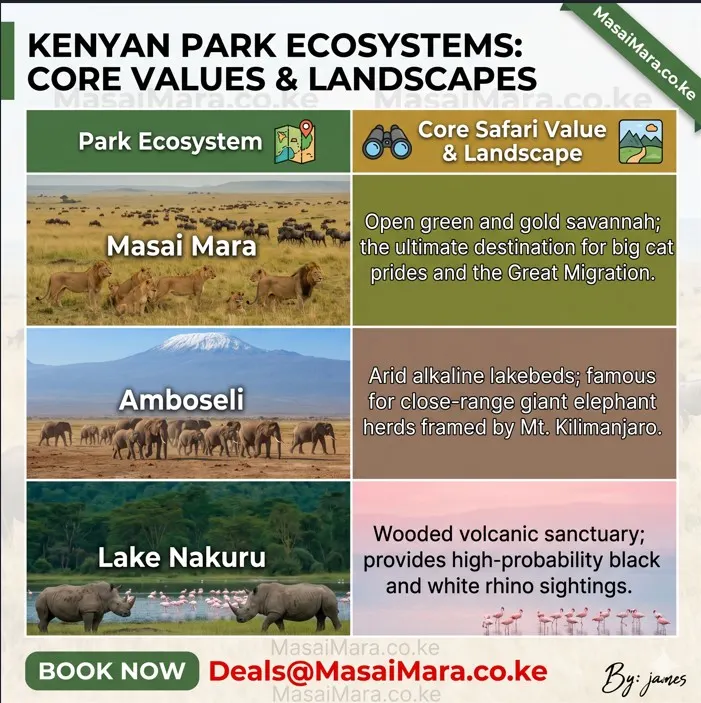
|
Park Ecosystem |
Core Safari Value & Landscape |
|
Masai Mara |
Open green and gold savannah; the ultimate destination for big cat prides and the Great Migration. |
|
Amboseli |
Arid alkaline lakebeds; famous for close-range giant elephant herds framed by Mt. Kilimanjaro. |
|
Lake Nakuru |
A fenced sanctuary with very good odds on black and white rhinos |
Most sites just list the parks. Here is why they work together.
The Mara (about 1,500 to 2,100 m). Open grassland savanna. This is the predator stage. You come here for lions, leopards, cheetahs and the migration.
Lake Nakuru (about 1,750 m). A fenced Rift Valley lake surrounded by woodland and cliffs, covering about 188 square kilometers. It became Kenya’s first rhino sanctuary in 1987, and the lake is part of the Kenya Lake System World Heritage Site. The fence and the park’s small size are why rhinos and predators are so easy to find here. Both black and white rhinos live in a small park, so your chances of seeing one are better than almost anywhere else in Kenya. What it does not have is elephants. The park is fully fenced and ringed by farms and towns, and it is too small to support them. That is exactly why it pairs with Amboseli.
Amboseli (about 1,150 m). A dry lakebed and swamps below Kilimanjaro. Some of the best close-range elephant viewing in Africa, and the only park on this circuit where you see the mountain.
Two Kinds Of Giraffe
This circuit is the best in Kenya for comparing two giraffes side by side. The Rothschild’s giraffe at Lake Nakuru has plain white “stockings”, with no markings below the knees, and soft brown patches with clean, creamy edges. The Maasai giraffe in the Mara and Amboseli is darker, with jagged, leaf-shaped patches that run all the way down the legs to the hooves. Once you have seen both, you never mix them up again.
The Mara gives you big cats. Nakuru gives you rhinos, the hardest of the Big Five to find in the Mara. Amboseli gives you Kilimanjaro elephants. No single park does all three.
The Route And Drive Times
Our classic route starts in the Mara, then goes to Nakuru and Amboseli. There is a reason. The Mara connects directly to Nakuru on a good road through the highlands, and Amboseli is the closest of the three to Nairobi, so your last day home is the shortest drive.
The 7-Day Itinerary At A Glance
Three nights in the Mara, one at Lake Nakuru and two in Amboseli. There is no game drive on the morning you leave a park, and lunch is at the next hotel on transfer days.
| Day | Plan |
|---|---|
| 1 | Nairobi to the Masai Mara, afternoon game drive |
| 2 and 3 | Full days in the Mara with picnic lunches |
| 4 | Masai Mara to Lake Nakuru, afternoon game drive |
| 5 | Lake Nakuru to Amboseli, afternoon game drive |
| 6 | Full day in Amboseli |
| 7 | Amboseli to Nairobi |
See the full 7-day itinerary, with departure times, lunch stops and gate rules.
2027 Park Fees
| Park & Ticket | Non-Resident Adult | Citizen / Resident Adult |
|---|---|---|
| Masai Mara National Reserve (Narok County). Calendar day, 6 AM to 6 PM. | USD 100 Jan-June, USD 200 July-Dec. Child (9 to 17) USD 50, under 9 free. | Citizen KES 1,500 / 3,000, child KES 300 / 500. Resident KES 2,500 / 4,500, child KES 1,250 / 2,500. |
| Lake Nakuru National Park (KWS). 24 hours from entry. | USD 90, child (5 to 17) USD 45 | Citizen KES 1,500, child KES 750. Resident KES 2,025, child about KES 1,000. |
| Amboseli National Park (KWS). 24 hours from entry. | USD 90, child (5 to 17) USD 45 | Citizen KES 1,500, child KES 750. Resident KES 2,025, child about KES 1,000. |
The Mara is run by Narok County and charges by calendar day. Nakuru and Amboseli are KWS parks, paid through KWS eCitizen, and their tickets run 24 hours from when you enter. Every ticket is already in your package price. Here is how they are used on the 7-day circuit:
- Masai Mara, Days 1 to 3: three calendar-day tickets. On Day 4 there is no game drive. Mara Sidai and Mara Sopa guests leave on the outside roads without touching a gate. The 10 AM closed-roof exit applies only to lodges inside the reserve, such as Sarova Mara.
- Lake Nakuru, Days 4 and 5: one 24-hour ticket, starting when you arrive around 2:30 PM on Day 4. It covers the afternoon drive and your exit on the morning of Day 5. There is no game drive that morning, because it is a transfer day.
- Amboseli, Days 5 to 7: two 24-hour tickets. The first starts when you arrive around 3 PM on Day 5 and covers that afternoon and the Day 6 morning drive. The second starts when you go back in for the Day 6 afternoon drive, at about 3:30 PM. At AA Lodge and Kibo Safari Camp, which are outside the park, you leave through Kimana Gate that evening and do not enter the park on Day 7. You check out after breakfast and drive straight to Nairobi on the C102. Only at Amboseli Serena, which is inside the park, does the second ticket also cover the night and your drive out on Day 7. There is no game drive on Day 7.
The Mara is run by Narok County and charges by calendar day. Nakuru and Amboseli are KWS parks, paid through KWS eCitizen, and their tickets run 24 hours from when you enter. Every ticket is already in your package price. Each duration page sets out exactly which tickets your trip uses, including the rules for lodges inside and outside the parks.
The full Mara rate card is on our park fee page.
The Gilanis Stop And The Dead Forest
Skip the curio shops for snacks. Ask your guide to stop at Gilanis supermarket in Nakuru town. It is where guides buy their own supplies. You can pick up Tropical Heat crisps and other local snacks for a fraction of the lodge price. It is also a good place to buy a shuka, the Maasai blanket, without the tourist mark-up.
The Dead Forest. At sunset, we head toward Hippo Point inside the park. The lake has risen a long way in recent years, and it has left a forest of white, skeletal acacias standing in the water. It looks like another planet, and the Rothschild’s giraffes often browse around the edges. The rising water also swallowed the old main gate and stretches of the old lakeshore road. The best rhino tracking has moved up into the acacia woodland between Lion Hill, Baboon Cliff and the Makalia side of the park in the south.
The flamingos. Many guidebooks still promise pink shorelines at Nakuru. The rising water has diluted the lake, and most of the flamingos have moved to other Rift Valley lakes such as Bogoria. You may still see some, but come to Nakuru for the rhinos, not the flamingos.
Lion Hill. Look at the rocks under your feet at the viewpoints on Lion Hill. They are covered in rock hyrax, small, guinea-pig-looking animals that are distant relatives of the elephant. I always tell my guests. It makes the encounter feel different.
Amboseli Away From The Crowds
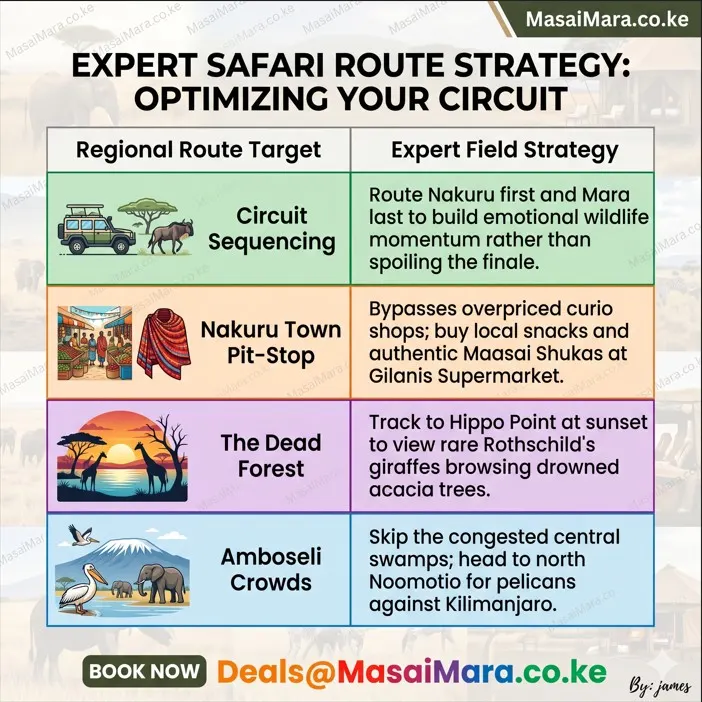
|
Regional Route Target |
Expert Field Strategy |
|
Circuit Sequencing |
Route Nakuru first and Mara last to build emotional wildlife momentum rather than spoiling the finale. |
|
Nakuru Town Pit-Stop |
Bypasses overpriced curio shops; buy local snacks and authentic Maasai Shukas at Gilanis Supermarket. |
|
The Dead Forest |
Track to Hippo Point at sunset to view rare Rothschild’s giraffes browsing drowned acacia trees. |
|
Amboseli Crowds |
Skip the congested central swamps; head to north Noomotio for pelicans against Kilimanjaro. |
Amboseli’s elephants are special for another reason. They have been studied without a break since 1972 by the Amboseli Elephant Research Project, started by Cynthia Moss, so every family here is known by name. That long, calm history is why they are so relaxed around vehicles. Amboseli is also one of the last places in Africa where you can still see big tuskers, old bulls whose tusks reach almost to the ground.
While the crowds gather around Enkongo Narok swamp, ask your guide to work the quieter northern side of the park, toward the old lakebed. When there is water, you get pelicans and waterbirds with Kilimanjaro behind them, and far fewer vehicles.
Be on the tracks at 6 AM. Kilimanjaro is shy. As the plains heat up, cloud builds around the mountain, and by about 8:30 or 9 AM the peak is often gone until late afternoon. The classic shot of elephants with the snow-capped peak behind them is a dawn shot.
Climb Observation Hill too. It is one of the few places in Amboseli where you can get out of the vehicle, and from the top you see the swamps, the elephants moving between them and the mountain on a clear morning.
11 Things to Know Before You Go
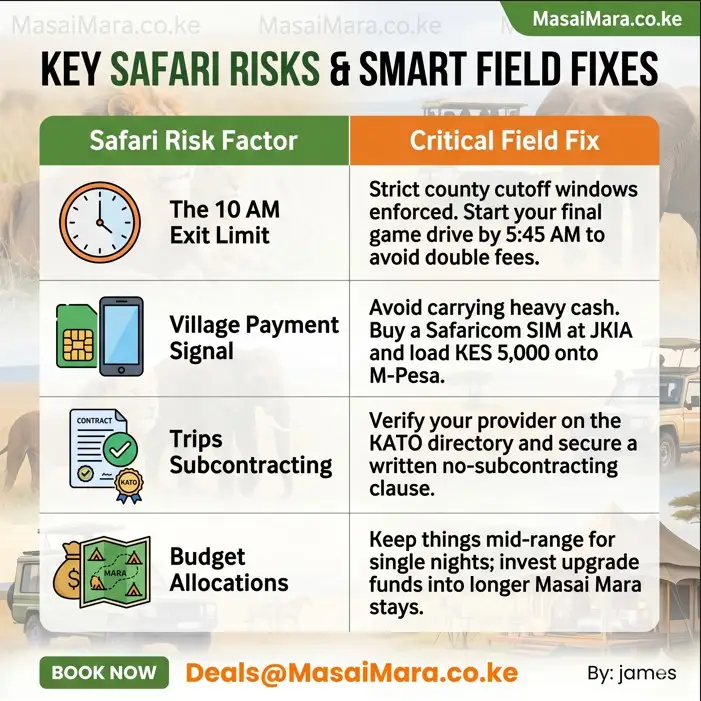
|
Safari Risk Factor |
Critical Field Fix |
|
The 10 AM Exit Limit |
Strict county cutoff windows enforced. |
|
Village Payment Signal |
Avoid carrying heavy cash. Buy a Safaricom SIM at JKIA and load KES 5,000 onto M-Pesa. |
|
Trips Subcontracting |
Verify your provider on the KATO directory and secure a written no-subcontracting clause. |
|
Budget Allocations |
Keep things mid-range for single nights; invest upgrade funds into longer Masai Mara stays. |
- The Musiara 6:15 AM window. If your camp is in the north of the Mara, we reach the marsh at dawn. The low mist gives you lions walking through fog, and it burns off by about 7:30.
- A Safaricom SIM. Get one at JKIA. M-Pesa is accepted at Maasai villages, in Narok and Nakuru shops and for some lodge extras. Load a few thousand shillings for the trip.
- The Hammerkop mansion. I will show you a Hammerkop nest, a huge stick mansion built by a small brown bird. Local legend says that if you harm one, your house catches fire. Finding one is good luck for the trip.
- The Athi plains. On the drive to Amboseli, do not sleep. Along Mombasa Road you pass the Athi plains, where Maasai cattle graze right next to zebras. The best place to talk about how people and wildlife share this land.
- Vegetarian food. Budget camps are meat-heavy. Tell us 48 hours ahead and we ask the lodges for dal, paneer and proper vegetable dishes.
- The KATO check. Before you pay, check your operator on the KATO directory. If they are not listed, you risk being handed to someone else’s trip. Get the guide’s name, the vehicle registration and a no-subcontracting clause in writing.
- The leopard wildcard. Lions and elephants are almost guaranteed. Leopards are the gamble. More nights in the Mara with a guide who knows the Talek River and Musiara territory gives you the best odds.
- Accommodation strategy. On a three-park circuit, go mid-range at Nakuru, where you spend one night, and put your upgrade money into the Mara and Amboseli. Sleep quality adds up over a week.
- Window pins. At Nakuru and Amboseli, vervet monkeys watch you leave for lunch. Lock your window pins or they will be in your room for your snacks.
- The 10 AM exit. If your Mara camp is inside the reserve, you must be through the gate by 10 AM on the day you leave, or you pay another full day. There is no game drive that morning. You have breakfast and go.
- WhatsApp booking. It is normal in Kenya to book over WhatsApp. But never pay 100% upfront. A 30 to 50% deposit is standard, and full payment long before arrival is a red flag.
When The Soil Changes Color
I remember a trip on this circuit when a guest saw a leopard across a dry-looking stream bed on our track in the Mara. He kept asking me to push on. The top layer was dry, red sand. Underneath was wet clay that had not seen sun in months.
We were not just stuck. We were anchored. Two Land Cruisers and two hours of digging in the heat to get us out. We missed the sunset drive entirely.
This circuit crosses three kinds of ground. Amboseli’s white dust hides wet pockets near the swamps. Nakuru’s lakeshore flats turn soft after rain. The Mara’s black cotton soil swallows a tire whole. When I say a track looks soft, I am keeping us out of a two-hour shovel party.
Best Time To Visit
| Season | Masai Mara | Lake Nakuru | Amboseli |
|---|---|---|---|
| January to March (dry) | Short grass, great cat viewing | Good rhino viewing, dry tracks | Clear Kilimanjaro mornings, elephants at the swamps |
| April and May (long rains) | Heavy rain, black cotton soil | Wet, some tracks flooded | Green, dust settles, the mountain often in cloud |
| July to October (dry) | The Great Migration | Good rhino viewing | Dry and dusty, big herds at the swamps |
| November and December (short rains) | Green plains, newborn animals | Lush and quieter | Short showers, good light |
July to October is the favorite because the migration is in the Mara and the other two parks are dry. Late June is good value, before the Mara fee rise, and in some years the first herds have already arrived. Month by month detail is in our best time to visit guide.
Frequently Asked Questions
How many days do I need for a Masai Mara, Amboseli and Lake Nakuru safari? Six or seven days for most people. See Choose Your Duration above.
Which order should I visit the parks in? We usually start in the Mara and finish in Amboseli, because Amboseli is the shortest drive home. If you want the big cats as the finale, we can reverse it.
How long are the drives between the parks? About 5 to 6 hours from the Mara to Nakuru, and 7.5 to 8.5 hours from Nakuru to Amboseli. See the drive time table above.
Can I fly one leg? Yes. Flying out of the Mara cuts out the longest road day. Ask us to add it.
Are there still flamingos at Lake Nakuru? Far fewer than there used to be. The lake has risen, and most of the flamingos have moved to lakes such as Bogoria. Nakuru’s strength now is its rhinos.
Will I see the Big Five? Your chances are very good. Lions, elephants and buffalo are near-certain, Nakuru takes care of the rhino, and the leopard is the gamble. More Mara nights improve your odds.
Is a 4×4 necessary? Yes. The black cotton soil in the Mara and the soft lakeshore tracks at Nakuru are no place for a minivan after rain. Every private safari we run uses a 4×4 Land Cruiser.
Can I add Tsavo or Samburu? Yes. See our Masai Mara and Tsavo safaris or our Masai Mara and Samburu safaris.
Can I add a beach after? Yes. Our Masai Mara and Diani Beach safari shows how it works.
What should I pack? Layers, a power bank, 8×42 binoculars, your physical passport, compression socks for the long drives and a Safaricom SIM. Full list on our packing list.
Is this trip safe? Yes. All three parks have rangers, your guide carries a radio, and the lodges are well established. We plan every drive to arrive before dark.
What Nobody Tells You At The End
A Masai Mara, Amboseli and Lake Nakuru safari is a lot of dust and early alarms. But when you see a big tusker at the swamp edge in Amboseli, or watch the Marsh Pride walk through the morning mist at Musiara, you stop thinking about the bumps on the road.
If the full circuit feels like too much, start with a 5 days Masai Mara safari or a 4 days Masai Mara safari. Or pair just two of the parks with our Masai Mara and Amboseli or Masai Mara and Lake Nakuru safaris.
Ready to start? Fill out our booking form and I will see you at the gate.
Related Reading
- Masai Mara and Amboseli Safari
- Masai Mara and Lake Nakuru Safari
- Masai Mara Flying Packages
- Luxury Safari Masai Mara
- Masai Mara Migration
- First-Time Safari Guide
Park fees change. Check Narok County for the Masai Mara and KWS eCitizen for Lake Nakuru and Amboseli.
Written by David Njunge, TRA-licensed safari guide with over 10 years in the Masai Mara. Edited by Cess Wambui, travel consultant, BSc Tourism and Hospitality Management. Verified for the 2027 season.
Welcome to Masaimara.co.ke
Thank you for visiting us! We're excited to help you plan an unforgettable safari adventure across Kenya.