
2-Day Masai Mara Weekend Safari From Nairobi (2026 Prices)
Fact-checked January 2026 by David Njunge (TRA Licensed Safari Guide)
A 2 days Masai Mara safari costs KES 62,500 to KES 185,000 for Kenyan citizens, or USD 660 to USD 1,780 for non-residents. One night in the bush. Two game drives. You leave Friday evening or Saturday morning, return Sunday. The overnight stay gives you a dawn game drive when predators are active.
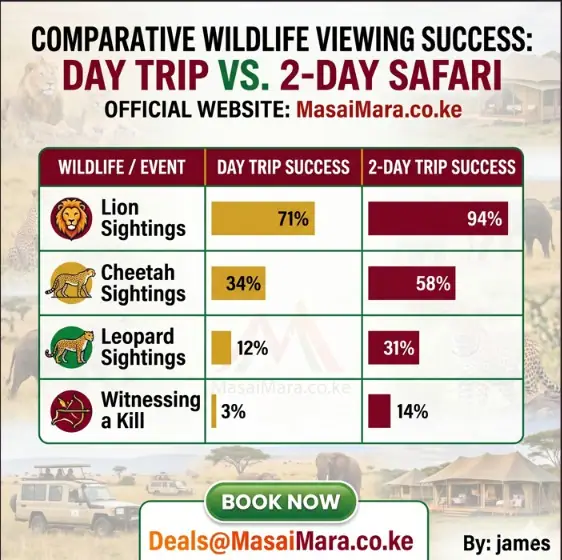
Wildlife / Event | Day Trip Success | 2-Day Trip Success |
Lion Sightings | 71% | 94% |
Cheetah Sightings | 34% | 58% |
Leopard Sightings | 12% | 31% |
Witnessing a Kill | 3% | 14% |
Nairobi office workers. That’s who books this trip.
Friday afternoon. You’re done with meetings. Car picks you up at 2pm. By 7pm you’re eating dinner in the Mara with hyenas cackling somewhere in the darkness. Saturday morning, you’re watching a cheetah hunt while your colleagues are still asleep in the city. Sunday evening, back home.
A 2 days Masai Mara safari is basically a long weekend with lions.
I ran 43 of these trips in 2024. Most were repeat clients. People who’d done a day trip before and felt cheated by it. They’d spent ten hours in a vehicle to see zebras and a distant elephant. The math didn’t add up.
Two days changes the math completely.
What’s Covered in the Price
All packages include:
- Return transport from Nairobi (4×4 Land Cruiser, pop-top roof, not shared with strangers)
- 1 night full board at your chosen camp
- Park fees for both days
- Afternoon game drive Day 1
- Full morning game drive Day 2
- Bottled water throughout
- English-speaking driver-guide
Not covered:
- Tips (KES 1,500-2,500 total is normal)
- Drinks beyond water
- Travel insurance
- Anything not listed above
Add-ons if you want them:
Activity | Cost |
KES 58,500 | |
KES 3,900 | |
Bush breakfast setup | KES 6,500 |
Night drive (conservancies only) | KES 9,100 |
The balloon is genuinely spectacular but eats into your morning game drive. You launch at 6am, land around 7:30am, have champagne breakfast until 9am. By then the best light is gone. I’d only recommend it if you’re extending to 3 days.
Park Entry Fees (2026)
Set by Narok County Government. Pay at the gate via cash or card. Your guide can help organize this.
Category | Low Season (Jan-Jun) | Peak Season (Jul-Dec) |
Kenyan Citizen (Adult) | KES 1,500 | KES 3,000 |
Kenyan Citizen (Child 9-17) | KES 300 | KES 1,000 |
Non-Resident (Adult) | USD 100 | USD 200 |
Non-Resident (Child 9-17) | USD 50 | USD 50 |
Children below 9 years: Free.
The Gate Strategy Nobody Mentions
Most 2-day visitors enter and exit through Sekenani Gate. Logical. It’s closest to the Nairobi road.
But there’s a smarter way.
Ask your driver for a “linear safari.” Enter via Sekenani. Exit via Oloolaimutia Gate or Talek Gate. You traverse a completely different sector on the way out instead of backtracking through areas you’ve already seen.
Timing matters too. Avoid Sekenani between 10am and 11:30am. That’s when the mass of 3-day group tours arrive. I’ve watched people sit in the queue for 45 minutes just waiting for paperwork processing.
If you’re arriving around that window, tell your driver to stop for coffee in Narok. Kill 20 minutes. Arrive at 12:15pm when the crowd has cleared.
2026 Packages

Prices per person sharing. Based on two travelers in a private vehicle. Low season: January-June. Peak season: July-December.
Peak season prices are significantly higher due to both doubled park fees and increased vehicle rates.
For Kenyan Citizens
Tier | Low Season | Peak Season | Camp Options |
Budget | KES 62,500 | KES 122,000 | Mara Sidai Camp, Enchoro Wildlife Camp, Mara Eden Safari Camp |
Mid-Range | KES 74,500 | KES 136,000 | Sarova Mara Game Camp, Mara Sopa Lodge, Sentrim Mara Camp |
Luxury | KES 92,500 | KES 158,000 | Mara Serena Safari Lodge, Keekorok Lodge, Ilkeliani Camp |
Premium | KES 117,500 | KES 185,000 | Governors Camp, Mara Intrepids, Kichwa Tembo Tented Camp |
For Non-Residents
Tier | Low Season | Peak Season | Camp Options |
Budget | USD 660 | USD 1,295 | Mara Sidai Camp, Enchoro Wildlife Camp, Mara Eden Safari Camp |
Mid-Range | USD 750 | USD 1,400 | Sarova Mara Game Camp, Mara Sopa Lodge, Sentrim Mara Camp |
Luxury | USD 890 | USD 1,570 | Mara Serena Safari Lodge, Keekorok Lodge, Ilkeliani Camp |
Premium | USD 1,080 | USD 1,780 | Governors Camp, Mara Intrepids, Kichwa Tembo Tented Camp |
What the Two Days Look Like
Day 1: Getting There
If you leave Friday afternoon:
Pickup at 2pm from Nairobi. Southern Bypass to avoid Uhuru Highway chaos. You drop into the Rift Valley around 4pm. Golden light over the escarpment. Quick photo stop at the viewpoint.
The road past Narok turns rough. Murram. Red dust. Eighty kilometers of it.
Arrive at camp around 7pm. Too late for a game drive. Dinner.
Then the sounds start. Hyenas around 9pm. That laughing-crying noise that sounds like someone losing their mind in the darkness. Hippos grunting if you’re near the river. Sometimes lions.
If you leave Saturday morning:
Pickup at 5:30am. Beat the Mai Mahiu traffic. Breakfast stop in Narok around 8:30am.
Arrive at camp by noon. Lunch. Rest during the hot hours. Afternoon game drive from 3:30pm until dark.
This is when things come alive. Lions shake off the midday drowsiness. Elephants move toward water. Cheetahs start scanning for dinner.
Back to camp. Dinner. Sleep.
Day 2: The Reason You Came
Wake at 5:45am. Coffee. Rusks. Out by 6:15am.
The grass is wet. Cold actually. Morning temperatures drop to 14-15°C this time of year. Bring a fleece. The open roof hatch creates wind chill.
Steam rises off the plains as the sun warms things up. Wild sage smell everywhere. Dew catching light on acacia thorns.
This is the drive that day-trippers miss entirely. They’re still grinding through potholes near Narok right now. You’re watching a leopard descend from her overnight tree.
Predators are active at dawn. Hyenas returning to dens with full bellies. Lions still feeding on night kills or digesting nearby. Cheetahs hunting before the heat drives prey into shade.
We stay out until 10am. Sometimes later if we’re onto something good.
Back to camp. Full breakfast. Pack. Checkout by 11am.
Drive to Nairobi. Arrive 5-6pm depending on traffic.
Location Secrets
Paradise Plain: Near Musiara. Open stretch. Short grass. Best spot in the Mara for Serval cats. More rewarding than another sleeping lion.
Airstrip Zones: Zero luck in tall grass? Ask for Keekorok or Musiara airstrips. Grass kept short for planes. Animals congregate. Accidental clear-viewing zones.
24-Hour Ticket: Entered at 2pm Day 1? Legally valid until 1:59pm Day 2. Drivers push for 10am departure for traffic. That’s preference, not rule. Negotiate the night before.
Radio Call Avoidance: Ask your guide to find your own sightings instead of chasing every broadcast. Trade certainty for calmer experiences. Some of my best trips happened when we ignored the radio.
I keep a rough tally of sightings by trip type. Not scientific. Just notes in my phone.
Day trips (87 trips in 2024):
- Lion sightings: 71%
- Leopard sightings: 12%
- Cheetah sightings: 34%
- Witnessed a kill: 3%
2-day trips (43 trips in 2024):
- Lion sightings: 94%
- Leopard sightings: 31%
- Cheetah sightings: 58%
- Witnessed a kill: 14%
The morning drive is the difference. Predators are active. Light is good. You’re not exhausted from five hours of driving.
A guest last February told me she’d done a day trip two years earlier. Saw zebras. Wildebeest. A sleeping lion from 200 meters. Nice but forgettable.
On her 2-day trip, the morning drive found a leopard hauling an impala up a fig tree at 6:40am. Twenty minutes later, lions from the Marsh Pride walked past her vehicle close enough to count their whiskers.
Same place. Different experience entirely.
Road vs Fly-In: The Honest Comparison

For 2-day trips specifically:
Factor | Road Safari | Fly-In Safari |
Travel time (total) | 10-12 hours | 90 minutes |
Game drive time | 6-8 hours | 10-12 hours |
Starting price (citizens) | KES 62,500 | KES 125,000+ |
Starting price (non-resident) | USD 660 | USD 1,200+ |
Day 1 game drive starts | 3:30pm | 9:30am |
Physical toll | High (bumpy roads) | Low |
Rift Valley scenery | Yes | No (you fly over) |
Flying is the single biggest “time multiplier” on a 2-day trip. You gain almost a full extra day of game viewing. The cost gap is real. So is the experience gap.
If budget allows, fly. If not, the road trip still works.
Practical Survival Tips
The Dust Reality
Mara dust isn’t normal dirt. Fine volcanic ash. Penetrates everything.
You’ll open and close the pop-top roof constantly. Bring large Ziploc bags for phone and camera. Never change a camera lens while moving or with the roof open. I’ve seen it destroy camera sensors.
Skip the Boxed Lunch
Most 2-day tours include sad sandwich boxes. Dry bread. Mystery meat.
Ask your guide to stop at Sarova Mara or Keekorok Lodge for walk-in lunch instead. About KES 4,500-5,500 extra. Proper buffet. Real restrooms. Worth the energy savings.
Safari Mouth
Altitude, wind, and dust create “safari mouth.” Cracked lips. Coated tongue.
Local remedy: Kenyatta honey in your tea (buy in Narok). Avoid cold sodas during the drive. Causes bloating on bumpy roads. Stick to room-temperature water.
Phone Signal Reality
Safaricom has better coverage near Sekenani and the main reserve. Airtel is stronger in Mara Triangle and some conservancies.
Neither is reliable inside the park. Download offline maps before leaving Nairobi. Tell family you’ll be unreachable.
Confirm Day 2 Game Drive Length
Some itineraries only include a short morning loop before the Nairobi return. People get surprised.
Ask before booking: “How many hours of game driving on Day 2?” Proper 2-day trips give 3-4 hours minimum. Not a 90-minute loop.
Tipping Maasai Spotters
While you tip your driver, there are often Maasai spotters standing near gates or crossings. If one points out a hidden leopard, a small tip (KES 200-500) directly to them is local courtesy. Ensures they keep sharing intel with your driver.
Eco-Conscious Options
A few operators now run electric safari vehicles. Emboo River Camp pioneered this.
Benefits: silent operation means closer wildlife approaches. No diesel vibration. Better for photography. No engine smell.
Most 2-day packages still use diesel Land Cruisers. If sustainability matters, ask specifically about EV availability when booking.
Where You’ll Sleep
Budget: Mara Sidai, Enchoro, Mara Eden
Basic tented camps outside the reserve near Sekenani Gate. Hot water depends on generator schedule. Kenyan home cooking. You’ll hear animals at night.
Mid-Range: Sarova, Mara Sopa, Sentrim
Proper facilities inside or at the edge of the reserve. Sarova sits inside the reserve – no gate queue in the morning. That matters. During peak season, Sekenani Gate backs up 30+ vehicles.
Luxury: Mara Serena, Keekorok, Ilkeliani
Serena perches on a hilltop in the Mara Triangle. Pool. Spa. Fewer vehicles at sightings. Keekorok is the oldest lodge. Ilkeliani sits along the Talek River with hippo sounds at night.
Premium: Governors, Mara Intrepids, Kichwa Tembo
Governors (1972) is the original Mara luxury camp. Canvas. Hurricane lanterns. Forest along the Mara River. Marsh Pride territory.
Kichwa Tembo is in Mara North Conservancy. Night drives. Walking safaris. Different experience than the main reserve.
Things That Go Wrong
Two days is tight. No buffer. When something goes wrong, you feel it.
The Card Machine Failure
August 2024. Family of four at Sekenani Gate. They planned to pay park fees by card. The gate’s card machine was down.
No cash on hand. The nearest ATM is in Narok, 45 minutes back.
They spent an hour sorting it out. Driver called camp. Camp sent someone with cash. Family paid back later.
By then it was 11:30am. The morning was gone.
Fix: Carry enough cash for park fees as backup. Card machines at gates aren’t always reliable. Your guide can help organize payment, but have a backup plan.
The Puncture Problem
September 2024. Fifteen kilometers from Sekenani. Front tire blew on a rock. No big deal. We have a spare.
The spare was soft. Not flat. Soft. Enough to drive slowly but not safely on murram.
We waited 90 minutes for a replacement vehicle from camp.
My client lost half her afternoon drive. On a 2-day trip, that’s a big hit.
Fix: Nothing you can really do except confirm the spare is checked before departure. I do this now. Every trip.
The Rain Wipeout
November 2024. Couple from Germany. Rain started Saturday afternoon. The black cotton soil near Musiara turned to soup. We couldn’t reach the main lion areas. Spent two hours on passable roads seeing zebras and wildebeest.
They saw no cats. Two days in the Mara. No cats.
Could’ve happened on any trip. But with only two days, there’s no recovery time.
Fix: If heavy rain is forecast, consider rescheduling. Or accept the risk. Your call.
Who Should Skip This Trip
I’ll be direct.
If you’re flying internationally and have 3+ days in Kenya, book longer. A 3 days or 4 days trip gives you buffer for weather, mechanicals, and bad luck.
If you specifically want a river crossing (the famous wildebeest thing), two days isn’t enough. Crossings are unpredictable. Even week-long visitors miss them. Two days is basically lottery odds.
If you hate early mornings, the dawn drive is the entire point. Skipping it defeats the purpose.
Why Not 3 Days Instead?
Three days is objectively better. Two morning drives instead of one. More recovery time if things go wrong. Higher odds on leopards and cheetahs.
But three days requires three nights away from Nairobi. For office workers, that means taking leave.
Two days is the “Executive Weekend” option. Leave Friday afternoon or Saturday morning. Back Sunday evening. No annual leave burned. Your boss doesn’t even know you left.
It’s a compromise. But it’s a good compromise for people whose time is the constraint, not money.
Two days works best for:
- Nairobi residents wanting a weekend escape
- Business travelers with limited free time
- First-timers testing whether they like safari before committing to longer trips
- Repeat visitors who’ve done the long trips and just want a quick fix
Best Timing
January through March. Short grass. You can spot a cheetah’s ears from 500 meters. Calving season means predator action. Lower fees. Fewer tourists. My pick for weekend trips.
July through October. Migration season. Highest fees. Most crowded. Tall grass limits visibility for cats. Great if you want wildebeest atmosphere. Frustrating if you specifically want predator sightings.
April and May. Long rains. Roads flood. Skip it.
November and December. Short rains. Hit or miss. Lower prices if you’re flexible about weather.
Full breakdown: Best time to visit Masai Mara
Frequently Asked Questions
How much does a 2 days Masai Mara safari cost?
Kenyan citizens: KES 62,500 to KES 185,000. Non-residents: USD 660 to USD 1,780. Depends on camp tier and season. Peak season (July-December) is significantly more expensive due to doubled park fees and higher vehicle rates.
Is 2 days enough time?
Enough for lions, elephants, zebras, and a proper dawn drive. Not enough for Big 5 guarantee or river crossings. Good for weekends.
What’s the difference between 2 days and a day trip?
Day trips have zero morning drives. You arrive when predators sleep. Two days includes dawn drive when animals are active. Night in the bush. Completely different.
Can I see the wildebeest crossing in 2 days?
Wildebeest are there year-round. River crossings (July-October) are unpredictable. People wait hours and see nothing. Two days isn’t realistic for crossings.
What should I pack?
Neutral colors. Layers. Camera with zoom. Power bank. Dust cover for electronics.
Ready to Book Your Weekend?
Tell us your dates and preferred camp tier. We’ll handle permits, logistics, and routing.
Related Trips
- 1 Day Masai Mara Safari
- 3 Days Masai Mara Safari
- 4 Days Masai Mara Safari
- Budget Masai Mara Safari
- Masai Mara Flying Packages
How We Put This Guide Together
Prices verified January 2026 through direct lodge inquiries. Park fees per Narok County and Kenya Wildlife Service 2026 tariffs.
Sighting statistics are from my personal trip notes (2024 data, 130 trips total). Not rigorous science. Just patterns I’ve noticed.
We earn commission on bookings. We don’t own camps. Recommendations based on client feedback and personal experience.
About the Author
This guide was edited by David Njunge, a TRA licensed safari guide with over a decade in the Mara ecosystem. He prefers conservancies over the main reserve and thinks everyone should do at least one dawn drive in their life.
Last updated: August 2026
Welcome to Masaimara.co.ke
Thank you for visiting us! We're excited to help you plan an unforgettable safari adventure across Kenya.