
10 Days Kenya Safari: 2027 Itinerary And Prices From Nairobi
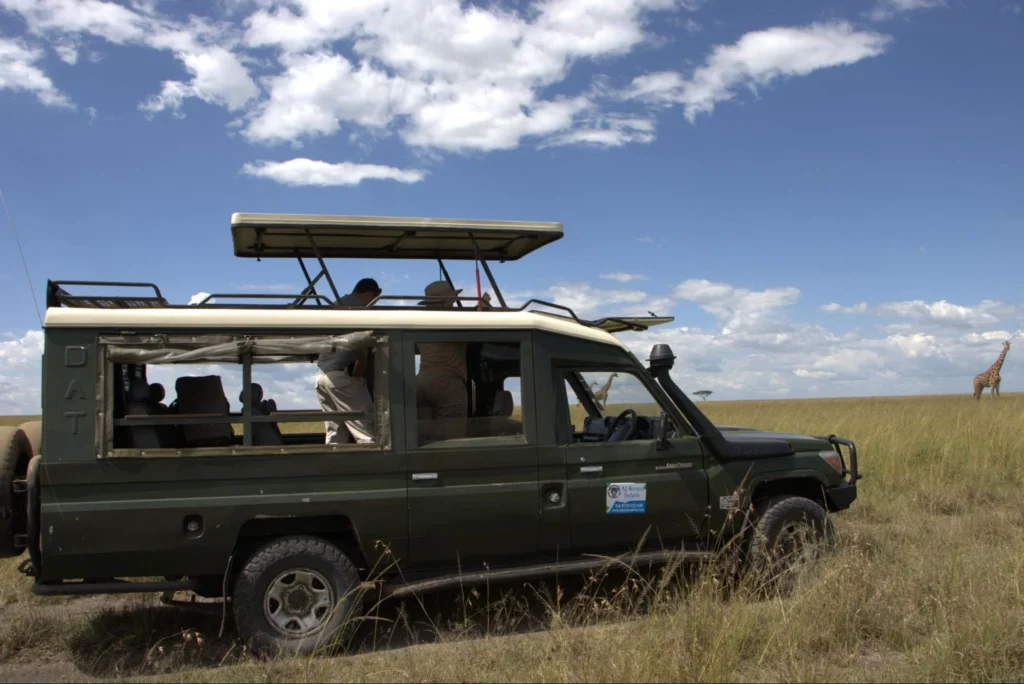
A 10 days Kenya safari with us runs north to Samburu and Ol Pejeta, down through the Rift Valley to Lake Nakuru, across to the Masai Mara for three nights, then back up to Lake Naivasha and Hell’s Gate before you fly home. For 2027 it costs from USD 3,950 or KES 280,000 per person sharing, by private Land Cruiser with all park fees and full board.
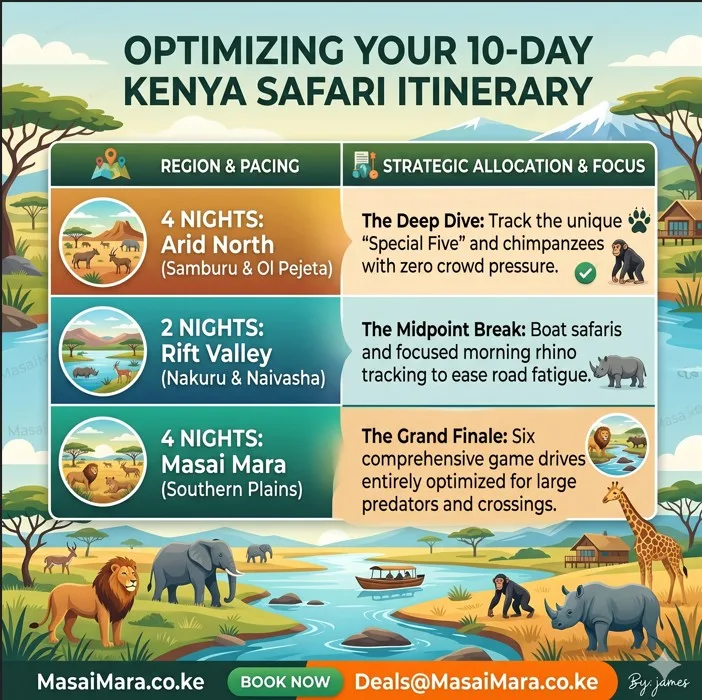
| Region And Pacing | Strategic Allocation And Focus |
|---|---|
| 4 nights: Samburu and Ol Pejeta | The Special Five in the dry north, then chimpanzees, black rhinos and the last two northern white rhinos below Mount Kenya. |
| 1 night: Lake Nakuru | A fenced rhino park on the way south, with a full afternoon drive. |
| 3 nights: Masai Mara | Five game drives across two full days for lions, cheetahs, leopards and the river crossings. |
| 1 night: Lake Naivasha | A boat, a walk among giraffes, then cycling in Hell’s Gate on the last morning. |
10 Days Kenya Safari Costs (2027)
These prices cover nine nights, two people sharing one private 4×4 Land Cruiser, with every park and conservancy fee on the route already paid. The shilling prices are calculated on their own, from citizen park fees and resident lodge rates, rather than taken from the dollar column.
International Visitors (USD)
| Tier | Lodges (Samburu + Ol Pejeta + Nakuru + Mara + Naivasha) | Jan-June | July-Dec |
|---|---|---|---|
| Budget | Lion King Bush Camp + Comfort Gardens Sweetwaters + Ziwa Bush Lodge + Mara Sidai Camp + Kongoni Lodge | 3,950 | 4,690 |
| Mid-Range | Samburu Sopa Lodge + Sweetwaters Serena Camp + Lake Nakuru Sopa + Mara Sopa Lodge + Lake Naivasha Sopa | 4,650 | 5,660 |
| Luxury | Samburu Intrepids + Ol Pejeta Bush Camp + Sarova Lion Hill + Sarova Mara Game Camp + Enashipai Resort | 6,160 | 8,060 |
Kenyan Citizens (KES)
| Tier | Lodges (Samburu + Ol Pejeta + Nakuru + Mara + Naivasha) | Jan-June | July-Dec |
|---|---|---|---|
| Budget | Lion King Bush Camp + Comfort Gardens Sweetwaters + Ziwa Bush Lodge + Mara Sidai Camp + Kongoni Lodge | 280,000 | 310,000 |
| Mid-Range | Samburu Sopa Lodge + Sweetwaters Serena Camp + Lake Nakuru Sopa + Mara Sopa Lodge + Lake Naivasha Sopa | 332,000 | 379,000 |
| Luxury | Samburu Intrepids + Ol Pejeta Bush Camp + Sarova Lion Hill + Sarova Mara Game Camp + Enashipai Resort | 439,000 | 555,000 |
If you hold a Kenyan work or residence permit, your park fees fall between the two sets of prices above, so mention it when you enquire and we will price your trip on resident rates.
Note: The July to December column is higher because the Mara fee doubles in those months and most lodges charge their high-season rate. With three Mara nights, this trip can sometimes use the stay-longer offers some Mara camps run in quieter months, so ask when you book. If you would like to fly one leg, see our Masai Mara flying packages. For camps above our Luxury tier, see our luxury safari Masai Mara page.
What Is Covered In The Price?
- Vehicle: One private 4×4 Land Cruiser with a pop-up roof for all ten days, fuel included.
- Guide: A TRA-licensed guide who collects you in Nairobi and drops you at the airport or your hotel on Day 10.
- Park Fees: Every 2027 entry on the route. Samburu goes to Samburu County, Ol Pejeta to the conservancy, Lake Nakuru and Hell’s Gate through KWS eCitizen with the KWS vehicle fee, the Masai Mara to Narok County, and Crescent Island to the private sanctuary.
- Activities: The Naivasha boat ride, the Crescent Island walk and the Hell’s Gate cycling permit.
- Accommodation: 9 nights full board, with packed lunches on full game drive days.
- Water: Refills for your reusable bottle in the vehicle every day.
- Cover: AMREF Flying Doctors evacuation cover.
- Excluded: Tips (USD 15 to 20 / KES 2,000 to 2,500 per day), drinks, bike hire and the gorge guide at Hell’s Gate, the hot air balloon (USD 500 / KES 58,500), the Maasai village visit (KES 1,500 for citizens / USD 20 for non-residents), Ol Pejeta extras such as the northern white rhino visit (USD 70) and the night drive (USD 70), international flights, the Kenya eTA (USD 34) and Kenya’s inbound travel health insurance (up to USD 44 a person).
I have been guiding for ten years, and the most common mistake I see on a ten-day trip is trying to fit in too many parks. This route uses six, but it gives two nights to the places that need them and only one to the places that do not. It covers about 1,300 km, and every road day before the last still ends with an afternoon among animals.
How to Split 10 Days
Most ten-day plans I am sent try to squeeze in seven or eight parks, and the guests are tired of packing before they see a lion. Here the long stays go to Samburu, Ol Pejeta and the Mara, and the lakes come in as short, easy stops. You get twelve game drives, plus the boat, the walk and the cycling. There is no game drive on the morning you leave a park.
Day 1: Nairobi To Samburu, Afternoon Game Drive
Pick-up is at 6:30 AM, early enough to be out of Nairobi before Thika Road fills with commuters. The road is tarmac all the way north through Nanyuki and Isiolo, with a short coffee stop at the Equator. You reach the lodge for lunch at about 1 PM, and the first drive follows the Ewaso Nyiro River from about 3:30 PM.
Day 2: Full Day Of Game Drives In Samburu
Two drives, early and late, with the hottest hours spent at the lodge. Mornings are for the Grevy’s zebra, reticulated giraffe, Beisa oryx, gerenuk and Somali ostrich out on the plains. In the afternoon we follow the river, where the elephants come down to drink and the leopards rest in the doum palms.
Day 3: Samburu To Ol Pejeta, Afternoon Game Drive
No game drive this morning. After breakfast we head back south past Isiolo and up onto the Laikipia plains, about 3 hours, and reach your camp in time for lunch. The Sweetwaters Chimpanzee Sanctuary opens to visitors from 2 PM to 4:30 PM in the afternoon session, so we are back in the vehicle by 3 PM to give you a full hour with the chimps, then drive the plains with Mount Kenya behind you.
Day 4: Full Day In Ol Pejeta
A morning visit to Najin and Fatu, the last two northern white rhinos alive, if you have booked it, then the Big Five on the open plains. Ol Pejeta has one of the largest black rhino populations in East Africa, and lions here are often easier to find than visitors expect. If you want it, the evening ends with a night game drive.
Day 5: Ol Pejeta To Lake Nakuru, Afternoon Game Drive
No game drive this morning. We leave at about 8 AM, west across Laikipia to Nyahururu for twenty minutes at Thomson’s Falls, then down the Subukia valley to Nakuru, about 3.5 hours. Lunch is at your lodge, and the rhino drive starts at about 3:30 PM, heading for the southern grassland first.
Day 6: Lake Nakuru To The Masai Mara, Afternoon Game Drive
No game drive this morning. We leave by 7:30 AM, through Njoro and over the Mau to Narok, and reach your Mara camp for lunch at about 1:30 PM. If you want to visit a Maasai village, we go to one just outside the gate from about 2:30 to 3:45 PM, then enter the reserve at 4 PM for a first drive until the gates close at 6 PM.
Days 7 And 8: Full Days In The Masai Mara
Two full days, out at dawn with a picnic lunch each time. If you want the balloon, book it for Day 7, your second day in the Mara, so Day 8 is there as a backup if the wind or rain keeps it on the ground. From July to October we spend the middle of the day at the Mara River crossing points.
Day 9: Masai Mara To Lake Naivasha, Boat Ride And Walking Safari
No game drive this morning. We leave at about 8 AM, through Narok and up to Mai Mahiu, then down to the lake, about 4.5 to 5.5 hours. After lunch at your Naivasha lodge, you take the boat out at about 2:30 PM among the hippos and fish eagles, then land on Crescent Island and walk among giraffes, zebras and wildebeest on foot.
Day 10: Hell’s Gate National Park, Then Nairobi
We are at the Hell’s Gate gate when it opens. You cycle in past Fischer’s Tower, among zebras and buffalo, then walk the Ol Njorowa Gorge with a local guide. After lunch, it is about 2 to 2.5 hours to Nairobi. We drop you at your hotel, or at Jomo Kenyatta International Airport by about 4 to 5 PM, so book a flight that leaves after 9 PM.
A shower before you fly. Naivasha lodges check you out by about 10 or 11 AM, so your bags are in the vehicle while you cycle about 16 km on gravel and scramble through a warm, muddy gorge. Nobody wants to board a long-haul flight like that. If you are flying out on Day 10, we book a late check-out or a day room, either at your Naivasha lodge or at a hotel near the airport, so you can shower, change and repack before the airport.
Why Naivasha comes after the Mara. Most trips end in the Mara, and on most routes that makes sense. Here we go to Naivasha on Day 9 on purpose. It splits the drive home into two easy halves, about 4.5 hours on Day 9 and 2 hours on Day 10, instead of 6 hours in the vehicle on the day you fly. And it swaps a long last morning on the road for a bike, a walk and fresh air.
The Road Between Parks
This route climbs and drops more than any other trip we run, and it crosses four very different kinds of country. By the end it feels like you have been to several countries, not one.
- The dry north (Samburu): low and hot, at about 800 to 1,000 m, with thorn scrub, doum palms and afternoons over 35°C.
- The central highlands (Ol Pejeta): around 1,800 m on the Laikipia plateau, with cool air, open grassland and Mount Kenya’s twin peaks on clear mornings.
- The Rift Valley lakes (Nakuru and Naivasha): volcanic country, with a soda lake, a freshwater lake, drowned acacia forest and the steam vents of Hell’s Gate.
- The savannah (the Masai Mara): rolling grass plains at about 1,500 to 2,100 m, with more big predators than anywhere else on the trip.
The cold above Nanyuki. The temperature swing catches people out. Samburu can pass 35°C in the afternoon, and the high ground around Timau, on the road north of Nanyuki, can be very cold at dawn. Keep a warm layer in the vehicle with you on Day 1 and Day 3, not packed away at the back.
The miraa trucks. North of Nanyuki you share the road with pick-ups carrying miraa, a leaf that has to reach market fresh, so the drivers do not hang about. If one comes up behind us with its hazard lights on, we pull over and let it pass. It is one more reason to leave the driving to a guide who knows the road.
Ol Pejeta and the Rhino Capital
Ol Pejeta and the Rhino Capital
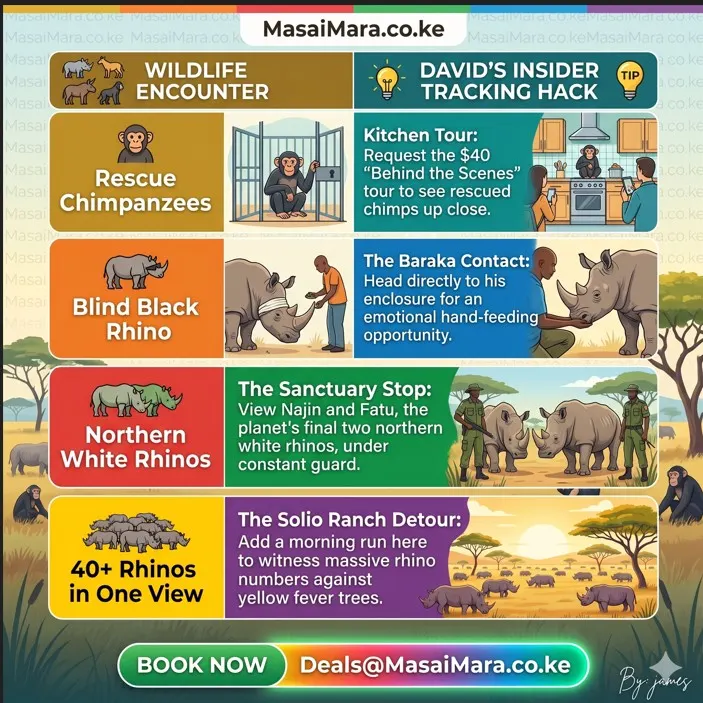
| Wildlife Encounter | David’s Insider Tip |
|---|---|
| Rescued Chimpanzees | The afternoon session runs from 2 PM to 4:30 PM, so we leave camp by 3 PM on Day 3. |
| Black Rhinos | Stop at the Morani Information Centre near the conservancy headquarters to understand how the rhinos are protected. |
| Northern White Rhinos | Book the USD 70 visit to Najin and Fatu ahead of time, because places are limited. |
| Solio’s Rhinos | With an extra night, a morning at Solio Ranch, between Nanyuki and Nyeri, can show you dozens of rhinos in one sweep. |
A ten-day trip gives you time for a proper look at Ol Pejeta, rather than the quick stop most shorter routes allow.
The chimps. Sweetwaters is the only place in Kenya to see chimpanzees. It opened in 1993 with the Jane Goodall Institute, and its first chimps came from Burundi. Today it takes in chimps rescued from the bushmeat and pet trades, and you watch them across the river that keeps them apart from the rest of the conservancy.
Najin and Fatu. Najin and her daughter Fatu are the last two northern white rhinos on earth, guarded day and night. Najin was retired from egg collection in 2021, so Fatu is now the only donor for the scientific programme working to create northern white rhino embryos for southern white rhino surrogates. The “Meet the Northern White Rhinos” visit costs USD 70 per adult.
The rhinos that came before. Baraka, the blind black rhino visitors once met at Ol Pejeta, died in August 2026. The Baraka and Morani Information Centre is still open, free of charge, and the conservancy’s other black and white rhinos are still out on the plains.
Solio Ranch. Solio is a private ranch towards Nyeri with a long history of rhino breeding, and on a good morning you can see more rhinos there in an hour than on a whole week elsewhere. It is not an open park. Visits are booked privately in advance and carry their own conservation fee, so plan Solio as a dedicated morning with an extra night, and tell us when you book rather than on the day.
Eleven headline animals. Put the north and the south together and this route gives you a real chance at a long list. The Big Five: lions in the Mara and at Ol Pejeta, leopards in Samburu and the Mara, elephants in Samburu and the Mara, buffalo in the Mara and at Nakuru, and both black and white rhinos at Ol Pejeta and Nakuru. The Samburu Special Five: Grevy’s zebra, reticulated giraffe, Beisa oryx, gerenuk and Somali ostrich. And the chimpanzees at Sweetwaters, which you will not see anywhere else in Kenya. Southern routes miss the Special Five and the chimps, and short trips rarely leave room for both rhinos. Our guide to the animals in the Masai Mara covers the southern half of the list.
The Mara on Day 7
By the seventh day, something happens that shorter trips never reach. Another lion starts to feel normal. Your head is full.
The slow drive. On Day 8, tell me if you want a different kind of morning. We spend two hours on the small things: dung beetles, birds, and the tracks in the dust. Once you can read what walked down the track before you, the bush looks different, and the next lion you see means more because you know what it crossed to get there.
Your last Mara morning. Mara tickets run per calendar day and close at 6 PM, so there is no game drive on Day 9. If your camp is inside the reserve, you need to be out of the gate by 10 AM. Camps outside the gates have no deadline.
Looking after your photos. Do not copy thousands of photos in the vehicle. The Mara dust is very fine and gets into open ports. Wait for the lodge in the evening, and bring a portable drive.
13 Things to Know Before You Go
13 Things to Know Before You Go
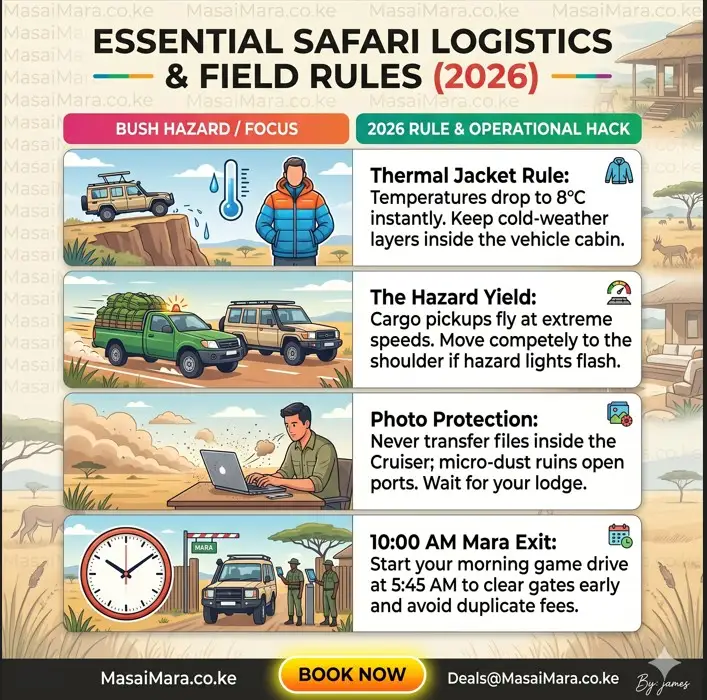
| Bush Hazard Or Focus | 2027 Rule And Operational Tip |
|---|---|
| The Cold North Of Nanyuki | Keep a warm layer in the vehicle on Days 1 and 3, not in your bag. |
| Miraa Trucks | Pull over and let fast pick-ups with hazard lights pass. |
| Mara Dust | Never copy photos in the vehicle. Wait for the lodge. |
| Mara Calendar-Day Tickets | No game drive on Day 9, and out by 10 AM if your camp is inside the reserve. |
- Health Cover Before You Fly. Kenya now asks every foreign visitor on a short stay to hold its own inbound travel health insurance. It came in on 5 October 2026, covers children too, costs no more than USD 44 a person and pays up to USD 50,000 towards treatment or evacuation. Buy it on eCitizen when you apply for your eTA, because the cover only begins once the policy is issued. Kenyan citizens, residents and East African Community nationals do not need it.
- Arrive A Day Early. If you can, land the day before Day 1. A morning at the Sheldrick Wildlife Trust’s elephant orphanage (book online ahead), an afternoon at the Giraffe Centre and dinner at The Talisman in Karen make a good start.
- 15 kg If You Fly. If you fly any leg, the small aircraft allow 15 kg each in a soft bag. See our Masai Mara flying packages.
- Two Nights Where It Counts. Packing and unpacking every morning wears you down. This route gives two nights or more in Samburu, Ol Pejeta and the Mara, which is where the game viewing is best.
- Early December. The short rains turn everything green, the crowds thin out and lodge rates drop before Christmas. It is one of the quietest times to do this route.
- The Right Gate At Nakuru. Coming from Ol Pejeta, we usually enter through Lanet Gate, then head south to the rhino grassland.
- Groups Larger Than Six. A Land Cruiser takes six comfortably with a window each. For seven or more, we split you into two vehicles rather than squeeze you into a minivan.
- Book Peak Season Early. For July to October, start planning about ten months ahead. Lodge rooms run out long before vehicles do.
- A Guide Who Understands Light. On a ten-day trip you spend more time with your guide than with anyone else. One who knows when the light is best and how to wait at a sighting makes a real difference to your photographs.
- The Hell’s Gate Gorge. Your gorge walk on Day 10 is with a local guide, which we book and pay for in advance so there is no wait at the gorge. In heavy rain the gorge can flood quickly, so the guide may shorten or cancel the walk.
- Stay-Longer Offers. Some Mara camps offer a free or cheaper third night in the quieter months, and this trip has three Mara nights. Ask when you book.
- Adding Tanzania. There is no tourist border crossing between the Mara and the Serengeti. See the FAQ below for how to combine the two.
- Insect Repellent At The Lakes. Mosquitoes are thicker by the water at Naivasha. Put repellent on from late afternoon.
The Couple Who Wanted Seven Parks
A couple from London once emailed me a spreadsheet: Samburu, Ol Pejeta, the Aberdares, Nakuru, Naivasha, the Mara and Amboseli, colour-coded by day. They had spent weeks on it.
I told them it would not work. Too much driving. They had already paid deposits at two of the lodges and did not want to lose them, so we ran their plan.
By Nakuru on Day 5, the wife was sleeping through every game drive. She was not bored. Her body had had enough of six hours a day in the vehicle and a new lodge every night. They dropped Amboseli and spent their last two days at a Mara camp with a pool.
At the airport she said to me, “We should have listened to you.” I hear that about twice a year.
The Route And Drive Times
| Leg | Route | Time |
|---|---|---|
| Nairobi to Samburu | The A2 through Thika, Karatina, Nanyuki and Isiolo to Archers Post | About 6 hours |
| Samburu to Ol Pejeta | Isiolo, Nanyuki, onto the Laikipia plains | About 3 hours |
| Ol Pejeta to Lake Nakuru | Nyahururu, Thomson’s Falls, the Subukia valley | About 3.5 hours |
| Lake Nakuru to the Masai Mara | Njoro, Mau Narok and Narok | 5 to 6 hours |
| Masai Mara to Lake Naivasha | Narok and Mai Mahiu | 4.5 to 5.5 hours |
| Naivasha to Nairobi | The Rift Valley escarpment | 2 to 2.5 hours |
2027 Park Fees
Five authorities collect fees on this trip. Samburu belongs to Samburu County and Ol Pejeta is a private conservancy. Lake Nakuru and Hell’s Gate are KWS parks, the Mara is Narok County’s, and Crescent Island is a private sanctuary.
Non-Residents (USD)
| Park | Adult | Child |
|---|---|---|
| Samburu | 85 | 50 |
| Ol Pejeta | 110 | 55 (3 to 11) |
| Lake Nakuru | 90 | 45 (5 to 17) |
| Masai Mara | 100 Jan-June, 200 July-Dec | 50 (9 to 17), under 9 free |
| Crescent Island | 33 | 16 (5 to 15) |
| Hell’s Gate | 50, plus 10 to cycle | 25 |
Kenyan Citizens (KES)
| Park | Adult | Child |
|---|---|---|
| Samburu | 800 | 300 |
| Ol Pejeta | 2,000 | 1,000 |
| Lake Nakuru | 1,500 | 750 |
| Masai Mara | 1,500 Jan-June, 3,000 July-Dec | 300 / 500 |
| Crescent Island | 800 | 400 |
| Hell’s Gate | 500, plus 300 to cycle | 250 |
Kenya Residents (KES)
| Park | Adult | Child |
|---|---|---|
| Samburu | 1,600 | 500 |
| Ol Pejeta | 3,500 | 1,750 |
| Lake Nakuru | 2,025 | 1,050 |
| Masai Mara | 2,500 Jan-June, 4,500 July-Dec | 1,250 / 2,500 |
| Crescent Island | 1,100 | 550 |
| Hell’s Gate | 675, plus 300 to cycle | 350 |
Across the ten days you use two Samburu tickets, two Ol Pejeta tickets (overnight guests pay per 24 hours), one Nakuru ticket, three Mara tickets, one Crescent Island entry and one Hell’s Gate ticket. All of them are bought before you arrive and are part of the package. For the rules on each, see Samburu County, the Ol Pejeta 2026 tariff, KWS eCitizen, the Mara online ticketing system and our Masai Mara park fee page.
Best Time To Visit
| Season | Samburu And Ol Pejeta | Nakuru And Naivasha | Masai Mara |
|---|---|---|---|
| January to March (dry) | Animals gather by the river and waterholes | Clear skies, calm water | Short grass, easy cat tracking |
| April and May (long rains) | Green, animals spread out | Muddy tracks, gorge walks can close | Mud, very few vehicles |
| July to October (dry) | Excellent Special Five viewing | Busy lakes, good rhino viewing | The Great Migration |
| November and December (short rains) | Green and quiet | Migrant birds arriving | Green plains, newborn animals |
For a month-by-month picture, see our best time to visit guide.
Frequently Asked Questions
How much does a 10 days Kenya safari cost?
With us, from USD 3,950 for international visitors or KES 280,000 for Kenyan citizens, per person sharing, between January and June on the Budget tier. Mid-Range starts at USD 4,650 / KES 332,000 and Luxury at USD 6,160 / KES 439,000. The price covers the vehicle, the guide, all park and conservancy fees, the Naivasha boat, Crescent Island, the Hell’s Gate cycling permit and full board.
Is 10 days too long for a Kenya safari?
No. Ten days is when a safari stops feeling like a schedule. You get eight days with game drives, two full days in the Mara, and time at the lakes to get out of the vehicle.
What documents and insurance do I need?
A Kenya eTA, which costs USD 34, and, since 5 October 2026, Kenya’s inbound travel health insurance, up to USD 44 each, children included. Both are done online before you travel. Kenyan citizens, residents and East African Community nationals are exempt from the insurance.
What is the best month?
July to October for the migration. Early December for green landscapes, fewer people and lower prices. January and February for animals concentrated around water in Samburu.
Is a 4×4 Land Cruiser mandatory?
Yes. Samburu, Nakuru and the Mara all have tracks that turn to deep mud after rain.
Can I add Tanzania?
Yes, but not by road from the Mara. The Sand River crossing has been closed to tourist vehicles for decades. You either fly from a Mara airstrip towards the Isebania border and on into the Serengeti, or fly back to Nairobi and connect to Kilimanjaro or Arusha. Tanzania visa costs depend on your nationality, so check before you book.
Can I add a beach after?
Yes. The easiest way is to fly from Nairobi to the coast on Day 10 instead of flying home. See our Masai Mara and Diani Beach packages.
Can I add Amboseli or Nairobi National Park?
Yes, with extra days. Amboseli needs at least two more nights. Nairobi National Park fits well on an arrival day if you land the night before Day 1.
What should I pack?
Soft bags, layers for Samburu heat and the cold mornings above Nanyuki, closed shoes for the Hell’s Gate gorge, a power bank, binoculars, a portable drive for photos, insect repellent and a Safaricom SIM. Full list in our packing list.
Is this trip safe?
Yes. Every park on the route has rangers, your guide carries a radio and the lodges are well established. The main road risk is the fast traffic north of Nanyuki, and your guide handles that.
What 10 Days Actually Feels Like
For the first three days, everything is new, and you photograph every zebra. By Day 5 your eye is sharper, and you can tell a resting lion from a hunting one before your guide says a word. By Day 7 the big animals feel familiar, so I slow things down with tracks and birds. By Day 9 you are reading the bush yourself: an oxpecker lifts off, and you know there is a buffalo behind the bushes before it steps out. That change does not happen on a four-day trip, and it barely happens on seven. Ten days is where it starts.
If ten days feels like too much, look at a 5 days Masai Mara safari. For fewer parks with more depth, see our Masai Mara, Samburu and Lake Nakuru safari. Browse everything on our Masai Mara safari packages page.
Related Reading:
- Masai Mara, Samburu and Lake Nakuru Safari
- 8 Days Masai Mara, Samburu and Lake Nakuru Safari
- Masai Mara and Samburu Safari
- Masai Mara, Lake Nakuru and Lake Naivasha Safari
- Masai Mara, Amboseli, Nakuru and Naivasha Safari
- Masai Mara, Amboseli and Tsavo Safari
- Masai Mara and Diani Beach Safari
- 5 Days Masai Mara Safari
- Masai Mara Safari Packages
- Luxury Safari Masai Mara
- Masai Mara Flying Packages
- Masai Mara Migration
- KWS Park Fee Portal
Written by David Njunge, TRA-licensed safari guide with over 10 years in the Masai Mara. Edited by Cess Wambui, travel consultant, BSc Tourism and Hospitality Management. Verified for the 2027 season.
Welcome to Masaimara.co.ke
Thank you for visiting us! We're excited to help you plan an unforgettable safari adventure across Kenya.