
Wildebeest in Masai Mara: The Honest 2026 Guide
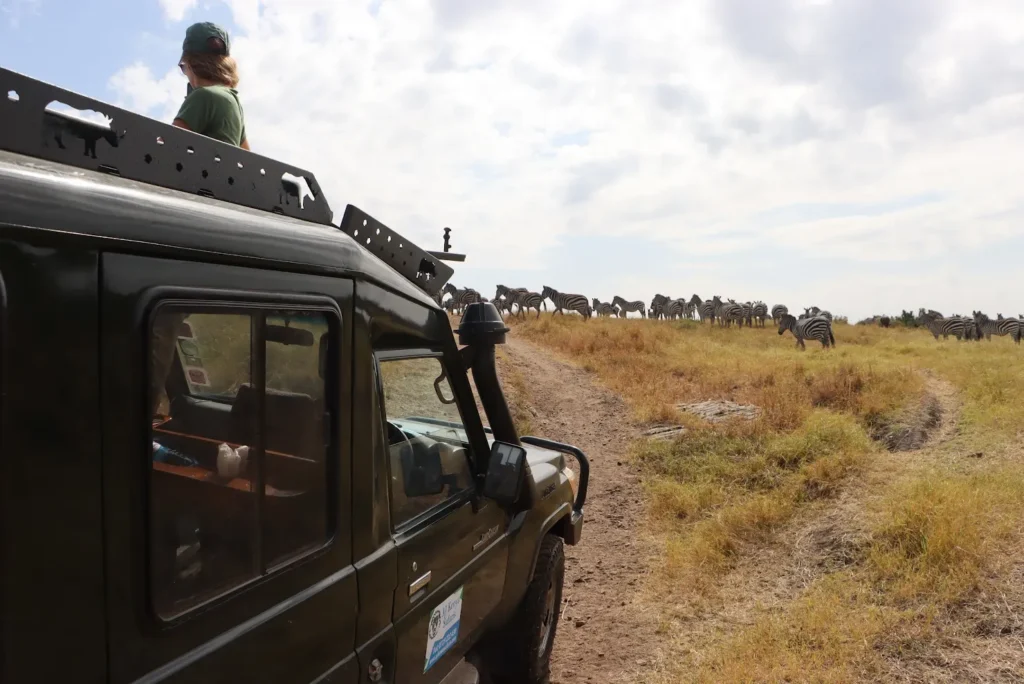
About 1.5 million wildebeest move through the Masai Mara between July and October as part of the Great Migration. The river crossings are the most dramatic wildlife event in East Africa, but they require patience, flexibility, and the right camp. For the 2026/2027 season, all-inclusive 5-day itineraries range from KES 252,200 ($1,940) to KES 1,348,100 ($10,370) per person sharing. Reserve entry is $100–$200/day. Conservancy fees ($80–$150/night) are included in camp rates.
Safari Costs (2026/2027)
All-inclusive prices per person sharing, based on two people in a private 4×4 Land Cruiser. Conservancy fees are included in camp rates.
5-Day All-Inclusive Rates (Per Person Sharing)
Package Tier | Camps (Nakuru + Mara) | Regular Season (KES) | Peak Season (KES) |
Budget | Lake Nakuru Lodge / Ol Kinyei Adventure | KES 252,200 | KES 447,200 |
Mid-Range | Sarova Lion Hill / Karen Blixen Camp | KES 304,200 | KES 538,200 |
Luxury | The Cliff Nakuru / Porini Lion Camp | KES 529,100 | KES 828,100 |
Luxury Plus | The Cliff Nakuru / Mara Plains Camp | KES 867,100 | KES 1,348,100 |
Note: Conservancy fees included. Reserve entry is extra ($100–$200/day). For a luxury safari or flying packages, request a custom quote.
What’s Covered
- A private 4×4 Safari Land Cruiser for the full trip.
- A TRA-licensed guide who knows the crossing points and herd behaviour.
- All conservancy conservation fees and Lake Nakuru entry fees.
- Night drives, off-road tracking, and guided walking safaris with Maasai trackers.
- One-way return flight from the conservancy airstrip to Nairobi Wilson (flight details).
- Full board, 3 meals daily.
- AMREF Flying Doctors emergency air evacuation insurance.
What’s Excluded
- Kenya eTA (~$30).
- Tips (KES 3,000/day for guide).
- Alcohol and premium drinks.
- Hot air balloon ($450–$500).
- Main reserve entry fees if crossing into the public park ($100–$200/day extra).
- International flights.
The 5-Day Itinerary
Day 1: Nairobi to Lake Nakuru
Leave Nairobi early. Afternoon at Lake Nakuru tracking rhinos. Stay at your selected lodge.
Day 2: Nakuru to the Mara
Drive through the Rift Valley. Enter the conservancy or reserve via the access tracks or fly in. During migration season, the herds are visible within minutes of entering. Thousands of animals spread across the plains as far as the horizon. Stay at your chosen camp.
Day 3–4: Full Days
Two full days. During migration, at least one morning should be spent at a crossing point. The wait can be hours. The guide monitors the radio and reads the herd to decide whether to stay or move. The rest of the time covers lions, leopards, cheetahs, and general game across the conservancy and reserve.
Day 5: Departure
Early morning drive. Fly back to Nairobi from the conservancy airstrip (fly-in options).
Wildebeest Behaviour in Masai Mara
Herd Behavior / Signal | Expert Field Interpretation (E-E-A-T) |
Mass Alignment Trot | Herds freeze and align to pursue storm vibrations up to 50 kilometers away. |
Muzzle Soil Tracking | Animals lower snouts to track chemical trails left by interdigital hoof glands. |
Decentralized Surge | No alpha leader exists; front animals are simply forced forward by pack pressure. |
Continuous Low Grunt | Massive vocalizations form a loud acoustic wall used to maintain mass group cohesion. |
Ash Soil Grazing | Nursing cows selectively follow volcanic grass belts rich in phosphorus and calcium. |
Wildebeest have no alpha, no leader, and no permanent family structure. The herd moves as a decentralised mass where each animal follows the one in front of it. I’ve heard other guides tell guests that a brave leader plunges in first. It makes a good story, but after ten years of watching crossings, that’s not what I see. The animal that enters the water first is usually the one that got pushed past its footing by the pressure of the thousands behind it. The back of the herd hears water and presses forward. The front has nowhere to go but in.
How they track distant rain is still debated. Guides and researchers have observed that herds begin moving toward storms they can’t possibly see, sometimes from 50 kilometres away. Some scientists think they detect the scent of rain-soaked earth carried on wind currents. Others suspect they pick up low-frequency vibrations from distant thunderstorms the way elephants do. Whatever the mechanism, the behaviour is real. When a resting herd suddenly aligns in one direction and starts trotting across a dry plain under clear sky, they’re heading toward water that hasn’t arrived yet.
Wildebeest have interdigital glands between the hooves that secrete scent onto the ground with every stride. When the herd scatters at night, whether from a lion ambush or a sudden noise, the separated animals put their muzzles to the soil and follow the chemical trail left by the main group. A herd sometimes traces a winding route across open ground rather than running straight because they’re tracking the footsteps of the animals ahead of them.
No photograph captures what a wildebeest herd sounds like. A continuous, low grunting from hundreds of thousands of animals produces a wall of sound that carries for kilometres. During peak migration, the plains carry a heavy animal smell from the sheer density. Guests who have only seen migration footage are not prepared for how physical the experience is.
Calving happens in the southern Serengeti between January and March, not in the Mara. Over 80% of pregnant cows give birth within a 2-to-3 week window, flooding the predator network with more calves than the lions and hyenas can take. By the time the herds reach the Mara in July, the calves are several months old and running with the group. Guests sometimes expect to see newborns here. They won’t.
Pregnant and nursing cows don’t chase just any green grass. They follow specific species growing on young volcanic ash soils because those grasses carry higher concentrations of phosphorus and calcium, the minerals needed for bone development and milk production. The migration route traces these mineral-rich belts across the ecosystem.
Several thousand wildebeest drown every year. Misjudged high-water crossings, steep banks that cause pile-ups, animals trampled by the herd behind them. The carcasses pile up downstream and feed crocodiles, vultures, and marabou storks for weeks. Over a peak week of crossings, the mass of drowned animals temporarily changes the underwater contour of the riverbed.
Outside migration season, a resident population stays on the Mara’s plains year-round.
How a Crossing Develops
Crossing Stage / Variable | On-The-Ground Protocol & Tactical Reality |
Wide Circular Milling | Indicates extreme group anxiety; the herd will loop repeatedly and refuse to plunge. |
Single-File Compression | The circular mass narrows into a tight downhill line; a crossing is imminent. |
Head-Snap Drinking | Impatient scouts sip water while quickly jerking heads up; signals a false alarm. |
Sustained Muzzle Hold | A scout keeps its snout submerged without looking up; the stampede follows within a minute. |
Immediate River U-Turns | Blocked front columns get crushed by incoming mass and turn back into dangerous waters. |
A crossing stakeout means hours of waiting in the vehicle. The herd gathers on one bank, approaches the edge, turns back, gathers again. False starts are normal. Most guests who leave early miss the crossing because they didn’t know what to watch for.
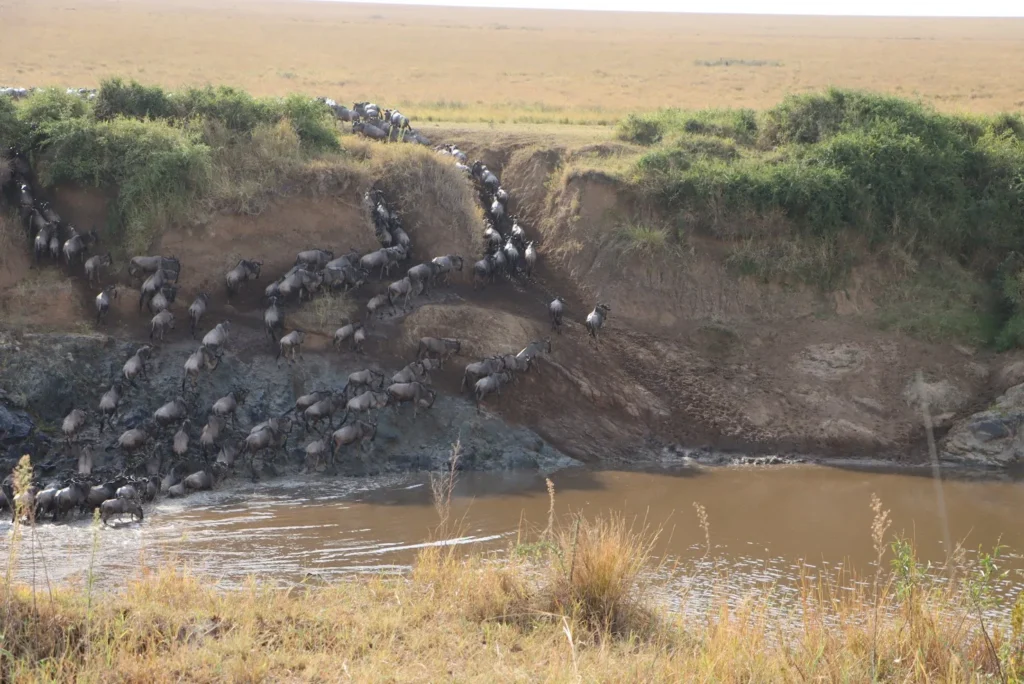
The shift from milling to committed happens in stages. As long as the herd is gathered in a wide, circular, chaotic block along the upper ridge, they won’t cross. They’re cycling under tension, reacting to wind shifts and shadows. The moment that circular block narrows and compresses into a tight single-file line pointing downhill toward the water, the crossing is about to happen. I watch the first animals to reach the waterline. If they drink while snapping their heads up to scan, it’s still a false alarm. When one animal drops its muzzle into the water and holds it there for more than a few seconds without looking up, the internal alarm has switched off. The stampede follows within a minute.
I’ve sat through three-hour waits where guests asked to leave and I talked them into staying. Every time, the crossing happened after the patience ran out and then came back. The guides who produce crossings are the ones who read the shape of the herd and refuse to drive away.
The herds sometimes cross and then immediately turn around and swim back. Guests assume stupidity. What’s actually happening is that the front animals hit an obstacle on the far bank, a mud wall they can’t scale or the scent of a predator, and try to stop. But the back of the herd is still charging into the water because the decentralised system has no way to communicate backwards through thousands of animals. The animals caught in the middle get crushed between the incoming pressure and the blocked front. They turn and flee the only way that’s open, back through the water they just crossed.
The main crossing points, Crossing Point #7, the Lookout, the Sand River, get overwhelmed with vehicles during August and September. Hundreds of tour vans queue along the banks. Entim Mara Camp sits on a private stretch of river where crossings happen away from the vehicle congestion. Staying inside the park or in a conservancy that borders the river is the practical answer to the crowding problem. A camp on the river margins puts the crossing within morning-drive distance rather than a 90-minute drive from the gate.
Climate change is making the timing increasingly unpredictable. Drought years delay the migration. Heavy rain brings the herds early. Building flexibility into the itinerary matters more than targeting a specific date.
What to Know Before Booking
- Build the safari around the full Mara experience (lions, leopards, cheetahs, elephants, the plains herds) and let the crossing be a bonus if it happens. Guests who plan the entire trip around a single event set themselves up for frustration.
- August and September have the highest odds of crossings but also the worst vehicle crowding. Late July and early October are quieter with reasonable odds.
- Ask the operator which camps have direct river access before booking. The crossing section above explains why location matters more than star rating during migration.
- The spectacle of the herds on the plains is worth the trip even without a crossing. Thousands of wildebeest spread to the horizon, predators working the margins, the constant sound. That is the migration, and it happens every day during the season.
- Predators stake out crossing points weeks in advance. Lions resting near the river bank in early July are often the first sign that crossings are imminent.
Questions Guests Ask
When is the best time to see the migration in the Mara?
Late July through mid-October. August and September have the highest concentrations. The migration guide and wildebeest migration page cover the full seasonal cycle.
Can I see wildebeest outside migration season?
Yes. The Behaviour section above covers this. Smaller herds are present in the Mara in every month.
Do all the wildebeest cross into Kenya?
Less than half. The migration splits, with a large portion remaining in the northern Serengeti. The animals that cross into Kenya are still numbered in hundreds of thousands.
Why do the herds sometimes cross back immediately?
The front animals hit an obstacle on the far bank while the back of the herd keeps pushing forward. The trapped animals in the middle flee the only way they can, back through the water. It’s a system failure, not stupidity.
How many vehicles will be at the crossing point?
During August and September at the main public points, dozens to hundreds. Get in touch and we’ll suggest camps with private river access or quieter crossing points.
A 5-day safari during migration gives enough time for a crossing attempt alongside the full Mara experience. The 3-day and 4-day trips reduce the odds because fewer mornings mean fewer chances at a crossing point. For Amboseli alongside the Mara, the 6-day circuit or three-park loop cover both parks. Everything from luxury lodges to fly-in transfers is on the packages page, or send us your dates and we’ll find a camp on the river. The booking page has the logistics.
This guide was authored by David Njunge, a TRA-licensed safari guide with over 10 years of experience, and edited by Cecilia Wambui, a travel consultant with a degree in Tourism and Hospitality Management.
Related Reading:
- Lions in Masai Mara
- Leopards in Masai Mara
- Cheetahs in Masai Mara
- Elephants in Masai Mara
- Rhinos in Masai Mara
- Buffalo in Masai Mara
- Hippos in Masai Mara
- Crocodiles in Masai Mara
- Giraffes in Masai Mara
- Zebras in Masai Mara
- Masai Mara Conservancies
- Conservancy vs National Reserve
- Olare Motorogi Conservancy
- Mara North Conservancy
- Ol Kinyei Conservancy
- Siana Conservancy
- Lemek Conservancy
- Ol Chorro Conservancy
- Enonkishu Conservancy
- Pardamat Conservation Area
- Masai Mara Entrance Gates
- Best Time to Visit Masai Mara
- Wildebeest Migration Kenya
- Masai Mara Migration
- Birding Safari Masai Mara
- Photography Safari Masai Mara
- Walking Safaris Masai Mara
- Night Game Drive Masai Mara
- All Inclusive Masai Mara Safari
- Masai Mara Amboseli Nakuru Safari
- 6 Days Masai Mara Amboseli Safari
- 5 Days Masai Mara Safari
- 4 Days Masai Mara Safari
- 3 Days Masai Mara Safari
- Luxury Safari Masai Mara
- Masai Mara Packages
- Masai Mara Flying Packages
- Masai Mara Booking
- Official KWS Park Fee Portal
- Kenya Wildlife Service
Welcome to Masaimara.co.ke
Thank you for visiting us! We're excited to help you plan an unforgettable safari adventure across Kenya.