
4 Days Masai Mara Safari from Nairobi: 2027 Packages and Prices
4 days Masai Mara safari at a glance
A 4 days Masai Mara safari costs from KES 132,000 for Kenyan citizens and USD 1,350 for international visitors, per person sharing. You get three nights, all meals, park fees, two full morning drives and a whole day in the Mara Triangle.
What the Fourth Day Buys You
Most people book three days because it sounds like enough. Two nights, one proper morning drive, home. It works, and our 3 days Masai Mara safari is still the trip we sell most.
The fourth day changes two things. You get a second full morning in the reserve, and mornings are when the cats are moving. And you have time to cross the river into the Mara Triangle, the western side of the reserve, which most three day trips never reach.
One October near the Talek River, a couple sat with me watching a leopard feed on an impala she had killed in the night. We got there at 6:40. She was still eating. By 8:15 she had groomed, slept, come down the tree and walked to the river to drink. The other vehicles had gone by 7:30, off after something on the radio. We stayed, because we had the time. On a three day trip I’d have been watching the clock.
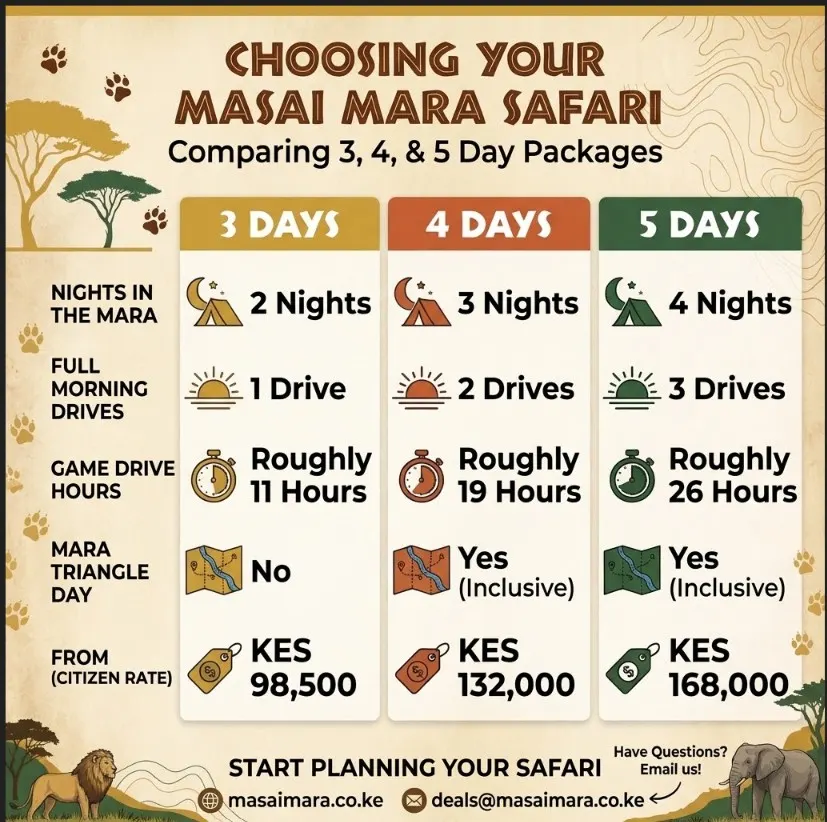
3 days | 4 days | 5 days | |
Nights in the Mara | 2 | 3 | 4 |
Full morning drives | 1 | 2 | 3 |
Game drive hours, roughly | 11 | 19 | 26 |
Mara Triangle day | No | Yes | Yes |
From (citizen) | KES 98,500 | KES 132,000 | KES 168,000 |
2027 Prices
Prices are per person sharing, for two people in a private 4×4 Land Cruiser with a pop-top roof, and include park fees. Low season is January to June. Peak season is July to December, when the Narok County park fee doubles. Travelling alone, as three or as a family? Ask for a quote, because the vehicle cost splits differently.
Kenyan citizens and residents (KES)
Tier | Low season | Peak season | Where you stay |
Budget | 132,000 | 252,000 | Mara Sidai Camp, Crocodile Camp |
Mid-range | 165,000 | 290,000 | Ashnil Mara Camp, Sentrim Mara |
Luxury | 240,000 | 370,000 | |
Premium | 350,000 | 475,000 |
International visitors (USD)
Tier | Low season | Peak season | Where you stay |
Budget | 1,350 | 2,630 | Mara Sidai Camp, Crocodile Camp |
Mid-range | 1,665 | 2,940 | Ashnil Mara Camp, Sentrim Mara |
Luxury | 2,360 | 3,700 | Mara Serena, Sarova Mara Game Camp |
Premium | 3,370 | 4,770 | Governors’ Camp, Kichwa Tembo |
The gap between the two tables is mostly park fees. Citizens pay KES 1,500 a day in low season and KES 3,000 in peak. Non-residents pay USD 100 and USD 200. The full rate card, children’s rates and how to pay are on our park fee page.
What is included
- Pickup and drop-off at your Nairobi hotel or the airport
- Private 4×4 Land Cruiser with pop-top roof and charging points
- A TRA-licensed English-speaking guide who drives you for the whole trip
- 3 nights full board at the camp you choose
- Park fees for Days 1 to 3, paid by us before you arrive
- Mara Triangle fee for the Day 3 crossing
- Game drives on Days 1, 2 and 3, with a packed lunch on the Triangle day
- Drinking water in the vehicle, as much as you need
Not included
- Tips. Around KES 3,500 to 5,000 for your guide over the four days, or USD 30 to 40, is normal. Give it to him directly.
- Drinks at camp
- Travel insurance
- The optional extras below
Optional Extras
Activity | Per person | Booked with |
Hot air balloon with champagne breakfast | KES 58,500 / USD 500 | At least two weeks ahead in peak season |
KES 1,500 / USD 20 | On the day | |
KES 6,500 / USD 70 | The evening before | |
Night game drive, conservancies only | KES 9,100 / USD 100 | When you book |
Night drives are not allowed inside the national reserve. They only run in the private conservancies along its border, such as Mara North, Naboisho and Olare Motorogi. If your camp is inside the reserve, we drive you out to a conservancy for it, so tell us when you book.
The village visit is yours to skip. If you don’t want to go, tell us when you book and we will keep the vehicle out on a game drive instead. Nobody waits in a parked car while the others finish.
Driving or Flying In
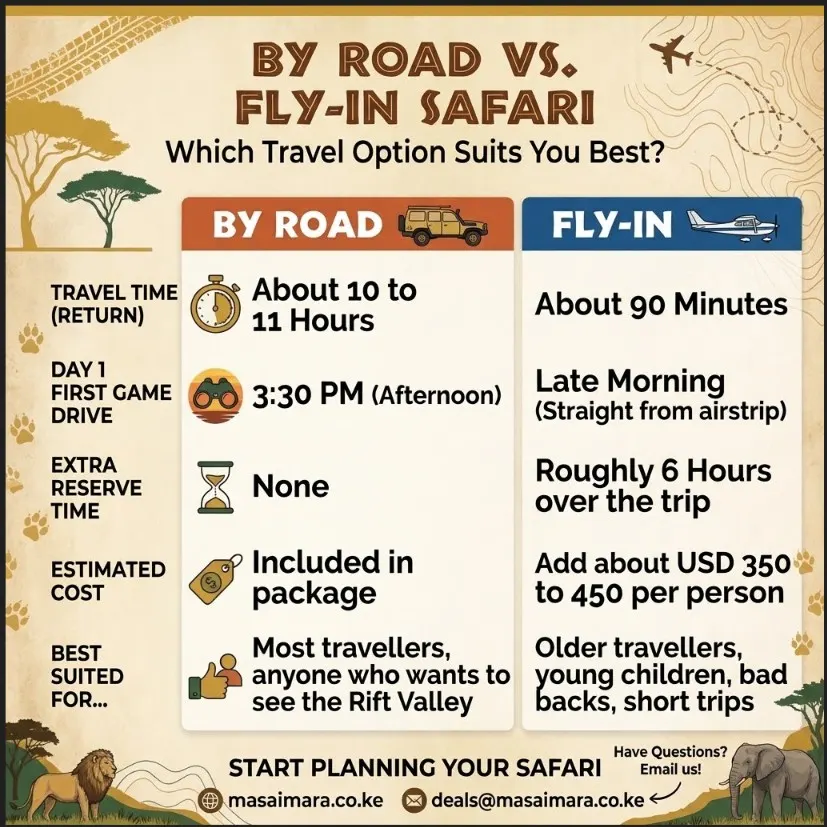
By road | Fly-in | |
Travel time, return | About 10 to 11 hours | About 90 minutes |
First game drive on Day 1 | 3:30 pm | Late morning, straight from the airstrip |
Extra time in the reserve | None | Roughly 6 hours over the trip |
Cost | Included in the prices above | Add about USD 350 to 450 per person return |
Suits | Most travellers, anyone who wants to see the Rift Valley | Older travellers, young children, bad backs, short trips |
People still warn each other about the road, but it’s much better than it was. The C12 from Narok to Sekenani Gate is smooth tarmac now. The bumpy part starts at the gate, inside the reserve, and that is the same for everyone. Flying still saves you two long days in a vehicle, and any of the tiers above can be done as a fly-in. Our flying packages page has the details, and the flights run on Safarilink and AirKenya from Wilson Airport.
Day by Day
Day 1: Nairobi to the Masai Mara
We collect you at 7:30. The Southern Bypass gets us out of the city traffic and then the road drops down the escarpment into the Rift Valley at Mai Mahiu, with the viewpoint stop on the way.
In Narok we stop at the Naivas supermarket rather than the curio shops. Clean toilets, normal prices, nobody following you round. Pick up snacks and anything you forgot.
We reach camp around 1 pm for lunch. Afternoon game drive from 3:30 until 6, when every vehicle has to be off the plains.
A small thing worth asking any operator: has your driver done an airport run before dawn the same day? A tired driver on the Narok road is the one real risk on this trip. Ours start fresh.
Day 2: A full day in the reserve
Out at 6 as the gate opens. The grass is wet and the light is low, and this is the hour the lions are still on their kills from the night. We drive the plains between Sekenani and the Talek until about 10, back to camp for brunch and a rest, then out again from 3:30 until 6.
If we find lions lying up, I switch the engine off and we wait. Most vehicles give a sleeping pride ten minutes and leave. The ones who stay are there when the cubs start playing and the females get up to hunt.
Day 3: Across the river to the Mara Triangle
If you ask me, this is the day you’re paying for. We leave at 6 with a packed lunch and drive west to the Mara River, crossing at the New Mara Bridge, which some guides still call Purungat. On the other side is the Mara Triangle, run by the Mara Conservancy. It has fewer vehicles, the best chance of a black rhino in the reserve, and big open plains under the Oloololo Escarpment.
The Triangle has its own ticket, separate from the Narok side. It is included in your package and we arrange it before the day, so there is nothing to pay at the bridge.
Lunch is by the river, often with hippos below. We spend the afternoon on whatever we haven’t found yet. Leopards are the hardest of the Big Five, and the leopard guide explains why. Then back over the bridge, and off the plains by 6, because no vehicle is allowed out on the game tracks after that.
If you’ve chosen Mara Serena or Kichwa Tembo, the day runs the other way round. Both are already inside the Triangle, so you spend most of the trip on the west side and Day 3 is the day we cross east into the main reserve for the Talek and the big cat country around it.
Day 4: Out by 10, home by mid-afternoon
Breakfast at 7, checkout by 8:30, and we drive to the gate the slow way, watching as we go. Narok County runs park tickets so that you must clear the gate by 10 am on your last day or pay for another full day, which in peak season is USD 200 each. Your package covers three days of fees, so we leave on time and you don’t pay twice.
If you want a proper last morning drive, we can stay out until 11:30 and pay the extra day’s fee. We’ll tell you the exact amount when you book. Otherwise we are back in Nairobi around 3:30 pm.
What We Have Learned on the Ground
Gates. Sekenani is the main gate and the busiest, with queues in August. Talek is quieter and closer to the lion prides along the river. Ololaimutiek is the least crowded but adds driving. We usually enter at Sekenani and spend the afternoons along the Talek, where you can watch Maasai herders bring cattle down to the river just outside the boundary.
Colours. Leave the navy and black at home. Tsetse flies go for dark blue and black, which is why the fly traps you see in the reserve are that colour. Khaki, olive and tan are the safe choice. Our packing list has the rest.
A few words of Maa. The Maasai greet each other with “Sopa”, and the answer is “Ipa”. “Ashe oleng” is thank you very much. Guides and camp staff love it, and you’ll usually get a laugh and a lesson in the next five words.
Camera dust. Don’t wrap your camera in a plastic bag. The static pulls the fine red dust into the lens seals. A cotton pillowcase works better and you can shoot through the opening in a second.
After dark. Most camps are unfenced and an askari walks you to your tent at night. Ask him in the morning what came through camp while you were at dinner. More often than you’d think, there are fresh tracks on the path.
Mosquitoes. Camps up on the Oloololo Escarpment, like Kichwa Tembo and Angama, get the breeze and far fewer mosquitoes. River camps are lovely but you will use the net.
Where 4-Day Trips Go Wrong
What happens | Why it matters | What to ask for |
The “last morning game drive” is just the drive to the gate | You pay for four days and get three | Ask the operator to say in writing what happens on Day 4, and whether it includes park fees |
The Triangle is promised but not included | You either skip it or pay at the bridge | Ask if the Triangle fee is in the price |
“Water included” means one small bottle a day | Eight hours in an open roof vehicle is thirsty work | Ask how much water is in the vehicle |
Shared tours pick up other guests on the way | You lose an hour of the first afternoon | Ask for a private vehicle, or the pickup window and the maximum wait |
The village visit is “optional” but the vehicle waits there | You sit in the car | Agree an alternative before you book |
When To Go
January to March. Short grass, so cheetahs and lions are easy to spot. Low season fees, few vehicles, warm and mostly dry. Our favourite time for a four day trip.
April and May. The long rains. Some camps close, tracks flood and the black cotton soil turns to glue. We don’t recommend it for a short trip.
June. Grass is long, prices are still low season, and in some years the first migration herds arrive late in the month.
July to October. The wildebeest migration and the river crossings. Park fees double, the camps fill up and the popular crossing points are crowded. Book early. The migration hub explains the season.
November and December. Short rains, usually afternoon showers. The herds have mostly gone back to Tanzania, prices are still peak until the new year.
The full month by month picture is in our best time to visit guide.
Questions Guests Ask
Is 4 days too long for the Masai Mara?
No. Four days is about where the trip stops feeling rushed. Looking back over our own trips, most of the sightings guests talk about afterwards came on the second morning or over in the Triangle.
Will I see the Big Five?
Lions, elephants and buffalo are close to certain. Leopards are likely over four days but never promised. Black rhino is possible in the Triangle, and rare anywhere else. Cheetahs, giraffes, zebras and hippos you will see.
How do park fees get paid?
We pay them for you before you arrive and the cost is in your package. If you are driving yourself, the Narok side of the reserve is paid online in advance through the Narok County Government platform, with card and M-Pesa as a backup at the gate. The card machines at the gates lose signal often, so pay the day before. The Mara Triangle is fully cashless and is booked ahead through the Mara Triangle KAPS portal, which the Mara Conservancy runs. KWS eCitizen tickets are for the national parks like Nakuru and Amboseli, and don’t work in the Mara. More on our park fee page.
How much should I tip the guide?
Around KES 3,500 to 5,000 for the four days, or USD 30 to 40. More if he found you a leopard and put you in the right spot for the photo. Hand it to him yourself.
Can I add another park?
Yes. Lake Nakuru or Lake Naivasha make a good first night on the way to the Mara. See the 4 days Mara and Nakuru and 4 days Mara and Naivasha trips. Keep at least two nights in the Mara.
Is it worth upgrading the camp?
In our experience a better bed and a hot shower matter more over four days than another activity. The jump from budget to mid-range is the one most guests say was worth it. Camps inside the reserve, like Sarova and Mara Serena, also save you the queue at the gate every morning.
Should I do 3, 4 or 5 days?
Three days if time is tight. Four if you want the Triangle and a second morning. Five if leopards and a river crossing are the point of the trip. Compare the 2 days, 3 days and 5 days safaris, or see the whole range on our safari packages page and the budget safaris guide.
Send your dates, the number of people and the tier you like, and we will reply with an itemised quote within 24 hours. Contact us or Get a quote.
Written by David Njunge, TRA-licensed safari guide with over 10 years in the Mara. Edited by Cess Wambui, travel consultant, BSc Tourism and Hospitality Management. Prices valid for 2027. Park fees are set by the Narok County Government for the national reserve and by the Mara Conservancy for the Mara Triangle. Scheduled flights are run by Safarilink and AirKenya.
Welcome to Masaimara.co.ke
Thank you for visiting us! We're excited to help you plan an unforgettable safari adventure across Kenya.