
Zebras in Masai Mara: The Honest 2026 Guide
Zebras are the most visible large mammal in the Masai Mara and the least appreciated. They lead the Great Migration, arriving weeks before the wildebeest. A resident population stays year-round. They are the primary prey for the Mara’s lion prides, which means a zebra herd is often the first clue that a hunt is developing. For the 2026/2027 season, all-inclusive 5-day itineraries range from KES 252,200 ($1,940) to KES 1,348,100 ($10,370) per person sharing. Reserve entry is $100–$200/day. Conservancy fees ($80–$150/night) are included in camp rates.
Safari Costs (2026/2027)
All-inclusive prices per person sharing, based on two people in a private 4×4 Land Cruiser. Conservancy fees are included in camp rates.
5-Day All-Inclusive Rates (Per Person Sharing)
Package Tier | Camps (Nakuru + Mara) | Regular Season (KES) | Peak Season (KES) |
Budget | Lake Nakuru Lodge / Mattikoko Tented | KES 252,200 | KES 447,200 |
Mid-Range | Sarova Lion Hill / Karen Blixen Camp | KES 304,200 | KES 538,200 |
Luxury | The Cliff Nakuru / Porini Lion Camp | KES 529,100 | KES 828,100 |
Luxury Plus | The Cliff Nakuru / Mara Plains Camp | KES 867,100 | KES 1,348,100 |
Note: Conservancy fees included. Reserve entry is extra ($100–$200/day). For a luxury safari or flying packages, request a custom quote.
What’s Covered
- A private 4×4 Safari Land Cruiser for the full trip.
- A TRA-licensed guide who understands zebra herd dynamics and predator-prey setups.
- All conservancy conservation fees and Lake Nakuru entry fees.
- Night drives, off-road tracking, and guided walking safaris with Maasai trackers.
- One-way return flight from the conservancy airstrip to Nairobi Wilson (flight details).
- Full board, 3 meals daily.
- AMREF Flying Doctors emergency air evacuation insurance.
What’s Excluded
- Kenya eTA (~$30).
- Tips (KES 3,000/day for guide).
- Alcohol and premium drinks.
- Hot air balloon ($450–$500).
- Main reserve entry fees if crossing into the public park ($100–$200/day extra).
- International flights.
The 5-Day Itinerary
Day 1: Nairobi to Lake Nakuru
Leave Nairobi early. Afternoon at Lake Nakuru tracking rhinos. Stay at your selected lodge.
Day 2: Nakuru to the Mara
Drive through the Rift Valley. Enter the conservancy via the access tracks or fly in. Zebra herds are usually the first large animals visible after entering — their stripes stand out against the grass from a distance. Stay at your chosen camp.
Day 3–4: Full Days
Two full days. Zebras appear on every drive without searching for them. The encounters worth stopping for are stallion fights, mutual grooming pairs, a herd approaching a water hole with lions nearby, and the migration crossings during July–October where zebras and wildebeest enter the river together. The conservancies give off-road access to follow predator-prey encounters across open ground.
Day 5: Departure
Early morning drive. Fly back to Nairobi from the conservancy airstrip (fly-in options).
Zebra Behaviour in Masai Mara
Zebra Behavioral Marker / Sign | Expert Field Interpretation (E-E-A-T) |
Ears Forward & Frozen | The entire herd is actively locking eyes on a hidden, camouflaged apex predator. |
Metallic Barking Alarm | Functions as a primary sentinel signal trusted by multiple co-habiting savanna herbivores. |
Head-to-Tail Alignment | Mutual grooming behavior that reinforces internal harem bonds and clears inaccessible skin parasites. |
Zig-Zag Cluster Sprint | Overlapping stripes create a disorienting optical illusion, keeping predators from isolating a single target. |
Harem Column Setup | The alpha mare strictly dictates direction at the front while the stallion guards the rear. |
The Mara’s zebras are plains zebras, the most common species in East Africa. They’re smaller than the Grévy’s zebra of northern Kenya and have broader stripes. A resident population lives in the Mara year-round, and during migration about 200,000 more arrive from the Serengeti.
Every stripe pattern is different. No two zebras match, and researchers use the shoulder and flank markings to identify individuals the way fingerprint databases work. From a vehicle the differences become obvious once a guide points them out. The leading scientific explanation for why stripes exist at all is fly repellent, not camouflage — the black-and-white pattern disorients tsetse flies and horseflies, making it hard for them to land. In the Mara’s river valleys, where fly populations are heavy and zebra coats are thinner than horses’, this protection matters.
A harem is the basic social unit — one stallion, up to six mares, and their foals. What most guests don’t realise is that the alpha mare leads the group, not the stallion. She picks the direction. He walks at the rear, defending from behind. When a predator attacks, the mares shield the foals with their bodies while the stallion turns to face the threat. A mature stallion’s rear kick can break a lion’s jaw. Despite looking like horses, their temperament is nothing like one — colonial-era attempts to domesticate zebras all failed because they bite, kick without warning, and resist handling completely.
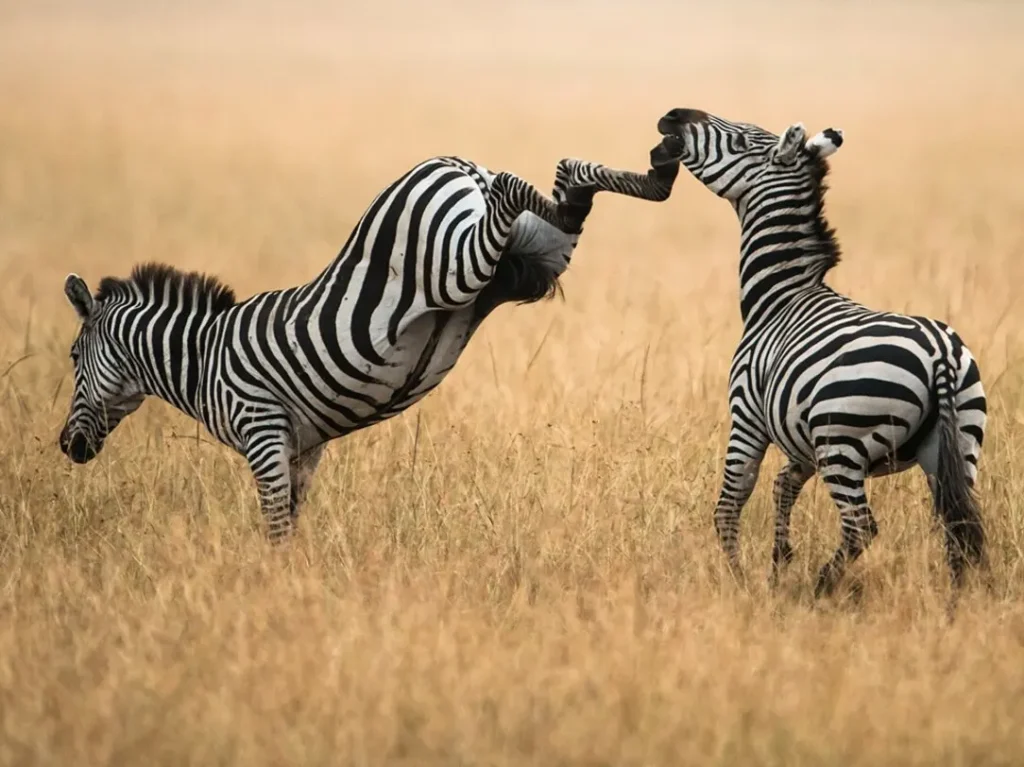
When a bachelor male challenges a harem stallion, the fight is more violent than most guests expect. Deep neck biting, hind-leg kicks that land with audible thuds, full-speed chasing across the plains. These happen in the open and the sound carries to the vehicle. Young males that haven’t won a harem form bachelor groups, sparring and testing each other until one is strong enough to take on an established stallion. Finding a bachelor group is a relaxed sighting with play-fighting and social jostling.
Lion prides in the Mara treat zebras as a primary food source. At about 65 km/h, zebras are fast enough that lions rely on ambush rather than open chase. A pride lying in tall grass near a water hole, waiting for a zebra herd to come and drink, is one of the tensest setups to watch. When the herd stampedes, they run in a tight, chaotic zig-zag cluster — the overlapping stripes make it harder for a pursuing lion to isolate one animal and judge its speed accurately.
Two zebras standing head-to-tail, nibbling each other’s necks and shoulders — that’s mutual grooming, and it happens constantly. It strengthens bonds within the harem and clears parasites from spots the animal can’t reach alone. The symmetry of two striped animals grooming each other makes a clean photograph on any drive.
Dust rolling is routine maintenance. The fine volcanic dust suffocates ticks and absorbs excess skin oils. At communal wallows, dominant animals roll first while lower-ranking members wait on the perimeter and keep watch. Even something this mundane follows a visible social hierarchy.
Standing sleep, always with a sentinel. Foals doze in the centre of the group. A resting herd with ears rotating and one animal alert while the others half-close their eyes is a common late-morning sighting.
The barking alarm call is why guides pay attention to zebras even when they’re not the target species. It’s a sharp, metallic sound that carries well, and other herbivores trust it more than any other alarm in the Mara.
During dry spells when mineral levels in the volcanic soil drop, zebras sometimes chew on old bones from predator kills. This bone-eating — osteophagia — compensates for calcium and phosphorus gaps. A zebra grinding a leg bone between its molars is rare enough that most visitors wouldn’t expect it from a herbivore.
Most migration coverage focuses on wildebeest, but zebras arrive in the northern Mara two to three weeks earlier. Their single-stomach digestive system handles the tall, coarse grass stems that wildebeest won’t touch. By cropping the rough top layer, they expose the short, protein-rich shoots underneath. An early July trip to the northern conservancies catches the zebra columns working the grasslands before the main vehicles arrive.
At river crossings, they handle the water differently from wildebeest. Stronger swimmers, smaller and more coordinated groups, less prone to the pile-up panic that drowns so many wildebeest at steep banks. Still vulnerable to crocodiles, but fewer zebras drown.
What to Know Before the Drive
- The value with zebras is in reading what they’re doing rather than just photographing them. A herd with ears forward, frozen and staring in one direction, is looking at a hidden predator. The guide follows their eyes.
- June is the best month for zebra photography. The grass is short from the dry cycle, animals are visible at body level, and the advance migration columns are arriving while the entry fee is still $100 instead of $200.
- For migration crossings, zebras and wildebeest enter the river together but behave differently. The zebra groups are smaller and more coordinated. Photographing a zebra crossing next to a wildebeest crossing shows the contrast.
- Wear khaki or olive near the river valleys. Dark blue and black attract the same tsetse flies that zebra stripes evolved to repel.
Questions Guests Ask
Migration & Demographic Metric | On-The-Ground Reality & Field Insight |
Two-Week Advance Lead | Zebras arrive early to crop coarse grass tops, exposing sweet shoots for incoming wildebeest flocks. |
River Crossing Formations | Move in highly coordinated, compact groups; significantly less prone to catastrophic crush panics. |
Rear Kick Deflection | Possesses enough force to shatter a lion’s jaw, forcing prides to rely entirely on ambush. |
Polka-Dot Pseudomelanism | Rare spotted mutations (like Tira) disrupt fly-repelling stripe mechanics, increasing predator tracking risks. |
Communal Volcanic Dusting | Oily hide maintenance adheres to a strict dominance hierarchy where alpha animals roll first. |
How many zebras are in the Masai Mara?
A resident population lives year-round. During migration (July–October), about 200,000 more arrive from the Serengeti. The migration guide covers the timing.
Do zebras migrate with the wildebeest?
They lead it. Zebras arrive two to three weeks before the wildebeest and prepare the grasslands. The wildebeest migration page covers the full cycle.
Are zebra stripes for camouflage?
The leading theory is fly repellent — the pattern disorients biting flies. The Behaviour section above covers the detail.
What happened to Tira, the polka-dot zebra?
Tira was a pseudomelanistic foal discovered in 2019 by Maasai guide Antony Tira. These foals rarely survive to adulthood because the altered pattern removes the fly-repellent benefit and makes them easier for predators to target. A second spotted foal was recorded in 2025.
Can zebras really kill a lion?
Yes. The Behaviour section covers the mechanics. Lions rely on ambush because a stallion’s rear kick can break bones, and injuries to attacking lions are common.
The Indicator Animal
Most guests treat zebras as background. They’re in every photograph whether planned or not, and after the first morning most people stop pointing the camera at them. What I’ve learned over ten years is that zebras are the best indicator animal in the Mara. Their alarm bark is louder and more trusted than any other herbivore’s. When a sentinel stallion barks and the whole herd freezes, every wildebeest, topi, and gazelle within earshot freezes too. The predator hasn’t been seen yet, but the zebra has already flagged the direction. Last September a guest asked me how I always seemed to know where the lions were. I told him I don’t find the lions. I listen to the zebras and they tell me where to drive.
The 5-day safari covers zebra encounters alongside the full Mara experience. The 3-day and 4-day trips work for zebras because sightings happen on any route. For Amboseli alongside the Mara, the 6-day circuit or three-park loop add Kilimanjaro views. Everything from luxury lodges to fly-in transfers is on the packages page, or send us your dates and we’ll sort out the route. The booking page has the logistics.
This guide was authored by David Njunge, a TRA-licensed safari guide with over 10 years of experience, and edited by Cecilia Wambui, a travel consultant with a degree in Tourism and Hospitality Management.
Related Reading:
- Lions in Masai Mara
- Leopards in Masai Mara
- Cheetahs in Masai Mara
- Elephants in Masai Mara
- Rhinos in Masai Mara
- Buffalo in Masai Mara
- Hippos in Masai Mara
- Crocodiles in Masai Mara
- Giraffes in Masai Mara
- Masai Mara Conservancies
- Conservancy vs National Reserve
- Olare Motorogi Conservancy
- Mara North Conservancy
- Ol Kinyei Conservancy
- Siana Conservancy
- Lemek Conservancy
- Ol Chorro Conservancy
- Enonkishu Conservancy
- Pardamat Conservation Area
- Masai Mara Entrance Gates
- Best Time to Visit Masai Mara
- Wildebeest Migration Kenya
- Masai Mara Migration
- Birding Safari Masai Mara
- Photography Safari Masai Mara
- Walking Safaris Masai Mara
- Night Game Drive Masai Mara
- All Inclusive Masai Mara Safari
- Masai Mara Amboseli Nakuru Safari
- 6 Days Masai Mara Amboseli Safari
- 5 Days Masai Mara Safari
- 4 Days Masai Mara Safari
- 3 Days Masai Mara Safari
- Luxury Safari Masai Mara
- Masai Mara Packages
- Masai Mara Flying Packages
- Masai Mara Booking
- Official KWS Park Fee Portal
- Kenya Wildlife Service
Welcome to Masaimara.co.ke
Thank you for visiting us! We're excited to help you plan an unforgettable safari adventure across Kenya.