
Olare Mara Kempinski: The Honest 2026 Guide
Olare Mara Kempinski sits on the banks of the Ntiakitiak River inside the Olare Motorogi Conservancy, one of the most exclusive wildlife areas in the Mara. Twelve tents, an unfenced riverbank, and hippos close enough to hear from bed. The conservancy is where the game drives happen on a completely different set of rules from the national reserve.
Getting There
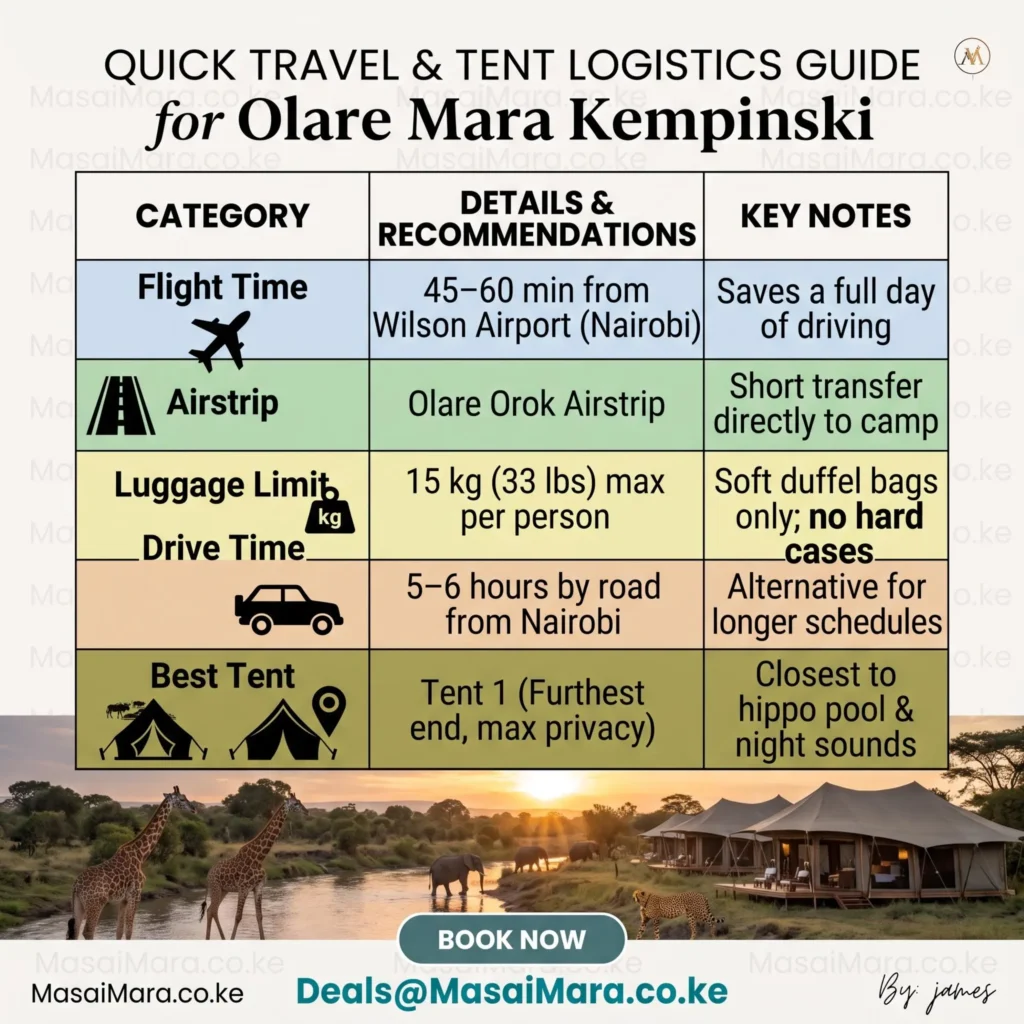
Quick Travel & Tent Logistics Guide
Essential transfer guidelines, flight details, baggage limits, and room selection tips for Olare Mara Kempinski are summarized below.
Category | Details & Recommendations | Key Notes |
Flight Time | 45–60 min from Wilson Airport (Nairobi) | Saves a full day of driving |
Airstrip | Olare Orok Airstrip | Short transfer directly to camp |
Luggage Limit | 15 kg (33 lbs) max per person | Soft duffel bags only; no hard cases |
Drive Time | 5–6 hours by road from Nairobi | Alternative for longer schedules |
Best Tent | Tent 1 (Furthest end, max privacy) | Closest to hippo pool & night sounds |
Olare Orok Airstrip is the closest landing point, with a short transfer to camp. Flights from Nairobi’s Wilson Airport take 45 to 60 minutes depending on how many strips the plane touches down at along the way. Flying in saves a full day in each direction, but pack in a soft duffel bag because hard cases don’t fit and the weight limit is 15 kg. The Nairobi-to-Mara road takes 5 to 6 hours if the schedule allows a day for the drive. Guests arriving in the afternoon don’t check in at a lobby. The vehicle takes a short detour and the first drink of the trip is served on the open plains as the sun drops. The safari starts before you’ve seen your tent.
The Tents and Which One to Request
The tents are spread along the riverbank, linked by paths through the bush. Each one is open-plan in a way that surprises first-timers: the bedroom, the sitting area, and the bathroom all flow into each other in one continuous space, and the only physical door in the entire tent is for the toilet. The bathtub sits open to the room with the river visible beyond it.
It feels less like a tent and more like a house with canvas above it.
Tent 1 is the furthest from the main building and the closest to the hippo pool. Maximum privacy, maximum night sounds. The walk to dinner is longer and needs an armed escort after dark, but for wildlife and quiet it’s the one to ask for.
Giraffes browse the acacia between tents during the day, and the twice-daily turndown means returning after each drive to a freshly prepared space with animals visible from the deck.
Game Drives and What the Conservancy Allows
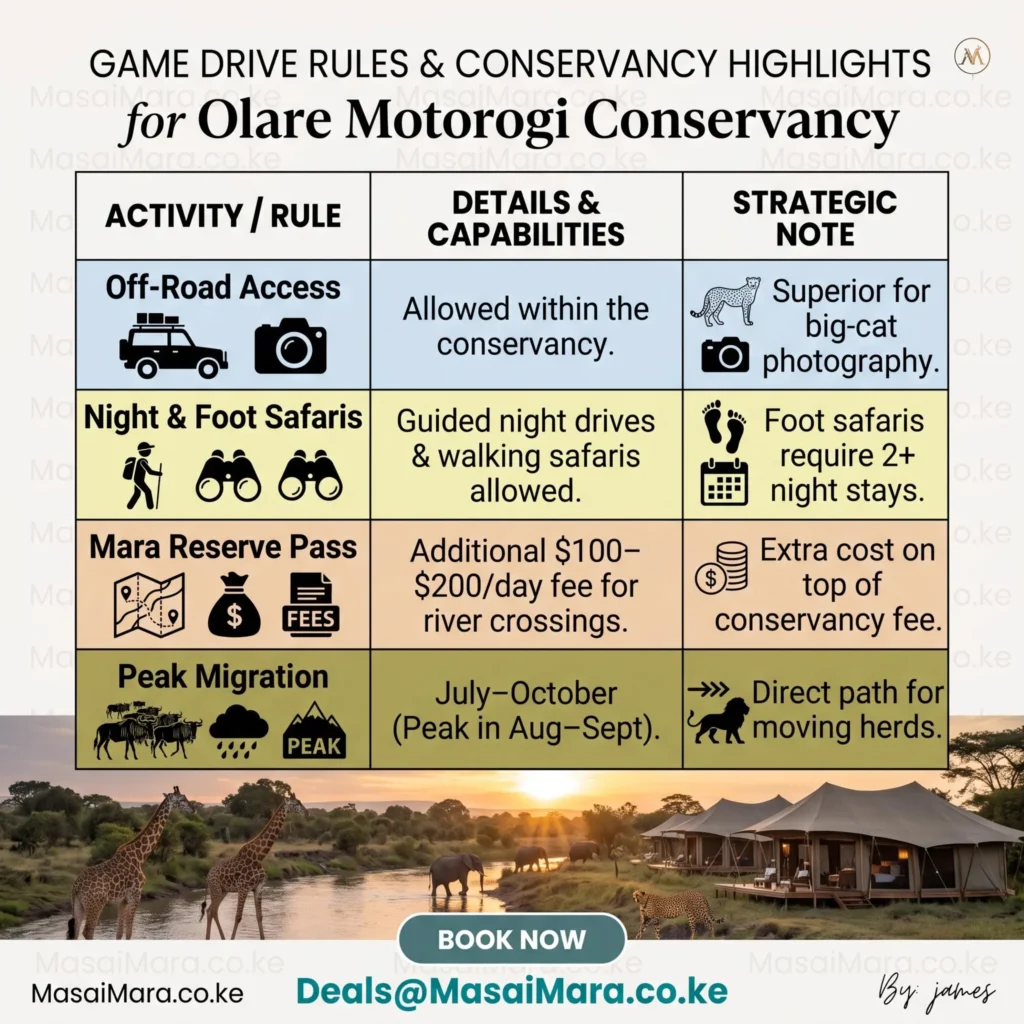
Game Drive Rules & Conservancy Highlights
A summary of safari activities, game drive guidelines, off-road access, and additional reserve fees for Olare Motorogi Conservancy is provided below.
Activity / Rule | Details & Capabilities | Strategic Note |
Off-Road Access | Allowed within the conservancy | Superior for big-cat photography |
Night & Foot Safaris | Guided night drives & walking safaris allowed | Foot safaris require 2+ night stays |
Mara Reserve Pass | Additional $100–$200/day fee for river crossings | Extra cost on top of conservancy fee |
Peak Migration | July–October (Peak in Aug–Sept) | Direct path for moving herds |
The conservancy caps vehicles at sightings, allows off-road driving, and permits night drives and walking safaris that the national reserve doesn’t. Off-road access makes a real difference for photography and big-cat encounters where the animal is 50 metres from the nearest track and a reserve vehicle would have to stay on the road.
Lions, cheetahs, and leopards are all resident. The conservancy sits in the migration path, so during July to October the herds move through on their way to the Mara River crossings.
Visiting the reserve for those crossings costs an additional 100-200 per day on top of the conservancy fee already in the camp rate. That double charge catches guests off guard, so budget for it before arriving. The migration usually peaks in August and September.
Walking safaris feel completely different from vehicle drives. On foot, the animals behave differently: wildebeest, zebras, and gazelles keep a wary distance in a way they don’t with vehicles. You notice tracks, dung beetles, grass seeds, things the vehicle drives past at speed. Available for guests staying 2 or more nights. Bush breakfasts and sundowners on the plains round out the day, and the game drives typically run from early morning to around 10 AM, then again from 4 PM through sunset and into the evening.
What to Do When You’re Not on a Drive
The pool overlooks the river and the plains beyond, and between drives this and the main lounge deck are where most of the slow hours go.
In-tent spa massages are available at extra cost: the therapist comes to the tent and sets up there, and the afternoon gap between drives is the natural slot. The food rotates daily, so guests staying 3 to 4 nights don’t eat the same thing twice. Standard drinks are included in the rate, covering house wines, beers, and spirits. Premium brands like top-shelf whisky and champagne sit on a separate price list, and the prices are steep, so ask before ordering.
The camp can also host weddings and Maasai blessing ceremonies on the plains, with couples exchanging vows near a lone acacia tree and the camp handling everything from setup to the celebration dinner.
What to Know Before Booking
Two nights is not enough.
Between the morning drives, afternoon drives, night drives, walks, and balloon flights, the schedule fills fast, and fitting everything into two nights means rushing through each one. Three nights lets the pace slow down, and that’s when the conservancy shows what it really has.
Peak migration months book out well in advance, so plan early. At this level, expect $1,500 to $2,500 per person per night all-inclusive during peak season, with lower rates from January to June.
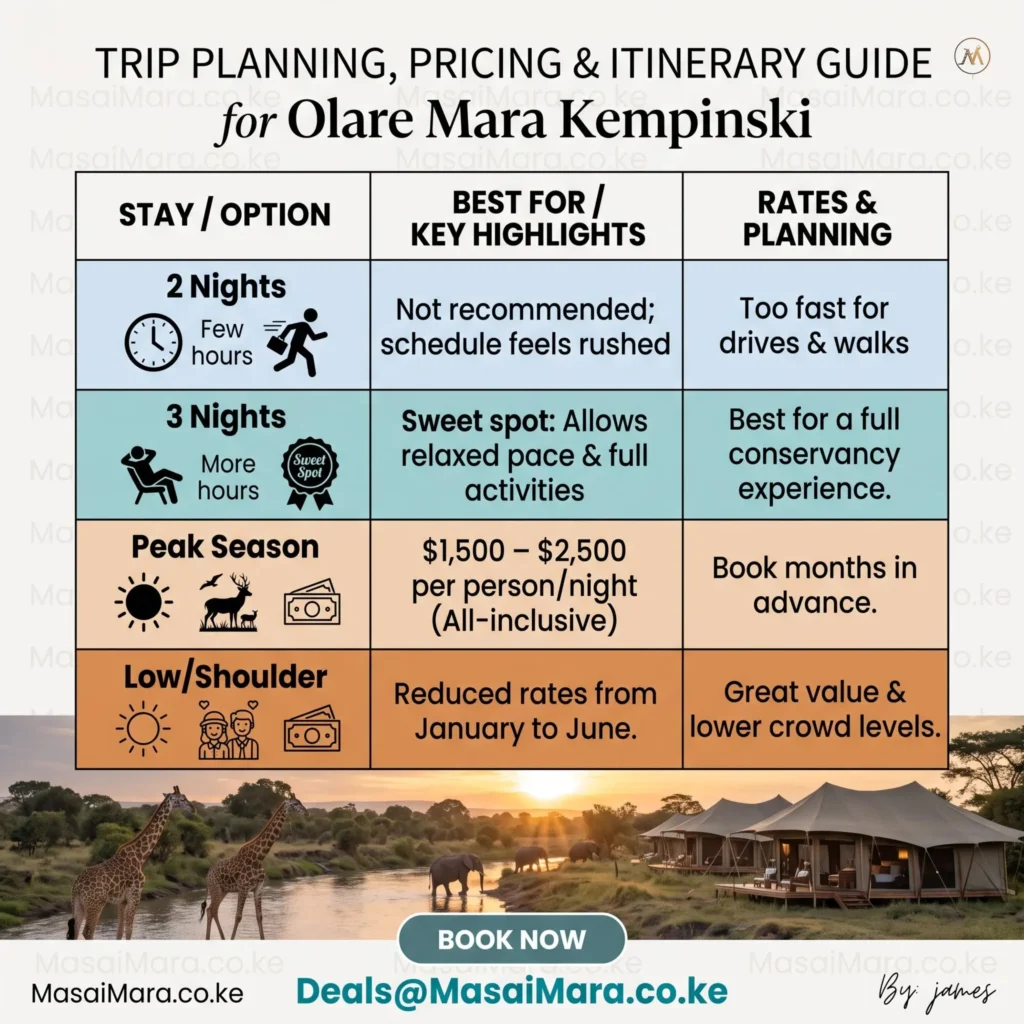
Trip Planning, Pricing & Itinerary Guide
Ideal stay durations, seasonal pricing guidelines, and suggested itinerary splits for Olare Mara Kempinski are detailed below.
Stay / Option | Best For / Key Highlights | Rates & Planning |
2 Nights | Not recommended; schedule feels rushed | Too fast for drives & walks |
3 Nights | Sweet spot: Allows relaxed pace & full activities | Best for a full conservancy experience |
Peak Season | $1,500 – $2,500 per person/night (All-inclusive) | Book months in advance |
Low/Shoulder | Reduced rates from January to June | Great value & lower crowd levels |
Questions Guests Ask
How does it compare to other camps in Olare Motorogi?
Olare Mara Kempinski runs on a more traditional luxury model than some of the newer camps in the conservancy. The river setting, the tent layout, and the food quality are its strengths. Other Olare Motorogi camps have different styles and price points, but the wildlife is the same across the conservancy because the animals don’t know the boundaries.
Is it good for honeymoons?
Very. The tent layout, the in-tent massages, the sunset drinks on the plains, and the option to arrange a Maasai blessing make it one of the stronger honeymoon options in the Mara.
How do I start planning?
Send us your dates and we’ll tell you whether Olare Mara Kempinski has availability and whether it’s the right fit for what you’re after. Three nights here is the sweet spot. If the migration crossings matter, we’d add a reserve day trip or pair it with a second camp inside the reserve for two nights. Guests flying in from Nairobi through Olare Orok can be on a game drive by lunchtime. If Kilimanjaro is on the wish list too, we build it as a Mara-Amboseli circuit with Olare Mara Kempinski as the Mara leg. Start a booking if dates are fixed, or just tell us what matters most and we’ll shape the trip around it.
This guide was authored by David Njunge, a TRA-licensed safari guide with over 10 years of experience, and edited by Cecilia Wambui, a travel consultant with a degree in Tourism and Hospitality Management.
Related Reading:
Welcome to Masaimara.co.ke
Thank you for visiting us! We're excited to help you plan an unforgettable safari adventure across Kenya.