Mara Plains Camp Review 2026: Rates, Room Tips & Insider Guide
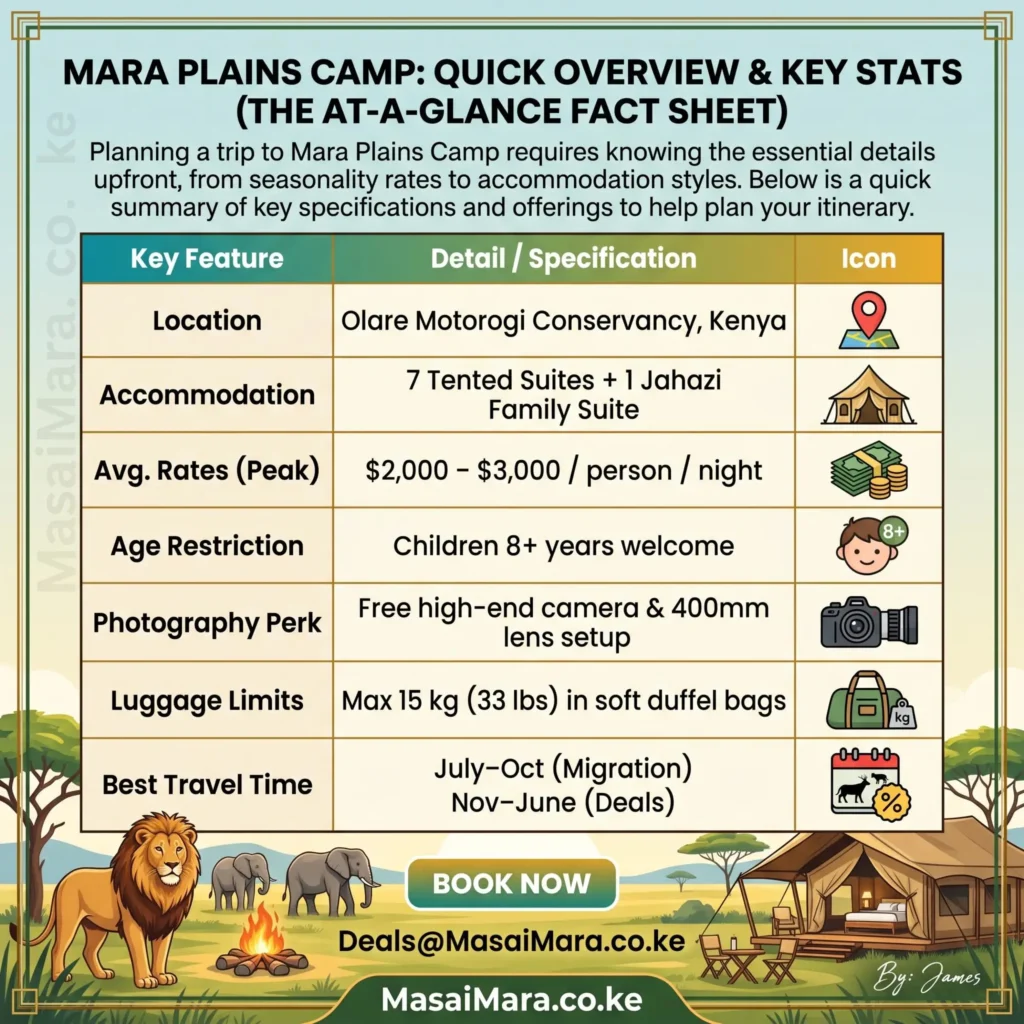
Mara Plains Camp is a 7-tent property in Olare Motorogi Conservancy, run by Great Plains Conservation. Rates: USD 1,606–3,133/person/night (KES 208,780–407,290) with return flights from Nairobi included. Best for photographers (Canon gear in every tent), couples wanting real exclusivity, and wildlife watchers who value triple conservancy access. Not ideal for budget travelers, families with kids under 6, or anyone who needs reliable WiFi.
I’ve placed clients here for years and stayed myself. What makes it different from Mahali Mzuri or Olare Mara Kempinski in the same conservancy? Only 7 tents instead of 12. Professional cameras included. Access to three wildlife areas, not one. The tradeoff nobody mentions: communal dining is now private by default, and honestly, the lounge areas don’t quite match the tent luxury.
What This Guide Covers
2026 Rates
Rates are per person, per night, fully inclusive. Return flights from Nairobi Wilson included for 2+ night stays.
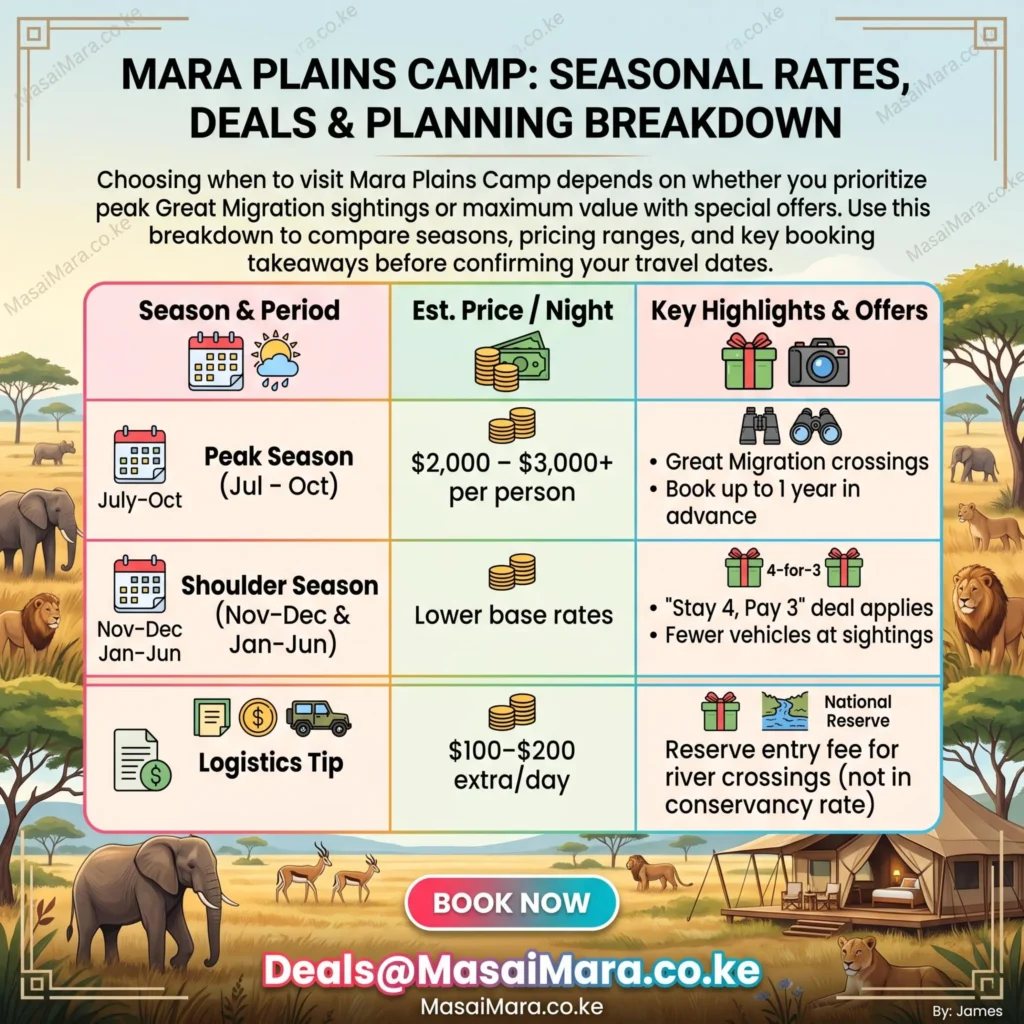
Season | Dates | Per Night |
Mid | 11 Jan – 31 Mar 2026 | USD 2,133 (KES 277,290) |
Low | 1 Apr – 14 Jun 2026 | USD 1,606 (KES 208,780) |
Peak | 15 Jun – 30 Sep 2026 | USD 3,133 (KES 407,290) |
Low | 1 Oct – 19 Dec 2026 | USD 1,606 (KES 208,780) |
Festive | 20 Dec – 10 Jan 2027 | USD 3,133 (KES 407,290) |
Additional: Conservation Levy — USD 100/night (KES 13,000). Mandatory.
Special Offer: Stay 4 nights, pay for 3 — available during low season 2026.
Quick Verdict
Book Mara Plains if: You’re a photographer, you want maximum exclusivity (14 guests max), you value triple-area access, and you can afford USD 1,600–3,100/night.
Skip it if: You need strong WiFi, you’re traveling with young children, you’re budget-conscious, or you prefer communal dining with other travelers.
Who Mara Plains Is Best For
Photographers: I’ve sent dozens of clients here specifically for the Canon 5D bodies and pro lenses in every tent. The vehicles are modified for camera stability. But what really matters? The guides understand light and positioning. They don’t just find animals — they find the right angle.
Couples and honeymooners: Only 7 tents. You’ll probably recognize every face by day two. The Jahazi Suite works for two couples traveling together.
Repeat safari-goers: If you’ve done the Mara three times and want something quieter, this is it. Triple conservancy access means you follow animals across boundaries instead of hoping they wander into your area.
Wildlife obsessives: Guides here explain why animals behave, not just what they’re doing. That’s a different experience entirely.
Who Should Look Elsewhere
Families with children under 6: Not allowed. Elephants walk through camp at night. This isn’t a figure of speech.
Budget travelers: At USD 1,600+/night, this is top-tier. Olare Mara Kempinski gives you the same conservancy at 40% less if price matters more than exclusivity.
Remote workers: I’ll be blunt — if you’re trying to send a work email from bed, forget it. The WiFi in tents barely loads a webpage. I ended up walking to the library every night with my laptop. Though honestly, the star view on that walk was better than any email.
Social travelers: Dining is private by default now. If you actually want to meet other guests, you’ll need to specifically ask the manager to arrange a communal table. Otherwise you’ll eat alone.
Best Rooms and Tent Location Tips
Room / Option | Key Features | Insider Tip & Tradeoff |
River-Facing Tents | Shaded by riverine canopy; stays cooler during the midday heat. | Located near hippo pools; pack earplugs if light sleepers find grunts disruptive. |
Plains-Facing Tents | Wide-open layout with premium morning photography light. | Sits on ancestral paths; you will occasionally see local Maasai walking or cycling past. |
Room 6 | Offers the absolute best unobstructed plains views in camp. | The perfect layout for early morning coffee-and-binocular sessions on the deck. |
Tent 7 | Positioned closest to the main resident savanna hippo pod. | Avoid during drought seasons due to strong wildlife odors; request an upstream tent instead. |
The Jahazi Suite | Features two en-suite bedrooms connected by a shared living space. | Ideal configuration for families of four; billed at the exact same rate as standard tents. |
In-Tent Tech & Extras | Balcony exercise bikes provided; connectivity is weak in rooms. | Head straight to the camp library if you need to make calls or upload media files. |
Not all tents are equal. I tell every client this before they book.
River-Facing vs Plains-Facing
River-facing tents sit under riverine canopy. Cooler during midday heat — genuinely pleasant when temperatures climb. But you’re closer to hippo pools. Some people love falling asleep to hippo grunts. Others pack earplugs by night two.
Plains-facing tents feel more open with better morning light for photography from your veranda. Fair warning: occasionally you’ll see local Maasai walking or cycling past. The conservancy land is owned by their families, and they still traverse it. This bothered one client; everyone else found it grounding.
Room-Specific Advice
Room 6: Best plains views. Morning light hits the deck perfectly for coffee-and-binoculars sessions.
Tent 7: Closest to the main hippo pod. During one drought visit, the dung smell was strong enough overnight that a client asked to switch. If you’re sensitive to smells, request upstream.
The Jahazi Suite: Two en-suite bedrooms with shared living space. Works well for families of four. Same nightly rate as standard tents.
The Small Stuff
Every tent has a stationary exercise bike on the balcony. Sounds odd until you’re cycling while watching a giraffe amble past.
WiFi is “available” but significantly weaker in tents than the main lounge. For uploads or calls, head to the library.
The tents stay surprisingly cool under the canopy during midday heat. But nights get cold — you’ll want that extra blanket the staff tucks into your bed.
The Arrival
I’ll be honest: my legs were a bit shaky crossing that rope footbridge for the first time. The entrance is hidden — you don’t just drive up to a reception desk. After your airstrip transfer, you cross a wooden bridge over the Ntiakitiak River. Looking down and seeing a hippo’s eyes poking out of the water is quite the welcome to the Mara.
Staff greet you with a traditional Maasai song. It’s lovely if you’re in the mood. If you’re exhausted from travel and just want quiet, tell your agent in advance — they can arrange a subdued arrival.
The first impression is forest, not savannah. The camp sits under riverine canopy. You hear hippos grunting — not background noise, but deep, vibrational sounds that become your sleep soundtrack. Surprisingly comforting once you realize you’re safe behind those canvas walls. Occasionally a leopard barks at night. It sounds like a rough saw. Carries surprisingly far.
What’s Included
Mara Plains Camp operates one of the most comprehensive all-inclusive models in the Mara.
Accommodation: 7 luxury tented suites on recycled railway sleeper decking.
Meals: All food, no fixed schedule — dining arranged around your game drives. House wines, premium spirits, beers, soft drinks included.
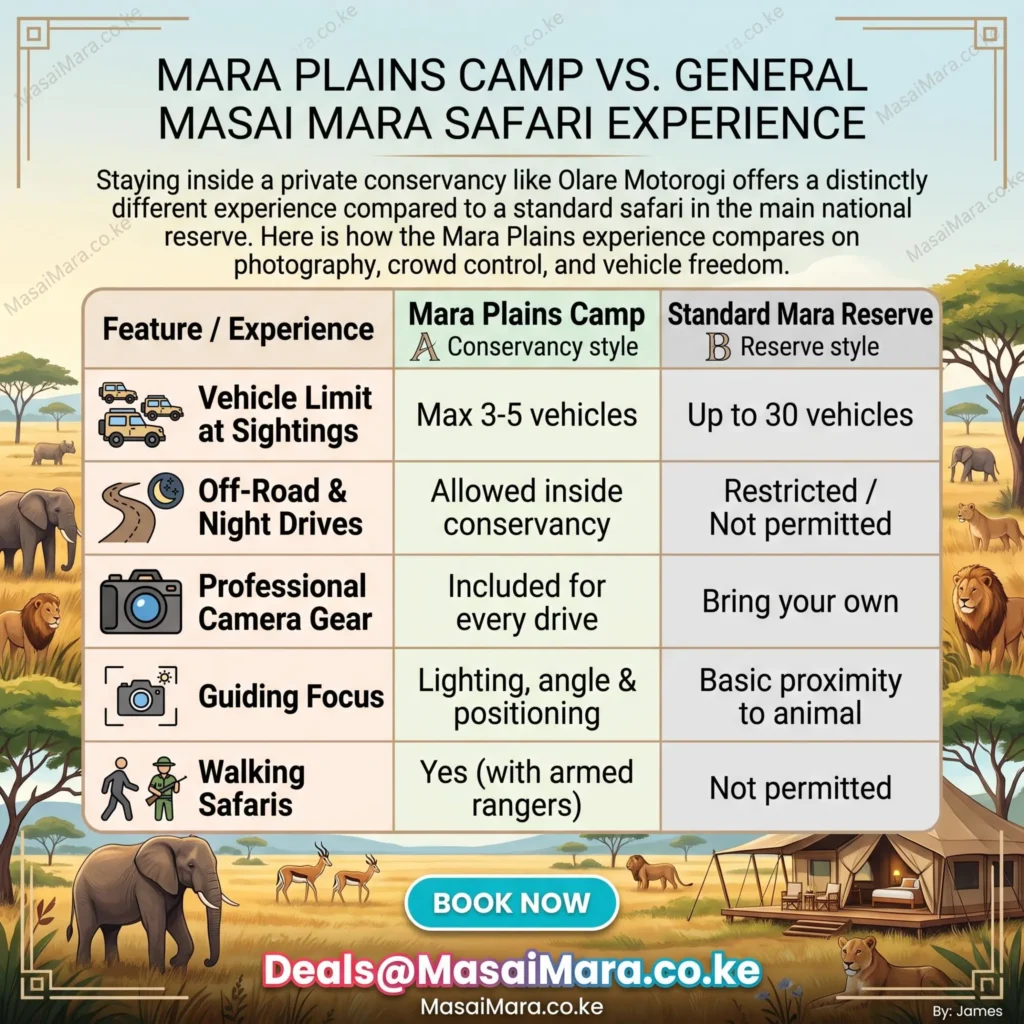
Safari activities: Twice-daily game drives, night drives, walking safaris with Maasai guides.
Flights: Return scheduled flights from Nairobi Wilson (minimum 2-night stay) plus airstrip transfers.
Park fees: Olare Motorogi, Mara North, and Masai Mara National Reserve access all covered.
Photography gear: Canon 5D camera body, 100-400mm telephoto, 24-70mm lens, Swarovski binoculars — per room.
Extras: Laundry, WiFi (main areas), bush boutique.
Not Included
Conservation levy: USD 100/night (mandatory). Hot air balloon: USD 550. Premium champagnes. Spa treatments. Photographic tuition. Gratuities.
Safari Packages: Quick Reference
Package | Low Season | Peak Season |
3 nights (flights included) | USD 3,412 (KES 443,560) | USD 6,466 (KES 840,580) |
4 nights (flights included) | USD 5,118 (KES 665,340) | USD 9,699 (KES 1,260,870) |
All packages include accommodation, conservation levy, and return flights from Nairobi Wilson.
Stay 4/Pay 3: Valid during low season 2026.
What Repeat Visitors Know
These are details that don’t show up in first-timer reviews:
The spotter vehicle system. For major sightings, the camp sometimes sends a second vehicle to hold position while you eat. You come back and the leopard is still there. I’ve seen this work multiple times. Ask about it.
Guide specializations matter. Kevin for leopards. Jackson for ecosystem context. Francis for photography. Edwin for conservancy land-use. Request by name.
The bridge trees. Ask your guide to check them on evening drives. That’s where the resident leopard hangs kills.
Dining is private now. If you want to meet other guests, you must request communal seating. Otherwise you’ll eat alone every night.
Photography Setup
Camera Gear in Every Tent
Each suite has a Canon 5D Mark III body, 100-400mm telephoto, and 24-70mm lens. No rental. No deposit. Staff download your images to a memory stick at departure.
I’ve watched clients who’d never used a professional camera before leave with portfolio-quality shots. The gear makes a real difference.
Vehicles Built for Photographers
The Land Cruisers have fold-down screens, raised roofs, stabilizing bars for lenses, and multi-plug inverters. Maximum 4 guests per vehicle. Private use available if you don’t want to negotiate angles with other travelers.
The Spotter Vehicle Strategy
For high-value sightings — a cheetah on a kill, a leopard descending — the camp sometimes sends a second vehicle to hold position while you eat breakfast. You return and the animal is still there. Ask about this if you’re serious about photography.
Night Drive Red Filter
On night drives, guides use spotlights. If you’re photographing predators, ask for a red filter. It prevents blinding the animals and allows more natural hunting behavior. Better photos, less disturbance.
Guide Recommendations
I tell clients: the guide matters more than the room. Request by name if you can.
Francis — We spent forty minutes in total silence with Francis, just watching a leopard flick its tail in a tree. Most guides would have moved on to find a lion. Francis knew the leopard was about to descend and hunt. That patience is what you’re paying for at this price point.
Daniel — Relaxed, friendly, explains context without lecturing. Good for first-time safari visitors who want to understand what they’re seeing.
Kevin — His family owns part of the conservancy land. The plains east of camp bear his family name. He knows where the leopards are because he grew up watching them. Clients have called themselves “leopard magnets” after four sightings in two days with him.
Jackson — Strong on ecosystem interpretation. He’ll explain why the lions are moving, not just that they’re moving.
Edwin — Knows the conservancy land-use model inside out. Good if you’re interested in how community ownership actually works.
The Bridge Trees
There’s a cluster of riverine trees near the Ntiakitiak River bridge where a resident leopard hangs its kills. Ask your guide to check the bridge trees first thing on evening drives. It’s not guaranteed — nothing is — but the odds are better there than anywhere else.
Off-Road Tip
Unlike the National Reserve, Mara Plains guides can go off-road in Olare Motorogi. But experienced repeat guests told me to stay on tracks for the first 20 minutes of sunset. Lions use tracks to move between territories. You’ll get better eye-level walking shots than bouncing through tall grass.
Food and Dining
No fixed meal schedule. Breakfast, lunch, dinner — everything bends around your game drives.
The Bush Breakfast
Not just a “picnic in the bush.” The camp can set up a full egg-cooking station in the field — chef in whites, cooked to order, savannah as backdrop. I watched a hyena trot past while eating scrambled eggs. Ask about this when booking; it’s not automatic.
Dinner Changes Nightly
Dinner setups rotate. One night it’s the main tent. Next night, more open-air. They intentionally vary atmosphere rather than repeating the same routine. I appreciated this more than I expected.
Wine Tip
The selection is strong, but presentation can be informal. If wine matters to you, ask early what’s available rather than waiting for default pours. One traveler told me he wished he’d requested a proper list on day one instead of day three.
The Local Food Secret
The menu leans Western. After three days of lodge cuisine, I asked the chef for Sukuma Wiki one night. It’s a simple kale dish, but that earthy, local flavor was the best thing I ate all week. Ask for it. They’re often happy to cook authentic Kenyan food that isn’t on the tourist menu.
Dietary Accommodations
The kitchen handles strict diets well — vegan, keto, allergies. They’ll make alternatives beyond the listed menu if you communicate in advance. Several clients with dietary restrictions have specifically thanked me for recommending this camp.
Facilities Nobody Mentions
Massage room behind the boutique: I didn’t know about this until day two. There’s a proper treatment room (plus adjacent shower) tucked behind the bush boutique. Not advertised anywhere.
Solar shower lag: The camp runs entirely on solar. Hot water takes several minutes to heat up. Start the shower, finish your coffee, organize your camera gear — then step in. Don’t stand there waiting.
24-hour electricity: British 3-pin plugs in all tents. Voltage fluctuates occasionally, so bring a surge protector for camera gear.
The Tents
Thick Lamu wood doors with brass accents. Deep canvas ceilings that billow slightly in wind. Raised decking from recycled railway sleepers. Deep copper bathtubs — I took more baths here than I have in years. Extensive private verandahs.
The aesthetic recalls early 20th-century safari history. Antique trunks, brass fittings, photographs from the Jouberts (the founders, wildlife filmmakers). It feels grounded in a specific place rather than “generic African luxury.”
The Borehole Water
The water comes from a borehole. Showers are piping hot but have a distinct mineral smell. I noticed it on my first shower; by the second day I’d stopped noticing. Worth knowing so you don’t think something’s wrong.
Around 11 PM, the hippos start. You’re lying in a tent with canvas walls, listening to snorting and splashing from the Ntiakitiak River below. It’s not background noise — it’s deep, vibrational. Surprisingly comforting once you realize you’re safe behind those walls.
Occasionally a leopard barks. Sounds like a rough woodsaw. Carries far. I heard one clearly from 300 meters.
Maasai guards walk the paths between tents all night. When you need the bathroom at 3 AM, they escort you with a flashlight. This is what “unfenced camp in a wildlife area” actually means.
By morning, staff have already brewed coffee in the main tent. No set schedule — breakfast happens when you want it. If you’re tracking a lioness on a hunt and want to stay out past lunch, they’ll drive food to you in the field. One client spent hours watching a failed hunt; the lodge delivered lunch to their vehicle rather than interrupt the experience.
Triple Conservancy Access
Mara Plains offers something almost no other Mara camp can: access to three separate wildlife areas.
Olare Motorogi Conservancy — 35,000 acres of private land. Lowest vehicle density in the Mara.
Mara North Conservancy — Adjacent conservancy with additional wildlife corridors.
Masai Mara National Reserve — The public reserve, including Mara River crossing points during migration.
This matters because animals move. A pride might spend mornings in Olare Motorogi and evenings in Mara North. With triple access, you follow the wildlife instead of hoping it wanders into your camp’s area. Most camps are confined to one.
When to Visit
Month | Weather | Migration | Rates | Photography |
Jan–Mar | Hot, dry | No crossings | Mid (USD 2,133) | Short grass, good visibility |
Apr–May | Heavy rain | No crossings | Low (USD 1,606) | Lush scenery, muddy roads |
Jun | Light rain | Herds arriving | Low (USD 1,606) | Green grass, dramatic skies |
Jul–Sep | Dry, cool | River crossings | Peak (USD 3,133) | Migration action, crowded reserve |
Oct | Short rains | Herds moving south | Low (USD 1,606) | Departing herds, fewer crowds |
Nov–Dec | Rains ending | No crossings | Low (USD 1,606) | Newborn animals, green plains |
Best for photography: September. Migration still present, grass shortening, excellent predator action.
Best value: April–May. Rates drop 50%. Rain is real but mornings often clear. Conservancy access means you won’t get stuck.
Worst time: Mid-April if you hate rain. But even then, triple access helps — if roads flood in one area, guides reroute.
Comparing Mara Plains to Alternatives
Camp | Conservancy | USD/Night (Low) | Tents | Flights | Cameras | Triple Access |
Mara Plains | Olare Motorogi | USD 1,606 | 7 | ✓ Included | ✓ Canon 5D | ✓ Yes |
Olare Motorogi | USD 1,660 | 12 | ✗ Extra | ✗ No | ✗ No | |
Olare Motorogi | USD 640 | 12 | ✗ Extra | ✗ No | ✗ No | |
Mara Triangle | USD 1,500 | 30 | ✗ Extra | ✗ No | ✗ No | |
Southern Reserve | USD 750 | 7 | ✗ Extra | ✗ No | ✗ No |
My Take
Mara Plains vs Mahali Mzuri: Same conservancy, similar prices. Mara Plains has 7 tents (more intimate), Canon gear included, and triple access. Mahali has air conditioning and the Virgin brand. For photographers, Mara Plains. For brand appeal or heat-sensitive travelers, Mahali.
Mara Plains vs Kempinski: Kempinski costs 40% less for the same conservancy. Add flights (USD 450+) and Mara Plains’ cameras, and the gap narrows. I send families to Kempinski; I send photographers to Mara Plains.
Mara Plains vs Angama: Different experiences entirely. Angama has escarpment drama and Out of Africa romance. Mara Plains has riverine intimacy and photographer focus. Both excellent. Different tastes.
Common Concerns
“Is it worth USD 1,600–3,100 per night?”
Honestly? It depends what you value. The rate includes return flights from Nairobi (worth USD 400–600), professional camera equipment (worth USD 5,000+ to own), and access to three wildlife areas. Most camps charge separately for flights and don’t offer cameras at all.
If photography matters and you’d otherwise rent a 400mm lens, the value equation shifts significantly. I’ve had clients who calculated the camera rental savings alone and felt they were getting a deal.
“The communal areas aren’t as impressive as the tents”
This is true. The tents are stunning. The shared dining and lounge areas are comfortable but not extraordinary. If you’re expecting the main area to match the tent luxury, adjust expectations. I tell clients: you’ll spend most of your time in the vehicle or your suite anyway. The lounge is functional, not a destination.
“Is it too remote for families?”
Children 6+ are welcome. The Young Explorers program keeps them engaged with activity books, animal tracking, and Kiswahili vocabulary. The Jahazi Suite works for families. But the camp is unfenced — I’ve watched elephants walk through at night. Very young children require constant supervision.
Sustainability
Mara Plains runs entirely on solar. The battery bank and solar plant are substantial — worth touring if you’re interested.
Water comes from a borehole and is treated on-site. Chemicals are manufactured naturally at the camp to avoid introducing contaminants.
No tree larger than an index finger was cut during construction. The founders (the Jouberts) insisted on this.
Each guest’s USD 100/night conservation levy supports 1,000+ Maasai families who own the conservancy land. This isn’t abstract. Kevin, one of the guides I mentioned earlier, lives on and owns a portion of this land. Tourism funds his income. He protects the wildlife in return. It’s a direct relationship.
Practical Advice
The 15kg Bag Reality
Bush flights enforce the weight limit with scales at Wilson Airport. I’ve seen guests pay overweight fees that could’ve bought another dinner. If you’re bringing the camp’s Canon gear back to the airstrip, make sure staff pack it separately so it’s clearly lodge property — otherwise it counts against your personal weight.
Walking Safari Footwear
“Bush walks” sounds casual. The terrain around Mara Plains is often “black cotton soil” — incredibly sticky when damp. One client wore sneakers and nearly lost one in the mud. Bring boots with deep lugs.
Talk to the Maasai Guards
Because the camp is unfenced, you’re escorted after dark. Use this time. Many guards are from families that own the conservancy land. They’ll tell you about specific history of the area, “spirit” of certain trees, and details the guides skip. Some of my best conversations at Mara Plains happened on those 3 AM bathroom escorts.
Tell the Camp Your Priorities
Before arrival, communicate what matters — photography, wine, walking, specific diets. The property responds well to advance preferences. I’ve had clients get private vehicles, special dietary menus, and photography-focused guide pairings because they told the camp in advance.
Ask About Private Vehicles
Some guests had effectively private vehicles despite shared-drive language; others explicitly requested private use. If vehicle privacy matters (especially for photographers who don’t want to negotiate angles), clarify this before booking.
Getting There
By Air (Included for 2+ Night Stays)
Scheduled flights from Nairobi Wilson to Ol Kiombo Airstrip. 45–50 minutes.
The camp provides complimentary transfers from the airstrip — about 30 minutes’ game drive through prime predator territory. Many clients see their first leopard before reaching camp.
What to know: 15kg soft bag limit. Physical ID required — Wilson rejects phone screenshots. I’ve seen it happen.
By Road
About 250 km from Nairobi. 5–6 hours. The camp doesn’t encourage road transfers given the flight inclusion, but it’s possible if you’re combining with other destinations.
Request a Quote
Tell us your dates and preferences. We’ll check availability, coordinate flights, and provide one price through Masaimara.co.ke.
Frequently Asked Questions
How much does Mara Plains Camp cost per night? USD 1,606–3,133/person/night depending on season, plus USD 100/night conservation levy. Flights from Nairobi included for 2+ night stays.
Is Mara Plains Camp worth it? For photographers: yes. Camera gear alone would cost thousands to rent. For exclusivity-seekers: yes. Only 14 guests max. For budget travelers: no. Olare Mara Kempinski offers the same conservancy at 40% less.
What camera equipment does Mara Plains provide? Canon 5D Mark III body, 100-400mm telephoto, 24-70mm lens, and Swarovski binoculars in every tent. Photos downloaded to memory stick at departure.
Which room should I request at Mara Plains? Room 6 for plains views and morning light. Avoid Tent 7 in drought season (hippo odor). River-facing tents are shadier; plains-facing are brighter.
Are children allowed? Ages 6+. Young Explorers program available. Jahazi Suite works for families. Camp is unfenced — supervision required.
Does Mara Plains include flights? Yes. Return flights from Nairobi Wilson included for 2+ night stays.
Is Mara Plains good for photographers? Yes. Professional Canon gear in every tent. Vehicles modified for camera stability. Guides understand positioning and light. Triple conservancy access means more flexibility.
What conservancies can I access? Three: Olare Motorogi, Mara North, and the Masai Mara National Reserve.
Can I see the wildebeest migration? Yes. Access to Mara River crossings. Peak months July–October, but timing varies.
Is WiFi reliable at Mara Plains? In the main lounge: yes. In tents: weak to unusable. Don’t plan on uploading photos from your room.
What’s the difference between Mara Plains and Mara Nyika? Both are Great Plains Conservation. Mara Plains is in Olare Motorogi (7 tents); Mara Nyika is in Naboisho (newer camp).
Official Resources
- Great Plains Conservation — official operator
- Relais & Châteaux — member property
- Kenya eTA Portal — visas
Related Guides
- Olare Motorogi Conservancy
- Olare Mara Kempinski Review
- Mahali Mzuri Review
- Angama Mara Review
- Mara Serena Safari Lodge
- Sala’s Camp Review
- Masai Mara Park Fees 2026
- Wildebeest Migration Guide
- Hot Air Balloon Safaris
- Luxury Masai Mara Safaris
- How to Get to Masai Mara
- Big Five Animals Kenya
- Game Drives in Masai Mara
- Animals in Masai Mara
- Masai Mara Packing List
How We Verified This Guide
Rates confirmed with Great Plains Conservation reservations, March 2026. Guest insights drawn from verified booking platform reviews and direct client feedback. Room-specific details and guide names verified across multiple independent sources. Editor has placed clients at this property.
Written by David Njunge, TRA-licensed safari guide with KPSGA Silver certification. 10+ years guiding across Kenya’s national parks and conservancies.
Edited by Cecilia Wambui, Tourism & Hospitality Management graduate (Kenya Utalii College) and senior travel consultant at Masaimara.co.ke.
Welcome to Masaimara.co.ke
Thank you for visiting us! We're excited to help you plan an unforgettable safari adventure across Kenya.