
7-Day Masai Mara, Samburu & Nakuru Safari: The 2026 Insider Guide
A 7 Days Masai Mara Samburu Nakuru Safari is Kenya’s Diversity Loop, connecting the arid Northern Frontier with the Great Rift Valley and the golden savannahs of the Mara. For the 2026/2027 season, all-inclusive costs for two people sharing range from KES 415,500 ($3,195) to KES 1,320,000 ($10,150) per person. This covers a private 4×4 Land Cruiser, professional guide, updated Jan 2026 eCitizen park fees, and 6 nights of lodging. This is the only circuit where you can see both the Special Five and the Big Five in a single week.
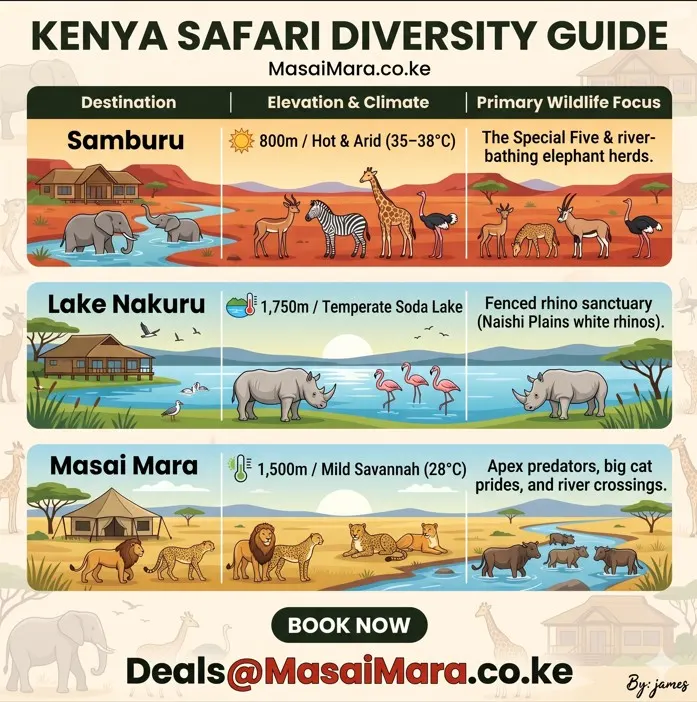
Destination | Elevation & Climate | Primary Wildlife Focus |
Samburu | 800m / Hot & Arid (35–38°C) | The Special Five & river-bathing elephant herds. |
Lake Nakuru | 1,750m / Temperate Soda Lake | Fenced rhino sanctuary (Naishi Plains white rhinos). |
Masai Mara | 1,500m / Mild Savannah (28°C) | Apex predators, big cat prides, and river crossings. |
7 Days Masai Mara Samburu Nakuru Safari Costs (2026/2027)
This is the 7-day version of our Masai Mara Samburu Nakuru Safari circuit. For a shorter version, see the 6-day option.
Pricing for the 2026 season reflects the updated January park fees and the latest Land Cruiser rates. These prices are for two people traveling together.
Budget & Mid-Range Rates (Per Person Sharing)
Package Tier | Suggested Hotels | Regular (KES) | Peak (KES) |
Budget | Samburu Riverside, Lake Nakuru Lodge, Talek Bush Camp | KES 415,500 | KES 695,000 |
Mid-Range | Ashnil Samburu, Sarova Lion Hill, Ashnil Mara Camp | KES 585,000 | KES 910,000 |
Book Now | 2026 Rates |
Luxury & Luxury Plus Rates (Per Person Sharing)
Package Tier | Suggested Hotels | Regular (KES) | Peak (KES) |
Luxury | Elephant Bedroom, The Cliff, Mara Serena | KES 840,000 | KES 1,150,000 |
Luxury Plus | Sasaab, The Cliff, Angama Mara | KES 1,020,000 | KES 1,320,000 |
Inquire | 2026/2027 |
Note: Peak season is July–October during the wildebeest migration. If you want to fly one leg, check our Masai Mara flying packages. For a luxury safari upgrade, request a custom quote.
What’s Covered in the Price?
- Vehicle. Private 4×4 Land Cruiser with pop-up roof and 12V inverter.
- Guide. TRA-licensed guide for all 7 days.
- Park Fees. All entries for Mara, Samburu, and Nakuru via eCitizen.
- Accommodation. 6 nights full board.
- Water. Bottled water in the vehicle plus extra reserves for Samburu. It’s a furnace up there.
Excluded. Tips (KES 3,500/day suggested), alcoholic drinks, hot air balloon (approx KES 78,000), Masai village visit (KES 4,500), Buffalo Springs night drive (KES 8,000–12,000), international flights and Kenya eTA.
I’ve been guiding for ten years. A 7 Days Masai Mara Samburu Nakuru Safari is a lot of time behind a windshield. Nearly 1,200 kilometres of Kenyan road. If your guide doesn’t know the shortcuts or how to handle the 2026 eCitizen gate bottlenecks, you’ll spend more time looking at the back of a truck than at a leopard.
In 2026, the rules for park entries have changed. Everything is digital via eCitizen, and if you haven’t pre-paid your Masai Mara park fee before hitting the gate, you’re looking at a two-hour wait in the sun.
The 7-Day Itinerary
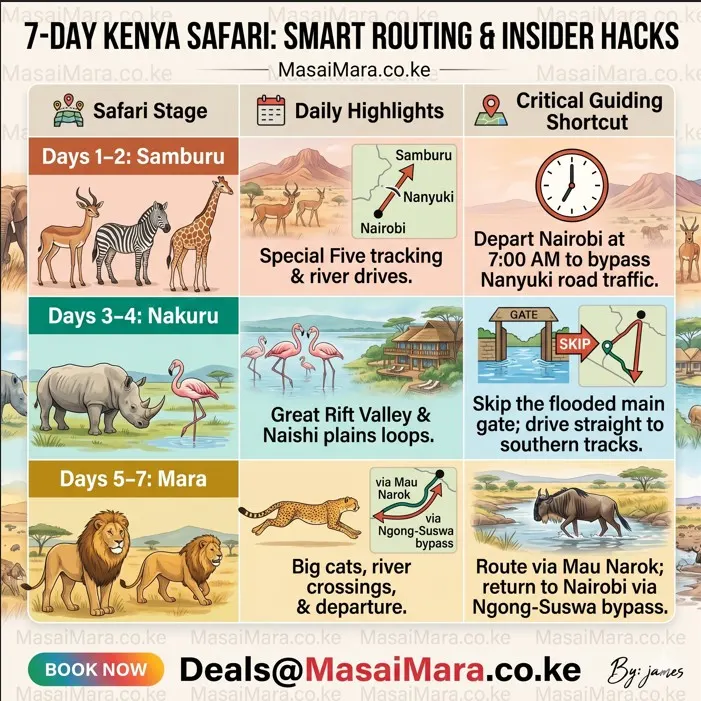
Safari Stage | Daily Highlights | Critical Guiding Shortcut |
Days 1–2: Samburu | Special Five tracking & river drives. | Depart Nairobi at 7:00 AM to bypass Nanyuki road traffic. |
Days 3–4: Nakuru | Great Rift Valley & Naishi plains loops. | Skip the flooded main gate; drive straight to southern tracks. |
Days 5–7: Mara | Big cats, river crossings, & departure. | Route via Mau Narok; return to Nairobi via Ngong-Suswa bypass. |
The order matters. We always start in the north and build toward the Mara. Going the other way makes Samburu feel like a downgrade. Starting with the desert rarities builds momentum.
Day 1: Nairobi to Samburu
Depart at 7:00 AM sharp to beat the Nanyuki traffic. The first 200 km is smooth tarmac. The last 100 km into Samburu is corrugated murram that shakes the vehicle. We arrive for a late lunch and afternoon game drive along the Ewaso Ng’iro River.
Day 2: Samburu Full Day
Focus on the “Special Five” and the river banks. Morning at Buffalo Springs for rare bird species. Afternoon watching elephants “river bathe” — whole herds submerge with just their trunks sticking up like snorkels.
Day 3: Samburu to Lake Nakuru
A long transit day crossing the Equator near Nanyuki — a 10-minute photo stop the kids will love. We aim to reach Nakuru for a late afternoon drive to the Naishi Plains for rhinos.
Day 4: Nakuru to Masai Mara
Morning rhino loop and Baboon Cliff viewpoint. Then we drive to the Masai Mara via the Mau Narok route. Arrival for a sunset drive.
Day 5–6: Heart of the Mara
Two full days tracking lions, cheetahs, and leopards. If the Masai Mara migration is happening (July–October), we position near the Mara River crossing points. Day 6 afternoon: optional hot air balloon or a community-run Masai village visit near Maji Moto.
Day 7: The 10 AM Exit & Return
Final dawn drive. We exit by 10:00 AM and reach Nairobi by 4:00 PM. If you’re heading to the coast, we can connect you to a Masai Mara and Diani Beach extension. Or book your next safari before you fly.
What You’ll Only See in Samburu
Samburu is semi-arid lowland. It sits at 800m compared to the Mara’s 1,500m. The temperature difference is real — Samburu afternoons hit 35–38°C, while the Mara stays around 28°C. Bring a wide-brim hat, extra sunscreen, and plan to drink 3+ litres per day.
It’s the only place to see the Special Five. The Grevy’s zebra — thinner stripes, bigger ears than the common zebra. The reticulated giraffe — sharp-edged patchwork instead of blotchy spots. The Beisa oryx with its straight spear-like horns. The Somali ostrich with a blue-grey neck instead of pink. And the gerenuk, the giraffe-gazelle that stands on its hind legs to eat acacias no other antelope can reach. Multiple guests have ticked off all five in a single day.
The Snorkel sight. In the midday heat, Samburu elephants aren’t just standing in the grass. They’re river bathers. I park near the Buffalo Springs bridge. Watching a herd of 40 elephants fully submerge in the Ewaso Ng’iro with only their trunks sticking up is something you won’t see on a 4 days Masai Mara safari.
The gerenuk stand-off. They’re skittish. If you see one, I cut the engine immediately. If we roll closer, they vanish.
Fewer vehicles. Where the Mara might have 20 vehicles around a lion pride, Samburu typically has 2–3. The reserve is only 165 km² but feels private. One experienced reviewer put Samburu above the Mara for that reason alone.
The Samburu warriors. The Samburu people are culturally distinct from the Maasai — different language, different beadwork, different customs. The community visits near the reserve tend to be less commercialised than the Mara gate villages. Ask your guide for the Lshamus tribe for a deeper conversation.
Nakuru Doesn’t Look Like It Used To
Ten years ago, Nakuru had flamingos on the shore and acacias growing along the waterline. Now the lake has swallowed both. The trees are still there, white and dead, standing in the water like a drowned forest. The smell on hot afternoons is sulfur. It catches first-time visitors off guard, but it’s just the soda lake doing its thing.
The wildlife shifted with the water. White rhinos moved south to the Naishi Plains to find dry grass. The northern tracks are often flooded. We skip the main gate area entirely and drive south from the start. Because Nakuru is fully fenced, the rhinos can’t leave, which is why this small park has some of the best rhino sighting rates on any Masai Mara and Lake Nakuru safari circuit.
11 Things to Know Before You Go
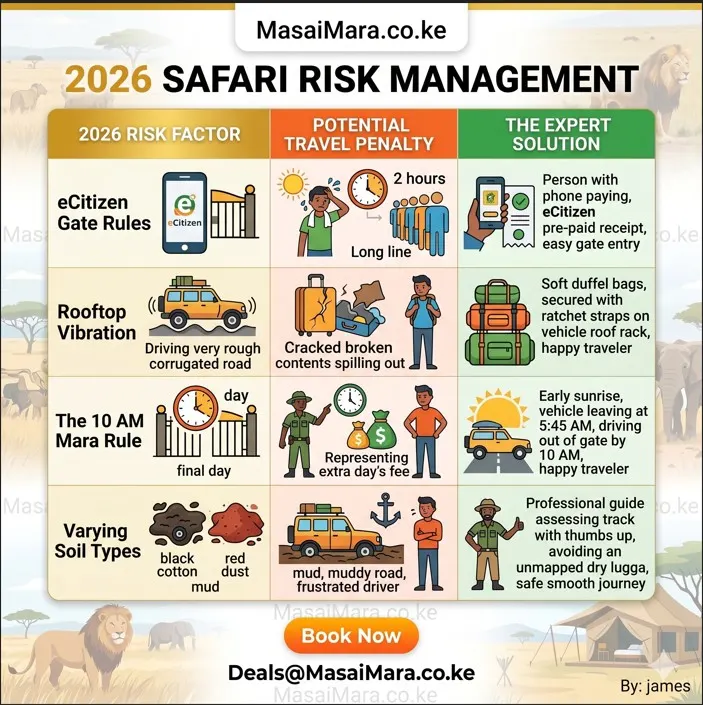
2026 Risk Factor | Potential Travel Penalty | The Expert Solution |
eCitizen Gate Rules | 2-hour wait in the sun at entry | Pre-pay all park fees digitally before reaching the gate. |
Rooftop Vibration | Hard cases crack on murram roads | Use soft duffel bags secured with ratchet straps. |
The 10 AM Mara Rule | Charged an extra day’s park fee | Complete final game drive and exit the gate by 5:45 AM–10:00 AM. |
Varying Soil Types | Vehicle anchored in deep hidden mud | Trust guide’s track assessment; avoid unmapped dry luggas. |
- Barney’s Pizza Over the Equator Trap. Every operator stops at the Nanyuki sign for the water swirling trick. It’s a tourist trap. Ask me to stop at Barney’s Restaurant at the Nanyuki Airstrip instead. Wood-fired pizza and a real Old Kenya pilot’s bar.
- The Vulturine Blue. Look for the Vulturine Guineafowl in Buffalo Springs. They’re neon blue and travel in groups of 50. A blue wave moving through the bush that looks incredible in photographs.
- The Kamunyak Legend. Ask me to take you toward the Westgate Conservancy. It’s the home of Kamunyak, the lioness who adopted oryx calves. The story is wild — and the landscape is empty.
- Night Drives. Samburu reserve doesn’t allow night drives, but Buffalo Springs next door does. It shares an unfenced border with Samburu. Porcupines, genets, aardvarks, and sometimes leopards on the hunt. About KES 8,000–12,000 per person.
- Mount Ololokwe. Swap a morning drive for a hike up this monolith with a Samburu warrior. The view from the top makes the Mara look like a backyard.
- Stay on the River. In Samburu, lodges on the Ewaso Ng’iro — like Ashnil Samburu or Sarova Shaba — give you wildlife from your room. Lodges away from the river miss the action.
- Leopard Luck. Samburu’s riverine forests provide better cover than the Mara’s open plains. Sighting rates here are often higher — one guest saw three leopards in two days.
- 10 AM Mara Exit. Under 2026 Masai Mara booking rules, you must exit by 10:00 AM on the last day. We start our final drive at 5:45 AM.
- Luggage on the Roof. The corrugated Samburu road beats rooftop luggage hard. Ask your guide to use ratchet straps, not bungee cords. Better yet, keep valuables and camera gear inside the vehicle.
- Samburu Elephants Are Bigger. The Ewaso Ng’iro provides year-round water, so these herds don’t migrate. They’ve been growing on stable feeding for decades. Even if you’ve seen elephants elsewhere, Samburu’s will impress.
- Sarova Shaba Pool. If staying at Sarova Shaba in Buffalo Springs, the pool is natural spring-fed and stays cool in 38°C heat. The only way to recover from a Samburu afternoon. Crocodiles in the river are visible from the restaurant terrace.
The Dry Sand That Wasn’t Dry
I remember a trip on this circuit where a guest got too brave with the camera. We were tracking a leopard near a dry lugga — a sandy riverbed — in Samburu. He saw a perfect angle from the other side and kept asking me to cross.
The top inch was dry, red sand. Underneath was wet clay that hadn’t seen sun in months. We weren’t just stuck. We were anchored. Three Land Cruisers and two hours of digging in 35°C heat to get us out. We missed the afternoon game drive entirely because we were covered in red mud and exhaustion.
This circuit crosses three different soil types. Samburu’s red dust hides wet pockets. Nakuru’s soda flats are like quicksand. The Mara’s black cotton swallows a tyre whole. When I say a track looks soft, I’m not being cautious — I’m keeping us out of a two-hour shovel party.
Frequently Asked Questions
What is the best month for this safari?
July to October for the Masai Mara migration. January is better for Samburu because the grass is shorter and the Special Five are easier to spot. Check our best time to visit Masai Mara guide.
Is a 4×4 Land Cruiser mandatory?
Yes. For this 1,200 km circuit, a minivan can’t handle the Samburu corrugations or the Nakuru mud. Every private safari we run uses a 4×4.
How much are 2026 park fees?
Samburu is roughly $70, Nakuru is roughly $60–$100, and the Mara is $100 regular / $200 peak. Full breakdown on our Masai Mara park fee page.
Can I add Lake Naivasha?
Yes, but you’d need to add a day. See our Masai Mara Nakuru Naivasha Safari for circuits that include all three Rift Valley lakes.
How does this compare to the Mara-Amboseli-Nakuru circuit?
The Masai Mara Amboseli Nakuru Safari swaps Samburu for Amboseli. Amboseli gives you Kilimanjaro views and massive elephant herds. Samburu gives you the Special Five, fewer crowds, and better leopard sighting rates. Different experiences.
What should I pack?
Layers (Samburu is hot, the Mara is cool at dawn), wide-brim hat, extra sunscreen, power bank, binoculars (8×42), and a trash bag for your suitcase on the Samburu road. Full list in our Masai Mara packing list.
Is this trip safe?
Yes. All three parks have rangers, your guide carries a radio, and the lodges are established. More in our Masai Mara safety guide.
What Nobody Tells You at the End
This trip is a lot of work. You’ll be dusty, you’ll be tired, and by Day 4, you might get sick of the bumpy roads. But when you see a gerenuk standing on its hind legs in the morning light, or you watch a white rhino graze in front of the submerged forest at Nakuru, you’ll understand why we call this the Diversity Loop.
It’s the only week-long trip in Kenya where you tick off ten headline species — five you can’t find anywhere else, and the Big Five on top of that. I can’t promise you’ll see a kill. But I can promise you’ll see the real, unpolished Kenya.
If 7 days feels like too much driving, try a 5 days Masai Mara safari or a 4 days Masai Mara safari. Want to fly one leg? Check Masai Mara flying packages. Browse everything on our Masai Mara packages page.
Ready to hit the road? Fill out our inquiry form at Masaimara.co.ke here and I’ll see you at the gate.
This guide was authored by David Njunge, a TRA-licensed safari guide with over 10 years of experience, and edited by Cecilia Wambui, a travel consultant with a degree in Tourism and Hospitality Management.
Related Reading:
Welcome to Masaimara.co.ke
Thank you for visiting us! We're excited to help you plan an unforgettable safari adventure across Kenya.