
Private Safari Masai Mara: Seven Days With Aberdare, Nakuru And Naivasha (2027)
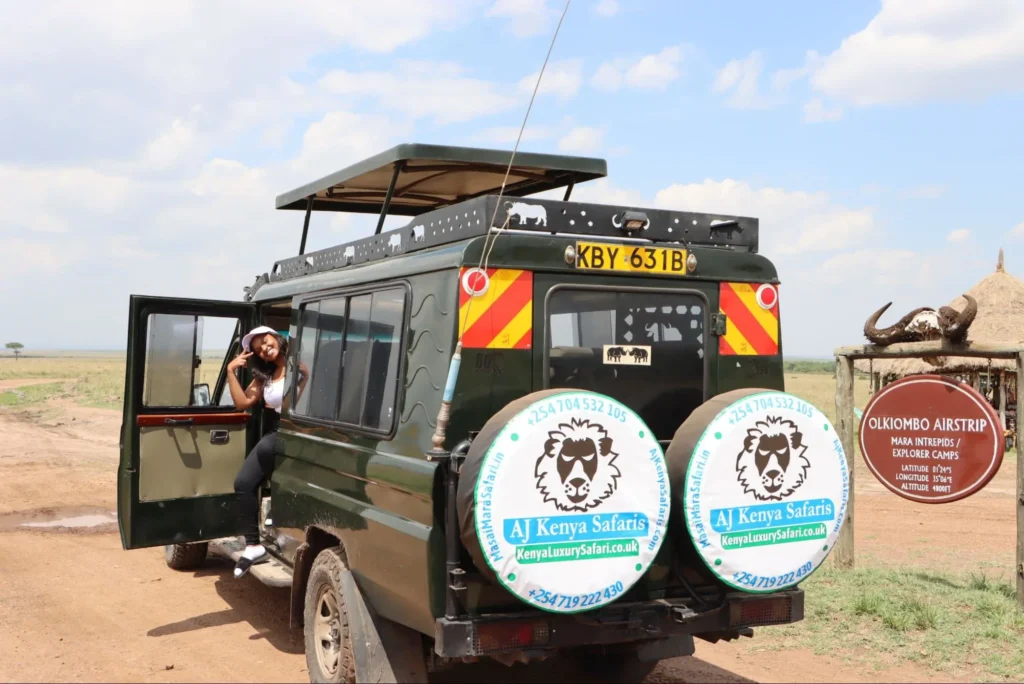
A private safari Masai Mara trip means one vehicle, one guide and one party: yours. Nobody else is booked into the Land Cruiser, and the day runs to your clock. This page sets out a seven-day private route that starts with a night at The Ark in the Aberdare forest, moves to Lake Nakuru for rhinos, spends three nights in the Masai Mara, and finishes with a boat ride and a walk at Lake Naivasha and a morning in Hell’s Gate. For 2027, it costs from USD 3,770 or KES 253,000 per person when two people travel, and less for each person you add.
Private Safari Masai Mara Costs (2027)
Each figure is what one person pays when two travel together, sharing a room and a Land Cruiser that nobody else uses. They include the vehicle and guide for seven days, six nights of accommodation, all meals, and the entry fees for Aberdare, Lake Nakuru, the Masai Mara, Crescent Island and Hell’s Gate.
International Visitors (USD)
| Level | Peak Season | Rest Of The Year |
|---|---|---|
| Budget | 4,220 | 3,770 |
| Mid-Range | 5,520 | 4,180 |
| Luxury | 7,720 | 6,580 |
Kenyan Citizens (KES)
| Level | Peak Season | Rest Of The Year |
|---|---|---|
| Budget | 282,000 | 253,000 |
| Mid-Range | 378,000 | 284,000 |
| Luxury | 541,000 | 461,000 |
Peak season is July to October. The Mara’s higher gate fee of USD 200 or KES 3,000 a day applies from 1 July to 31 December, and the Rest Of The Year prices already cover it, so a trip in November or December costs nothing extra. A festive supplement applies at most lodges from about 23 December to 2 January.
Where You Stay
| Stop | Nights | Budget | Mid-Range | Luxury |
|---|---|---|---|---|
| Aberdare | 1 | The Ark | The Ark | The Ark |
| Lake Nakuru | 1 | Lake Nakuru Lodge | Lake Nakuru Lodge | Sarova Lion Hill Game Lodge |
| Masai Mara | 3 | Jambo Mara Safari Lodge | Ashnil Mara Camp | Elewana Sand River |
| Lake Naivasha | 1 | Lake Naivasha Sopa Resort | Lake Naivasha Sopa Resort | Lake Naivasha Sopa Resort |
The level is decided by the three Mara nights, because that is where the lodge rates differ most. The Ark is the same at every level. There is only one Ark.
What A Fuller Vehicle Saves
| Party | Saving Per Person (USD) | Saving Per Person (KES) |
|---|---|---|
| 2 people | Price as shown | Price as shown |
| 4 people | 570 less | 59,000 less |
| 6 people | 760 less | 78,000 less |
The Land Cruiser costs the same whether two people or six are in it. A family of four on the Budget level pays USD 3,200 each outside peak season, in a vehicle that is still theirs alone. Our group safari page shows how the sums work for larger parties.
Single rooms. A person travelling in a party but sleeping alone pays a single supplement at each lodge. A person travelling completely alone also carries the whole vehicle, and our solo safari Masai Mara page deals with that.
Children. Every lodge on this route and every park gate charges less for children. Give us their ages on the day of travel and we price each one.
Residents of Kenya. Holders of Kenyan work or residence permits pay resident lodge rates and resident gate fees: KES 1,100 at Aberdare, KES 2,025 at Lake Nakuru, KES 675 at Hell’s Gate, KES 1,100 at Crescent Island, and in the Mara KES 2,500 a day in the first half of the year and KES 5,000 in the second. Ask for a resident quote.
What Is Covered in the Price?
- Vehicle: A 4×4 Land Cruiser with a lifting roof for all seven days, with fuel, for your party only.
- Guide: One TRA-licensed driver-guide from the first morning to the last afternoon.
- Park Fees: Aberdare National Park, 24 hours in Lake Nakuru National Park, three days in the Masai Mara National Reserve and entry to Hell’s Gate National Park.
- The Ark: Lunch at the Aberdare Country Club, the lodge bus into the forest and back, dinner, the night at The Ark and breakfast.
- Lake Naivasha: The boat, and the Crescent Island ticket for your walk among the animals.
- Accommodation: Six nights, two people to a room.
- Meals: Full board, starting with lunch at the Country Club and ending with lunch at Naivasha on the last day.
- Water: Bottled drinking water on every drive and transfer.
- Excluded: Tips (USD 15 to 20 / KES 2,000 to 2,500 per day), drinks, single room supplements, bicycle hire and the cycling fee at Hell’s Gate (USD 10 for visitors / KES 300 for citizens, plus the hire), the separate KWS gorge walk fee and the local guide if you walk into Ol Njorowa Gorge, a hot air balloon flight (USD 500 / KES 58,500), a Maasai village visit (KES 1,500 for citizens / USD 20 for non-residents), international flights, the Kenya eTA (USD 34) and Kenya’s inbound travel health insurance (up to USD 44).
People ask me what they are really buying when they pay for a private vehicle. My answer is forty-five minutes. A private party can be rolling at 5:45 AM. A vehicle that has to gather six strangers from three camps rarely moves before 6:30. In that gap, the lions are still walking, the hyenas are still on last night’s kill and the light is low and gold. By 7:30, the cats are lying down for the day. Three mornings in the Mara means three of those gaps, and that is where most of my guests’ best sightings have come from.
Key Features of a Private Safari
The vehicle and the guide are yours. No seat is sold to anyone outside your party. The guide gets to know what you care about by the second day and stops explaining things you already know. If you are birders, the commentary becomes about birds. If you have children, it becomes about dung beetles and why zebras have stripes.
You set the timing. You choose when to leave camp, how long to stay with a leopard in a fig tree and when to give up on a herd that will not cross. You can come back for a hot lunch or stay out all day with a picnic. Nobody votes.
The route is built for you. This page prices one route, but nothing in it is fixed. You can drop Aberdare, add a night in the Mara, swap Nakuru for Amboseli or fly back from the Mara. On a scheduled tour, the route exists before you book. On a private trip, it is written after we know who is travelling.
It suits some travellers more than others. Families with young children need to stop when a child needs to stop. Photographers need to wait for light and choose their angle. Couples on an anniversary do not want to make conversation with four other people at dawn. Older travellers want a slower start. For all of them, private is the practical way to travel.
Private Safari vs. Shared Group Tour
| Feature | Private Safari | Shared Group Tour |
|---|---|---|
| Vehicle and guide | Your party only | Shared with travellers you have not met |
| Pace and timing | You set it each day | A fixed timetable set by the operator |
| Who is in the vehicle | Your family, partner or friends | Usually six or seven guests |
| Route and lodges | Chosen around you | Decided before you book |
| Cost | Higher for two, falling quickly as your party grows | Lower, because strangers split the vehicle |
One thing the table does not show: a private party of four or more often pays about the same per person as a seat on a shared tour at the same lodges. The price gap is widest for one or two travellers and nearly closes by six.
The 7-Day Itinerary
| Day | Route | Driving | Overnight |
|---|---|---|---|
| 1 | Nairobi to the Aberdares, afternoon and night at The Ark | About 3 hours | The Ark |
| 2 | Aberdares to Lake Nakuru, afternoon game drive | About 3.5 hours | Lake Nakuru |
| 3 | Nakuru morning drive, then to the Masai Mara | 5 to 6 hours | Masai Mara |
| 4 | Masai Mara, full day | In the reserve | Masai Mara |
| 5 | Masai Mara, full day | In the reserve | Masai Mara |
| 6 | Mara to Lake Naivasha, boat ride and walking safari | About 5 hours | Lake Naivasha |
| 7 | Hell’s Gate, then Nairobi | About 2.5 hours | Trip ends |
Day 1: Nairobi To The Ark
We leave Nairobi at 8 AM and drive north through Thika and the coffee and tea country around Nyeri to the Aberdare Country Club at Mweiga. You have lunch there, on a lawn where peacocks and warthogs wander between the tables. Your main bags and our Land Cruiser stay at the club. At 2:30 PM, the lodge bus takes you into Aberdare National Park with an overnight bag only, a 45-minute climb through thick forest.
There are no game drives here. The Ark is shaped like a ship and moored beside a waterhole and a salt lick, and the animals come to you. You watch from four decks and a ground-level hide where an elephant can be three metres away. Elephants, buffalo, bushbuck and giant forest hogs come through the afternoon. After dark, the waterhole is floodlit, and a buzzer in your cabin tells you if something special arrives in the night. Hyenas and genets are regular. Black rhinos and leopards are the ones people get out of bed for.
Day 2: The Aberdares To Lake Nakuru
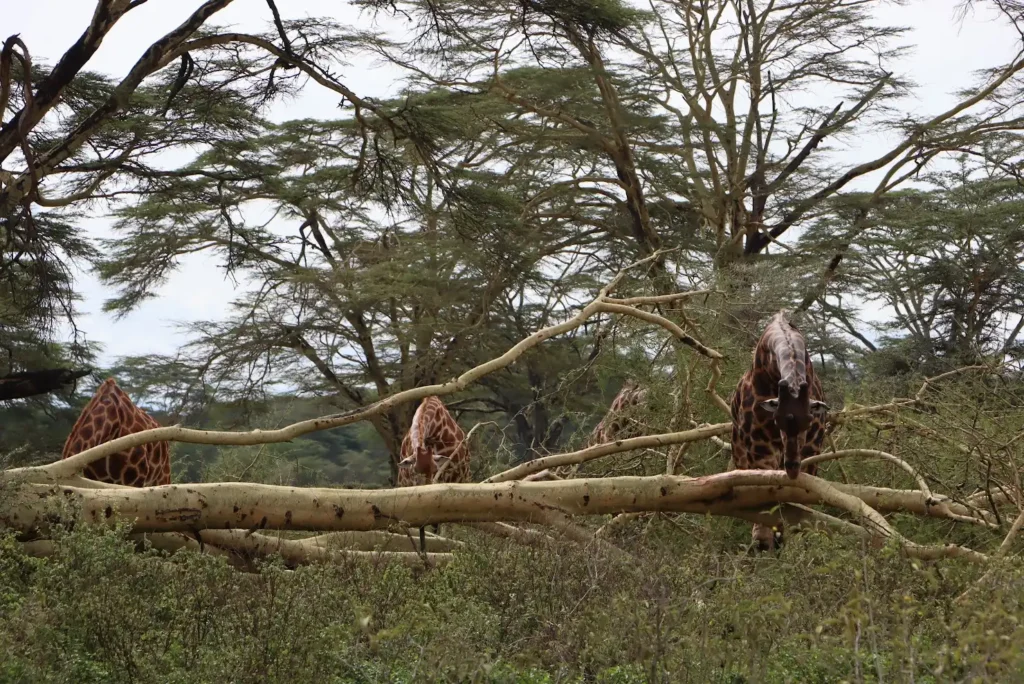
The bus returns you to the Country Club after breakfast, where your guide is waiting with the vehicle. The road crosses the high farmland of Nyandarua to Nyahururu, where we stop at Thomson’s Falls, and then drops off the edge of the Rift Valley to Nakuru. You enter Lake Nakuru National Park in time for lunch at your lodge, which is inside the park. The afternoon drive is for rhinos. Both black and white rhinos live here behind a fence, and the white ones graze in the open near the shore. Rothschild’s giraffes, buffalo and, with luck, a lion asleep in a yellow fever tree fill out the afternoon.
Day 3: Nakuru To The Masai Mara
The Nakuru ticket lasts 24 hours from the time you came in, so the early drive this morning is already paid for. We take it on the way out, up to Baboon Cliff for the view over the lake, and leave the park by about 9 AM. The road to the Mara goes through Narok, where you can eat a packed lunch or stop at a restaurant. You reach your camp in the middle of the afternoon. Guests at Ashnil and Sand River drive through the reserve to get there, which makes the last hour and a half a game drive. Guests at Jambo Mara check in and go into the reserve for the last light.
Day 4: The Masai Mara
This is the first of two full days, and how you use them is your decision. Most parties go out at 5:45 AM with breakfast packed, find the cats while they are active and eat on the plains. In the migration months, the hours around noon are spent near the Mara River in case a herd crosses. In other months, we cover the Talek and Sand River areas, where lions, cheetahs and leopards hold territories all year.
Day 5: The Masai Mara Again
A second full day changes the trip. On the first day, guests want to see everything. On the second, they start to choose. Some ask to go back to the same lion pride and watch the cubs for two hours. Some want a long, slow morning looking for a leopard and nothing else. Anyone booked on a balloon flies this morning. If you want an afternoon by the pool, take it. The vehicle waits for you.
Day 6: The Mara To Lake Naivasha
There is no game drive this morning. The reserve bills by the calendar day. Ashnil and Sand River are both inside it, so their guests need to clear the gate before 10 AM, or a fourth day’s fee falls due. Breakfast is unhurried, and then it is roughly five hours on the road to Lake Naivasha, where lunch is waiting at the lodge. In the afternoon, a boat takes you along the papyrus among hippos, pelicans and fish eagles and lands you on Crescent Island. There you walk for an hour with a guide among giraffes, zebras, wildebeest and waterbuck. Nothing on the island hunts people, which is why you can walk.
Day 7: Hell’s Gate And Back To Nairobi
Hell’s Gate National Park is twenty minutes from the lodge. It is a dry gorge of red cliffs with no lions or elephants in it, so you may leave the vehicle. Most guests hire bicycles at the gate and ride the flat track past zebras, giraffes and warthogs to Fischer’s Tower and the Central Tower. You can also walk it or stay in the Land Cruiser. A walk into the lower gorge is possible with a local guide when the rangers have it open, and they close it after rain. After lunch at Naivasha, we drive to Nairobi and arrive between 3 and 4 PM. Book a flight home for after 9 PM.
The 2+1 Conservancy and Reserve Split
The prices on this page keep you at one Mara camp for all three nights, which is the simplest way to do it. A private trip gives you another choice that a fixed tour cannot: spend the first Mara night in a conservancy and the other two at the reserve.
Why the first night. You reach the Mara in mid-afternoon on Day 3. If you sleep inside the reserve, you pay a full day’s reserve fee, USD 200 from July to December, for about two hours of daylight. If you sleep in a conservancy that night, you pay no reserve fee for Day 3. You pay the conservancy’s own fee instead, and for it you get an evening drive that carries on after dark with a spotlight.
What a conservancy adds. The conservancies are private wildlife areas on Maasai-owned land along the northern and eastern edges of the reserve. Mara North, Naboisho, Olare Motorogi and Ol Kinyei are the best known. They limit the number of beds and the number of vehicles at a sighting. They allow night drives, driving off the tracks and guided walks, none of which is permitted in the reserve. Aardvarks, bat-eared foxes, springhares and hunting leopards are night-drive animals. You will not see them on a day ticket.
What the reserve adds. The reserve has the Mara River, the crossings and the largest concentrations of animals. The south, around the Sand River, is its quietest corner. In the migration months, herds come over from the Serengeti there with only a handful of vehicles watching.
How the days run. On Day 3, you arrive at the conservancy camp and go on an evening and night drive. On Day 4, you can walk with a Maasai guide at dawn, then drive into the reserve with a picnic and check in at your reserve camp. Day 5 is a full day in the reserve. That is two reserve fees in place of three.
What it costs. It depends on the conservancy camp, and most cost more per night than the camps in our Budget and Mid-Range levels. We quote the split on request and tell you the difference before you decide.
Who Drives You Matters More Than What You Drive
| Guide | Strength | Limit |
|---|---|---|
| Your own guide, with you for all seven days | Knows your party and adjusts every day to suit it | Covers several parks, so relies partly on radio in each |
| A camp guide, based at one camp | Knows that patch daily: which den is active, where the leopard fed last night | Stays with the camp, and may be shared with other guests |
| KPSGA Silver or Gold guide | Tested knowledge of birds, tracks, behaviour and ecology | Fewer of them, so ask early |
Every Land Cruiser on the Mara road looks much the same. The guides do not. On a private trip, you spend sixty hours with one person, and that person decides what you see.
The guide who travels with you. On this route, one guide drives you from Nairobi to Nairobi. That has real advantages. By the Mara, the guide knows that you like to stay with elephants, that your daughter wants a serval and that your father needs a break every two hours. A guide who meets you for the first time at a Mara airstrip starts from nothing.
The guide who lives there. A camp-based guide works the same few square kilometres every day of the year. He knows which thicket the female leopard used yesterday and reads the vultures and the alarm calls without waiting for the radio. In the conservancies, camps use their own vehicles and guides, so a conservancy night gives you both kinds on one trip.
The radio. Guides in the reserve share sightings by radio. It finds animals fast, and it also brings every vehicle to the same lion. A good private guide uses it and knows when to ignore it. Ask yours to try for one sighting a day that you find yourselves.
The qualification. The Kenya Professional Safari Guides Association examines guides at Bronze, Silver and Gold levels. Bronze is the entry standard. Silver and Gold guides have passed written and field tests over years, and there are not many of them. If guiding quality is the thing you care about most, ask us for a Silver guide when you enquire, not a week before travel.
At The Ark. Your guide does not come into the forest with you. The Ark has its own resident naturalist, who gives a talk before dinner and stays up with the guests who are watching the waterhole.
What to Know Before You Book
| Subject | Guide’s Advice |
|---|---|
| Best value | Four to six people in the vehicle |
| Best seat for photographs | Front passenger seat in the morning, roof hatch later |
| The Ark | Overnight bag only, and bring warm clothes |
| Mara fees | Three days, charged per calendar day |
| Flights home | After 9 PM on Day 7 |
- Arrange Kenya’s Inbound Health Insurance. It became a condition of entry for foreign visitors on 5 October 2026. You buy it through eCitizen before flying, the price is up to USD 44 a person with children paying too, and it meets up to USD 50,000 of emergency medical and evacuation costs in Kenya. It is not required of Kenyan citizens, permit-holding residents or East African Community nationals. Keep a screenshot of the page that says “Insurance: Valid” together with the reference number, because a PDF does not always arrive. Each traveller needs a certificate in their own name, and you should have it ready at the airport in case the airline asks to see it at check-in.
- Pack A Small Bag For The Ark. Only an overnight bag and your camera go on the lodge bus. Put what you need for one night in a daypack before you leave Nairobi: warm layers, medication, chargers and a torch. The rest stays locked at the Country Club.
- Expect Cold In The Aberdares. The Ark stands at about 2,300 metres. Nights on the open decks are close to freezing in July and August. Bring a fleece, a windproof jacket and a hat, even if the rest of your trip is in shorts.
- Know That Ark Cabins Are Small. They are built like ship’s cabins, snug and simple. You are paying for the waterhole, and the best guests spend most of the night on the decks.
- Sit In Front For The Morning Drive. Through the front passenger window, a lion is at eye level and fills the frame. From the roof, you are looking down on it. Use the front seat at dawn and the hatch when the sun is higher.
- Tell Your Guide What You Want On Day 1. Cats, birds, elephants, photographs or a slow pace with long lunches. A private guide can only shape the trip around you if you say what shape you want.
- Ask For Bush Breakfast The Night Before. Camps pack it if you order at dinner. Eating on the bonnet of the vehicle with the plains in front of you saves the hour it takes to drive back to camp.
- Do Not Self-Drive The Mara. It is allowed, but the tracks are unsigned, phone signal comes and goes, and the black cotton soil after rain will hold a hired car until someone tows it out. A guide here is how you find your way as much as how you find animals.
- Decide On Bicycles Before Hell’s Gate. The ride to the towers and back is flat, about 16 km, and takes two hours at an easy pace. It is hot by 11 AM, so start early. If anyone in the party does not cycle, the vehicle can follow.
- Carry Shillings. Bicycle hire, the gorge guide, tips and curios are paid in cash. Lodges take cards.
- Book Peak Dates Early. A private trip can be put together in a few days outside peak season. For July to October, The Ark and the Mara camps inside the reserve fill months ahead.
Frequently Asked Questions
How much does a private safari in the Masai Mara cost?
Our seven-day private trip costs from USD 3,770 or KES 253,000 per person for two people outside peak season, and from USD 4,220 or KES 282,000 from July to October. Mid-Range and Luxury levels cost more. Each person pays USD 570 less in a party of four and USD 760 less in a party of six.
Is a private safari worth the extra cost?
For a couple, it costs noticeably more than a seat on a shared tour, and you are paying for early starts, time at sightings and a guide who works only for you. For a family or four friends, the difference per person is small, and private is almost always the better choice.
Can I change the route?
Yes. The itinerary here is one example. You can remove or add parks, change lodges, add nights or fly one way. We reprice it and send you the new figure.
Are there game drives at The Ark?
No. Vehicles do not operate from the lodge. You watch the waterhole and salt lick from the decks and the ground-level hide, by day and under floodlights at night.
Is a 4×4 necessary?
Yes. The Mara’s tracks turn to mud after rain, and a two-wheel-drive vehicle gets stuck. All our private trips use a 4×4 Land Cruiser.
Will I see the Big Five?
This route gives you a good chance at all five. Rhinos are near certain at Lake Nakuru and possible at The Ark. Lions, elephants and buffalo are reliable in the Mara, and leopards are seen on most trips with three nights there.
What is the best month for a private safari?
August and September for the river crossings. January and February for dry weather, fewer vehicles and lower prices. June for green country and quiet camps. See our best time to visit Masai Mara guide.
The Difference You Are Paying For
It is not the seat or the vehicle. It is that when a cheetah stands up and starts to walk, your guide can follow her for an hour without asking anyone’s permission. It is that you can spend a whole morning in the quiet south of the reserve and meet two other vehicles. It is that the child in the back who asks to stop for a tortoise gets to stop for the tortoise. A private safari does not show you different animals. It lets you look at them for as long as you want.
For shorter private trips, see our 4 days Masai Mara safari and 5 days Masai Mara safari.
Related Reading:
- Group Safari Masai Mara
- Solo Safari Masai Mara
- Mid-Range Masai Mara Safari
- Budget Kenya Safari
- Luxury Safari Masai Mara
- Masai Mara Conservancies
- Masai Mara Park Fees
Written by David Njunge, TRA-licensed safari guide with over 10 years in the Masai Mara. Edited by Cess Wambui, travel consultant, BSc Tourism and Hospitality Management. Verified for the 2027 season.
Welcome to Masaimara.co.ke
Thank you for visiting us! We're excited to help you plan an unforgettable safari adventure across Kenya.