
Masai Mara, Samburu & Lake Nakuru Safari: The 2026 Guide
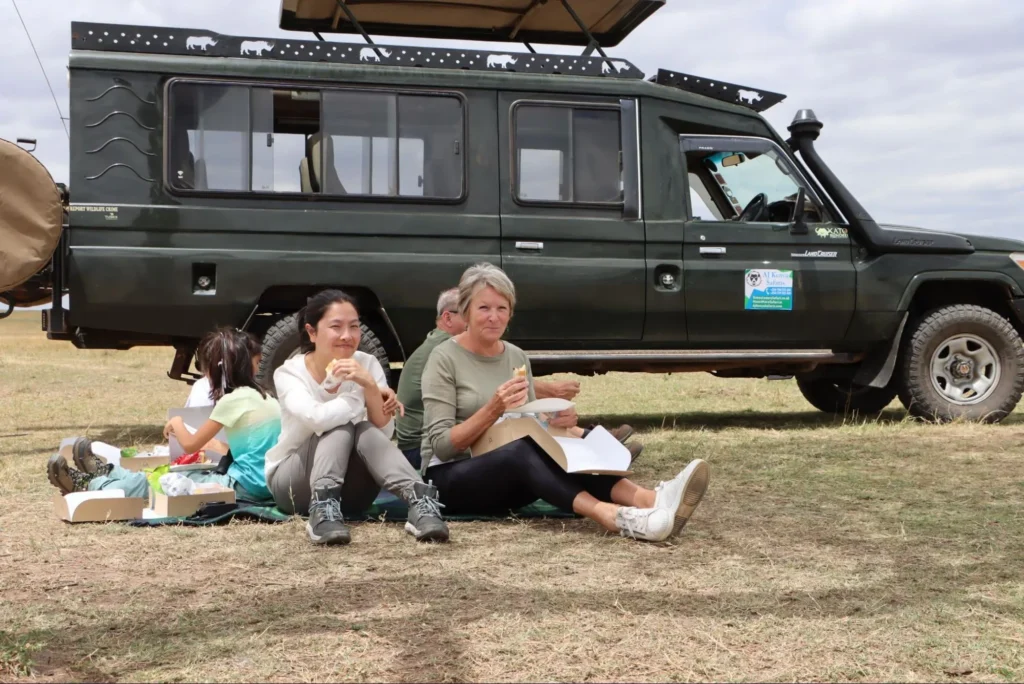
A Masai Mara Samburu Lake Nakuru Safari covers three ecosystems that share almost nothing in common, offering the chance to tick off both the Big Five and the Samburu Special Five in a single week. For the 2026/2027 season, all-inclusive rates for two people sharing range from KES 415,500 ($3,195) to KES 1,320,000 ($10,150) per person. This covers a private 4×4 Land Cruiser, professional TRA-licensed guide, all eCitizen park fees, and 6 nights of lodging. Success on this circuit requires a guide with a deep radio network across all three parks and soft bags instead of hard suitcases.
Choose Your Duration
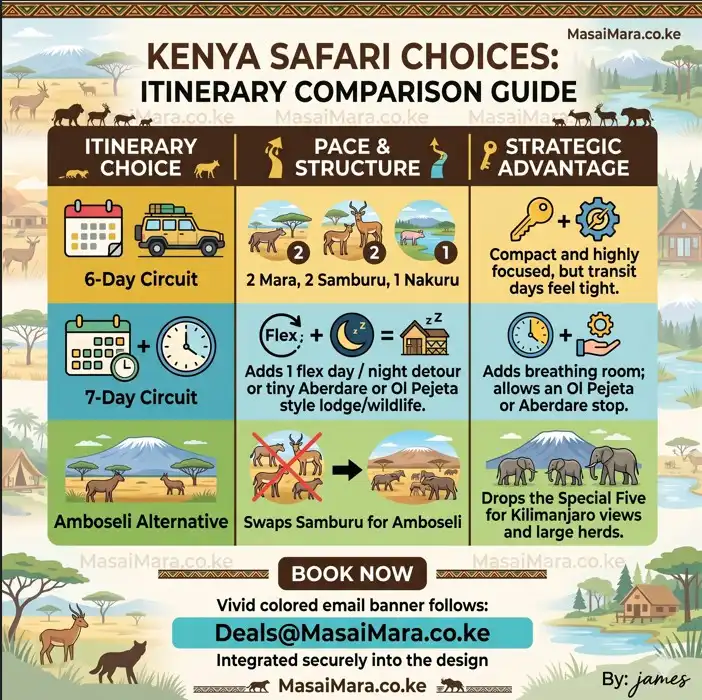
Itinerary Choice | Pace & Structure | Strategic Advantage |
6-Day Circuit | 2 Mara, 2 Samburu, 1 Nakuru | Compact and highly focused, but transit days feel tight. |
7-Day Circuit | Adds 1 flex day / night detour | Adds breathing room; allows an Ol Pejeta or Aberdare stop. |
Amboseli Alternative | Swaps Samburu for Amboseli | Drops the Special Five for Kilimanjaro views and large herds. |
This trip works best in either 6 or 7 days, depending on how much time you have.
- 6 Days Masai Mara Samburu Nakuru Safari — 2 Mara nights, 2 Samburu nights, 1 Nakuru night. Works but tight.
- 7 Days Masai Mara Samburu Nakuru Safari — 2 Mara nights, 2 Samburu nights, 1 Nakuru night, plus the conservancy split or Ol Pejeta detour. More breathing room.
The extra day on the 7-day version turns the Samburu-to-Nakuru transit from a dead driving day into an opportunity. You can add a night at Ol Pejeta Conservancy to see the last two northern white rhinos on earth, or break the drive at Aberdare National Park for a night at The Ark tree-lodge.
How this differs from the Amboseli-Nakuru circuit. The Masai Mara Amboseli Nakuru Safari replaces Samburu with Amboseli. Amboseli gives you Kilimanjaro views and massive elephant herds. This circuit gives you the Special Five, better leopard sighting rates, and a landscape that feels completely different from the Mara. Less popular, fewer crowds, and harder to find as a pre-packaged product — which is an advantage if you want a custom trip.
Masai Mara Samburu Lake Nakuru Safari Costs
Pricing reflects the updated park fees and the mandatory 4×4 vehicle rates. These are all-inclusive prices for two people sharing a private 4×4 vehicle on the 7-day version. The 6-day is roughly 15% less.
7-Day All-Inclusive Rates (Per Person Sharing)
Package Tier | Suggested Hotels | Regular (KES) | Peak (KES) |
Budget | Samburu Riverside & Talek Bush Camp | KES 415,500 | KES 695,000 |
Mid-Range | Ashnil Samburu & Sarova Lion Hill | KES 585,000 | KES 910,000 |
Luxury | Elephant Bedroom & The Cliff & Mara Serena | KES 840,000 | KES 1,150,000 |
Luxury Plus | Sasaab & Angama Mara | KES 1,020,000 | KES 1,320,000 |
Book Now | Current Rates |
Note: Peak season is July–October during the wildebeest migration. If you want to fly one leg, check our Masai Mara flying packages. For a luxury safari upgrade, request a custom quote.
What’s Covered in the Price?
- Vehicle. Private 4×4 Safari Land Cruiser with pop-up roof.
- Guide. TRA-licensed guide with radio connections across all three parks.
- Park Fees. All entries via the kwspay portal.
- Accommodation. 6 nights full board.
- Water. Bottled water in the vehicle.
Excluded. Tips (KES 3,500/day recommended), alcoholic drinks, hot air balloon (approx KES 78,000), Masai village visit (KES 4,500), international flights and Kenya eTA.
I’ve been guiding for ten years. A Masai Mara Samburu Lake Nakuru Safari covers nearly 1,200 kilometres. Semi-arid desert in the north. A volcanic soda lake in the Rift Valley. Open grassland savannah in the west. No two days look or feel the same. But the distance is real. If your guide doesn’t know the shortcuts, you’ll spend more time looking at the back of a truck than at a leopard.
The 10-Species Achievement
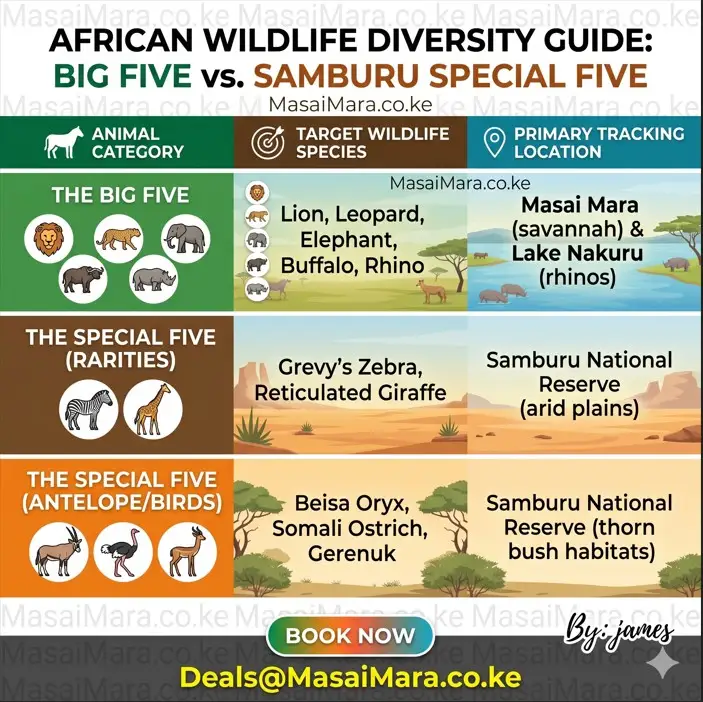
Animal Category | Target Wildlife Species | Primary Tracking Location |
The Big Five | Lion, Leopard, Elephant, Buffalo, Rhino | Masai Mara (savannah) & Lake Nakuru (rhinos). |
The Special Five (Rarities) | Grevy’s Zebra, Reticulated Giraffe | Samburu National Reserve (arid plains). |
The Special Five (Antelope/Birds) | Beisa Oryx, Somali Ostrich, Gerenuk | Samburu National Reserve (thorn bush habitats). |
Most Masai Mara packages focus only on the Big Five. This circuit is different. It’s the only one where you can tick off ten headline species in a week.
The Big Five. Lions, leopards, elephants, buffalo from the Mara, and rhinos from Nakuru.
The Special Five. Grevy’s Zebra, Reticulated Giraffe, Beisa Oryx, Somali Ostrich, and the Gerenuk. Samburu only. You won’t find these in the Mara or Nakuru.
A guide with 10+ years of contacts across all three parks finds the Gerenuk faster by talking to rangers who know where the thorn bushes are blooming. The radio network is what separates a good guide from a great one on this circuit.
The Subukia Shortcut
When driving from the heat of Samburu to Nakuru on Day 3, most drivers take the main B3 highway. It’s boring and dusty.
The Subukia Tea Route. Ask your guide to take the Subukia climb instead. You rise from the desert to nearly 2,600m in an hour. You’ll see the Great North Road winding beneath you like a snake, and the tea plantations are green year-round.
Thomson’s Falls Chameleon. We stop at Nyahururu, Kenya’s highest town. Look for the chameleon handlers near the falls. For a few shillings, they’ll show you the Jackson’s Three-horned Chameleon — it looks like a miniature Triceratops and is almost impossible to find alone.
Lord Egerton’s Heartbreak. Just outside Nakuru, we can stop at Lord Egerton Castle. He built a 52-room mansion to impress a woman who rejected him because the house was too small. It’s the strangest piece of architecture in Kenya.
Samburu: Singing Wells & Snorkel Elephants
Samburu is a furnace, often hitting 35°C. The wildlife here behaves differently from anything you’ll see in the Mara.
The Snorkel sight. Samburu elephants fully submerge in the Ewaso Ng’iro River at midday. We park near the Buffalo Springs bridge to watch them cross with only their trunks above water.
Doum Palm Leopards. In the Mara, leopards love yellow fever trees. In Samburu, they hide in the thick fronds of the Doum Palm. Most tourists scan the trunks. We scan the crown of the palm.
The Singing Wells. If we find a family willing to let us watch, you’ll hear Samburu warriors singing unique, family-coded songs to lead their cattle to water. It’s the holy grail of cultural authenticity, but you must leave your camera in the car. It’s a functional ritual, not a show.
What Happened to Nakuru’s Shoreline
The lake has risen so much that the old forest is now an underwater forest of skeletal white trees near Hippo Point.
Hyrax Hill Detour. Ten minutes from the park is the Hyrax Hill Museum, a Neolithic site from 3,000 years ago. It proves this corridor has been a migratory route for humans and animals for millennia.
Naishi Shift. Because the north is flooded, the white rhinos have moved to the Naishi Plains in the south. We head there first.
Skip Lake Nakuru Lodge for dinner. Guests keep telling me the food there is disappointing. One Indian family described it as the worst meal of their trip. If your operator gives you a choice, go with Sarova Lion Hill. Better buffet, better vegetarian options, and the location inside the park is just as good.
11 Things to Know Before You Go
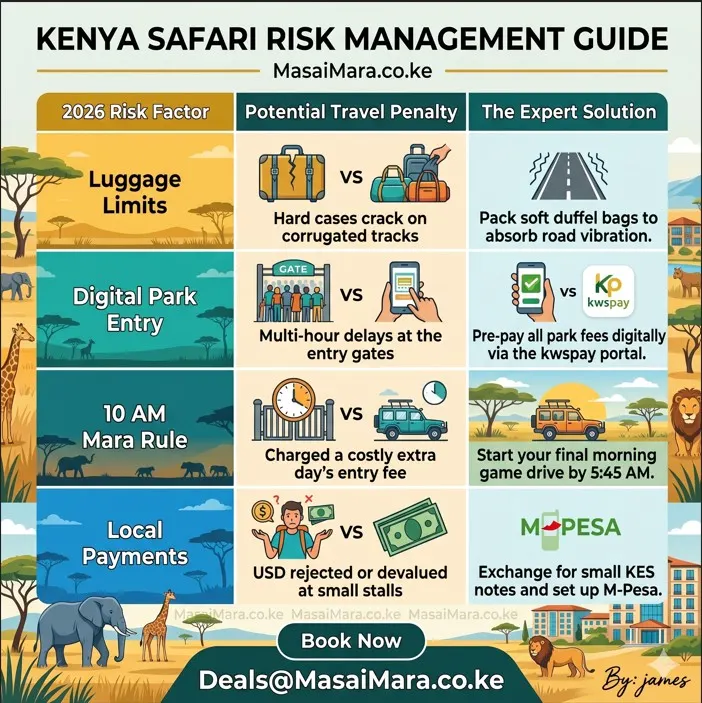
2026 Risk Factor | Potential Travel Penalty | The Expert Solution |
Luggage Limits | Hard cases crack on corrugated tracks | Pack soft duffel bags to absorb road vibration. |
Digital Park Entry | Multi-hour delays at the entry gates | Pre-pay all park fees digitally via the kwspay portal. |
10 AM Mara Rule | Charged a costly extra day’s entry fee | Start your final morning game drive by 5:45 AM. |
Local Payments | USD rejected or devalued at small stalls | Exchange for small KES notes and set up M-Pesa. |
- Vervet Monkey Bombing. Never park under an Umbrella Thorn tree in Samburu with the windows down. Monkeys drop heavy seed pods onto the roof to startle you, then drop inside to grab your phone.
- Soft Bags Only. Hard suitcases crack on the corrugated Samburu road. Zippers burst, wheels snap off. Use soft duffel bags. If you must bring a hard case, keep it inside the vehicle.
- Ol Pejeta Detour. See the “Choose Your Duration” section. If you take the 7-day version, a Day 1 stop at Ol Pejeta fits naturally before continuing to Samburu.
- Wise Over SWIFT. Bank transfers from the UK or US cost $25–50 in SWIFT fees. Use Wise or PayPal instead. Faster and cheaper.
- Binocular Audit. I carry two pairs, but ask your guide to confirm they’re in the vehicle before leaving Nairobi. On this circuit, binoculars are the difference between seeing a shape and seeing a leopard’s whiskers.
- Kuku Kienyeji. For a real local lunch, ask for Kuku Kienyeji (free-range chicken) in Nakuru. It’s tougher but has ten times the flavour of the broiler chicken at the lodges.
- 10 AM Mara Exit. Under current Masai Mara booking rules, you must exit by 10:00 AM on the final day. We start our last drive at 5:45 AM.
- Vegetarian Advance Notice. Hotels like Samburu Sopa have excellent Indian vegetarian options, but I need to tell them 48 hours before arrival so they can prep the paneer and dal.
- The Data Black Hole. Most Mara camps have Wi-Fi now, but the road between Nakuru and the Mara is a signal desert. Make your calls before we leave Nakuru.
- Group Tour Trap. If you book a group departure and the others cancel, some operators won’t tell you. Get a guaranteed departure confirmation in writing. Ask how many passengers are confirmed on your date.
- KES Over USD. Tips, village visits, roadside food, and small shops run on Kenyan shillings. Carrying only USD means you’re losing value on every exchange. Get a mix of KES small notes plus a Safaricom SIM for M-Pesa.
The Hard Suitcase That Didn’t Survive Day 2
I had a family on this circuit who brought two hard-shell suitcases. I told them at JKIA that the Samburu road would be rough. They said the cases were “indestructible.”
By the time we reached Samburu, one case had cracked along the hinge. The zipper on the other had burst open on the roof rack. Clothes were scattered inside the dust cover. We spent 30 minutes at the lodge repacking everything into plastic bags.
On a circuit that covers 1,200 km of mixed road, your luggage takes more punishment than you do. Soft duffel bags absorb the vibration. Hard cases amplify it. If your guide tells you to switch bags, listen.
Frequently Asked Questions
How many days do I need?
See the “Choose Your Duration” section above. Short answer: 7 days is the sweet spot. The 6-day version works but the Samburu-to-Nakuru transit is rushed.
What is the best month for this safari?
July to October for the Masai Mara migration. January is better for Samburu because the grass is shorter and the Special Five are easier to spot. Check our best time to visit Masai Mara guide.
Is a 4×4 Land Cruiser mandatory?
Yes. A minivan can’t handle the corrugated Samburu road or the Nakuru mud. Every private safari we run uses a 4×4.
How much are park fees?
Samburu is roughly $70. Nakuru is $60–$100. The Mara is $100 regular, $200 peak. Full breakdown on our Masai Mara park fee page.
How does this compare to the Mara-Amboseli-Nakuru circuit?
See the comparison in “Choose Your Duration” above. Short version: the Masai Mara Amboseli Nakuru Safari gives you Kilimanjaro views. This circuit gives you the Special Five and better leopard odds.
What should I pack?
Soft duffel bags (no hard cases), layers (Samburu is hot, the Mara is cool at dawn), wide-brim hat, extra sunscreen, power bank, binoculars (8×42), and a Safaricom SIM from the airport. Full list in our Masai Mara packing list.
Is this trip safe?
Yes. All three parks have rangers, your guide carries a radio, and the lodges are established. More in our Masai Mara safety guide.
What I’d Tell a First-Timer
This circuit is a lot of driving. By Day 4, the bumpy roads start to feel normal. By Day 5, you stop noticing the dust. And somewhere around Day 6, when you’re sitting in the Mara watching a pride of lions wake up in the morning mist, you realise the distance was the point. Each park felt like a different country. The Samburu heat, the Nakuru forest, the Mara grassland. Ten species you couldn’t see on any other trip. That’s the Diversity Loop.
If this feels like too much ground, try a 5 days Masai Mara safari or a 4 days Masai Mara safari. Want Amboseli instead of Samburu? See the Masai Mara Amboseli Nakuru Safari. Browse everything on our Masai Mara packages page.
Ready to hit the road? Fill out our inquiry form at Masaimara.co.ke here and I’ll see you at the gate.
Related Reading:
- 6 Days Masai Mara Samburu Nakuru Safari
- 7 Days Masai Mara Samburu Nakuru Safari
- Masai Mara and Samburu Safari
- Masai Mara and Lake Nakuru Safari
- Masai Mara Amboseli Nakuru Safari
- 6 Days Masai Mara Amboseli Safari
- 5 Days Masai Mara Safari
- 4 Days Masai Mara Safari
- Masai Mara Packages
- Luxury Safari Masai Mara
- Masai Mara Flying Packages
- Masai Mara Migration
- Masai Mara Booking
- Wildebeest Migration Kenya
- Masai Mara vs Serengeti
- Masai Mara Safari from Nairobi
- Masai Mara Entrance Gates
- Mara River Crossing
- Official KWS Park Fee Portal
- Kenya Wildlife Service
This guide was authored by David Njuge, a TRA-licensed safari guide with over 10 years of experience, and edited by Cecilia Wambui, a travel consultant with a degree in Tourism and Hospitality Management.
Welcome to Masaimara.co.ke
Thank you for visiting us! We're excited to help you plan an unforgettable safari adventure across Kenya.