
14 Days Kenya And Tanzania Safari: Seven Parks And A Beach (2027)

A 14 days Kenya and Tanzania safari has room for the whole northern circuit of both countries and a proper rest at the end. This route gives the Masai Mara three nights, stops at Lake Naivasha, spends two nights under Kilimanjaro in Amboseli, and crosses into Tanzania by road at Namanga. From there it goes on to Lake Manyara, the Ngorongoro Crater and the Serengeti, then flies straight from the bush to Zanzibar for three nights by the sea. For 2027, it costs from USD 9,520 or KES 886,000 per person sharing. You start in Nairobi and fly home from Zanzibar.
14 Days Kenya and Tanzania Safari Costs (2027)
This is the longest trip in our Kenya and Tanzania safari range. The 10-day version covers six stops without the beach.
Every price below is for one person, with two travelling together. It includes a private 4×4 Land Cruiser and guide on each side of the border, all park and conservation fees, the Naivasha boat ride and Crescent Island walk, one descent into the Ngorongoro Crater, the flight from the Serengeti to Zanzibar, airport transfers on the island and thirteen nights of accommodation.
International Visitors (USD)
| Season | Mid-Range | Luxury |
|---|---|---|
| January to March | 10,310 | 14,370 |
| June | 9,610 | 13,860 |
| July to October | 12,010 | 16,130 |
| November | 9,520 | 14,730 |
Kenyan Citizens (KES)
| Season | Mid-Range | Luxury |
|---|---|---|
| January to March | 1,046,000 | 1,501,000 |
| June | 955,000 | 1,435,000 |
| July to October | 1,191,000 | 1,631,000 |
| November | 886,000 | 1,462,000 |
Lodges And Camps
| Stop | Nights | Mid-Range | Luxury |
|---|---|---|---|
| Masai Mara | 3 | Ashnil Mara Camp | Elewana Sand River |
| Lake Naivasha | 1 | Lake Naivasha Sopa Resort | Enashipai Resort |
| Amboseli | 2 | Kibo Safari Camp | Amboseli Serena Safari Lodge |
| Lake Manyara | 1 | Lake Manyara Serena Safari Lodge | Lake Manyara Kilimamoja Lodge |
| Ngorongoro rim | 1 | Ngorongoro Serena Safari Lodge | Lemala Ngorongoro Tented Camp |
| Serengeti, January to March | 2 | Lake Masek Tented Camp | Lemala Ndutu |
| Serengeti, June to December | 2 | Lemala Ewanjan | Kubu Kubu Tented Lodge |
| Zanzibar | 3 | Turaco Nungwi Resort | Zuri Zanzibar |
Meals. The safari nights are full board. The three Zanzibar nights are half board, with breakfast and dinner at the hotel, so you can eat lunch wherever the day takes you.
April, May and December. We price April and May on request, because several camps close or cut their rates for the long rains. December costs more than the November row once the festive season starts around 20 December.
Kenyan citizens and residents. For the shilling table, we applied Kenyan citizen fees up to Namanga and East African Community fees after it. Residents on a Kenyan permit pay resident fees in the Mara and Amboseli and non-resident fees in every Tanzanian park.
What Is Covered in the Price?
- Vehicles: A private Land Cruiser with a Kenyan guide from Nairobi to the Namanga border, and a private Land Cruiser with a Tanzanian guide from Namanga to the Serengeti airstrip.
- Guides: A TRA-licensed Kenyan guide for Days 1 to 7, and a licensed Tanzanian guide from the border to the Serengeti airstrip.
- Park Fees: Three days in the Masai Mara, two 24-hour tickets for Amboseli, one Lake Manyara permit, Ngorongoro entry and concession fees with the crater service fee, and Serengeti permits and concession fees for two nights.
- Lake Naivasha: The boat ride and the Crescent Island entrance fee.
- Flights: The Day 11 flight from the Serengeti to Zanzibar, which is part of the package price and not an extra.
- Zanzibar: Transfers from the airport to the hotel on Day 11 and back on Day 14.
- Accommodation: Ten nights full board on safari and three nights half board on Zanzibar.
- Excluded: International flights, tips (USD 15 to 20 / KES 2,000 to 2,500 per guide per day), drinks, lunches on Zanzibar, island excursions, Zanzibar’s hotel infrastructure tax (USD 5 per person per night at 4- and 5-star resorts, paid at checkout), the Olduvai Gorge museum, a hot air balloon flight (USD 500 / KES 58,500 in the Mara), a Maasai village visit (KES 1,500 for citizens / USD 20 for non-residents), the Kenya eTA (USD 34), Kenya’s inbound health insurance (up to USD 44), the Tanzania eVisa (USD 50, or USD 100 for US citizens), Tanzania’s visitor insurance and Zanzibar’s own insurance (USD 44 adults, USD 22 children each).
Ten years of guiding have taught me that two weeks on safari goes wrong in one of two ways. Either the route tries to add a park a day, and the guests see everything through a windscreen. Or it has no rest in it, and by Day 10 a lion gets a glance and a yawn. This route takes care of the first problem by staying two or three nights where it counts, and the second by putting the sea at the end.
The 14-Day Itinerary
| Day | Route | Overnight |
|---|---|---|
| 1 | Nairobi to the Masai Mara, afternoon game drive | Masai Mara |
| 2 | Masai Mara, full day | Masai Mara |
| 3 | Masai Mara, full day | Masai Mara |
| 4 | Mara to Lake Naivasha, boat ride and walk | Lake Naivasha |
| 5 | Naivasha to Amboseli, afternoon game drive | Amboseli |
| 6 | Amboseli, full day | Amboseli |
| 7 | Amboseli to Lake Manyara through Namanga | Lake Manyara |
| 8 | Lake Manyara to Ngorongoro, crater game drive | Ngorongoro rim |
| 9 | Ngorongoro to the Serengeti, game drive on the way | Serengeti |
| 10 | Serengeti, full day | Serengeti |
| 11 | Fly to Zanzibar | Zanzibar |
| 12 | Zanzibar, at leisure | Zanzibar |
| 13 | Zanzibar, at leisure | Zanzibar |
| 14 | Transfer to the airport | Trip ends |
Day 1: Nairobi To The Masai Mara
Your guide meets you at 7 AM and drives west, down the escarpment and through Narok. You are at Sekenani Gate by about 12:45 PM and see your first animals on the way to camp. Lunch is late, and the afternoon game drive runs until the sun is nearly down.
Days 2 And 3: The Masai Mara
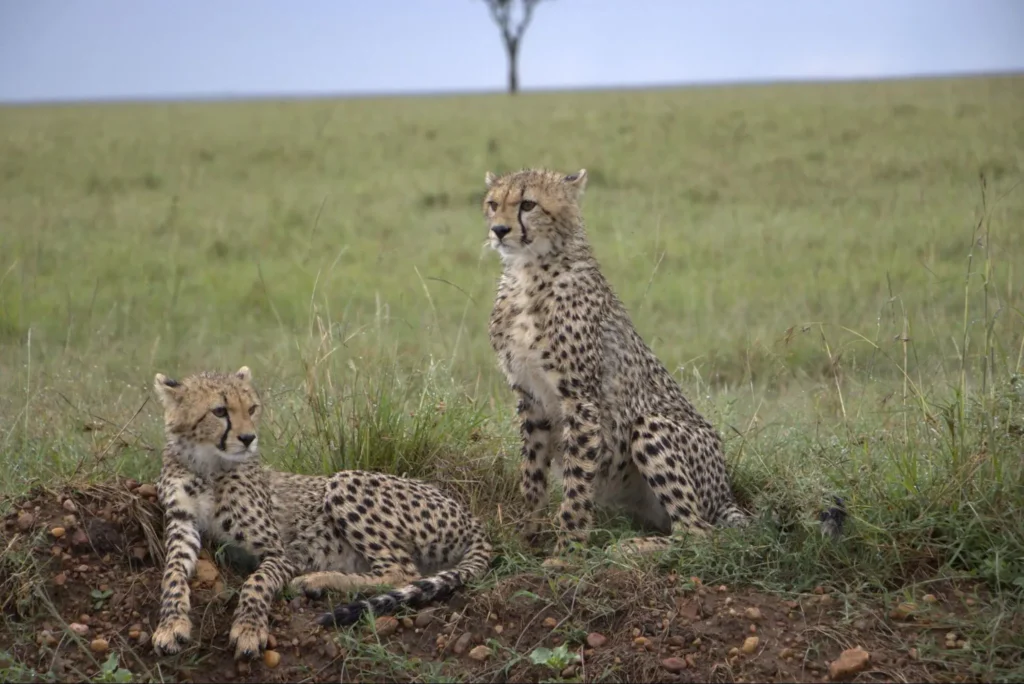
Two complete days, each with a picnic so that nobody has to turn back at noon. In July to October, the wildebeest are here and one day goes to the Mara River. In the other months, we concentrate on the lions, leopards and cheetahs that live in the reserve all year. Starting the trip in the Mara means you see the big cats while you are fresh.
Day 4: The Mara To Lake Naivasha
We leave the reserve after breakfast, before the 10 AM exit time, and reach Lake Naivasha in about five hours. After lunch at the lodge, you take a boat across the lake among hippos and pelicans and step off at Crescent Island. A guide walks you through the herds of zebra, giraffe and wildebeest that live there without predators. You are back at the lodge by sunset. It is a light afternoon, and you will be glad of it tomorrow.
Day 5: Naivasha To Amboseli
This is the longest road day in Kenya, six to seven hours. We leave at 6:30 AM, skirt Nairobi on the bypass, follow the Mombasa road to Emali and turn south to the park. You arrive for a late lunch and go out at about 4 PM. Kilimanjaro is usually behind cloud at midday and often clears just before sunset, so keep looking south.
Day 6: A Full Day In Amboseli
Be up before dawn. The mountain is at its clearest in the first hour of light, and the elephant families walk out of the acacia woodland towards the swamps at the same time. Amboseli’s elephants have been studied for more than fifty years and are relaxed around vehicles, so you can sit close while a herd of forty files past. Later, we climb Observation Hill on foot for the view over the swamps.
Day 7: Across The Border To Lake Manyara
We leave Amboseli at 6:30 AM and drive about two hours to Namanga. At the One Stop Border Post, your Kenyan guide walks you in, both countries stamp your passport in the same hall, and your Tanzanian guide is waiting outside with the second Land Cruiser. Your Kenyan guide goes no further than this, and he drives back to Nairobi once you are through.
From Namanga, the road runs past Mount Longido and Mount Meru to Arusha, where we stop for lunch, and then west to Lake Manyara National Park. You enter at about 3 PM for a game drive through the groundwater forest to the lake shore. Manyara is small and green, with large baboon troops, hippos and, when the water level suits them, thousands of flamingos. Its lions sometimes climb trees, though you need luck to see it.
Day 8: Lake Manyara To The Ngorongoro Crater
The crater is an hour up the road, so we leave early with a picnic and go straight down. Vehicles may spend six hours on the floor. That is enough to see the lions, the big bull elephants in the Lerai Forest, the hippos at Ngoitokitok Springs and, with binoculars, the black rhinos on the open grass. You drive up to the rim in the afternoon and check in at the lodge, 600 metres above where you ate lunch.
Day 9: Ngorongoro To The Serengeti
The lodge packs your lunch, and we do not see a hotel again until evening. After breakfast, we cross the highlands and drop to the plains, with an optional stop at Olduvai Gorge. At Naabi Hill Gate, your guide handles the permits while you climb the short path to the viewpoint. Then the day turns into one long game drive north across the plains, with lunch under a tree. You reach camp at about 6 PM for check-in and a shower. From January to March, the day is spent on the southern plains around Ndutu.
Day 10: A Full Day In The Serengeti
A whole day to work the area around camp. At Seronera, we follow the river for leopards in the sausage trees and check the kopjes for lions. At Ndutu in the calving months, we stay with the herds and the cheetahs that hunt among them.
Day 11: Fly To Zanzibar
A short drive takes you to the airstrip, where you thank your Tanzanian guide. The flight to Zanzibar usually goes through Arusha and lands in the afternoon. A hotel driver is waiting in arrivals, and the road to the north coast takes roughly ninety minutes. The rest of the day is free.
Days 12 And 13: Zanzibar
Two days with nothing planned. The beaches at Nungwi and Kendwa can be swum at any tide, which is not true of the east coast. If you want an outing, the hotel can arrange a morning in Stone Town, a spice farm visit or snorkelling at Mnemba Atoll at extra cost. Most guests do one of these and spend the remaining time on a sunbed.
Day 14: Transfer To The Airport
After breakfast, a driver takes you to Abeid Amani Karume International Airport. The drive from the north coast takes about an hour and a half, so book a flight that leaves after midday.
Why You Need Rest Days
| Day | Hours In The Vehicle | How It Feels |
|---|---|---|
| 4, Mara to Naivasha | About 5 | Easy, with a boat and a walk at the end |
| 5, Naivasha to Amboseli | 6 to 7 | The longest day in Kenya |
| 7, Amboseli to Manyara | 6, plus the border | Long, broken up by Namanga and Arusha |
| 9, Ngorongoro to the Serengeti | All day | Mostly game driving, so it does not feel like travel |
| 11 to 14, Zanzibar | None | Real rest |
Most people reach their limit after about ten days of 6 AM starts. The first sign is that you stop reaching for the camera. On this route, we have put the rest where it does the most good.
Naivasha is a half rest. On Day 4 you are out of the vehicle by early afternoon and on your feet or in a boat until dark. It is not a day off, but it uses different muscles.
Amboseli can be slowed down. Day 6 is a full day in the park, but the lodge is never more than half an hour away. If you want a quiet afternoon by the pool, take it. The elephants will be there at four.
Zanzibar is the real break. Ten days of early mornings end at the airstrip on Day 11. Three nights on the island with no schedule is what turns this from a hard trip into a holiday. Do not be tempted to fill both free days with excursions.
If you want more. A fourth Zanzibar night, or a night in Arusha after Day 7, can be added to make this a 15-day trip.
The Serengeti Zones
| Months | Where You Stay | Where The Herds Are |
|---|---|---|
| January to March | Ndutu, south | Around you, calving on the short grass |
| June | Seronera, centre | Passing through the centre and west |
| July to October | Seronera, centre | In the far north, and in the Masai Mara |
| November and December | Seronera, centre | Coming back south through the centre |
This route enters the Serengeti by road from Ngorongoro and has two nights there, so your base has to be in the south or the centre of the park. The Mara River in the far north is a full day’s drive beyond Seronera and cannot be reached on this itinerary.
What that means in July to October. You see the migration on Days 1 to 3, in the Masai Mara, where the same herds are crossing the same river. The Serengeti days are then about the resident wildlife of the Seronera valley, which is some of the best cat country in Africa at any time of year.
What that means in January to March. The herds are at Ndutu, two hours from the crater, and we base you there. The Mara is quiet and cheaper in those months, and the calving makes up for it.
Seronera in the other months. In June and November, the herds are moving through the middle of the park and can often be found within an hour of camp. Your guide will know where they were the day before.
If the northern Serengeti crossings are what you most want to see, the Masai Mara and Serengeti safari flies you to Kogatende and is the better choice.
What to Know Before You Go
| Topic | Guide’s Rule |
|---|---|
| Insurance | Three policies: Kenya, mainland Tanzania and Zanzibar |
| Visas | Kenya eTA and Tanzania eVisa, which also covers Zanzibar |
| Border | Namanga on Day 7, with passport, visa and yellow fever booklet in hand |
| Luggage | About 15 kg in a soft bag for the Day 11 flight |
| Health | Travel clinic six to eight weeks before departure |
- Kenya’s Inbound Health Insurance. Since 5 October 2026, Kenya has required every foreign visitor to buy its travel health policy on eCitizen before arriving. It costs at most USD 44 each, adults and children alike, and pays for up to USD 50,000 of emergency treatment or evacuation in Kenya. Nobody with Kenyan citizenship, a Kenyan residence permit or an East African Community passport has to buy it. Save a screenshot of the confirmation page and note the reference number in case the certificate does not download.
- Tanzania’s Mainland Policy. You also need mainland Tanzania’s visitor insurance, in force since 1 October 2026, at USD 44 per adult and USD 22 per child from the National Insurance Corporation. It is checked when you enter at Namanga.
- Zanzibar’s Policy. Zanzibar runs its own scheme through the Zanzibar Insurance Corporation at the same prices, and neither of the other two policies replaces it. Buy it before Day 11.
- Visas. For Kenya, travellers on most passports from beyond Africa apply for the eTA online. The Tanzania eVisa, from the official portal, covers both the mainland and Zanzibar. The joint East Africa Tourist Visa is no use here, because Tanzania never signed up to it.
- Papers For Namanga. Keep your passport, printed eVisa, insurance certificates and original yellow fever booklet in your day bag. The vaccination has to be at least 10 days old. Leave plastic carrier bags behind, as Tanzania confiscates them at the border.
- Tip Your Kenyan Guide At The Border. He turns back at Namanga, so that is the moment. Your Tanzanian guide leaves you at the Serengeti airstrip on Day 11.
- Luggage. The Day 11 flight is on a small aircraft that takes about 15 kg per person in soft bags. If you are bringing more for the beach, tell us when you book and we will arrange for the extra bag to be sent ahead to Zanzibar.
- Dust And Cold. Amboseli is very dusty in the dry months, so bring a scarf and a cover for your camera. The Ngorongoro rim is cold at night, and you will want a fleece.
- Travel Clinic. Every stop on this route, including Zanzibar, is a malaria area. See a travel clinic six to eight weeks ahead for tablets and vaccinations.
- Dress On Zanzibar. The island is mostly Muslim. Swimwear is fine on the beach and at the hotel, but cover shoulders and knees in Stone Town and in villages.
- Money. Carry US dollar notes from 2013 or later for tips and extras in Tanzania. Kenyan shillings are not accepted across the border.
- Flights Home. Zanzibar has direct flights to Nairobi, Doha, Dubai, Addis Ababa and Istanbul, so you do not need to return to the mainland to fly out.
Frequently Asked Questions
How much does a 14 days Kenya and Tanzania safari cost?
In 2027, from USD 9,520 per person sharing for international visitors and from KES 886,000 for Kenyan citizens, both on the Mid-Range tier in November. July to October costs the most, from USD 12,010 or KES 1,191,000.
Is 14 days too long for a safari?
Not on this route. Ten days are spent in the parks and the last three nights are on the beach, which is about the point where most guests have had enough early mornings.
Where do I cross the border?
At Namanga on Day 7, by road. You change guide and vehicle there. It is the main crossing between Nairobi and Arusha and has a One Stop Border Post, so both countries are cleared in one building.
Will I see the wildebeest migration?
From July to October, in the Masai Mara on Days 1 to 3. From January to March, at Ndutu on Days 9 and 10. In June and November, the herds are often near Seronera.
Do I need two visas?
Yes, one for Kenya (the eTA) and one for Tanzania (the eVisa). Zanzibar does not need a third, since the Tanzanian visa is valid there.
Can I end the trip in Arusha and skip the beach?
Yes. We can replace the Zanzibar nights with a flight from the Serengeti to Arusha. The 10 days Kenya and Tanzania safari is also built without a beach.
Is this trip safe?
Yes. You travel with a licensed guide in a private vehicle on the mainland and with hotel drivers on Zanzibar. More on the Kenyan parks is in our safety guide.
What the Full Circuit Feels Like
The Mara comes first, loud with lions. Naivasha is a slow afternoon on the water. In Amboseli you wake up to Kilimanjaro filling the window and elephants walking under it. Then a border post, a new guide, and a forest full of baboons at Manyara. The crater is a morning inside a volcano. The Serengeti is so wide that the vehicle feels small. And on Day 11 you step off a small plane into warm, salty air, and someone hands you a cold drink. By then you have earned it.
For a shorter cross-border trip, see the 10 days Kenya and Tanzania safari or the Masai Mara Serengeti and Ngorongoro safari. For the Mara and the beach alone, see the Masai Mara and Zanzibar safari.
Related Reading:
- Kenya And Tanzania Safari
- 10 Days Kenya And Tanzania Safari
- Masai Mara Serengeti And Ngorongoro Safari
- Masai Mara and Serengeti Safari
- Masai Mara and Zanzibar Safari
- Masai Mara and Amboseli Safari
- Masai Mara and Lake Naivasha Safari
- 14 Days Kenya Safari
Written by David Njunge, TRA-licensed safari guide with over 10 years in the Masai Mara. Edited by Cess Wambui, travel consultant, BSc Tourism and Hospitality Management. Verified for the 2027 season.
Welcome to Masaimara.co.ke
Thank you for visiting us! We're excited to help you plan an unforgettable safari adventure across Kenya.