
Walking Safari Masai Mara: Ten Days On Foot Across Kenya (2027)
Walking Safari Masai Mara | Written by David Njunge, TRA Licensed Safari Guide (10+ years)
A walking safari Masai Mara trip cannot happen inside the national reserve, where nobody is allowed out of the vehicle. It happens in the private conservancies beside it, with Maasai guides who grew up on that ground. This ten-day trip ends there, in Mara North, and costs from USD 7,380 or KES 559,000 per person.
Walking Safari Masai Mara Costs (2027)
What follows is the cost for each traveller when rooms are shared by two. They include a private 4×4 Land Cruiser and guide from Nairobi to the Mara, nine nights of accommodation, every walk and game drive in the itinerary, all entry and conservancy fees, and the flight back to Nairobi.
International Visitors (USD)
| Party | Peak Season | Rest Of The Year |
|---|---|---|
| 2 people | 9,720 | 8,250 |
| 4 people | 9,070 | 7,600 |
| 6 people | 8,850 | 7,380 |
Kenyan Citizens (KES)
| Party | Peak Season | Rest Of The Year |
|---|---|---|
| 2 people | 726,000 | 649,000 |
| 4 people | 659,000 | 582,000 |
| 6 people | 636,000 | 559,000 |
Peak season on this route is July to September. A festive supplement applies from about 20 December to early January.
Where You Stay
| Stop | Nights | Lodge | Where It Is |
|---|---|---|---|
| Nairobi | 2 | The Residences at Karen | Beside Karen golf course, close to the park, the elephants and the giraffes |
| Laikipia | 2 | Jambo Mutara Camp | Mutara Conservancy, on the boundary of Ol Pejeta |
| Lake Naivasha | 2 | Chui Lodge | Oserengoni Wildlife Sanctuary, near Lake Oloiden |
| Masai Mara | 3 | Saruni Mara | Mara North Conservancy |
Every Walk On This Trip
| Day | Walk | Length | Who Leads It | Dangerous Animals Present |
|---|---|---|---|---|
| 1 | Nairobi Safari Walk | 1 to 1.5 hours | You, on a raised boardwalk | No, the animals are in enclosures |
| 4 | Ol Pejeta bush walk | 1.5 to 2 hours | Armed conservancy ranger | Yes |
| 4 | Mutara Conservancy walk from camp | About 1 hour | Camp guide | Possible |
| 5 | Crescent Island | About 1 hour | Island guide | No predators |
| 6 | Hell’s Gate, on foot or by bicycle | 2 to 3 hours | Your own guide | Buffalo, seen at a distance |
| 8 and 9 | Mara North bush walks | 1.5 to 3 hours | Maasai guides from Saruni | Yes |
The order is deliberate. Each walk asks a little more of you than the last, so by the time you are following a Maasai tracker through Mara North, walking near big animals no longer feels strange. You walk a boardwalk in Nairobi, track with an armed ranger at Ol Pejeta, stroll among giraffes on Crescent Island and hike under the cliffs of Hell’s Gate before you set foot in lion country.
What Is Covered in the Price?
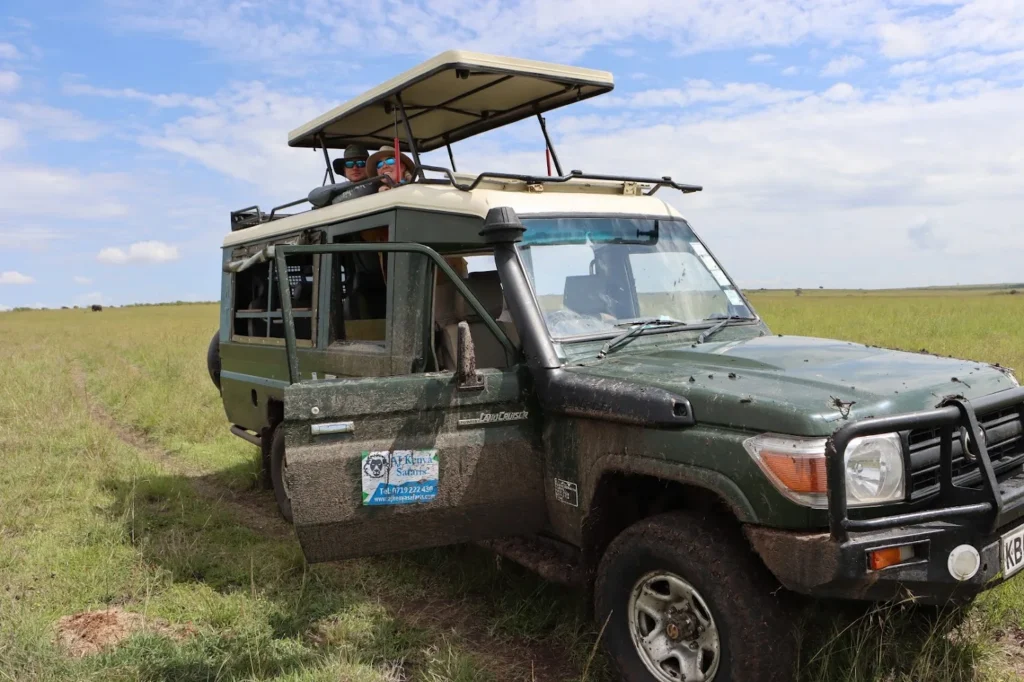
- Vehicle: Your own 4×4 Land Cruiser, roof hatch and fuel included, for the seven days from Nairobi to Mara North.
- Guide: A TRA-licensed driver-guide from Nairobi to Mara North. At Saruni Mara, the camp’s own Maasai guides and vehicles take over.
- Nairobi Entry Fees: Nairobi Safari Walk, Nairobi Animal Orphanage, Nairobi National Museum, Nairobi National Park, the Sheldrick elephant orphanage and the Giraffe Centre.
- Ol Pejeta: Conservancy entry on both days and the guided bush walk with a ranger.
- Lake Naivasha: The boat ride, Crescent Island entry and the Oserengoni sanctuary fee for both nights.
- Hell’s Gate: Park entry, the cycling fee and bicycle hire.
- Mara North: Conservancy fees, shared game drives by day and night, and bush walks.
- Accommodation: Nine nights, as listed.
- Meals: Breakfast in Nairobi, and all meals from lunch on Day 3 to breakfast on Day 10. Chui Lodge and Saruni Mara also include house drinks.
- Flight: Mara North to Wilson Airport on Day 10, with a transfer from Wilson to your hotel or the international airport.
- Excluded: Lunch and dinner in Nairobi on Days 1 and 2, tips (USD 15 to 20 / KES 2,000 to 2,500 per day), drinks at Karen and Mutara, the northern white rhino visit at Ol Pejeta, the separate KWS gorge fee and the local guide if you hike down into Ol Njorowa Gorge at Hell’s Gate, a hot air balloon flight (USD 500 / KES 58,500), a Maasai village visit (KES 1,500 for citizens / USD 20 for non-residents), international flights, the Kenya eTA (USD 34) and Kenya’s inbound travel health insurance (up to USD 44, or about USD 50 to 52 with the portal’s fees).
Single rooms and children. A single room carries a supplement at each lodge. Bush walks in predator country have age limits. Ol Pejeta takes walkers from 12, but Saruni Mara does not allow anyone under 18 on a walking safari. If you are travelling with teenagers of 12 to 17, we replace Saruni Mara with a Mara conservancy camp that accepts younger walkers, so tell us every child’s age before we plan.
Residents of Kenya. Permit holders pay resident rates at the lodges and at every gate on this route. We quote residents separately.
I started leading walks about eight years ago. Until then, I believed the vehicle was the way to see the Mara. Then I took a guest out on foot at six one morning, and a twig snapped thirty metres away, and I watched him stop breathing. In a vehicle, you watch the bush. On foot, the bush watches you, and you know it. Nothing I can show anyone from a Land Cruiser does what that first hundred metres on foot does.
Only Want A Bush Walk, Not Ten Days?
You do not need this whole trip to walk in the Mara. Any stay at a conservancy camp can include a bush walk of one to three hours, and the camp does not charge extra for it. A 3-day safari has room for one walk. A 4-day or 5-day safari has room for two, alongside the game drives. The one condition is that the camp is in a conservancy and not inside the reserve.
The 10-Day Itinerary
| Day | Plan | On Foot | Overnight |
|---|---|---|---|
| 1 | Nairobi Safari Walk, Animal Orphanage, National Museum | Yes | Nairobi |
| 2 | Nairobi National Park, Sheldrick orphanage, Giraffe Centre | Short | Nairobi |
| 3 | Drive to Laikipia, afternoon game drive at Ol Pejeta | No | Mutara |
| 4 | Ol Pejeta bush walk, afternoon game drive | Yes | Mutara |
| 5 | Drive to Naivasha, boat ride, Crescent Island walk | Yes | Naivasha |
| 6 | Hell’s Gate on foot or by bicycle | Yes | Naivasha |
| 7 | Drive to Mara North Conservancy | Evening | Mara North |
| 8 | Bush walk and game drives | Yes | Mara North |
| 9 | Bush walk, game drive and night drive | Yes | Mara North |
| 10 | Fly to Nairobi | No | Trip ends |
Day 1: Nairobi On Foot
The trip starts gently, at the main gate of Nairobi National Park. The Nairobi Safari Walk is a raised wooden boardwalk, about a kilometre and a half long, through wetland, savannah and forest. You look down on a white rhino, a leopard, a pygmy hippo and a bongo, which is an antelope almost nobody sees wild. Next door, the Animal Orphanage looks after lions, cheetahs and other animals that were rescued and cannot be released. After lunch, we go to the Nairobi National Museum for the fossil hall and the bird gallery. It is the best hour you can spend learning what you are about to see.
Day 2: Nairobi National Park, Elephants And Giraffes
The gate of Nairobi National Park opens at 6 AM, and we are through it for a dawn game drive. Lions, black rhinos, buffalo and giraffes live here with the city’s towers on the skyline. At 11 AM, we are at the Sheldrick orphanage, where the young elephants come out for milk and a mud bath. In the afternoon, you stand on the platform at the Giraffe Centre and feed Rothschild’s giraffes by hand. Across the road, a short forest trail gives you a quiet half hour of walking among birds.
Day 3: Nairobi To Laikipia
The road north leaves Nairobi at 7:30 AM, skirts the western side of Mount Kenya and passes the equator sign just before Nanyuki. Jambo Mutara Camp is in Mutara Conservancy, which shares a boundary with Ol Pejeta. After lunch, we drive into Ol Pejeta for the afternoon. It has more black rhinos than anywhere else in East Africa, and its chimpanzee sanctuary is included with entry.
Day 4: Walking At Ol Pejeta
This is your first walk in country where the animals can hurt you. An armed Ol Pejeta ranger leads it and gives a briefing first. You walk for an hour and a half to two hours across open plains and along the Ewaso Nyiro river, reading tracks and dung, and you may see rhinos, giraffes and zebras on foot from a safe distance. We return to camp for lunch, and in the afternoon we drive in Ol Pejeta again. Before dinner, a camp guide takes you on a second, shorter walk in Mutara Conservancy.
Day 5: Laikipia To Lake Naivasha
A drive of about five hours brings us down into the Rift Valley, with a stop at Thomson’s Falls. Lunch is by the lake, and then you cross by boat to Crescent Island, with hippos surfacing beside you and fish eagles in the trees. Nothing on the island preys on people, and a guide walks you right up among the giraffes, zebras, wildebeest and waterbuck. It is the easiest walk of the trip and many guests’ favourite. Then we drive to Chui Lodge, in its own wildlife sanctuary.
Day 6: Hell’s Gate
Hell’s Gate is one of very few Kenyan national parks where you may walk or cycle. We go in early, before the heat. The track runs for eight kilometres between red cliffs to the Central Tower, with zebras, giraffes, warthogs and gazelles grazing beside it. You can cycle it, walk part of it or do both, and the vehicle follows. The lower gorge, Ol Njorowa, is a separate hike. Rangers close it in wet weather, and when it is open there is an extra KWS gorge fee and a local guide to pay in cash. The afternoon is free at Chui Lodge, where a game drive in the sanctuary is included.
Day 7: To Mara North Conservancy
We drive about six hours through Narok to Mara North. This is where your guide and the Land Cruiser leave you, and the Maasai guides of Saruni Mara take over with the camp’s open vehicles. After tea, there is a short evening walk near camp. It is an introduction: how to move, where to stand and what the hand signals mean.
Day 8: The First Mara Walk
You leave camp on foot at 6:30 AM with a Maasai guide in front and an armed escort. The walk lasts two to three hours and covers perhaps four kilometres, because you stop constantly. You return for a late breakfast. The afternoon is a game drive, and here the conservancy rules help: vehicles may leave the tracks, and only a few are allowed at each sighting.
Day 9: Walk, Drive And Night Drive
The second walk takes a different direction, often along a river line where the tracks are thickest. By now, you are finding prints before the guide points to them. In the afternoon, you drive again, and after dark the vehicle goes out with a spotlight on a night drive for the animals of the night: bat-eared foxes, springhares, genets and, with luck, a leopard hunting.
Day 10: Fly To Nairobi
There is time for a last short bird walk around camp. Then the camp drives you to the airstrip for the late-morning flight to Wilson Airport, which takes about 45 minutes. A driver meets you there. Book an international flight for after 5 PM.
What Happens Once You Step Out of the Vehicle
| Signal From The Guide | Meaning | What You Do |
|---|---|---|
| Raised fist | Stop | Freeze where you are, in line |
| Flat hand pushed down | Get low | Crouch quietly |
| Pointing | Look there | Look, without moving your feet |
| Hand waved back | Retreat | Walk backwards slowly, do not turn and run |
You sign a form. Every conservancy asks walkers to sign an indemnity before leaving camp. You are choosing to leave the vehicle in a place with lions, buffalo and elephants, and the form says so.
You walk in single file. The guide leads and reads the ground ahead. The armed escort walks with the group. You stay within two or three metres of the person in front. If you drop back to take a photograph, tell someone first.
You keep quiet. Voices carry, and animals hear you long before you see them. Phones are switched to silent. The guide talks at the stops and uses hand signals between them.
You do not approach dangerous animals. The purpose of the walk is not to get close to a lion. A good guide uses the wind, the birds and the tracks to keep the group away from buffalo, elephants and big cats. If you do meet one, the guide stops everyone, reads the animal and backs the group out quietly.
You never run. Running makes you look like prey. Whatever happens, you stand still and do what the guide says.
Plains animals let you come closer than you expect. Giraffes stare down at you. Zebras bunch up, watch and trot off at about sixty metres. Their reactions to a person on foot are different from their reactions to a vehicle, and you see behaviour you never see from a seat.
Hippos are the animal to respect most. In the rains, they sometimes lie up in thickets well away from water. Meeting one on land is more dangerous than meeting a lion, which is one more reason to stay behind the guide.
Walking Safari Or Game Drive
| What Differs | Walking Safari | Game Drive |
|---|---|---|
| Where it is allowed | Conservancies only | Reserve and conservancies |
| Ground covered | 3 to 5 kilometres | 30 kilometres or more |
| What you look at | Tracks, dung, plants, birds, insects | Big cats, herds, the migration |
| Distance from big animals | Kept wide on purpose | Often a few metres |
| Time of day | Early morning or late afternoon | Morning, afternoon and night |
| Minimum age | 12 to 18, by camp | Usually none in a private vehicle |
The two do different jobs. A walk will not put you beside a lion, and a drive will not teach you to read a track. Guests who do both get more from each.

What You Learn on Foot
Most of what makes the bush interesting is too small or too quiet to notice from a moving vehicle.
Tracks. A lion’s print shows four toes and no claws, because cats keep their claws sheathed. A hyena’s shows claws. A buffalo’s is deep and splayed. Your guide shows you how to tell how old a track is from its edges and from what has fallen into it. After three hours, you will be finding them yourself.
Dung. Elephant dung tells you what the animal ate and roughly when it passed. Hyena droppings turn white from the bone in them. A rhino midden marks a territory. None of this sounds appealing until you are doing it.
Plants. The Maasai use the bush as a pharmacy and a toolbox. Leleshwa, the camphor bush, has soft grey leaves that are crushed and tucked under the arm as a deodorant and burned to keep mosquitoes away. One tree has leaves rough enough to smooth a wooden club. Another gives a twig that is chewed into a toothbrush. Your guide will have used all of them.
Birds. On foot, there is time to stop and listen. The grey go-away bird gives a nasal alarm when it sees a predator. Oxpeckers flying up tell you buffalo or rhino are close. A crowned plover screaming and dragging a wing is drawing you away from its nest.
Insects and small things. Dung beetles rolling a ball in a straight line. Ant lion pits in the sand. A termite mound with its air shafts. These hold children and adults for longer than you would think.
It changes your game drives. After a walk, you notice tracks on the road from the vehicle, you hear an alarm call and look for its cause, and you check the wind without thinking. Guests who walk early in a trip see more on every drive after it.
Conservancies That Offer the Best Walks
| Conservancy | Walking Country | Good To Know |
|---|---|---|
| Mara North | Hills, river lines and open plains | Where this trip stays, with Maasai guides at Saruni Mara |
| Naboisho | Acacia woodland and rocky ridges | Strong guiding, and high lion numbers |
| Olare Motorogi | Open plains and the Ntiakitiak river | Very low vehicle density |
| Ol Kinyei | Springs, plains and hills | One of the first Mara conservancies |
| Lemek | Rolling grassland north of the reserve | Quieter, with fewer camps |
Walking is forbidden in the Masai Mara National Reserve itself. All bush walks take place in the conservancies around it, which are private wildlife areas on land leased from Maasai families. Our Masai Mara conservancies guide describes each one.
The best ground for walking is where grassland meets trees along a river. Open plains have little to look at close up. Thick bush hides too much and is more dangerous. The edge between the two has the freshest tracks, the most birds and the widest mix of plants.
Group size. Walks are kept small, usually no more than six or eight guests with one guide. If more people want to walk, the camp sends out a second group in another direction.
Walks are included, but ask. Conservancy camps do not charge extra for a bush walk, but a guide and an escort have to be arranged. On this trip, we book your walks in advance.
Top Destinations for Walking Safaris in Kenya
The Mara conservancies are one of several places in Kenya where you can walk among wildlife. This trip takes in all five.
Crescent Island, Lake Naivasha. A private sanctuary with no predators, where anyone can walk among giraffes, zebras, waterbuck and wildebeest. It is the best first walk for nervous walkers and for children.
Hell’s Gate National Park. Walking and cycling are allowed in the open among plains animals, under volcanic cliffs and near steaming geothermal vents.
Laikipia. Ol Pejeta, Lewa, Borana and Loisaba all offer walks with armed rangers, and some offer rhino tracking on foot. Further north, specialist outfits run walking safaris of several days with camels carrying the camp.
The Mara conservancies. Mara North, Naboisho, Olare Motorogi, Ol Kinyei and Lemek, with Maasai guides.
Nairobi Safari Walk. A boardwalk of about a kilometre and a half at the gate of Nairobi National Park. It is flat, safe and suitable for every age.
What to Know Before You Book a Walking Safari
| Subject | Guide’s Advice |
|---|---|
| Footwear | Worn-in boots that cover the ankle |
| Colours | Khaki, olive and brown |
| Best walking months | June to October and January to February |
| Minimum age | 12 at Ol Pejeta, 18 at Saruni Mara |
| Luggage | 15 kg in a soft bag, because you fly back |
- Buy Kenya’s Inbound Health Insurance Before You Travel. It has been required of foreign visitors since 5 October 2026 and is sold on eCitizen. The premium is up to USD 44 for each person, children included, and the portal’s own fees bring the total to about USD 50 to 52. It covers up to USD 50,000 of emergency treatment and evacuation inside Kenya, and one policy is valid for a year. Nobody with Kenyan citizenship, a residence permit or an East African Community passport has to buy it. The portal sometimes sends no PDF, so photograph the screen reading “Insurance: Valid”, note the reference number and have both with you at the airport, where the airline may ask each traveller for it at check-in.
- Wear Proper Boots. The grass hides thorns, burrs and ant nests, and after rain the black cotton soil will pull a loose trainer off your foot. Boots that cover the ankle, already worn in, are right. Wear long trousers and long socks to keep grass seeds off your skin. Our packing list has the rest.
- Dress In Dull Colours. Khaki, olive, brown and dark green. White shows from a long way off and bright colours make animals wary. Avoid dark blue and black where there are tsetse flies.
- Carry Water And Cover Your Head. There is no roof over you for two or three hours. Take a litre of water, a hat with a brim and sunscreen.
- Leave The Big Lens Behind. A long telephoto is a burden on foot. Bring binoculars and a small camera or a mid-range zoom. The subjects are tracks, plants, insects and wide views.
- Pack Light For The Flight. The light aircraft out of Mara North carries 15 kg for each passenger, hand luggage included, and only in soft bags. The same bag has to fit in the Land Cruiser for the first seven days.
- Be Realistic About Fitness. None of these walks is hard. The ground is mostly flat and the pace is slow. You do need to manage two to three hours on your feet in the sun.
- Tell Us About Children. Crescent Island, Hell’s Gate and the Nairobi Safari Walk suit all ages. Ol Pejeta accepts walkers aged 12 and over. Saruni Mara sets its limit at 18, which rules out teenagers on the Mara North walks in this itinerary. For a family with children of 12 to 17, we book a different conservancy camp with a lower age limit and requote.
- Expect No Toilets. On a three-hour walk, you may need one. The guide finds a spot, checks it and stands at a distance. Bring tissue and a small bag to carry it out.
- Book The Sheldrick Visit Three Months Ahead. The orphanage takes no walk-in visitors. Places for the 11 AM visit open three months before the date, and the booking needs the name of every adult and the name and age of every child. Send us your names as soon as you confirm, and we make the reservation the day it opens.
- Listen To The Briefing. It takes five minutes and it is the same every time. It is also the reason walking safaris in Kenya have a very good safety record.
Frequently Asked Questions
How much does a walking safari in the Masai Mara cost?
Our ten-day trip costs from USD 8,250 or KES 649,000 per person for two people outside peak season, and USD 9,720 or KES 726,000 from July to September. In a party of six, it falls to USD 7,380 or KES 559,000 each. All walks, entry fees, conservancy fees and the flight back are included.
Can you walk in the Masai Mara National Reserve?
No. Walking is not permitted inside the reserve. Bush walks take place in the private conservancies that border it, such as Mara North, Naboisho and Olare Motorogi.
Is a walking safari safe?
Yes, when it is led by trained guides. You walk in single file with a guide who knows the area and an armed escort, the group avoids dangerous animals instead of approaching them, and everyone is briefed first. Our Masai Mara safety guide has more.
How long is a bush walk?
Between one and three hours, covering three to five kilometres. The pace is slow, with many stops.
Can children go on a walking safari?
Children of any age can do the Nairobi Safari Walk, Crescent Island and Hell’s Gate. Bush walks in predator country are stricter. Ol Pejeta takes walkers from 12, and Saruni Mara, the Mara camp on this trip, only from 18. Families with teenagers of 12 to 17 can still do the trip with a different Mara conservancy camp that allows younger walkers.
What is the best time of year for a walking safari?
The dry months, from June to October and in January and February. The grass is short, so the guide can see further, and the ground is firm. In April and May, the grass is long and some walks are cancelled after rain. Our guide to the best time to visit covers each month.
Do I still go on game drives?
Yes. Walks are in the early morning or late afternoon, and you drive at the other end of the day. On this trip, you have game drives in Nairobi National Park, Ol Pejeta, the Oserengoni sanctuary and Mara North, including a night drive.
Do walking safari guides carry a gun?
In predator country, yes. At Ol Pejeta an armed conservancy ranger leads the walk, and in Mara North an armed escort walks with the group behind the Maasai guide. The rifle is a last resort. The guide’s job is to keep the group far enough from big animals that it is never needed.
What should I wear on a walking safari?
Worn-in boots that cover the ankle, long trousers, long socks and a hat with a brim. Keep to khaki, olive and brown. Leave white, bright colours, dark blue and black at camp.
Which animals do you see on a walking safari?
Mostly plains animals: giraffes, zebras, wildebeest, gazelles, warthogs and waterbuck, often closer than you expect. Guides keep the group well away from lions, buffalo, elephants and hippos, so you see their tracks more often than the animals themselves.
What Changes When You Leave the Vehicle
You hear what the engine was covering up. You smell wild sage when your boot crushes it. You stop for a dung beetle the way you would stop for a lion from a Land Cruiser. Your pulse runs a little fast the whole time, because the guide is ten metres ahead and there is nothing else between you and whatever moved in the grass. When you climb back into a vehicle afterwards, the game drives feel different for the rest of the trip. Most guests who walk ask me the same question on the last day: why did we not start with this?
For a private trip without the walking focus, see our private safari Masai Mara page. For the Mara with the lakes, see the Masai Mara and Lake Naivasha safari.
Related Reading
- Things to Do in Masai Mara
- Night Game Drive Masai Mara
- Horse Riding Safari Masai Mara
- Masai Mara Conservancies
- Mara North Conservancy
- Photography Safari Masai Mara
- Private Safari Masai Mara
- Masai Mara and Lake Naivasha Safari
- Masai Mara, Lake Naivasha and Hell’s Gate Safari
- Luxury Safari Masai Mara
- Masai Mara Packing List
- Is Masai Mara Safe?
About the Experts Behind This Guide
Written by: David Njunge, TRA-Licensed Safari Guide (10+ years of on-the-ground experience in the Masai Mara).
Edited by: Cecilia Wambui, Lead Travel Consultant & Logistics Expert.
✅ Verified for the 2027 travel season.
Welcome to Masaimara.co.ke
Thank you for visiting us! We're excited to help you plan an unforgettable safari adventure across Kenya.