
8 Days Masai Mara, Samburu And Lake Nakuru Safari: 2027 Itinerary And Prices
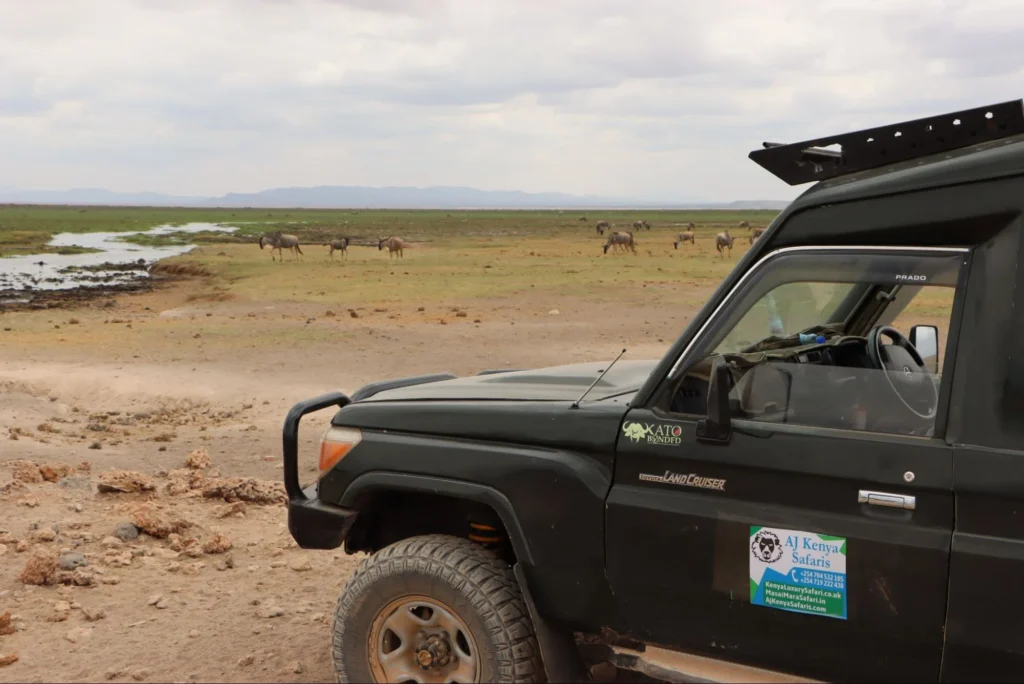
An 8 days Masai Mara, Samburu and Lake Nakuru safari gives you two full days in Samburu, an afternoon with the rhinos of Nakuru and two full days in the Mara. For 2027 it costs from USD 3,040 or KES 217,000 per person sharing, with a private Land Cruiser, park fees and full board, and you can swap a Samburu night for Ol Pejeta.
8 Days Masai Mara, Samburu, and Lake Nakuru Safari Costs (2027)
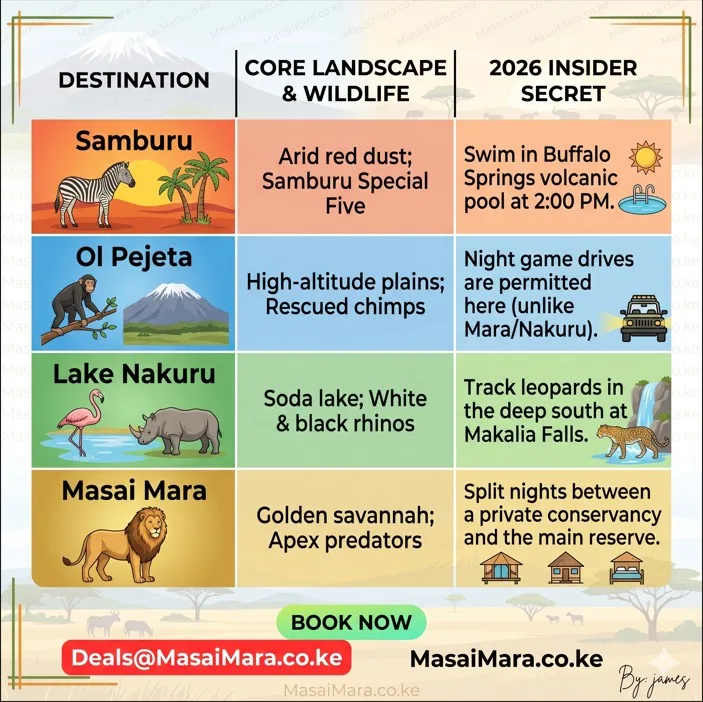
| Destination | Core Landscape And Wildlife | 2027 Insider Tip |
|---|---|---|
| Samburu | Red dust and doum palms, the Special Five | Two full days, so a conservancy night drive or a hike up Ololokwe fits. |
| Ol Pejeta (optional swap) | Highland plains below Mount Kenya, chimps, the last northern white rhinos | Night drives are allowed inside the conservancy. |
| Lake Nakuru | Soda lake, black and white rhinos | Head south first, to the grassland where the rhinos graze. |
| Masai Mara | Golden savannah, the big cats | Balloon on Day 7, so Day 6 keeps its dawn drive. |
This is the 8-day version of our Masai Mara, Samburu and Lake Nakuru safari circuit. For shorter options, see the 6-day or 7-day versions.
Prices are per person, two people sharing a private 4×4 Land Cruiser. Kenyan citizen prices are not the dollar price converted. Citizens and residents pay much lower park fees and lodge rates, and the prices are worked out from those.
International Visitors (USD)
| Tier | Lodges (Samburu + Nakuru + Mara) | Jan-June | July-Dec |
|---|---|---|---|
| Budget | Lion King Bush Camp + Ziwa Bush Lodge + Crocodile Camp | 3,040 | 3,700 |
| Mid-Range | Samburu Sopa Lodge + Lake Nakuru Sopa + Mara Sopa Lodge | 3,590 | 4,450 |
| Luxury | Samburu Intrepids + Sarova Lion Hill + Mara Crossing Camp | 4,760 | 6,320 |
Kenyan Citizens (KES)
| Tier | Lodges (Samburu + Nakuru + Mara) | Jan-June | July-Dec |
|---|---|---|---|
| Budget | Lion King Bush Camp + Ziwa Bush Lodge + Crocodile Camp | 217,000 | 242,000 |
| Mid-Range | Samburu Sopa Lodge + Lake Nakuru Sopa + Mara Sopa Lodge | 258,000 | 296,000 |
| Luxury | Samburu Intrepids + Sarova Lion Hill + Mara Crossing Camp | 341,000 | 432,000 |
Foreign nationals living in Kenya on a work or residence permit pay resident park fees, which sit between the dollar and shilling prices. Tell us when you book and we will quote you on resident rates.
Note: Peak prices apply from July to December, when Mara park fees double and the lodges move to high-season rates. If one of these lodges is closed for maintenance on your dates, we move you to an equal lodge, such as Ashnil Samburu Camp in Samburu, and tell you before you pay. If you take the Ol Pejeta swap, we add a camp there, such as Sweetwaters Serena Camp, and quote the difference. For the lowest cost, see our budget safaris, and for camps above our Luxury tier, see our luxury safari Masai Mara options.
What Is Covered In The Price?
- Vehicle: A private 4×4 Land Cruiser with a pop-up roof for all 8 days, with fuel for every transfer and game drive.
- Guide: A TRA-licensed guide who drives you from Nairobi and back.
- Park Fees: All 2027 entries. Samburu is paid to Samburu County, Lake Nakuru through KWS eCitizen, including the KWS vehicle fee, and the Masai Mara to Narok County. On the Ol Pejeta swap, the conservancy fee is paid to Ol Pejeta.
- Accommodation: 7 nights full board, with packed lunches on full game drive days.
- Water: Drinking water in reusable containers, with extra for the hot Samburu days.
- Cover: AMREF Flying Doctors evacuation cover.
- Excluded: Tips (USD 15 to 20 / KES 2,000 to 2,500 per day), alcoholic and soft drinks, the hot air balloon (USD 500 / KES 58,500), the Maasai village visit (KES 1,500 for citizens / USD 20 for non-residents), conservancy night drives (paid locally), the Najin and Fatu visit on the Ol Pejeta swap, international flights, the Kenya eTA (USD 34) and Kenya’s inbound travel health insurance (up to USD 44 per person).
I have been guiding for ten years, and the 8-day is the version of this circuit I would choose for myself. You start in the red, sun-baked dust of Samburu, climb up past Mount Kenya and Thomson’s Falls to the Rift Valley, and finish in the predator country of the Mara. It is about 1,200 km of road, but the extra day changes the feel of it.
On the 7-day trip, you arrive in Samburu, have one full day, and leave. Here you get two. That second day is where Samburu stops being a list of animals and becomes a place: the Singing Wells in the dry season, a night drive in a community conservancy, or a morning on the slopes of Ololokwe with a Samburu guide.
The 8-Day Itinerary
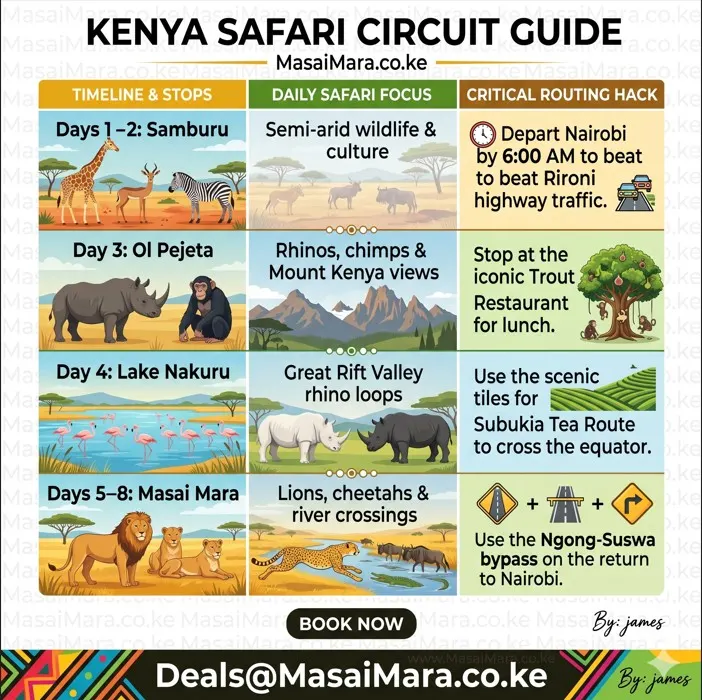
| Timeline And Stops | Daily Safari Focus | Routing Tip |
|---|---|---|
| Days 1 to 3: Samburu | The Special Five, river elephants and Samburu culture | Leave Nairobi at 6:30 AM to clear Thika Road. |
| Day 4: Lake Nakuru | Black and white rhinos | Leave Samburu at 7 AM, and keep Thomson’s Falls to 20 minutes. |
| Days 5 to 7: Masai Mara | Lions, cheetahs and the river crossings | Balloon on Day 7, so Day 6 keeps its dawn drive. |
| Day 8: Nairobi | The Rift Valley escarpment | No morning drive, home on the Mai Mahiu tarmac. |
We start in the dry north and build towards the Mara. Going the other way makes Samburu feel like a step down after the Mara. This way, every park adds something new.
You get eleven game drives: five in Samburu, one at Nakuru and five in the Mara. There is no game drive on the morning you leave a park.
Day 1: Nairobi To Samburu, Afternoon Game Drive
We leave at 6:30 AM. The morning bottleneck is the commuter traffic on Thika Road out of Nairobi, so we clear it before it builds. From there the road is tarmac all the way, about 325 km through Thika, Karatina, Nanyuki and Isiolo to Archers Post. Only the tracks inside the reserve are murram. We stop briefly at the Equator near Nanyuki and reach your lodge for lunch at about 1 PM. The afternoon drive follows the Ewaso Nyiro River from about 3:30 PM.
Day 2: Full Day In Samburu
Out at 6 AM for the Special Five while it is cool, back to the lodge as the heat builds, and out again at 4 PM. In the middle of the day the elephants come down to the Ewaso Nyiro. We stay on the Samburu side of the river, because Buffalo Springs across the bridge is a separate reserve with its own ticket.
Day 3: Second Full Day In Samburu
This is the day the 8-day trip buys you. Spend it on the river and the plains for the animals you have not found yet, often the gerenuk or a leopard in the palms. Or use it for something the shorter trips cannot fit: a morning hike on Mount Ololokwe with Samburu guides, the Singing Wells in the dry season if a family agrees to let us watch, or an evening night drive in a community conservancy such as Westgate or Kalama.
Day 4: Samburu To Lake Nakuru, Afternoon Rhino Drive
No game drive this morning. We leave at 7 AM sharp, back through Isiolo and Nanyuki, west across the Laikipia plateau to Nyahururu, and down through the Subukia valley to Nakuru, about 330 km. We stop for 15 to 20 minutes at Thomson’s Falls, no longer, so you reach the lodge for lunch by about 1:30 PM, before the buffets close. The rhino drive starts at about 3:30 PM and runs until the park gates close at 6 PM.
Day 5: Lake Nakuru To The Masai Mara, Afternoon Game Drive
No game drive this morning. We leave at about 7:30 AM, south through Njoro, where Lord Egerton Castle is a photo stop from the gate at most, then over the Mau to Narok for fuel. You reach camp at about 1:30 PM for lunch. If you want a Maasai village visit, we go to a village just outside Talek or Sekenani Gate from about 2:30 to 3:45 PM, then enter the reserve at 4 PM for the first drive.
Day 6: Full Day In The Masai Mara
Out at dawn with a picnic lunch, and we stay out until the gates close. The early hours are for lions and cheetahs. From July to October we spend the middle of the day at the Mara River crossing points. Keep this morning for the dawn drive.
Day 7: Second Full Day In The Masai Mara
If you book the balloon, the pick-up is before 5 AM, you lift off around sunrise, and after the champagne breakfast you are back in your vehicle by about 9:30 AM with the whole day ahead. Balloons fly only at dawn. If you skip it, we go back to wherever yesterday was slow, a crossing point or the leopard trees along the Talek.
Day 8: The Masai Mara To Nairobi
No game drive this morning. Your three Mara tickets covered Days 5, 6 and 7, so a drive today would mean a fourth ticket. Breakfast, then home through Narok and down the Mai Mahiu escarpment on tarmac, about 270 km and 5 to 6 hours. We never use the Suswa to Ngong track, which is rough and unpaved. If your camp is inside the reserve, you must be out by 10 AM. If you are flying the same day, book a flight that leaves after 9 PM. Heading to the coast? See our Masai Mara and Diani Beach packages.
The Route And Drive Times
| Leg | Route | Distance And Time |
|---|---|---|
| Nairobi to Samburu | Thika Road, Karatina, Nanyuki, Isiolo and Archers Post, tarmac all the way | 325 km, 5.5 to 6 hours |
| Samburu to Lake Nakuru | Isiolo and Nanyuki, the Laikipia plateau to Nyahururu, down the Subukia valley | 330 km, 5.5 to 6 hours of driving |
| Lake Nakuru to the Masai Mara | Njoro, Mau Narok and Narok, then the C12 to the reserve gates | 280 km, 5 to 6 hours |
| The Masai Mara to Nairobi | The C12 to Narok, then down the Mai Mahiu escarpment | 270 km, 5 to 6 hours |
| Ol Pejeta swap: Samburu to Ol Pejeta | Isiolo and Nanyuki | About 3 hours |
| Ol Pejeta swap: Ol Pejeta to Lake Nakuru | Nyahururu and the Subukia valley | About 3.5 hours |
Samburu: Two Full Days And The Singing Wells
Samburu is a furnace. The heat can reach 35°C by noon, so we drive early and late and rest in the middle of the day.
The Special Five. Grevy’s zebra, reticulated giraffe, Beisa oryx, gerenuk and Somali ostrich all live here, and none of them live in the Mara or at Nakuru. With two full days, there is time to find the shy ones properly.
Singing Wells. In the dry season, Samburu herders dig wells into the sandy riverbeds outside the reserve, and the men sing to their cattle as they pass the water up by hand. Each family has its own songs. We can only watch if a family agrees. Leave your camera in the car. It is daily work, not a performance.
Reteti Elephant Sanctuary. Reteti, in the Mathews Range to the north, is a community-owned elephant orphanage run by Samburu people, and one of the best examples of community conservation in Kenya. It sits off the Isiolo to Moyale highway near Sereolipi, about 2.5 to 3 hours each way from Archers Post. Visitors watch the midday milk feed, from 11:30 AM to 1 PM, which must be booked at least 24 hours ahead, and Reteti asks for a donation of USD 75 per adult and USD 50 per child under 15 (KES 1,000 for Kenyan citizens). To make the feed, we leave Samburu by about 8 AM on Day 3 and are back in the reserve by late afternoon, so it takes most of your second Samburu day. We arrange it only on request.
Buffalo Springs and its pools. Across the river, Buffalo Springs reserve is named after its springs, and some guides take guests there to swim. It is a separate Isiolo County reserve with its own ticket, so we do not plan it unless you ask.
Ol Pejeta: Chimps & The Last Northern White Rhinos
If you would rather swap your third Samburu night for Ol Pejeta Conservancy, it fits neatly on the map. Ol Pejeta sits on the Laikipia plains near Nanyuki, right on the road between Samburu and Nakuru, so the swap turns one 6-hour drive into two shorter ones of about 3 and 3.5 hours. That suits families, older travellers and photographers who want shorter days in the vehicle. You give up the second Samburu day, and we quote the difference. The park fee side of it is small: Ol Pejeta charges non-resident adults USD 110 a day against USD 85 for Samburu, so about USD 25 more per adult, plus the change in lodge rate.
Chimpanzees. Sweetwaters Chimpanzee Sanctuary at Ol Pejeta is the only place in Kenya to see chimpanzees. It was set up in 1993 with the Jane Goodall Institute to take in chimps rescued from the bushmeat and pet trade, and dozens now live there on islands of forest by the river. You watch them from across the water. The sanctuary keeps set visiting hours and closes in the late afternoon, so on the swap day we leave Samburu after breakfast, keep lunch short and aim to reach the chimps by about 3 PM.
Najin and Fatu. Najin and her daughter Fatu are the last two northern white rhinos on earth, guarded around the clock by armed rangers. Neither can carry a calf, so the BioRescue scientific programme is working to create northern white rhino embryos and carry them in southern white rhino surrogates. Najin was retired from egg collection in 2021 because of her age, so Fatu is now the only donor. Ol Pejeta’s “Meet the Northern White Rhinos” visit costs USD 70 per adult and is booked through the conservancy, and it helps pay for the round-the-clock ranger protection the two rhinos need.
Night drives. Ol Pejeta allows night drives inside the conservancy. You may see servals, aardwolves, striped hyenas and, with luck, a leopard.
A note for returning visitors. Baraka, the blind black rhino that guests used to meet and touch at Ol Pejeta, died on 16 August 2026, aged 31. That visit no longer runs, but the conservancy’s other black and white rhinos are still there.
Nakuru: Makalia Falls And The Drowned Forest
The lake has risen so much since about 2010 that it drowned a belt of acacia forest. Near Hippo Point you now drive past white, dead trees standing in the water.
The flamingos. The rising water made the lake less salty, and flamingo numbers rise and fall with it. In some months there are thousands on the shore, in others very few.
Makalia Falls. In the far south of the park, the Makalia River drops over a small waterfall, with a picnic site nearby. It is quiet, and you have a good chance of finding animals on the way. Watch the baboons at the picnic site, which are bold and quick to grab food.
Baboon Cliff and the hyraxes. From Baboon Cliff you look across the whole lake. On the rocks nearby, look for rock hyraxes, small furry animals that look like guinea pigs but are distant relatives of the elephant.
Menengai Crater. Just north of Nakuru town, Menengai is a huge volcanic caldera about 12 km across, with a viewpoint on the rim. It does not fit this 8-day route. You have one night at Nakuru, arriving for lunch on Day 4 and leaving after breakfast on Day 5, so a visit would cost you either the rhino drive or your arrival time in the Mara. If you want Menengai, ask for a 9-day version with two nights at Nakuru. If you bring a drone, you need a permit from the Kenya Civil Aviation Authority, and drones are not allowed in the national parks without KWS permission.
Inside or outside the park. Lake Nakuru Sopa and Sarova Lion Hill are inside the park. Ziwa Bush Lodge, our Budget pick, is just outside. The KWS Lake Nakuru page has the park rules.
13 Things to Know Before You Go
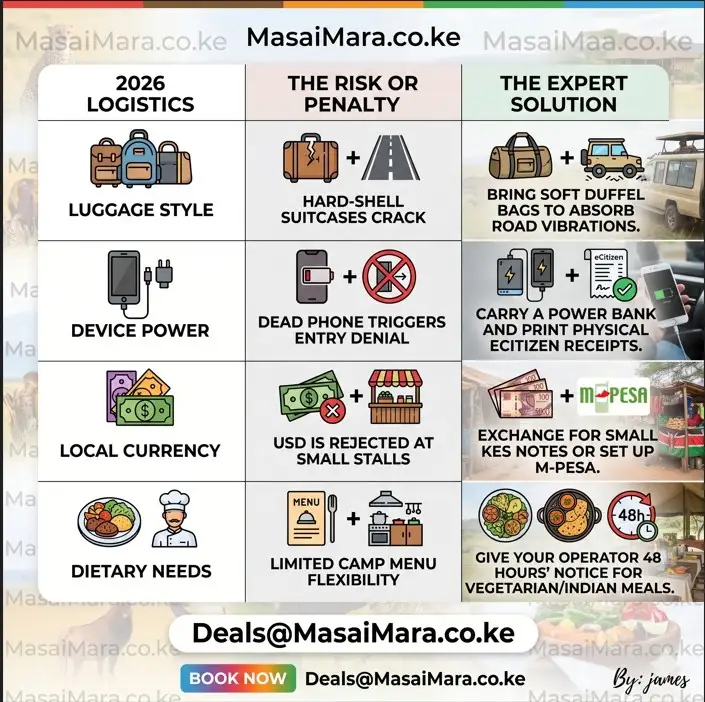
13 Things to Know Before You Go
| 2027 Logistics | The Risk Or Penalty | The Expert Solution |
|---|---|---|
| Luggage Style | Hard-shell suitcases crack | Soft duffel bags, carried inside the vehicle. |
| Three Fee Systems | Confusion at the gates | Samburu County, KWS and Narok County, all paid before you arrive. |
| 10 AM Mara Rule (Inside Camps) | An extra day’s park fee | No game drive on Day 8, out of the gate by 10 AM. |
| Dietary Needs | Limited camp menus | Tell us when you book for vegetarian or Indian meals. |
- Inbound Travel Health Insurance. From 5 October 2026, every non-Kenyan visitor staying under three months must buy Kenya’s inbound travel health insurance online before arriving, children included. It costs up to USD 44 per person and covers up to USD 50,000 for medical care and emergency evacuation. Buy it together with your eTA, because cover only starts once the policy is issued. Kenyan citizens, residents and East African Community nationals are exempt.
- Night Drives In The Conservancies. Samburu, Buffalo Springs, Nakuru and the main Mara reserve do not allow night drives. The community conservancies next to Samburu, such as Westgate and Kalama, do, and so does Ol Pejeta. See our guide to night game drives.
- Mount Ololokwe. The great flat-topped rock near Archers Post is sacred to the Samburu. A guided hike with Samburu guides takes half a day or more and has its own fees, and the second Samburu day is the time for it.
- Mwea Rice. On Day 1 the road passes near Kenya’s rice country, and sellers at the roadside offer bags of pishori rice. It has a popcorn smell when it cooks, and a small bag makes a good present to take home.
- Jackson’s Chameleon. At Thomson’s Falls, local handlers may show you a three-horned Jackson’s chameleon for a small tip. Look and take a photo, then let them put it back on the branch.
- Trout Tree. If you take the Ol Pejeta swap, the Trout Tree restaurant near Nanyuki, built in a huge fig tree over a trout farm, is a good lunch stop on a shorter day. It is popular with Kenyan families and safari groups, especially at weekends, so we book a table at least a day ahead rather than turn up and wait, which keeps the afternoon on schedule. On the standard route, it is off the road and would cost you the Nakuru afternoon.
- Soft Bags Only. Hard suitcases crack on the corrugated reserve tracks. Bring a soft duffel bag, and it rides inside the Land Cruiser with you. See our packing list.
- Vegetarian Meals. Lodges such as Samburu Sopa cook good vegetarian and Indian food, but tell us when you book so we can warn each kitchen ahead.
- Phone Signal. Signal comes and goes on the Samburu tracks and on the road from Nakuru to the Mara. Make important calls from the lodges.
- The 10 AM Mara Exit. If your Mara camp is inside the reserve, you must leave by 10 AM on Day 8. There is no game drive that morning. Camps outside the reserve have no exit deadline.
- Three Reserves, Three Tickets. Samburu, Buffalo Springs and Shaba look like one park but are three reserves with three tickets. Your package covers Samburu. If you want the others, tell us and we add the fee.
- Sweetwaters Shop. On the Ol Pejeta swap, the conservancy shop is a good place for souvenirs, because the money goes back into conservation.
- Shillings And M-Pesa. Tips, village visits and roadside stalls run on Kenyan shillings. Carry small KES notes, and buy a Safaricom SIM at the airport for M-Pesa.
The Suitcase Warning
A guest once ignored my advice on bags and brought two hard-shell designer suitcases. On the first afternoon in Samburu, the wheels of one snapped off on the gravel path to the tent, and by the end of Day 2 the corner of the other had cracked from bouncing around in the back of the vehicle on the reserve tracks. We spent the evening repacking everything into lodge laundry bags.
On a circuit of about 1,200 km of mixed road and rough game tracks, your luggage takes more punishment than you do. Soft bags flex with the bumps. Hard cases crack. When your guide says soft bags only, it is not a suggestion.
2027 Park Fees
Samburu National Reserve is run by Samburu County, Lake Nakuru by KWS and the Masai Mara by Narok County. Samburu and Nakuru tickets run 24 hours from entry. The Mara charges per calendar day, 6 AM to 6 PM.
Non-Residents (USD)
| Park | Adult | Child |
|---|---|---|
| Samburu | 85 | 50 |
| Lake Nakuru | 90 | 45 (5 to 17) |
| Masai Mara | 100 Jan-June, 200 July-Dec | 50 (9 to 17), under 9 free |
Kenyan Citizens (KES)
| Park | Adult | Child |
|---|---|---|
| Samburu | 800 | 300 |
| Lake Nakuru | 1,500 | 750 |
| Masai Mara | 1,500 Jan-June, 3,000 July-Dec | 300 / 500 |
Kenya Residents (KES)
| Park | Adult | Child |
|---|---|---|
| Samburu | 1,600 | 500 |
| Lake Nakuru | 2,025 | 1,050 |
| Masai Mara | 2,500 Jan-June, 4,500 July-Dec | 1,250 / 2,500 |
On the standard route you use three Samburu tickets (Days 1 to 4), one Nakuru ticket (Day 4 to Day 5) and three Mara tickets (Days 5, 6 and 7). KWS also charges a vehicle fee of about KES 1,500 a day at Nakuru. Ol Pejeta is a private conservancy with its own fees, which we quote with the swap. Every ticket is in your package price, and we buy them all before you arrive: Samburu through Samburu County, Nakuru through KWS eCitizen and the Mara through the Mara online ticketing system, with fees set by Narok County. See our Masai Mara park fee page for the full rules.
Best Time To Visit
| Season | Samburu | Lake Nakuru | Masai Mara |
|---|---|---|---|
| January to March (dry) | Animals close to the river, the Singing Wells | Clear skies, easy rhino tracking | Short grass, good for cats |
| April and May (long rains) | Green, animals spread out | Muddy tracks, very quiet | Mud, very few vehicles |
| July to October (dry) | The best Special Five viewing | Good rhino viewing | The Great Migration |
| November and December (short rains) | Green and quiet | Green, birds arriving | Green plains, newborn animals |
Month by month detail is in our best time to visit guide.
Frequently Asked Questions
How much does an 8 days Masai Mara, Samburu and Lake Nakuru safari cost?
From USD 3,040 for international visitors and KES 217,000 for Kenyan citizens, per person sharing, from January to June, on the Budget tier. Mid-Range starts at USD 3,590 / KES 258,000 and Luxury at USD 4,760 / KES 341,000. Every price includes the vehicle, the guide, park fees and full board. July to December prices are higher because Mara park fees double.
Should I book 7 days or 8 days?
Eight, if you can. It costs about USD 400 / KES 28,000 more per person on the Budget tier than the 7-day version, and it adds a second full day in Samburu without adding a single road transfer. Both versions give you two full days in the Mara.
Can I add Ol Pejeta?
Yes. You can swap your third Samburu night for a night at Ol Pejeta, which splits the long Samburu to Nakuru drive into two shorter days and adds the chimps, Najin and Fatu and a conservancy night drive. Or you can add Ol Pejeta as an extra night and keep both Samburu days. We quote either one.
What documents and insurance do I need to enter Kenya?
Two things, both bought online before you fly: the Kenya eTA at USD 34, and, from 5 October 2026, Kenya’s inbound travel health insurance at up to USD 44 per person, children included. Kenyan citizens, residents and East African Community nationals are exempt from the insurance. The rules are new, so check the eCitizen page close to your departure.
Can I drive from Samburu to the Mara in one day?
We do not. Even on the best route it is 9 to 10 hours, and the Mara gates close at 6 PM. Lake Nakuru sits halfway, so we stop there for the night and add the rhinos.
What is the best month for this safari?
July to October for the migration in the Mara and the best Special Five viewing in Samburu. January and February are also very good, with short grass and animals close to water.
Is a 4×4 Land Cruiser mandatory?
Yes. A minivan struggles on the Samburu tracks and the Nakuru mud. Every private safari we run on this route uses a Land Cruiser.
How much are the 2027 park fees?
For non-residents, Samburu is USD 85 per adult and USD 50 per child, Lake Nakuru is USD 90 per adult and USD 45 per child, and the Masai Mara is USD 100 per adult from January to June and USD 200 from July to December, with children at USD 50. Ol Pejeta charges its own conservancy fee, which we quote with the swap. Citizen and resident rates are in the tables above.
Can I see the Big Five and the Special Five?
Yes. Lions, leopards, elephants and buffalo in the Mara and Samburu, rhinos at Nakuru, and all of the Special Five in Samburu. With two full days in Samburu, this is the version of the trip that gives you the best chance at all ten. Take the Ol Pejeta swap and you can add an eleventh: the rescued chimpanzees at Sweetwaters, the only chimps in Kenya. See our guide to the animals in the Masai Mara.
What should I pack?
Soft duffel bags, layers (Samburu is hot, the Mara is cold at dawn), a wide-brimmed hat, strong sunscreen, a power bank, binoculars and a Safaricom SIM. Full list in our packing list.
Is this trip safe?
Yes. All the parks have rangers, your guide carries a radio and the lodges are well established. We drive in daylight only, on tarmac roads between the parks.
What I Would Tell a Friend
This trip covers three parks that look nothing alike. Red dust and doum palms in Samburu. A soda lake with rhinos at Nakuru. Gold savannah in the Mara. By Day 3 you have had time to sit with a gerenuk on its hind legs, or stand at a well while a Samburu family sings their cattle in to drink. By Day 7 you have watched a pride of lions wake up in the morning mist. The road between those moments is what makes the story worth telling.
If 8 days feels like too much, look at a 5 days Masai Mara safari. Want a different circuit? See the Masai Mara, Amboseli and Lake Nakuru safari or the Masai Mara, Amboseli and Tsavo safari. Browse everything on our Masai Mara safari packages page.
Related Reading:
- Masai Mara, Samburu and Lake Nakuru Safari
- 6 Days Masai Mara, Samburu and Lake Nakuru Safari
- 7 Days Masai Mara, Samburu and Lake Nakuru Safari
- Masai Mara and Samburu Safari
- Masai Mara and Lake Nakuru Safari
- Masai Mara vs Samburu
- Masai Mara, Amboseli and Lake Nakuru Safari
- Masai Mara, Amboseli and Tsavo Safari
- Masai Mara and Diani Beach Safari
- 5 Days Masai Mara Safari
- Masai Mara Safari Packages
- Luxury Safari Masai Mara
- Masai Mara Flying Packages
- Masai Mara Migration
- Masai Mara Park Fees
- KWS Park Fee Portal
Written by David Njunge, TRA-licensed safari guide with over 10 years in the Masai Mara. Edited by Cess Wambui, travel consultant, BSc Tourism and Hospitality Management. Verified for the 2027 season.
Welcome to Masaimara.co.ke
Thank you for visiting us! We're excited to help you plan an unforgettable safari adventure across Kenya.