
Masai Mara Amboseli Tsavo Safari: The Honest 2026 Guide
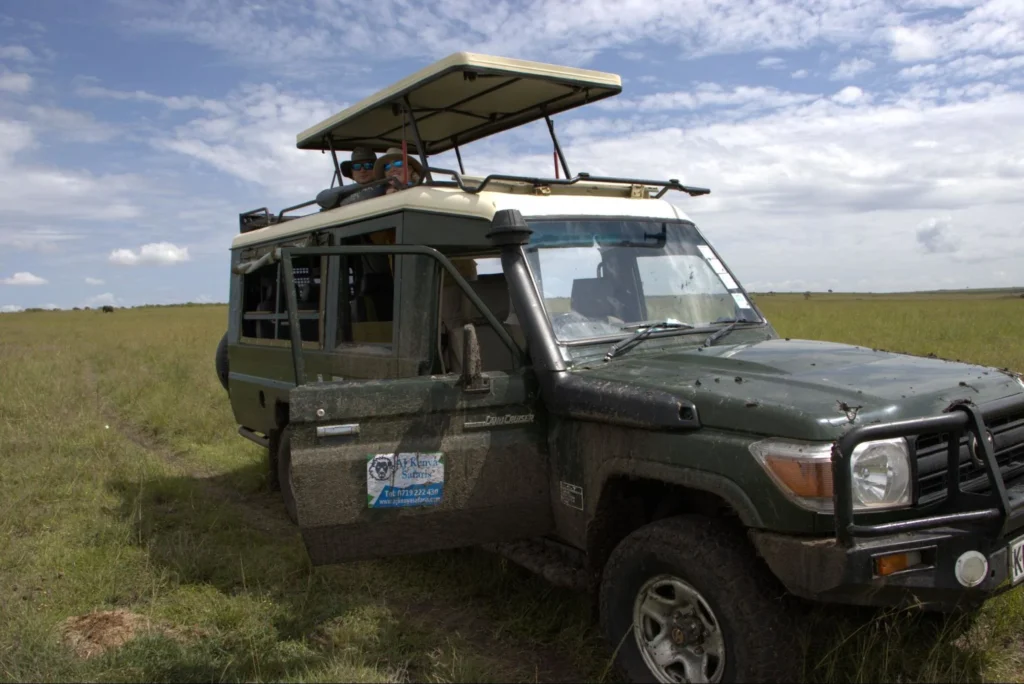
A Masai Mara Amboseli Tsavo Safari is Kenya’s “Gold-White-Red” wildlife circuit. Gold savannah in the Mara, white alkaline dust in Amboseli, blood-red iron soil in Tsavo. For the 2026/2027 season, expect all-inclusive rates for two people sharing to range from KES 415,500 ($3,195) to KES 1,580,000 ($12,150) per person. This trip covers 1,200 km, including the Big Five, the maneless lions of Tsavo, and the Big Tuskers of Amboseli. This is the only Kenya circuit that ends near the coast naturally, making it the best route for a safari + beach combo.
Choose Your Duration
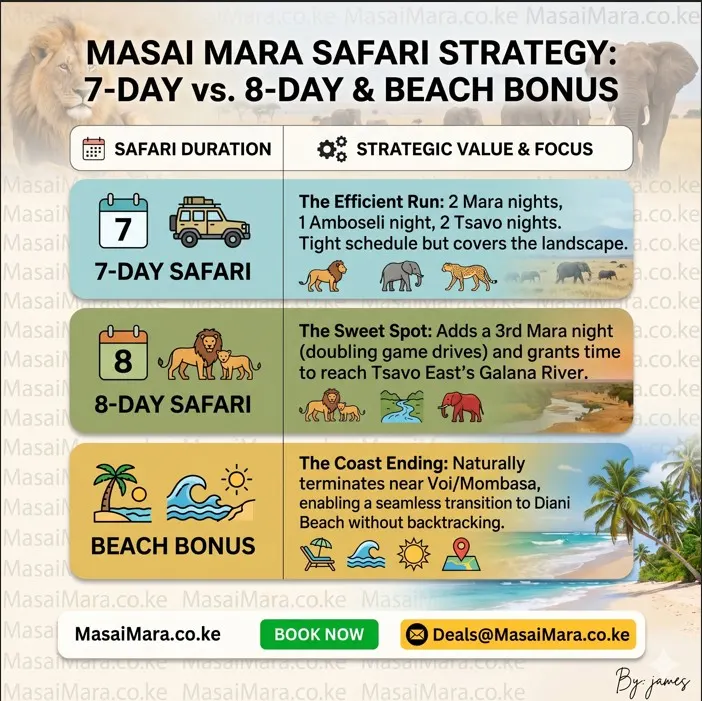
Safari Duration | Strategic Value & Focus |
7-Day Safari | The Efficient Run: 2 Mara nights, 1 Amboseli night, 2 Tsavo nights. Tight schedule but covers the landscape. |
8-Day Safari | The Sweet Spot: Adds a 3rd Mara night (doubling game drives) and grants time to reach Tsavo East’s Galana River. |
Beach Bonus | The Coast Ending: Naturally terminates near Voi/Mombasa, enabling a seamless transition to Diani Beach without backtracking. |
This trip works best in either 7 or 8 days, depending on how much time you have.
- 7 Days Masai Mara Amboseli Tsavo Safari — 2 Mara nights, 1 Amboseli night, 2 Tsavo nights. Tight but works.
- 8 Days Masai Mara Amboseli Tsavo Safari — 3 Mara nights, adds Salt Lick and the Sala Gate detour. The sweet spot.
The extra day buys you a third Mara night (four game drives instead of two) and time for Tsavo East’s Galana River, which most 7-day trips can’t reach.
How this circuit is different. The Masai Mara Amboseli Nakuru Safari swaps Tsavo for Nakuru. Nakuru gives you better rhinos in a small, fenced park. This circuit gives you red elephants, the Man-Eaters history, underwater hippo viewing, 1,000-year-old baobab trees, and total solitude. Tsavo is raw and empty where Nakuru is compact and dense. Different trips for different travellers.
2026 Masai Mara Amboseli Tsavo Safari Costs
Pricing reflects the 2026 Masai Mara park fee (up to $200 in peak) and the mandatory 4×4 Land Cruiser rates. These are all-inclusive prices for two people sharing on the 8-day version. The 7-day is roughly 15% less.
8-Day All-Inclusive Rates (Per Person Sharing)
Package Tier | Suggested Hotels | Regular (KES) | Peak (KES) |
Budget | Talek Bush Camp, Sentrim Amboseli, Ashnil Aruba | KES 415,500 | KES 795,000 |
Mid-Range | Ashnil Mara, Ol Tukai, Kilaguni Serena | KES 590,000 | KES 1,050,000 |
Luxury | Mara Serena, Amboseli Serena, Finch Hattons | KES 945,000 | KES 1,320,000 |
Luxury Plus | Angama Mara, Tortilis Camp, Finch Hattons | KES 1,210,000 | KES 1,580,000 |
Book Now | 2026 Rates |
Note: Peak season is July–October during the wildebeest migration. Tsavo lodges cost 30–40% less than Mara equivalents, so you can go luxury in Tsavo and mid-range in the Mara without exceeding a standard budget. If you want to fly one leg, check our Masai Mara flying packages.
What’s Covered in the Price?
- Vehicle. Private 4×4 Safari Land Cruiser with pop-up roof and 12V inverter.
- Guide. TRA-licensed guide for the full duration.
- Park Fees. All 2026 entries via eCitizen.
- Accommodation. 7 nights full board.
- Water. Bottled water plus extra reserves for Tsavo.
Excluded. Tips (KES 3,500/day recommended), alcoholic drinks, hot air balloon ($450–$500), LUMO night drives (KES 9,500), Masai village visit (KES 4,500), international flights and Kenya eTA.
I’ve been guiding for ten years. A Masai Mara Amboseli Tsavo Safari covers nearly 1,200 kilometres across three landscapes that look nothing alike. It’s a lot of road. But it’s the only trip where you watch thick-maned lions hunt in the morning and maneless lions patrol volcanic plains by sunset.
The Ngong-Suswa Bypass
If you’re driving back to Nairobi from the Mara or Amboseli, forget the Mai Mahiu escarpment. Professional guides now use the Ngong-Suswa bypass. It was fully tarmacked at the end of 2025 and it bypasses the truck gridlock of Mai Mahiu entirely.
You’ll drive across the floor of the Rift Valley beneath Mount Suswa. The traffic is nearly zero. It’s a 90-minute time-saver that matters if you have a tight flight connection at Wilson Airport. The view of the Suswa double-crater volcano on your right is something most people drive past without noticing.
Amboseli’s Noomotio History
Everyone knows Observation Hill. Few know its history as Noomotio, meaning “The Place of Pottery.” Before it was a lookout, it was home to the Ndorobo people.
Ancient shards. Ask me to show you the base of the hill after a heavy rain. You can still find traces of ancient clay shards.
The elephant telephone. Look for an elephant lifting one front foot and spreading its ears. They’re sensing seismic vibrations through their feet from herds up to 10 km away. If you see this, be silent. You’re witnessing a long-distance call.
No leopards here. I’ll be honest. Leopards haven’t been reliably spotted in Amboseli for decades. If that’s your priority, we save your energy for the Mara leg or Tsavo.
Tsavo West’s Maneless Lions
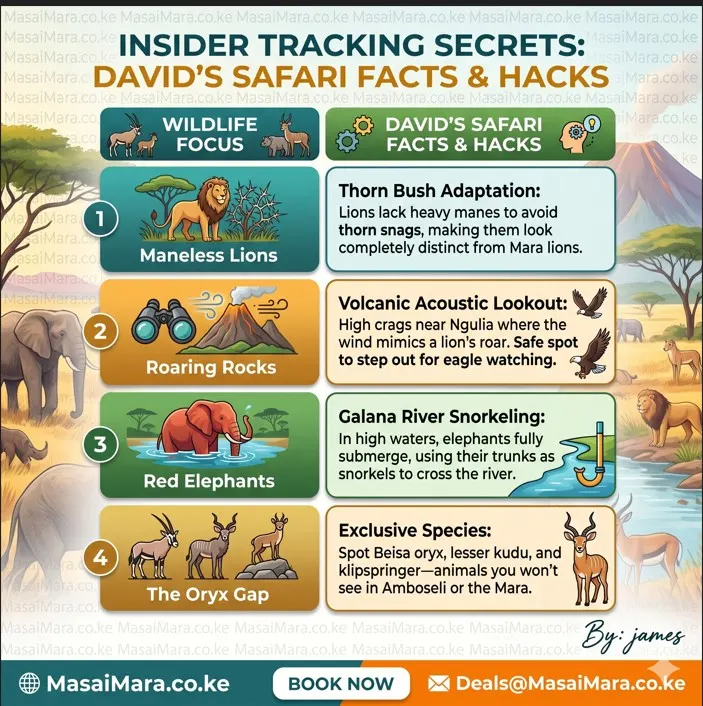
Wildlife Focus | David’s Tracking Fact & Hack |
Maneless Lions | Thorn Bush Adaptation: Lions lack heavy manes to avoid thorn snags, making them look completely distinct from Mara lions. |
Roaring Rocks | Volcanic Acoustic Lookout: High crags near Ngulia where the wind mimics a lion’s roar. Safe spot to step out for eagle watching. |
Red Elephants | Galana River Snorkeling: In high waters, elephants fully submerge, using their trunks as snorkels to cross the river. |
The Oryx Gap | Exclusive Species: Spot Beisa oryx, lesser kudu, and klipspringer—animals you won’t see in Amboseli or the Mara. |
Tsavo West is hilly and volcanic. You’ll notice the lions here look different from the thick-maned males in the Mara.
The thorn bush biology. It’s a survival trait. Thick manes are a death trap in the dense “Wait-a-Bit” thorn bushes. They get snagged and cause infections. Tsavo males have adapted by going maneless, with higher testosterone to survive the heat. That makes them more aggressive than their shaggy cousins. Your Tsavo lion photos will look noticeably different from your Mara photos. It’s like photographing two different species on one trip.
Roaring Rocks. Visit this spot near the Ngulia Rhino Sanctuary. The wind howling through the volcanic crags sounds like a lion’s roar. It’s one of the few places you can safely exit the vehicle at height for a wide view of migratory eagles and hawks.
Tsavo East and the Galana River
Tsavo East is flat, dry, and dominated by the world’s longest lava flow, the Yatta Plateau.
Elephant snorkelling. In May 2026, the Galana River is high. Head to the Sala Gate corridor. You can see red elephants performing a full submerge, using their trunks as snorkels to cross. Most Mara-only travellers never see an elephant completely underwater.
Ancient baobabs. Tsavo has 1,000-year-old baobab trees that look like they were planted upside down. The Mara has no baobabs. One reviewer described a baobab silhouetted at sunset with red elephants walking past as the single best photo of their trip.
The oryx gap. Beisa oryx, lesser kudu, and klipspringer are found in Tsavo but not in the Mara or Amboseli. Adding Tsavo gives you species beyond the Big Five that the Masai Mara Amboseli Nakuru circuit can’t offer.
11 Things to Know Before You Go
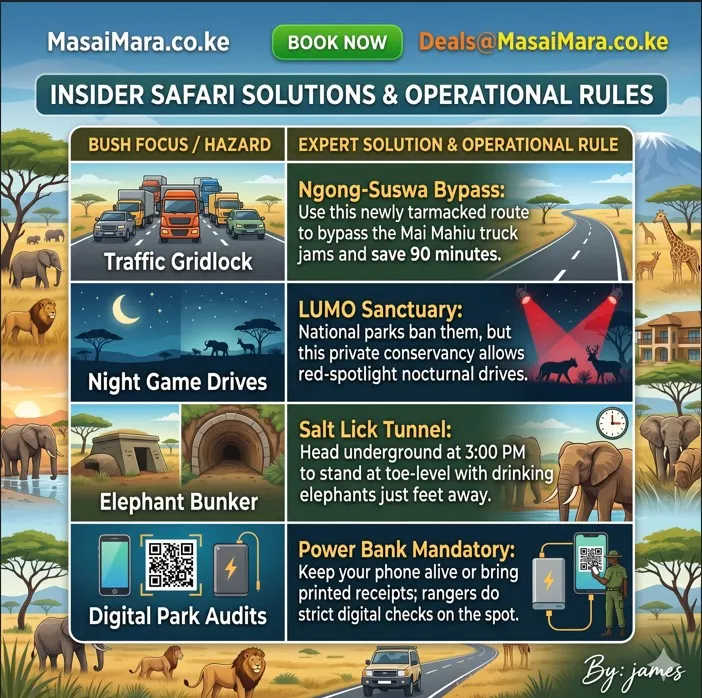
Bush Focus / Hazard | Expert Solution & Operational Rule |
Traffic Gridlock | Ngong-Suswa Bypass: Use this newly tarmacked route to bypass the Mai Mahiu truck jams and save 90 minutes. |
Night Game Drives | LUMO Sanctuary: National parks ban them, but this private conservancy allows red-spotlight nocturnal drives. |
Elephant Bunker | Salt Lick Tunnel: Head underground at 3:00 PM to stand at toe-level with drinking elephants just feet away. |
Digital Park Audits | Power Bank Mandatory: Keep your phone alive or bring printed receipts; rangers do strict digital checks on the spot. |
- LUMO Night Drives. National Parks don’t allow night drives. But the LUMO Community Sanctuary near Taita Hills does. We use red-filtered spotlights to see Springhares and the elusive Aardwolf.
- Salt Lick Bunker. If we stay at Salt Lick, go to the underground tunnel at 3:00 PM. You’ll be at toe-level with elephants drinking two feet away. You can hear their stomachs rumble.
- Mara Radio Codes. If you hear me say Madoadoa on the radio, it’s a leopard. Kichwa Ngumu means there’s a grumpy old buffalo nearby. Duma is a cheetah. Chui is a leopard.
- The Coast Ending. Exit via Voi Gate and you’re 3.5 hours from Diani Beach by road or 3 hours by SGR train to Mombasa. No backtracking to Nairobi.
- December–February Window. Clear Kilimanjaro views, shorter grass, manageable Tsavo temperatures. This is the best time for this specific circuit outside the migration months.
- SGR Train Hack. I can drop you at the Emali Station near Amboseli. You catch the train to Voi, see the landscape from the window, and I meet you at the other end with the luggage. Or take the train from Voi to Mombasa for a beach extension.
- Phone is Your Ticket. KWS rangers now do digital audits inside the parks. Carry a portable power bank. If your phone dies and you can’t show your QR code receipt, you get charged again on the spot.
- Self-Drive in Tsavo East. This is the only park on the circuit where self-driving is realistic. Good signage, flat terrain, well-maintained tracks. Some budget travellers rent a 4×4 and self-drive Tsavo while using a guide for the Mara and Amboseli legs.
- The Patience Trade-Off. The Mara gives you sightings every 10 minutes. Tsavo can go 45 minutes between animals. But when you find something in Tsavo, you’ll have it to yourself. No 20-vehicle traffic jams.
- KATO Check. Before you pay, check your operator on the KATO directory. If they aren’t listed, you risk subcontracting. Get the guide name, vehicle registration, and a no-subcontracting clause. Full details in our Masai Mara booking guide.
- Ant Lion Challenge. At the Lugard Falls picnic site, look for tiny conical pits in the sand. Drop a grain of sand in and watch the Ant Lion larva flick sand to trap prey. Best 60-second micro-safari on the circuit. Kids love it.
When Your Phone Died at the Ranger Check
I had a guest on this circuit who was so excited about a rhino sighting that he used his phone to record 4K video all morning. By the time we reached the mid-park ranger check, the phone was dead.
We had the Masai Mara packages paid for, but we couldn’t produce the QR code for the ranger’s scanner. Even though I had my copy, the 2026 rule is that the lead guest must show theirs too. We sat at a ranger post for two hours while we charged the phone off the Land Cruiser’s battery just to prove we’d paid.
Your phone is your ticket now. Carry a power bank and keep a printed copy of your eCitizen receipts in the glove box. Don’t run your battery down on video when you still need it to get through the park.
Frequently Asked Questions
How many days do I need?
See the “Choose Your Duration” section above. The 7-day version works but is tight. The 8-day version is the sweet spot. It adds a third Mara night and the Sala Gate corridor in Tsavo East.
What is the best month for the Great Migration?
July to October. However, January is best for Kilimanjaro views. For non-migration timing, see Tip #5 above. Full guide at best time to visit Masai Mara.
Can I finish the safari at the beach?
Yes. We drop guests at the Voi SGR station for the 3-hour train to Mombasa. Or continue by road to Diani Beach. This is the most efficient safari-to-beach route in Kenya.
How does this compare to the Mara-Amboseli-Nakuru circuit?
See the comparison in the “Choose Your Duration” section above. Short version: the Masai Mara Amboseli Nakuru Safari swaps Tsavo for Nakuru. Better rhinos there, better solitude here.
Is Tsavo worth it if I’ve already done the Mara?
Yes. One experienced reviewer put it well: the Mara gives you Africa as you imagined it. Tsavo gives you Africa as it actually is. The solitude, the red dust, the 1,000-year-old baobabs, and the total absence of other vehicles make it a completely different experience.
What should I pack for Tsavo?
Dark colours (no white), thick-soled boots for lava walks, a torch for caves, extra camera protection, a power bank, and a portable SSD for photo storage. Full list in our Masai Mara packing list.
Is this trip safe?
Yes. All parks have KWS rangers, your guide carries a radio, and the lodges are established. Main concern is the Nairobi-Mombasa highway after dark — avoid driving that stretch at night. More in our Masai Mara safety guide.
What Nobody Tells You at the End
A Masai Mara Amboseli Tsavo Safari involves long drives and 5:00 AM alarms. But when you hear an elephant drinking two feet from you in the Salt Lick tunnel, or watch a maneless lion patrol the Yatta Plateau in complete silence, you stop thinking about the road.
In the Mara, you’re chasing sightings every ten minutes. In Tsavo, you drive in silence for an hour and it changes how you see things. In Amboseli, you just sit at the swamp edge and watch old elephants eat, and somehow that’s the moment that stays. Together, the three parks tell a story no single park can.
If this feels like too much ground, try a 5 days Masai Mara safari or a 4 days Masai Mara safari. Want Nakuru instead of Tsavo? See the Masai Mara Amboseli Nakuru Safari. Browse everything on our Masai Mara packages page.
Ready to start? Fill out our inquiry form at Masaimara.co.ke below here and let’s get your Land Cruiser ready.
Related Reading:
- 7 Days Masai Mara Amboseli Tsavo Safari (Spoke Page)
- 8 Days Masai Mara Amboseli Tsavo Safari (Spoke Page)
- Masai Mara Tsavo Mombasa Safari
- Masai Mara and Amboseli Safari
- Masai Mara Amboseli Nakuru Safari
- 6 Days Masai Mara Amboseli Safari
- 5 Days Masai Mara Safari
- 4 Days Masai Mara Safari
- Masai Mara and Diani Beach Safari
- Masai Mara and Mombasa Safari
- Masai Mara Packages
- Luxury Safari Masai Mara
- Masai Mara Flying Packages
- Masai Mara Migration
- Masai Mara Booking
- Wildebeest Migration Kenya
- Masai Mara vs Serengeti
- Elephants in Masai Mara
- Lions in Masai Mara
- Leopards in Masai Mara
- Nairobi National Park Day Trip
- Masai Mara Entrance Gates
- Official KWS Park Fee Portal
- Kenya Wildlife Service
This guide was authored by David Njunge, a TRA-licensed safari guide with over 10 years of experience, and edited by Cecilia Wambui, a travel consultant with a degree in Tourism and Hospitality Management.
Welcome to Masaimara.co.ke
Thank you for visiting us! We're excited to help you plan an unforgettable safari adventure across Kenya.