
8 Days Masai Mara, Amboseli And Tsavo Safari: 2027 Itinerary And Prices
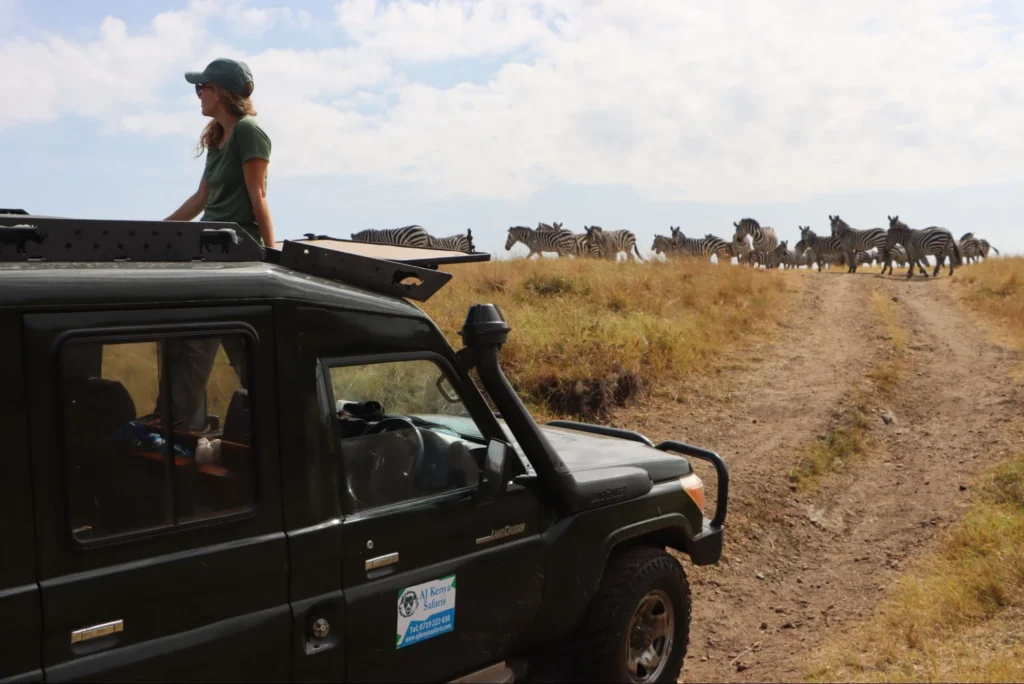
An 8 days Masai Mara, Amboseli and Tsavo safari gives you three nights in the Mara, a flight to Amboseli and four nights between Amboseli, Tsavo West and Tsavo East. For 2027 it costs from USD 3,940 or KES 314,000 per person sharing, including the flight, two guides, park fees and full board.

| Safari Stop | Landscape And Colour | 2027 Field Tracking Tip |
|---|---|---|
| Masai Mara | Golden savannah plains | Track leopards in the thick riverine bush along the Talek River. |
| Amboseli | White alkaline flats | Wait at the edge of Enkongo Narok swamp at dawn, engine off. |
| Tsavo West | Black volcanic rock and hills | Be at the Ngulia Rhino Sanctuary gate when it opens at 4 PM. |
| Tsavo East | Red soil plains | Reach Mudanda Rock from 3:30 PM, when the elephants come in to drink. |
8 Days Masai Mara, Amboseli And Tsavo Safari Costs (2027)
This is the 8-day version of our Masai Mara, Amboseli and Tsavo safari circuit. For the shorter option, see the 7-day version.
Prices are per person, two people travelling together, and include the scheduled flight from the Mara to Amboseli. Kenyan citizen prices are not the dollar price converted. Citizens and residents pay much lower park fees and lodge rates, and the prices are worked out from those.
International Visitors (USD)
| Tier | Lodges (Mara + Amboseli + Tsavo West + Tsavo East) | Jan-June | July-Dec |
|---|---|---|---|
| Budget | Jambo Mara + AA Lodge Amboseli + Ngulia Safari Lodge + Voi Safari Lodge | 3,940 | 4,710 |
| Mid-Range | Sentrim Mara + Sentrim Amboseli + Severin Safari Camp + Ashnil Aruba | 4,480 | 5,470 |
| Luxury | Mara Serena + Amboseli Serena + Kilaguni Serena + Satao Camp | 5,660 | 7,340 |
Kenyan Citizens (KES)
| Tier | Lodges (Mara + Amboseli + Tsavo West + Tsavo East) | Jan-June | July-Dec |
|---|---|---|---|
| Budget | Jambo Mara + AA Lodge Amboseli + Ngulia Safari Lodge + Voi Safari Lodge | 314,000 | 340,000 |
| Mid-Range | Sentrim Mara + Sentrim Amboseli + Severin Safari Camp + Ashnil Aruba | 355,000 | 394,000 |
| Luxury | Mara Serena + Amboseli Serena + Kilaguni Serena + Satao Camp | 438,000 | 530,000 |
Foreign nationals living in Kenya on a work or residence permit pay resident park fees, which sit between the dollar and shilling prices. Tell us when you book and we will quote you on resident rates.
Note: Peak prices apply from July to December, when Mara park fees double and the lodges move to high-season rates. Tsavo lodges are often better value than their Mara equivalents, so you can go a level up in Tsavo without stretching your budget. For camps above our Luxury tier, see our luxury safari Masai Mara options.
What Is Covered In The Price?
- Vehicles: A private 4×4 Land Cruiser with a pop-up roof in the Mara, and a second one waiting for you at Amboseli airstrip for the rest of the trip, with fuel for every transfer and game drive.
- Guides: Two TRA-licensed guides, one in the Mara and one who meets you in Amboseli and stays with you to the end.
- Flight: The scheduled flight from the Mara to Amboseli with Safarilink or Mombasa Air Safari.
- Park Fees: All 2027 entries. Amboseli, Tsavo West and Tsavo East are paid through KWS eCitizen, including the KWS vehicle fee. The Masai Mara is billed separately by Narok County.
- Accommodation: 7 nights full board, with packed lunches on full game drive days.
- Water: Drinking water in reusable containers, with extra reserves for Tsavo, where the distances are long.
- Cover: AMREF Flying Doctors evacuation cover.
- Excluded: Tips (USD 15 to 20 / KES 2,000 to 2,500 per day), alcoholic and soft drinks, the hot air balloon (USD 500 / KES 58,500), the Maasai village visit (KES 1,500 for citizens / USD 20 for non-residents), LUMO night drives (paid locally), the SGR train if you choose it, international flights and the Kenya eTA (USD 34).
I have been guiding for ten years, and this is the route I give people who want space. The Mara is gold grass and busy sightings. Amboseli is white dust and old elephants under Kilimanjaro. Tsavo is red soil and silence, more than 20,000 km² across its two parks, where an hour can pass without another vehicle.
The trip runs on fixed times: the flight to Amboseli, the 6 PM park gates and the two-hour Ngulia window. Plan around those and everything else falls into place.
8 Days Or 7 Days: Which Should You Book?
Eight days is the version I prefer, and the reason is the Mara. The extra night goes there, so you get two full days in the reserve instead of one. That changes two things:
- A second chance at the migration. On the 7-day trip you have one full Mara day, Day 2. If the herds stall on the bank and do not cross, your migration window closes with the gates at 6 PM. On this trip, Day 3 is your backup. We go back to the crossing points and wait, and you still have time for the big cats.
- The balloon without the trade-off. A balloon flight takes the whole early morning, from before 5 AM pick-up to about 9:30 AM after the champagne breakfast. On the 7-day route it costs you your only dawn drive, the best time for lions and cheetahs. On this route you keep Day 2 for the dawn predators and fly on Day 3.
The 8-Day Itinerary
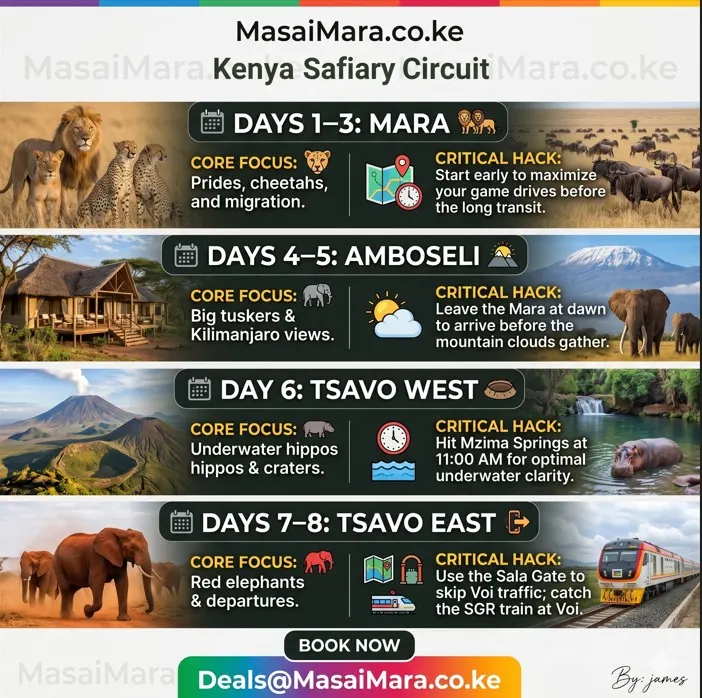
| Itinerary Phase | Core Safari Focus | Timing Tip |
|---|---|---|
| Days 1 to 3: Masai Mara | Prides, cheetahs and the migration | Two full days, so the balloon and a full day of drives both fit. |
| Days 4 and 5: Amboseli | Big tuskers and Kilimanjaro | Land at 12:30 PM, out on the first drive at 2 PM. |
| Days 5 and 6: Tsavo West | Mzima hippos, Chaimu Crater, Ngulia rhinos | Ngulia opens from 4 PM to 6 PM only. |
| Days 7 and 8: Tsavo East | Red elephants at Mudanda and Aruba | Leave through Voi for the road, the SGR or the coast. |
Three nights in the Mara, one in Amboseli, two in Tsavo West and one in Tsavo East, in this direction: Nairobi, Mara, Amboseli, Tsavo. You get eleven game drives: five in the Mara, two in Amboseli, three in Tsavo West and one in Tsavo East. There is no game drive on the morning you leave the Mara, Tsavo West or Tsavo East. The one exception is Amboseli, where the morning drive before the Tsavo transfer runs on the ticket you bought the afternoon before.
Pack soft from Day 1. You fly on Day 4, and light aircraft allow 15 kg per person in a soft duffel with no wheels or frames. Leave any extra luggage at your Nairobi hotel. If you are finishing at Diani Beach or Mombasa, you do not have to leave your hard suitcases behind. Our operations team sends your rigid international bags by road from Nairobi to your beach hotel, and you fly the Mara to Amboseli leg with only your 15 kg soft duffel. Tell us when you book.
Day 1: Nairobi To The Masai Mara, Afternoon Game Drive
We leave Nairobi at 7 AM, down the escarpment at Mai Mahiu and on through Narok on tarmac, about 5 to 6 hours. Lunch is at your camp at about 1:30 PM. If you want a Maasai village visit, the villages sit outside the reserve, so we go from about 2:30 to 3:45 PM and enter the gate at 4 PM for your first game drive, until the reserve closes at 6 PM.
Day 2: Full Day In The Masai Mara
Out at dawn with a picnic lunch, and we stay out until the gates close. Mornings are for lions and cheetahs on the move. From July to October we spend the middle of the day at the Mara River crossing points.
Day 3: Second Full Day In The Masai Mara
This is the day the 8-day trip buys you. Take the balloon at dawn and join the vehicle after the champagne breakfast, with a full day of driving still ahead. Or skip the balloon and spend the whole day where yesterday was slow: a crossing point that did not cross, the leopard in the Talek trees, the cheetah we lost in the long grass.
Day 4: Fly To Amboseli, Afternoon Game Drive
No game drive this morning. Your three Mara tickets covered Days 1 to 3. If you stay inside the reserve at Mara Serena, the drive to the airstrip is a closed-roof transit under the 10 AM exit rule. Jambo Mara and Sentrim Mara sit outside the reserve, and their flights go from airstrips outside the gates, so there is no ticket to buy that morning. The flight lands in Amboseli at about 12:30 PM, and your second guide is waiting with his Land Cruiser. You check in, have lunch, and are out on your first Amboseli game drive by 2 PM, until the park closes at 6 PM.
Day 5: Morning In Amboseli, Transfer To Tsavo West
We are in the park by 6 AM, while Kilimanjaro is clear, for the swamps and the big tuskers. We drive until about 9:30 or 10 AM, then leave through Kimana Gate and cross the saddle between Kilimanjaro and the Chyulu Hills, entering Tsavo West at Chyulu Gate, about 2.5 to 3 hours in all. We pass the Shetani lava flow on the way in. Lunch is at your Tsavo West lodge, then an afternoon game drive.
Day 6: Full Day In Tsavo West
We climb Chaimu Crater first, while the black cinder is still cool and the rim is calm. Then Mzima Springs in the late morning, when the sun is high and the light reaches down into the water. An armed KWS ranger walks you to the underwater viewing tank. Picnic lunch at Roaring Rocks. The afternoon is planned around the Ngulia Rhino Sanctuary, which opens to visitors only from 4 PM to 6 PM, so we are at the gate when it opens.
Day 7: Tsavo West To Tsavo East, Afternoon Game Drive
No game drive this morning. After breakfast we leave through Tsavo River Gate, beside the river where the man-eaters hunted in 1898, cross the highway and the railway, and enter Tsavo East at Manyani Gate, about 2.5 to 3 hours. We drive straight to your Tsavo East lodge for lunch and a rest through the midday heat. The afternoon drive takes us to Mudanda Rock from about 3:30 to 4:30 PM, then on to Aruba Dam and the Kanderi Swamp.
Day 8: Tsavo East To Nairobi, Or On To The Coast
No game drive this morning. Breakfast, then out through Voi Gate. You have three ways home:
- By road to Nairobi: about 5 to 6 hours on Mombasa Road. If you are flying out the same day, book a flight that leaves after 9 PM, because the road through Athi River often jams with trucks.
- By SGR train from Voi: the Madaraka Express takes you to Nairobi Terminus at Syokimau, close to JKIA. Voi is an intermediate stop with a small share of seats, so book on the Kenya Railways site the day booking opens for your date. From July to October and over the December holidays, Voi seats can sell out within days. Do not plan to buy a ticket on the platform on Day 8.
- To the coast: the train from Voi reaches Mombasa in under two hours, or we drive you to Diani Beach in about 3 to 4 hours. See our Masai Mara and Diani Beach packages.
The Route And Drive Times
| Leg | Route | Time |
|---|---|---|
| Nairobi to the Masai Mara | Mai Mahiu, Narok and the tarmac to the reserve | 5 to 6 hours |
| Masai Mara to Amboseli | Scheduled light-aircraft flight | Lands about 12:30 PM |
| Amboseli to Tsavo West | Kimana Gate, the Chyulu saddle, Chyulu Gate | 2.5 to 3 hours |
| Tsavo West to Tsavo East | Tsavo River Gate, across the highway, Manyani Gate | 2.5 to 3 hours |
| Tsavo East to Nairobi | Voi, then Mombasa Road | 5 to 6 hours |
Amboseli’s Old Tusker Swamps
The name Amboseli comes from the Maa word Empusel, which means salty dust. Get to the swamps early, before the wind picks up and the dust devils start crossing the lake bed.
Enkongo Narok Swamp. Most visitors look for elephants on the dry plains. I take you to the swamp edge instead. The older bulls stay here because the swamp grass is soft enough for their worn-down teeth. We park at the edge, switch off the engine and let them feed past the vehicle.
The super tuskers. Amboseli is one of the last places in Africa where you can still see bulls carrying tusks that each weigh more than 45 kg. Ask me which families are near the swamp that week.
Cheetahs on the firm ground. While the vehicles crowd Observation Hill, the cheetahs keep to the dry, open plains away from the swamps, where the ground is firm enough for a sprint and the lions are fewer. They are an occasional sighting here, never a sure thing
What Most People Miss in Tsavo West
Tsavo West is hilly and volcanic. It feels nothing like the Masai Mara.
Mzima Springs. From the underwater viewing tank you watch hippos move through clear spring water like slow-motion dancers, with shoals of fish working over their skin. A 3-tonne hippo gliding past at eye level is a sight you do not forget.
Ngulia Rhino Sanctuary. The black rhino sanctuary is open to visitors only from 4 PM to 6 PM. Arrive early and you wait at the gate. Arrive late and you lose part of the window. Sightings are never certain inside the fence, so we use every minute of it.
Chaimu Crater. A small volcanic cone near Kilaguni, with a short, steep climb to the rim over loose cinder. From the top you see the lava fields, the Chyulu Hills and, on a clear day, Kilimanjaro. The cone is loose, jet-black volcanic cinder, which soaks up the sun and gets very hot by midday, and the wind across the rim can be strong around the middle of the day. That is why we climb it in the morning. Wear sturdy hiking shoes. Light trainers and running shoes fill with sharp pumice gravel within a few steps.
Leopards at Ngulia Safari Lodge. On the Budget tier you sleep at Ngulia Safari Lodge, where the bush below the dining terrace is lit in the evening and leopards often come in after dark. It is never guaranteed.
Finch Hattons. If you want something above our Luxury tier in Tsavo West, Finch Hattons is a tented camp built around natural springs and pools, named after Denys Finch Hatton of Out of Africa. We quote it as an upgrade.
Tsavo East And The Galana River
Tsavo East is flat, dry and huge, at about 13,700 km². The Yatta Plateau, one of the longest lava flows in the world, runs along its western side for close to 300 km.
The Galana River. The Galana holds some of the biggest crocodiles in Kenya, and Lugard Falls, really a set of rapids squeezed through rock, is the place to look for them. It is a long way north of Voi, so it does not fit the standard Day 7 afternoon. Add a second Tsavo East night and we give a full day to the river, with almost no other vehicles on the tracks.
Mudanda Rock. Mudanda is an inselberg, a single ridge of bare rock about 1.6 km long, rising out of the flat bush. Rain runs off the rock into a pool at its base, which holds water long after the plains dry out. In the dry months, July to October and January to March, it works like an open amphitheatre. In the late afternoon, hundreds of red elephants and buffalo come in to drink, and you watch from the rock above, out of the vehicle, with no other cars in the frame. The rock gets very hot in the middle of the day, so we come from about 3:30 PM, when it has cooled and the herds arrive.
The dry-country animals. Tsavo East is drier and further east than anywhere else on this trip, and it holds animals you will not find in the Mara:
- Fringe-eared oryx: long, straight horns like a pair of rapiers, and black tufts on the tips of the ears.
- Lesser kudu: a shy antelope with spiral horns and thin white stripes down its body. Look in thick bush, not on open ground.
- Gerenuk: the “gazelle-giraffe”, which rises onto its hind legs to reach the high thorn twigs.
- Somali ostrich: blue-grey neck and legs. The Maasai ostrich you saw in the Mara has pink ones.
Wild dogs. Tsavo East has a small African wild dog population. Sightings are rare, but on an 8-day trip I have time to ask the rangers where a pack was last seen. If we find one, it is one of the rarest sightings on any Kenyan safari.
Voi Safari Lodge. On the Budget tier your Tsavo East lodge is Voi Safari Lodge, on a ridge above a waterhole. After dark, sit on the terrace with a drink and watch elephants and buffalo come in below you.
Salt Lick’s Underground Tunnel
Salt Lick Safari Lodge sits in the Taita Hills Wildlife Sanctuary, a private reserve next to LUMO, on the road from Voi towards Taveta. It is not on the standard route, but on the 8-day trip you can swap your Tsavo East night for a night here. You give up the Mudanda and Aruba afternoon, and we quote the difference.
The underground bunker. A tunnel runs from the lodge to a hide at ground level beside the waterhole. Go in the afternoon, when the elephants come in to drink. You are at the height of their feet, close enough to hear their stomachs rumble. Keep still and wear muted colours, because the elephants notice movement through the viewing slits.
The First World War history. The East Africa Campaign of 1914 to 1918 was fought across this country, and the Battle of Salaita Hill in 1916 took place near Taveta, towards the Tanzania border. Taveta has a Commonwealth war cemetery. It is a detour of a few hours from Salt Lick, so tell us when you book if you want to see it.
11 Things to Know Before You Go
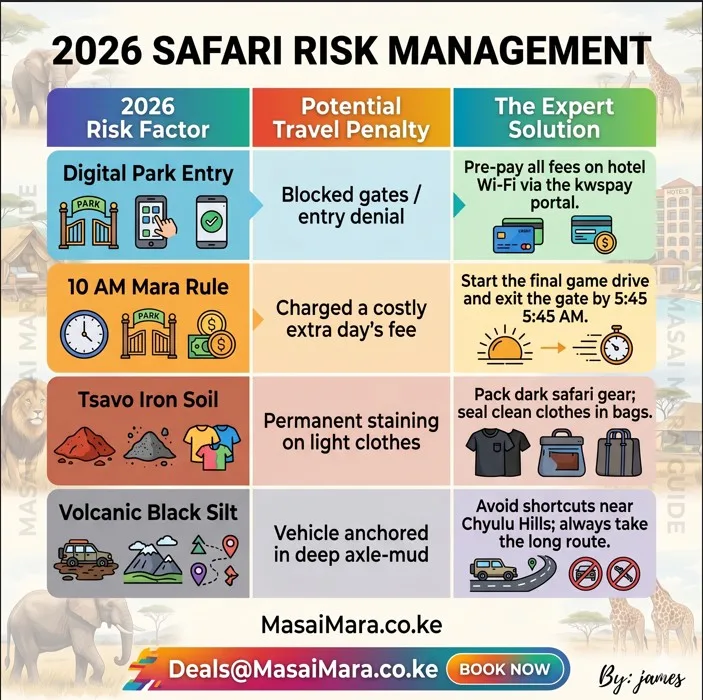
| 2027 Risk Factor | What Goes Wrong | The Expert Fix |
|---|---|---|
| Light-Aircraft Baggage | Hard cases refused at the airstrip | Pack a 15 kg soft duffel in Nairobi. |
| 10 AM Mara Rule (Inside Camps) | An extra day’s park fee | Closed-roof transit to the airstrip before 10 AM. |
| Tsavo Iron Soil | Stained light clothes | Dark safari gear, clean clothes sealed in bags. |
| Black Cotton Soil | Vehicle stuck to the axles | No shortcuts near the Chyulu Hills. |
- LUMO Night Drives. Tsavo’s national parks do not allow night drives, but the LUMO Community Wildlife Sanctuary next door does. We use a red-filtered spotlight. Look for the aardwolf, the rarest sighting on this circuit. It is paid locally.
- The Red Souvenir. Tsavo’s iron-rich soil stains light clothes for good. Pack dark gear for the Tsavo days and keep your clean clothes in a sealed bag.
- The Small Five. By Day 6 you have probably seen the Big Five. Now look for the elephant shrew, the leopard tortoise, the buffalo weaver, the ant lion and the rhino beetle. The shrew moves so fast that finding one is harder than finding a leopard.
- Two Guides, One Handover. You change guide and vehicle once, at Amboseli airstrip. Get both guides’ names in your booking confirmation.
- The 10 AM Mara Exit. If you stay inside the reserve at Mara Serena, you must leave by 10 AM on Day 4. The drive to the airstrip is a closed-roof transit well inside that time. Camps outside the reserve have no exit deadline.
- SGR From Voi. The Madaraka Express runs from Voi to Mombasa and to Nairobi Terminus at Syokimau. Voi is an intermediate stop with rationed seats, and in the migration months and the December holidays they can be gone within days of booking opening. Book on the Kenya Railways site the day booking opens for your date. You cannot count on buying a ticket at the station on Day 8.
- Tsavo Signal. Long stretches of Tsavo East have no phone signal. Tell your family before Day 7 that you may be offline until the evening. The lodges have signal or Wi-Fi.
- Laundry Strategy. Eight days is a lot for a 15 kg bag. Hand in laundry on the morning of Day 6, your second night in Tsavo West, and it comes back by evening. Lodges charge by the piece.
- Guide Experience. A guide who is excellent in the Mara may be lost in Tsavo. The Mara is about 1,500 km² with a dense road network. Tsavo East alone is about 13,700 km², with long, faint tracks. Your Amboseli and Tsavo guide works these parks every month.
- The Highway At Night. We never drive the Nairobi to Mombasa road after dark. Heavy trucks, no lighting and blind overtaking make it the most dangerous part of any Tsavo trip.
- The Migration Window. From July to October, the Mara River crossing is the most dramatic wildlife event on this circuit, which is why the Mara comes first and gets the extra night.
Trust the Soil, Not the Shortcut
There is a stretch near the Chyulu Hills, between Amboseli and Tsavo, that looks like a perfectly good track. Flat. Dry on the surface. A guest once asked me to take it to save 40 minutes. I looked at the colour of the dirt and said no. He asked again at the next junction.
So I stopped, got out and pressed my boot heel into the edge of the track. It sank, and the mud came up black and sticky. That is black cotton soil, volcanic silt that turns to glue the moment the weight of a Land Cruiser hits it. I have seen a vehicle sit axle-deep in it for four hours. We went the long way and were at the lodge in time for the afternoon drive.
On an 8-day trip you have the time to go around. When the soil turns dark, the long way is the right way.
2027 Park Fees
The Mara is run by Narok County and charges per calendar day, 6 AM to 6 PM. Amboseli, Tsavo West and Tsavo East are KWS parks, with tickets that run 24 hours from entry. Tsavo West and Tsavo East are separate parks with separate tickets.
Non-Residents (USD)
| Park | Adult | Child |
|---|---|---|
| Masai Mara | 100 Jan-June, 200 July-Dec | 50 (9 to 17), under 9 free |
| Amboseli | 90 | 45 (5 to 17) |
| Tsavo West | 80 | 40 (5 to 17) |
| Tsavo East | 80 | 40 (5 to 17) |
Kenyan Citizens (KES)
| Park | Adult | Child |
|---|---|---|
| Masai Mara | 1,500 Jan-June, 3,000 July-Dec | 300 / 500 |
| Amboseli | 1,500 | 750 |
| Tsavo West | 1,000 | 500 |
| Tsavo East | 1,000 | 500 |
Kenya Residents (KES)
| Park | Adult | Child |
|---|---|---|
| Masai Mara | 2,500 Jan-June, 4,500 July-Dec | 1,250 / 2,500 |
| Amboseli | 2,025 | 1,050 |
| Tsavo West | 1,350 | 675 |
| Tsavo East | 1,350 | 675 |
KWS also charges a vehicle entry fee of about KES 1,500 a day for a safari Land Cruiser. Every ticket is in your package price. On this trip you use:
- Masai Mara: three calendar-day tickets, Days 1 to 3. On Day 4 there is no game drive. Mara Serena guests reach the airstrip on the 10 AM closed-roof transit, and guests at outside camps fly from airstrips outside the gates.
- Amboseli: one 24-hour ticket from about 1:30 PM on Day 4, covering the afternoon drive and the Day 5 morning drive until you leave at about 10 AM.
- Tsavo West: two 24-hour tickets. The first runs from your arrival on Day 5 to the middle of Day 6. The second covers the rest of Day 6, including Ngulia, the night and your exit on Day 7.
- Tsavo East: one 24-hour ticket from Manyani Gate on Day 7 to your exit through Voi Gate on Day 8.
Park fees change. Check Narok County and KWS eCitizen for the current rates, or see our Masai Mara park fee page.
Best Time To Visit
| Season | Masai Mara | Amboseli | Tsavo |
|---|---|---|---|
| January to March (dry) | Short grass, good for tracking cats | Clearest Kilimanjaro mornings | Hot, animals close to water |
| April and May (long rains) | Mud, very few vehicles | Green, the mountain often in cloud | Lush, black cotton tracks soft |
| July to October (dry) | The Great Migration | Big herds at the swamps | Elephants at Mudanda and Aruba |
| November and December (short rains) | Green plains, newborn animals | Short showers, good light | Migrant birds, quieter lodges |
If the migration is your reason for coming, the 8-day trip is the better choice from July to October, because two full Mara days double your chances at a crossing. Month by month detail is in our best time to visit guide.
Frequently Asked Questions
How much does an 8 days Masai Mara, Amboseli and Tsavo safari cost?
From USD 3,940 for international visitors and KES 314,000 for Kenyan citizens, per person sharing, from January to June. That includes the flight from the Mara to Amboseli, two guides, all park fees and 7 nights full board. July to December prices are higher because Mara park fees double.
Why do you fly from the Mara to Amboseli?
On this circuit that leg is always flown. The flight lands at about 12:30 PM, in time for lunch and a full afternoon drive, and your second guide meets you at the airstrip.
What is the best month for this safari?
July to October for the migration and for elephants at the Tsavo waterholes. January and February are best for clear Kilimanjaro views in Amboseli.
Is a 4×4 Land Cruiser mandatory?
Yes. A minivan cannot handle Tsavo’s corrugations or black cotton soil. Every safari we run on this route uses a Land Cruiser.
Can I end the trip at the beach?
Yes, and it is the most common way to finish this circuit. We drop you at Voi station for the train to Mombasa, which takes under two hours, or drive you to Diani Beach in about 3 to 4 hours.
How does this compare to the 7-day version?
The 7 days Masai Mara, Amboseli and Tsavo safari follows the same route with two Mara nights instead of three, so you get one full day in the reserve instead of two. With one full day, the balloon costs you your only dawn drive. With two, it does not.
How does this compare to the Mara, Amboseli and Nakuru circuit?
The Masai Mara, Amboseli and Lake Nakuru safari swaps Tsavo for Lake Nakuru. Nakuru gives you easier rhinos in a small, fenced park. Tsavo gives you red elephants, the man-eaters history, underwater hippo viewing and total solitude.
What should I pack for Tsavo?
A soft duffel of 15 kg or less for the flight, dark clothes rather than white, closed-toe shoes for the lava and Chaimu Crater, a torch, binoculars, a power bank and camera protection from the dust. Full list in our packing list.
Is this trip safe?
Yes. All the parks have KWS rangers, your guides carry radios, and the lodges are well established. The main risk is the Nairobi to Mombasa highway after dark, and we never drive it at night.
One Last Thing
This trip covers four parks that look nothing alike. Gold grass in the Mara. White alkaline dust in Amboseli. Black volcanic rock in Tsavo West. Red plains in Tsavo East. When a rust-coloured bull walks past your vehicle in complete silence, with no other cars and no engine noise, you will understand why some people fly halfway around the world for this.
If 8 days feels like too much, look at a 5 days Masai Mara safari or a 4 days Masai Mara safari. Want Nakuru instead of Tsavo? See our Masai Mara, Amboseli and Lake Nakuru safari. Browse everything on our Masai Mara safari packages page.
Related Reading:
- Masai Mara, Amboseli and Tsavo Safari
- 7 Days Masai Mara, Amboseli and Tsavo Safari
- Masai Mara and Tsavo Safari
- Masai Mara, Tsavo and Mombasa Safari
- Masai Mara vs Tsavo
- Masai Mara and Amboseli Safari
- Masai Mara, Amboseli and Lake Nakuru Safari
- Masai Mara and Diani Beach Safari
- Masai Mara Safari Packages
- Luxury Safari Masai Mara
- Masai Mara Flying Packages
- Masai Mara Migration
- Masai Mara Park Fees
- KWS Park Fee Portal
Written by David Njunge, TRA-licensed safari guide with over 10 years in the Masai Mara. Edited by Cess Wambui, travel consultant, BSc Tourism and Hospitality Management. Verified for the 2027 season.
Welcome to Masaimara.co.ke
Thank you for visiting us! We're excited to help you plan an unforgettable safari adventure across Kenya.