
Masai Mara Tsavo Mombasa Safari – The Full Kenya Loop
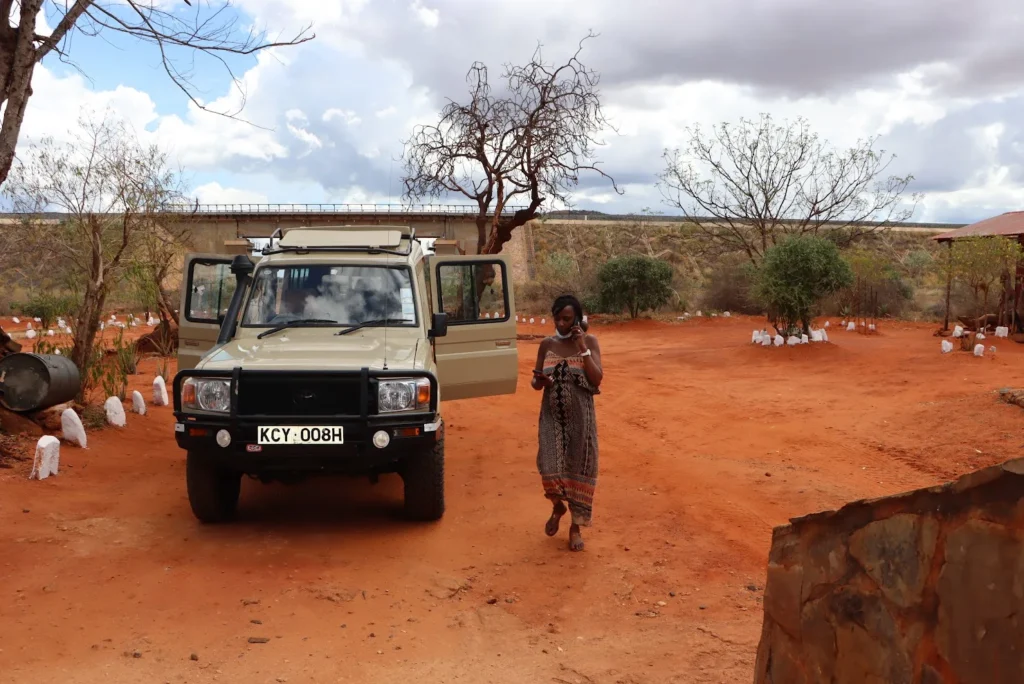
This trip makes sense on a map.
The Mara is southwest of Nairobi. Tsavo is southeast. Mombasa is east of Tsavo. Instead of doubling back to Nairobi after safari, you continue to the coast. Linear routing. And you end on a beach instead of in airport traffic, which after a week of 5:30 AM wake-ups feels like the only civilized option.
Masai Mara Tsavo Mombasa Safari runs 8-10 days. At Masaimara.co.ke we book it as one package – vehicle for the bush legs, beach transfer and hotel handled together.
What This Guide Covers
What It Costs
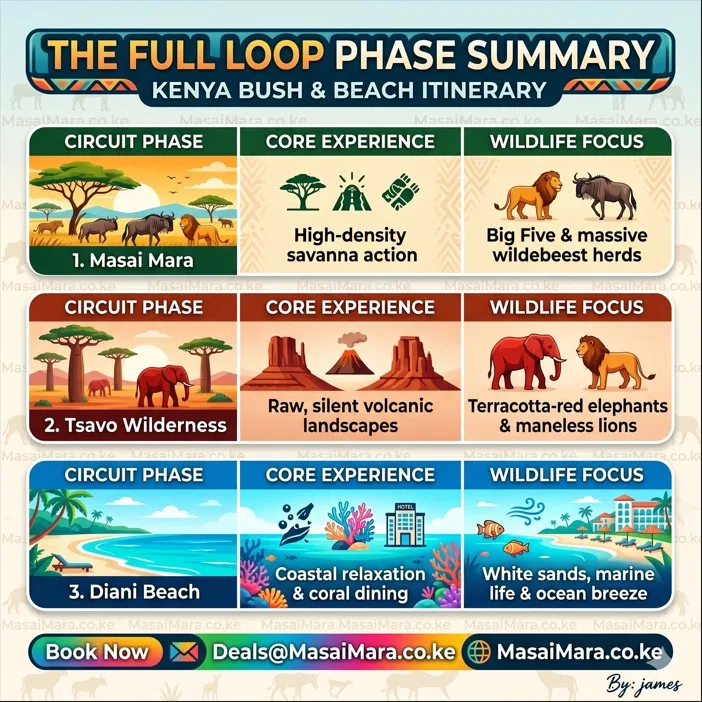
Circuit Phase | Core Experience | Wildlife Focus |
1. Masai Mara | High-density savanna action | Big Five & massive wildebeest herds |
2. Tsavo Wilderness | Raw, silent volcanic landscapes | Terracotta-red elephants & maneless lions |
3. Diani Beach | Coastal relaxation & coral dining | White sands, marine life & ocean breeze |
Two sharing. Private Land Cruiser for safari. Beach separate.
Park Fees (Non-Resident, USD)
- Masai Mara: USD 100/day (low) / USD 200/day (peak)
- Tsavo West: USD 80/day
- Tsavo East: USD 80/day
8 Nights (3 Mara + 2 Tsavo + 3 Beach) – Non-Residents (USD)
Tier | Low Season | Peak Season | Safari Lodges | Beach Hotel |
Budget | 2,320 | 4,040 | Jambo Mara, Ngulia, Voi Lodge | Diani Reef, Papillon Lagoon |
Mid-Range | 2,880 | 4,780 | Sentrim Mara, Kilaguni Serena, Ashnil Aruba | Baobab Beach, Leopard Beach |
Luxury | 3,680 | 5,980 | Mara Serena, Kilaguni, Satao Camp | Swahili Beach, Sands at Nomad |
8 Nights – Kenyan Residents (KES)
Tier | Low Season | Peak Season | Safari Lodges | Beach Hotel |
Budget | 302,000 | 448,000 | Jambo Mara, Ngulia, Voi Lodge | Diani Reef, Papillon Lagoon |
Mid-Range | 375,000 | 548,000 | Sentrim Mara, Kilaguni Serena, Ashnil Aruba | Baobab Beach, Leopard Beach |
Luxury | 478,000 | 698,000 | Mara Serena, Kilaguni, Satao Camp | Swahili Beach, Sands at Nomad |
Flying out of the Mara instead of driving? Add USD 280 / KES 36,000 per person.
What’s Included
Safari Portion:
- Private 4×4 Land Cruiser with pop-up roof
- English-speaking driver-guide throughout safari
- Fuel for all transfers and game drives
- Full board accommodation at safari lodges (all meals)
- Park entry fees: Masai Mara (3 days), Tsavo West (1 day), Tsavo East (1 day)
- Bottled drinking water during drives
- AMREF Flying Doctors emergency evacuation cover
Beach Portion:
- Half board accommodation (breakfast + dinner)
- Return airport transfers if flying out of Mombasa/Ukunda
- Beach hotel taxes and service charges
What’s Not Included
- Tips for driver-guide (USD 15-20 / KES 2,000-2,500 per day)
- Tips for lodge and beach hotel staff
- Alcoholic and soft drinks
- Travel insurance (required)
- Visa/eTA fees (etakenya.go.ke)
- Personal expenses: laundry, souvenirs
- Hot air balloon in Mara (USD 500 / KES 65,000)
- Water sports and excursions at the beach
- Lunches at beach hotel (half board only)
- Internal flights if upgrading from road transfers
The Route
Day 1-3: Masai Mara Day 4: Mara to Nairobi, continue to Tsavo West Day 5-6: Tsavo West and East Day 7: Tsavo East to Diani (not as quick as you’d think) Day 8-10: Beach
Some people skip Tsavo and fly Mara direct to Diani. Cuts the trip to 6-7 days. But you miss the red elephants and volcanic landscapes. And the Mara-to-Diani flight costs USD 425 / KES 55,000+ per person. Driving through Tsavo adds game drives and costs less.
The Mara Days
By the third night in the Mara, my neck usually hurts from scanning the horizon and I’ve developed a personal vendetta against the 5:30 AM wake-up call. But then you see a leopard at sunrise – backlit, gold and black, completely ignoring your camera – and suddenly you’re fine. That’s the trade.
Three nights gets you 5-6 game drives. Lions are easy here. Cheetahs most days. Wildebeest migration if you’re here July-October. Vehicle convoys at every big sighting, which can feel like rush hour with better views.
Gate choice matters. Talek puts you in big cat territory faster than Sekenani. My guide Joseph always says: “Sekenani is for the vehicle, Talek is for the animals.” He’s right.
Lodge vs tented camp: Stone-walled lodges are comfortable but you lose the night symphony – hyenas whooping, lions somewhere in the dark. If you want to actually hear the bush, ask for a permanent tented camp. Canvas lets sound in, keeps bugs out. I sleep better in tents than lodges, which probably says something about me.
The Mara smells like grass and dung and dust. That smell gets into your clothes and stays. By Day 3 you’ve stopped noticing. Then you get to a beach shower and realize just how much bush you’ve been breathing.
About the balloon flights – book before you arrive. Slots fill during peak season.
Day 4: The Slog
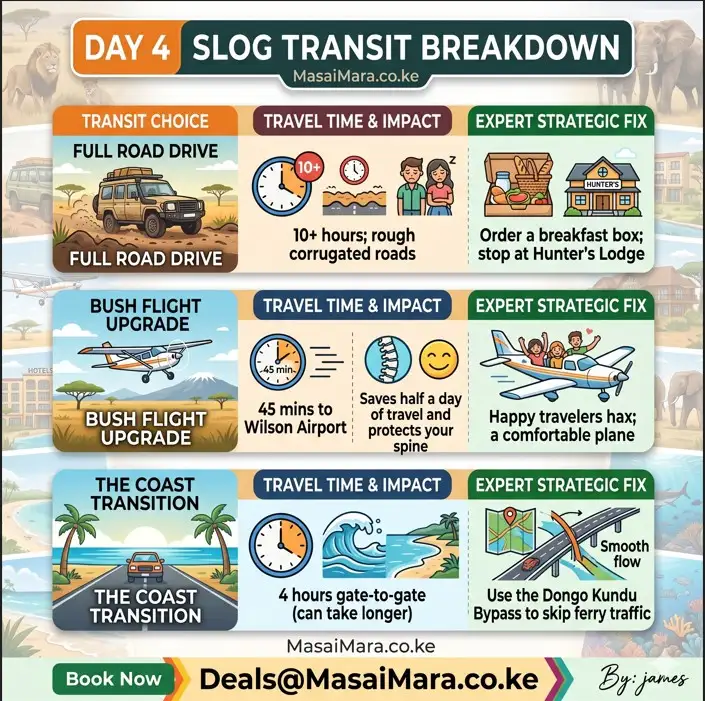
Transit Choice | Travel Time & Impact | Expert Strategic Fix |
Full Road Drive | 10+ hours; rough corrugated roads | Order a breakfast box; stop at Hunter’s Lodge |
Bush Flight Upgrade | 45 mins to Wilson Airport | Saves half a day of travel and protects your spine |
The Coast Transition | 4 hours gate-to-gate (can take longer) | Use the Dongo Kundu Bypass to skip ferry traffic |
Look, Day 4 is rough. There’s no way around it.
You’re leaving the Mara high and staring down a long stretch of tarmac. This is the day you’ll question your life choices. You’ll be tired from early starts. Your back will hurt from the “African Massage” – that’s what we call the corrugated roads.
The lunch box situation. Safari lunch boxes are legendary for being terrible. Dry chicken. A hard-boiled egg that somehow takes forty minutes to peel while the vehicle bounces over potholes. A warm fruit juice box. Save yourself. Tell your Mara lodge you want a breakfast box instead. Then stop for a real lunch at Hunter’s Lodge in Kiboko – actual site of the Man-Eaters of Tsavo railway attacks. They have hot food and toilets that flush.
If you’re flying out of the Mara instead of driving, you land at Wilson by noon and reach Tsavo by evening. Much better. The flight costs USD 280 / KES 36,000 but buys you half a day and your spine.
Tsavo
The Mara is loud. Tsavo is silent. Diani is… well, Diani is a dream.
Tsavo doesn’t look like the safari from the documentaries. It looks like Mars. Red dust, volcanic rock, baobabs that look like they’re growing upside down. The elephants don’t look real – they look like they’ve been spray-painted with terracotta. If you lean out the window, you’ll feel that same grit between your teeth for the next four hours.
Joseph has a saying about this too. “In the Mara, the animals find you. In Tsavo, you have to earn the animals.” He’s right about this also.
You might drive 45 minutes with nothing. Nothing. Just red dust and scrub and that weird pressure in your ears from the silence. Then suddenly – elephants. A whole herd at a waterhole, coating themselves in mud. Or a maneless lion lying under a baobab, watching you like you’re the boring one.
The maneless lions. Tsavo males often have sparse manes or none at all. They look prehistoric. Scarier than Mara lions, honestly. Thicker necks. More scars. And they’re not habituated to vehicles the way Mara lions are. Don’t ask your guide to get closer. A Tsavo lion is more likely to charge.
Mudanda Rock – most articles miss this. It’s a massive rock outcrop in Tsavo East. You can walk to the top and look down on elephant herds at the natural dam below. One of the few places you can legally stretch your legs in predator country. My calves appreciated it.
Mzima Springs – go early, 8 AM. There’s an underwater tank where you watch hippos from below. By midday the water clouds up. The springs also have these “walking trees” – Ficus roots snaking over volcanic rock. Most visitors just look for hippos. The trees are better.
Satao Camp waterhole – if you’re staying there, get to the deck 30-45 minutes before sunset. First-timers miss the best elephant action because they’re in their tents freshening up. Don’t freshen up. Get a drink and sit.
Voi Safari Lodge hide – worth the fee even if you’re not staying. Ask for rooms in the “200 series” if you do stay – closest to the tunnel. Wear black or dark grey in the hide. Elephants see movement behind the glass and won’t approach if you’re visible.
The Coast Transition
You leave Tsavo East after a morning drive. The guidebooks say “4 hours to the coast.”
They’re lying.
Four hours is gate-to-gate. If you’re at an interior lodge like Satao, add 2-3 hours of slow game-drive speed just getting out of the park. Don’t plan anything for that first beach afternoon. You won’t make it.
The Dongo Kundu Bypass has changed everything. Most older guidebooks talk about the Likoni Ferry – the two-hour nightmare, the crowds, the mechanical failures. The bypass is a newer bridge system that skirts the ferry entirely. Ask your driver about it. Cuts the “Mombasa traffic nightmare” by 70%.
If you do take the ferry, hit Likoni around 6:30-7:30 AM. Just after the early commuter crush. Pre-6 AM is chaos.
Flying out: Use Ukunda airport for domestic connections, not Mombasa’s main airport. Faster check-in, shorter transfers from Diani. Matters if your connection is tight.
Keep one buffer night in Diani before an early flight. Even minor highway snags can push afternoon arrivals into evening.
Beach Lodges
Budget: Diani Reef, Papillon Lagoon. Big resort energy. Pools with animation teams shouting at you to do water aerobics. Fine for families.
Mid-range: Baobab Beach, Leopard Beach. Better food. Quieter pools. Some have private beach sections.
Luxury: Swahili Beach, The Sands at Nomad, Alfajiri Villas. The Sands is boutique – smaller, calmer. Alfajiri is villa-style, good for honeymoons or groups who want privacy.
All-inclusive vs half-board: Resorts push all-inclusive. Worth it if you drink. But Diani has restaurants worth leaving for. Ali Barbour’s Cave Restaurant is carved into actual coral. Eat dinner underground by candlelight. At least once.
If leaving Diani early for Tsavo (doing the trip in reverse), ask your hotel the night before for packed breakfast plus a thermos of coffee. Some places only do this on request. Beats the roadside coffee stop.
Stuff That Goes Wrong

Safari Pitfall | The Real Threat | Expert Field Fix |
Volcanic Dust Silt | Grinds into and scratches camera lenses | Brush with a soft paintbrush; never wipe dry |
Roadside Honey Scam | Vendors sell fake sugar syrup | Only buy authentic dark honey at official KWS gates |
Tipping Currency | Rural staff cannot exchange small USD | Tip using local 200 and 500 KES notes |
Safari Recalibration | Spending beach time hunting for leopards | Plan a full transition day for your brain to relax |
The dust follows you. Tsavo’s volcanic dust is in your camera by Day 6. In your phone charging port. In your luggage zippers. Some clients bring a separate “bush bag” that stays outside the beach hotel room until it’s dealt with.
Camera tip: don’t wipe dust with a cloth. The silica grinds into glass. Carry a soft-bristle paintbrush and brush it off first.
Safari mode doesn’t switch off. I’ve had clients spend their first beach afternoon scanning palm trees for leopards. Your brain takes a day to recalibrate. Plan for it.
Stomach adjustment. Safari food is heavy – buffets, three courses, packed lunches. Beach food is lighter, more seafood. Some stomachs need a transition day.
The honey scam. Don’t buy “honey” from roadside vendors between Tsavo and Mombasa. It’s sugar syrup. Real Tsavo honey is dark and smoky, sold at KWS gates. The cashews and macadamia nuts from Mtito Andei vendors are the better buy.
Tipping in the wrong currency. Everyone says bring USD. The real tip: bring 200 and 500 KES notes. If you tip a porter in USD, they often can’t exchange it. Rural banks refuse small or worn American bills. KES is immediately spendable.
Small ferry bag. Pack a soft bag for roadside stops: valuables, light scarf or kanga (for dust and modesty at busy loos), flip-flops for the ferry deck. Main duffel stays closed.
Binoculars. Bring compact ones even when animals seem close enough for photos. Guides spot things at distance first. Binos make the slow stretches more engaging.
Is This Trip Too Long?
Eight to ten days is a lot.
6 days: Skip Tsavo. Fly Mara direct to Diani. Three Mara nights, two beach nights.
7 days: Mara (3) + Tsavo (1) + Beach (2). Tight on Tsavo but still gives you red elephants.
10+ days: Add Amboseli for Kilimanjaro views. Or extend beach time.
The sweet spot for most people is 8 nights. Long enough to justify the routing. Short enough to not exhaust your leave balance.
Book This
Tell us your dates and beach preferences.
David Njunge · August 2026
Related: Mara Packages · Budget Options · 7-Day Safaris · First Timer Guide
Verify fees: KWS · Kenya Tourism Board
Welcome to Masaimara.co.ke
Thank you for visiting us! We're excited to help you plan an unforgettable safari adventure across Kenya.