
Masai Mara vs Tsavo – Honest Comparison From Someone Who Works Both
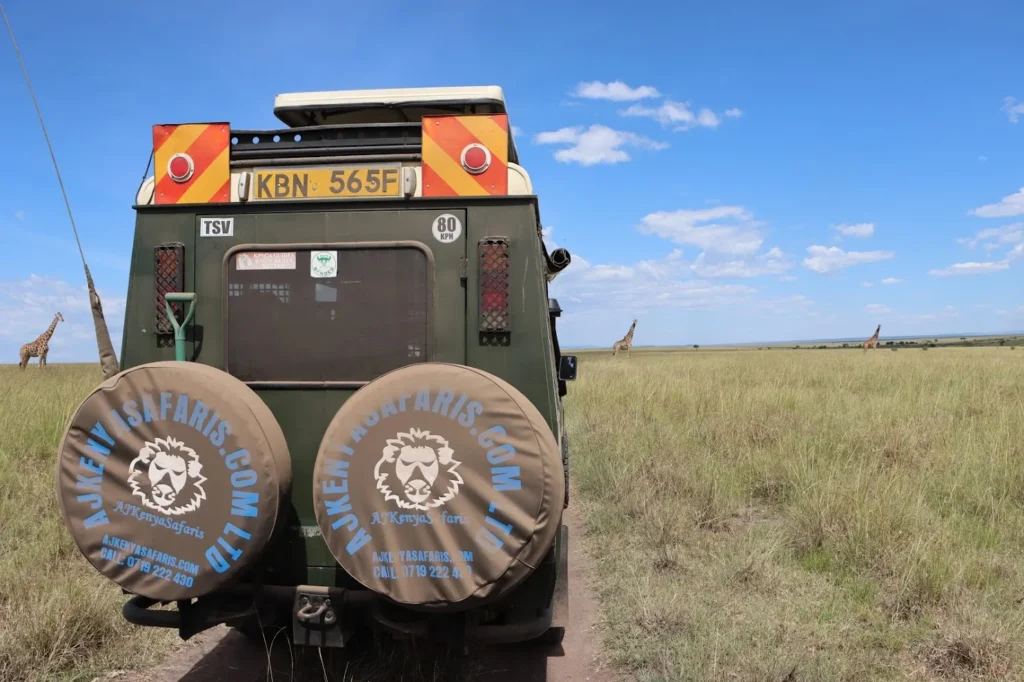
Quick Verdict: Go to the Masai Mara if you want high-density big cat sightings and the Great Migration. Go to Tsavo if you want vast, uncrowded wilderness and can handle a “slow burn” safari. The Mara is a highlights reel. Tsavo is an expedition.
People ask me this constantly. Which is better?
Wrong question. They’re completely different experiences. The Mara smells like grass and dung. Tsavo tastes like red grit between your teeth. Comparing them is like asking whether you’d rather go to a concert or go hiking. Different moods entirely.
I’ve guided in both for over a decade. Here’s what actually matters.
What This Guide Covers
What It Costs

Safari Destination | The Core Vibe | Best Suited For… |
Masai Mara Plains | High-density cat action; constant movement and noise. | First-time safari visitors looking for a guaranteed highlight reel. |
Tsavo Wilderness | Raw volcanic desert silence; uncrowded, vast tracks. | Experienced travelers seeking true solitude and a “slow burn” adventure. |
Park Fees (Non-Resident, USD)
- Masai Mara: USD 100/day (low) / USD 200/day (peak)
- Tsavo West: USD 80/day
- Tsavo East: USD 80/day
3-Night Mara Safari (4 days) – Non-Residents (USD)
Tier | Low Season | Peak Season | Camps |
Budget | 1,330 | 2,530 | Jambo Mara, Mara Sidai, Rhino Tourist |
Mid-Range | 1,630 | 2,880 | Sentrim Mara, Mara Leisure, Fig Tree |
Luxury | 2,130 | 3,480 | Mara Serena, Mara Intrepids, Sarova Mara |
3-Night Mara Safari – Kenyan Residents (KES)
Tier | Low Season | Peak Season |
Budget | 173,000 | 278,000 |
Mid-Range | 212,000 | 328,000 |
Luxury | 277,000 | 418,000 |
3-Night Tsavo Safari (4 days) – Non-Residents (USD)
Tier | Low Season | Peak Season | Camps |
Budget | 1,240 | 2,180 | Ngulia Lodge, Voi Safari Lodge |
Mid-Range | 1,440 | 2,430 | Kilaguni Serena, Ashnil Aruba |
Luxury | 1,940 | 2,980 | Satao Camp, Finch Hattons |
3-Night Tsavo Safari – Kenyan Residents (KES)
Tier | Low Season | Peak Season |
Budget | 161,000 | 248,000 |
Mid-Range | 187,000 | 298,000 |
Luxury | 252,000 | 378,000 |
What’s Included
- Private 4×4 Land Cruiser with pop-up roof
- English-speaking driver-guide throughout
- Fuel for all transfers and game drives
- Full board accommodation (all meals)
- Park entry fees for duration of stay
- Bottled drinking water during drives
- AMREF Flying Doctors emergency evacuation cover
- Airport/hotel pickup and drop-off in Nairobi
What’s Not Included
- Tips for driver-guide (USD 15-20 / KES 2,000-2,500 per day)
- Tips for lodge staff
- Alcoholic and soft drinks
- Travel insurance (required)
- Visa/eTA fees (etakenya.go.ke)
- Personal expenses: laundry, souvenirs
- Hot air balloon in Mara (USD 500 / KES 65,000)
- Mzima Springs underwater viewing (USD 15 / KES 2,000)
How They Actually Feel
In the Mara, you’re tripping over lions. I once saw three different prides before my morning coffee – and that was a slow day. You drive through Sekenani gate or Talek gate and within thirty minutes you’re watching something hunt. Cheetahs by lunch. Maybe a leopard at the Cul-de-Sac crossing point by sunset. The plains are open, golden grass stretching to the horizon, and animals are everywhere.
It’s also a parking lot in August. I’ll be honest. During peak migration, you might have fifteen vehicles around a river crossing. The wildebeest grunting is constant – this low rumble that never stops. By Day 3 you’ve stopped noticing until you leave and realize how loud it was.
Tsavo is the opposite. You enter through Mtito Andei gate and… nothing. Red dust. Volcanic rock. Baobabs that look like they’re growing upside down. You’ll go an hour seeing nothing but scrub and sky, and then – boom – a herd of “red” elephants appears out of the bush like ghosts. It’s a different kind of reward.
The silence is disorienting. Locals call it “Safari Ear.” Your brain adjusts to constant Mara noise, and when that disappears, the pressure feels weird. You start noticing the sound of wind through the whistling thorns. That’s usually when you spot the leopard.
My buddy Joseph, who’s been tracking in Tsavo West since I was in school, always says: “In the Mara, the animals find you. In Tsavo, you have to earn the animals.” He’s right about most things.
Reading the Bush
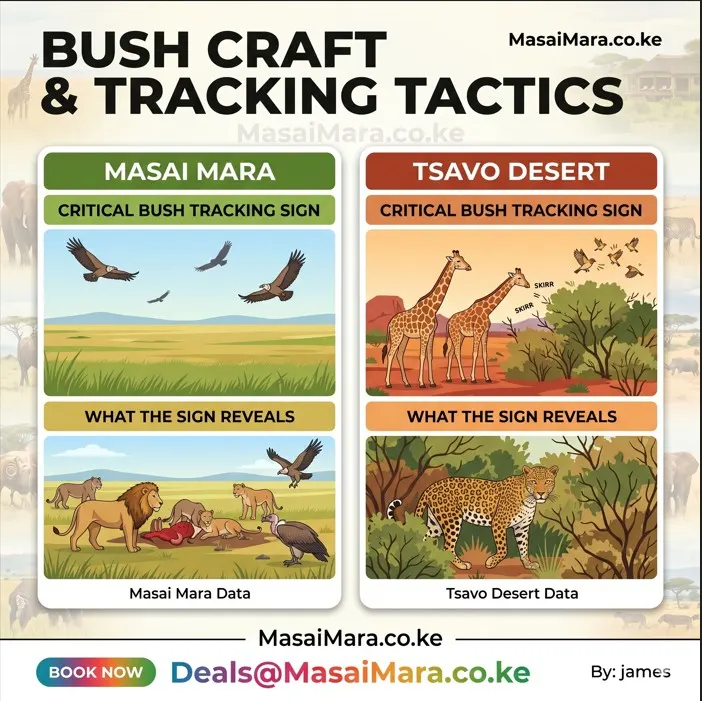
Safari Park | Critical Bush Tracking Sign | What the Sign Reveals |
Masai Mara | Circling vultures on the open horizons. | Pinpoints active big cat kills across the clear grasslands. |
Tsavo Desert | Frozen, staring giraffes; frantic sparrow-weaver bird calls. | Exposes hidden lions or leopards camouflaged within thick scrub vegetation. |
Different parks need different skills.
In the Mara, you follow the vultures. See them circling over the Mara Triangle? Something died. Drive toward it. The game viewing is straightforward because the plains are open and animals are dense. A decent guide will find you cats. An excellent guide will find you the good angles without twenty other vehicles.
Tsavo requires bush craft.
Here’s something nobody writes about: giraffes are your early-warning system. If you see a Maasai Giraffe standing perfectly still near a whistling thorn acacia, don’t move. They watch predators long before human eyes can spot anything. If the giraffe’s ears are locked in one direction, point your binoculars exactly where it’s looking. There’s probably a lion in that scrub.
And the birds. In Tsavo’s thick vegetation around places like Aruba Dam or near Mudanda Rock, look for White-browed Sparrow-weavers. They build messy nests on the “safe” side of trees – away from predators. If you hear them making a frantic “skirr” sound, there’s a leopard or snake nearby. In the Mara you follow vultures. In Tsavo you follow small birds.
Guide quality matters more in Tsavo because animals are harder to find. Reading fresh dung, bird calls, dust plumes – that’s the difference between seeing everything and seeing nothing. In the Mara, even a mediocre guide stumbles into sightings.
The Vehicle Problem Nobody Mentions
This matters more than people realize.
In the Mara, you need a pop-top roof. High-density sightings mean vehicle scrums – sometimes ten Land Cruisers around one leopard in the Greater Mara. Without a roof hatch, you’re looking at other cars, not animals.
Tsavo is different. The bush around Mzima Springs and the Shetani Lava Flow is thick. Animals hide in vegetation at eye level. A roof hatch means you’re looking down at the tops of bushes. What you actually need are removable side panels – that’s how you spot a leopard tucked into rock shade near the Roaring Rocks or a lion lying in scrub.
Most rental vehicles are configured for Mara-style viewing. If you’re doing Tsavo, ask specifically about side visibility. Sounds minor. It isn’t.
One more thing that never makes the brochures: the roads. I lost a bumper on the C11 route back in ’24 because I ignored my own advice. Don’t be me. Stick to the C12 via Sekenani unless you want to spend your afternoon waiting for a tow truck from Narok. And the lava tracks in Tsavo West near Shetani are brutal – women who’ve done this route tell me a high-impact sports bra is “essential gear” regardless of fitness level. We call the bouncing the “African Massage.” It’s not relaxing.
The Camera Situation
Everyone mentions Tsavo’s red dust. Nobody mentions the static.
The volcanic dust is electrically charged. If you change lenses inside your vehicle near Lugard Falls or anywhere in Tsavo East, your sensor will literally pull dust toward it like a magnet. I’ve seen clients ruin expensive equipment this way.
The fix sounds stupid but works: bring a large pillowcase. Keep your entire camera inside the pillowcase while it’s around your neck. Change lenses inside the pillowcase, not in open air. It’s faster than a camera bag and blocks the static-charged grit.
In the Mara, dust is finer – talcum-like. Standard cleaning works. But brush it off with a soft-bristle paintbrush before wiping. The silica grinds into glass coatings if you wipe first.
Getting Between Them
This is the question nobody asks until they’re planning.
The parks are in opposite directions from Nairobi. The Mara is southwest. Tsavo is southeast. You can’t just drive between them in a day – not comfortably anyway.
To the Mara: 5-6 hours from Nairobi by road via C12 through Sekenani. Ignore Google Maps if it suggests the C11 via Maji Moto – local drivers call that route a “vehicle killer.” You can also fly. Bush flights from Wilson Airport to Keekorok or Mara North take 45 minutes. Expect KES 26,000+ per person.
To Tsavo: 4-5 hours from Nairobi to Tsavo West via Mtito Andei. Or take the SGR train – the Madaraka Express from Nairobi to Voi costs KES 4,000 for First Class and you’ll see elephants from the window. Your vehicle meets you at Voi station. Some people call this a “train safari” and honestly they’re not wrong.
Combining both: You need at least 6 days and probably a Nairobi overnight between parks. Some operators fly you out of the Mara to Wilson, then drive you to Tsavo same day. It works but it’s a long transfer day. We’ve written about Masai Mara and Tsavo combinations if you want details.
The middle-ground option: Taita Hills Wildlife Sanctuary sits between Tsavo and the coast. Salt Lick Safari Lodge there has those famous elevated rooms. It gives you Mara-style viewing density but Tsavo’s red soil, plus legal night drives (which are banned in national parks). Good buffer if the jump from Mara to Tsavo feels too long.
The Hidden Spots

Hidden Situation | The Unexpected Trap | The Pro Field Solution |
Tsavo Camera Static | Charged volcanic dust clings to lens sensors like a magnet. | Swap out your lenses completely inside a clean, closed pillowcase. |
Ngulia Rhino Timing | Shy black rhinos hide from early afternoon tourist engine noise. | Arrive late at 5:15 PM just before the gates lock for the night. |
Mara Triangle Signal | Kenyan mobile phones accidentally roam onto pricey Tanzanian networks. | Manually lock your device to Safaricom or Airtel KE upon arrival. |
Voi Safari Lodge’s 200 series: If staying at Voi, request a room in the 200s. They’re built closest to the cliff-edge watering hole. You can hear elephants rumbling through the walls at night – that low-frequency communication they do. Other rooms are too far to feel it.
Ngulia Rhino Sanctuary timing: Most itineraries just say “visit the sanctuary.” But Tsavo’s rhinos are shy. If you arrive at the 4 PM opening, you’ll see nothing – they wait for tourist vehicles to leave. The pro move: arrive at 5:15 PM, just before gates close at 6 PM. Rhinos emerge once engine noise fades.
The Mara Triangle phone trap: In the western Mara, Safaricom often roams onto Tanzanian networks. This triggers massive roaming charges. Manually lock your phone to “Safaricom” or “Airtel KE” the moment you descend the Oloololo Escarpment.
Market over show village: Maasai “cultural visits” in the Mara cost KES 2,000-3,000 and feel staged. If you want something real, ask your guide to stop at a weekly market – Sekenani or Talek. Real livestock trading, real bead-making. A shuka purchase there means more than a forced village fee.
Which Should You Pick?
Look, if you hate crowds, stay out of the Mara in August. It’s a parking lot. Go to Tsavo and actually hear yourself think.
If this is your first African safari, do the Mara. It delivers. You’ll see lions. You’ll see cheetahs. You’ll probably see a hunt. The Mara gives you the safari from the documentaries.
If you’ve done that already and want something different – more landscape, more solitude, more patience – Tsavo is the answer. You might go hours without sightings. But when you find those red-dusted elephants at Aruba Dam or spot a maneless lion near the Pipeline, you’ll have them to yourself.
Some people do both. 6+ days, Nairobi stopover in the middle. The contrast is worth it.
There’s no wrong answer. Different safaris for different moods.
Questions People Ask
Which is cheaper? Tsavo, by about USD 90-150 / KES 12,000-20,000 for a 3-night trip. Lower park fees (USD 80 vs USD 100-200), slightly cheaper lodges.
Can I see the Big Five in Tsavo? Technically yes. Rhinos are possible at Ngulia Sanctuary. But don’t expect Mara-style density. Tsavo is about elephants, landscapes, and earning your sightings.
Is Tsavo better for a second-time visitor? Usually yes. If you’ve done the Mara highlights, Tsavo offers something different – vast emptiness, red elephants, volcanic terrain. It’s a different kind of beauty.
Which has better roads? Neither is great. The Mara Triangle has the best-maintained roads overall. Tsavo’s lava tracks near Shetani are rough. Both will rattle you.
Can I combine them in one trip? Yes, with 6+ days and planning. We run Mara-Tsavo combinations – talk to us about logistics.
Ready to Decide?
Tell us what matters – guaranteed sightings or solitude, open plains or volcanic wilderness – and we’ll point you the right direction.
David Njunge · August 2026
Related: Mara Packages · Budget Safaris · 5-Day Options · 7-Day Safaris · First Timer Guide
Park info: KWS · Mara Conservancies
Welcome to Masaimara.co.ke
Thank you for visiting us! We're excited to help you plan an unforgettable safari adventure across Kenya.