
7-Day Masai Mara, Amboseli & Tsavo Safari: The Honest 2026 Guide
A 7 Days Masai Mara Amboseli Tsavo Safari is the most rugged wildlife loop in Kenya, connecting the Great Rift Valley with the volcanic plains of the south. For the 2026/2027 season, all-inclusive packages for two people sharing range from KES 385,500 ($2,965) to KES 1,220,000 ($9,385) per person. This rate covers a private 4×4 Land Cruiser, professional guide, updated eCitizen park fees, and six nights of lodging. Success on this route depends on timing the Ngulia rhino emergence and using the SGR train hack to avoid the Mombasa highway traffic.
7 Days Masai Mara Amboseli Tsavo Safari Costs (2026/2027)
This is the 7-day version of our Masai Mara Amboseli Tsavo Safari circuit. For the longer version, see the 8-day option.
Pricing for the 2026 season reflects the updated January park fees and the latest Land Cruiser rates. These prices are for two people traveling together.
Budget & Mid-Range Rates (Per Person Sharing)
Package Tier | Suggested Hotels | Regular (KES) | Peak (KES) |
Budget | Talek Bush Camp, Sentrim Amboseli, Ashnil Aruba | KES 385,500 | KES 620,000 |
Mid-Range | Ashnil Mara Camp, Ol Tukai, Kilaguni Serena | KES 515,000 | KES 850,000 |
Check Dates | 2026 Rates |
Luxury & Luxury Plus Rates (Per Person Sharing)
Package Tier | Suggested Hotels | Regular (KES) | Peak (KES) |
Luxury | Mara Serena, Amboseli Serena, Finch Hattons | KES 895,000 | KES 1,105,000 |
Luxury Plus | Angama Mara, Tortilis Camp, Finch Hattons | KES 1,020,000 | KES 1,220,000 |
Book Now | 2026/2027 |
Note: Peak season is July–October during the wildebeest migration. If you want to fly one leg, check our Masai Mara flying packages. Tsavo lodges cost about 30–40% less than equivalent Mara properties, so you can go luxury in Tsavo and mid-range in the Mara without blowing your total.
What’s Covered in the Price?
- Vehicle. Private 4×4 Land Cruiser with pop-up roof.
- Guide. TRA-licensed guide for all 7 days.
- Park Fees. All 2026 entries for Masai Mara, Amboseli, and Tsavo via the kwspay portal.
- Accommodation. 6 nights full board.
- Water. Bottled water in the vehicle plus extra reserves for Tsavo (distances are long).
Excluded. Tips (KES 3,500/day recommended), alcoholic drinks, hot air balloon (KES 78,000), Masai village visit (KES 4,500), international flights and Kenya eTA.
I’ve been guiding for ten years. A 7 Days Masai Mara Amboseli Tsavo Safari is a journey through changing colours. You start in the gold of the Mara, move to the dusty white of Amboseli, and end in the blood-red soil of Tsavo. Nearly 1,200 kilometres of road. It’s the only trip that feels like “Old Africa” because Tsavo is so empty you can drive for an hour without seeing another vehicle.
In 2026, the rules for park entries have changed. No cash at the gates. No “maybe” on timing. If the Ngulia Sanctuary closes at 6:00 PM and you arrive at 5:50, they’ll let you in. If you arrive at 6:05, they won’t.
The SGR Train Hack
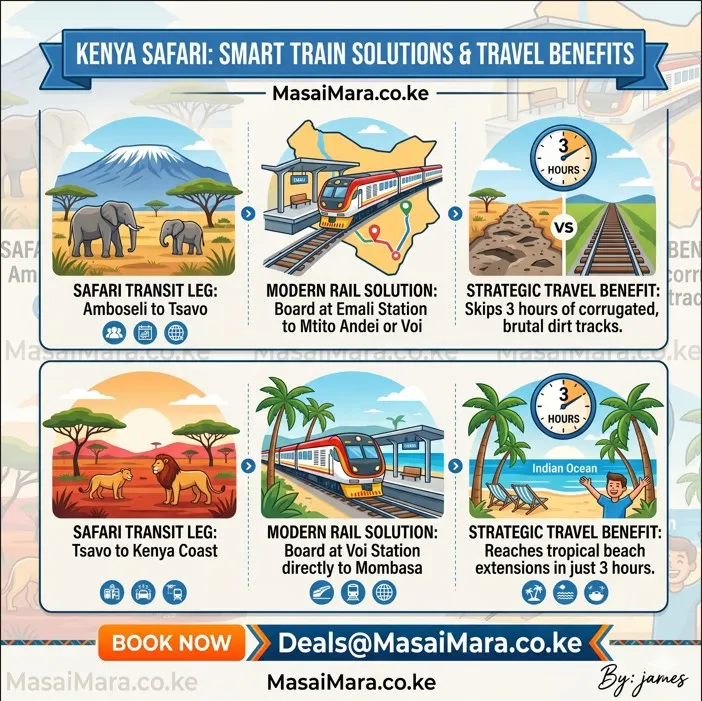
Safari Transit Leg | Modern Rail Solution | Strategic Travel Benefit |
Amboseli to Tsavo | Board at Emali Station to Mtito Andei or Voi | Skips 3 hours of corrugated, brutal dirt tracks. |
Tsavo to Kenya Coast | Board at Voi Station directly to Mombasa | Reaches tropical beach extensions in just 3 hours. |
The drive from Amboseli to Tsavo (or Tsavo back to Nairobi) is brutal and dusty.
Here’s what I do instead. I have the driver drop you at the Emali SGR Station (about 90 minutes from Amboseli) and you catch the Madaraka Express train to Voi (for Tsavo East) or Mtito Andei (for Tsavo West). You see the landscape from the train window, better for photos, while skipping 3 hours of corrugated road. I meet you at the destination station with the Land Cruiser.
The train costs about KES 1,000–3,000 depending on class. In 2026, this is the most comfortable way to arrive at Tsavo. It also works in reverse — if you’re ending the trip at the coast, exit through Voi and take the train to Mombasa in about 3 hours.
Tsavo’s Red Elephants
People think Tsavo has a unique breed of red elephant. It doesn’t. The elephants coat themselves in iron-rich red laterite soil as sunscreen and insect repellent. After a dust bath, they look rust-red from trunk to tail. The effect is strongest in Tsavo East, where the soil is darkest. Don’t wear white or light blue — by Day 6, the red dust will have bonded with your clothes permanently. Consider it your free Tsavo souvenir.
Mudanda Rock
This 1.6 km rock is a natural water catchment in Tsavo East. In May 2026, the black rock absorbs 100% of the sun’s heat. By noon it can hit 50°C. Visit at 6:30 AM. Leopards sit on the cool rock to watch the elephants below. By 9:00 AM, both the leopards and your shoes start to cook.
Mzima Springs
Go at 11:00 AM. The sun hits the water at the perfect angle to see the “Hippo Ballet” through the submerged glass viewing chamber. You can watch 3-ton hippos glide through crystal-clear water like slow-motion birds. Look for the Barbel fish cleaning the hippos’ skin. It’s an ecosystem you can’t see from the surface.
The Galana River
Tsavo East’s Galana River has the biggest crocodiles in Kenya. Some are 5–6 metres long. The Lugard Falls area (actually rapids, not a waterfall) is where they congregate. Most day-trippers from Mombasa never reach this far. On a 7-day circuit, you have time.
The Shetani Lava Flow
Near Chyulu Hills in Tsavo West, there’s a 200-year-old lava flow called Shetani (Swahili for “devil”). You can walk on the black volcanic rock — sharp, so wear proper shoes. The landscape is alien: black rock, red soil, and green bush all in one frame. Most operators skip it because it’s “not wildlife,” but the 30-minute detour is worth it. And ask me about the Shetani Caves — if I hear a “whoop” from the entrance, we stay out. That means hyenas are using the lava tubes to stay cool.
Ngulia Rhino Sanctuary
In Tsavo West, you need to hit Ngulia between 4:00 PM and 6:00 PM. Show up at 3:45 and they’ll turn you away. Show up at 5:50 and you’re fine. Show up at 6:05 and you’ve missed the rhinos entirely. The window is strict.
The Man-Eaters of Tsavo
In 1898, two maneless lions killed an estimated 35 railway workers at the original Tsavo Bridge. We’ll stop at the site. Ask me to show you the “Lion Cave” where the man-eaters stored their victims. Most operators skip this because it’s “too dark” for a holiday mood. But if you care about history, it’s the most powerful 15 minutes of the whole trip. The original skulls are at the Field Museum in Chicago.
Amboseli’s Old Tusker Swamps
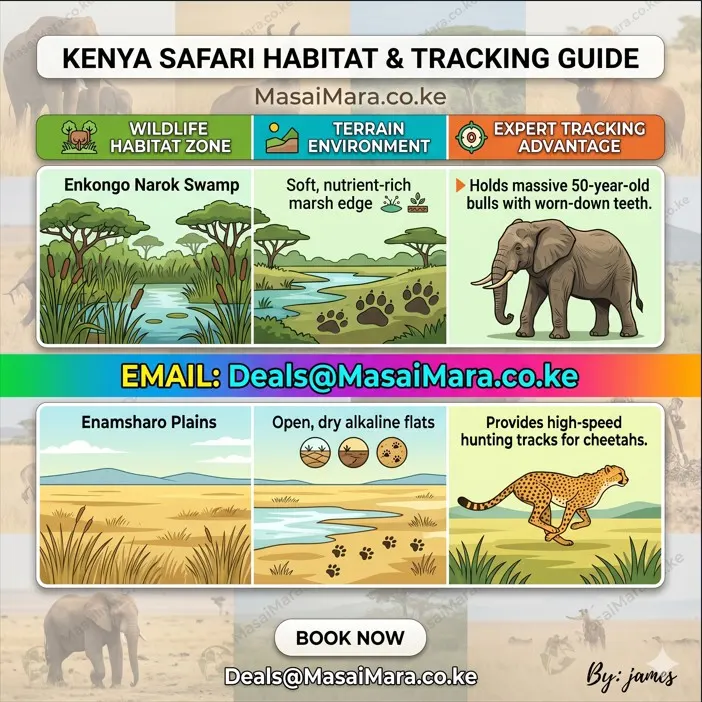
Wildlife Habitat Zone | Terrain Environment | Expert Tracking Advantage |
Enkongo Narok Swamp | Soft, nutrient-rich marsh edge | Holds massive 50-year-old bulls with worn-down teeth. |
Enamsharo Plains | Open, dry alkaline flats | Provides high-speed hunting tracks for cheetahs. |
Most Masai Mara and Amboseli Safari circuits focus only on the Kilimanjaro view. That’s the Instagram shot. But the real Amboseli is in the swamps.
Enkongo Narok Swamp. Don’t look for big elephants on the dry plains. The older bulls stay at the swamp edge because the vegetation is soft enough for their worn-down teeth. They’re “swamp-bound” in old age. Park at the edge and wait.
13 Things to Know Before You Go
- Aruba Dam Birding. In May 2026, look for the Madagascar Bee-eater migrating through Tsavo East. Flashes of green and bronze near the water’s edge.
- 10 AM Mara Exit. Under 2026 rules, you must exit the Masai Mara by 10:00 AM on Day 3. We start our final morning drive at 5:45 AM.
- End at the Beach. This circuit ends near the coast. If your next stop is Diani or Mombasa, we can exit through Voi instead of looping back to Nairobi. See our Masai Mara and Diani Beach or Mombasa combos.
- Red Dust & Cameras. Tsavo dust is almost magnetic. Wrap your camera in a pillowcase between sightings or your zoom ring will jam by Day 6.
- Vervet Monkey Raid. At Ol Tukai in Amboseli, lock your window pins before lunch. They watch you leave and then raid your room.
- No Night Drives in Tsavo. The park doesn’t allow them. But nearby conservancies do — porcupines, aardvarks, and bat-eared foxes come out after dark.
- Extra Water. Distances in Tsavo are huge. I carry an extra 10 litres beyond the standard vehicle supply. Don’t let a budget driver leave the gate with only 3 bottles.
- Gate Strategy. Use Ololaimutiek Gate in the Mara for a faster entry. Sekenani can have 45-minute queues in August.
- M-Pesa for Villages. Don’t bring $100 bills to a Masai village. Use M-Pesa. It’s more respectful and easier for the community.
- Adjust Your Expectations for Tsavo. Sighting frequency drops compared to the Mara. In the Mara, you’ll see something every 10 minutes. In Tsavo, you might go 45 minutes between sightings. But when you do find something — a red elephant herd, a 5-metre croc, a leopard on Mudanda Rock — you’ll have it to yourself. No 20-vehicle traffic jams.
- Vehicle Consistency. Confirm the same 4×4 and guide for all 7 days. Budget operators sometimes swap their oldest vehicle in for the Tsavo leg because the roads are easier. Don’t accept a vehicle swap at the park boundary.
- The Masai Mara migration window. If you’re visiting July–October, start with the Mara while the herds are crossing. The Mara River crossing is the single most dramatic wildlife event on this circuit.
- Kilaguni Serena Lodge. Built in 1962, it’s one of Kenya’s original safari lodges. The waterhole viewpoint at sunset draws elephants and buffalo every evening. If your Tsavo West camp is Kilaguni, sit on the terrace at 5:30 PM with a cold Tusker beer. That’s the real sundowner.
The 7-Day Itinerary
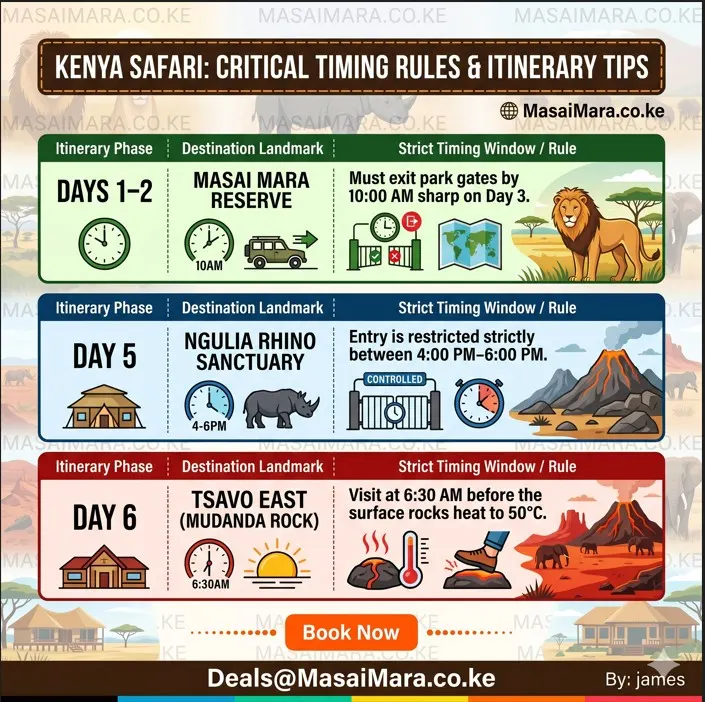
Itinerary Phase | Destination Landmark | Strict Timing Window / Rule |
Days 1–2 | Masai Mara Reserve | Must exit park gates by 10:00 AM sharp on Day 3. |
Day 5 | Ngulia Rhino Sanctuary | Entry is restricted strictly between 4:00 PM–6:00 PM. |
Day 6 | Tsavo East (Mudanda Rock) | Visit at 6:30 AM before the surface rocks heat to 50°C. |
This “Wild Frontier” loop works best in this direction. Nairobi → Mara → Amboseli → Tsavo.
Day 1–2: Masai Mara
We start with the big cats while your energy is fresh. Focus on lions, cheetahs, and the Masai Mara migration river crossings (July–October).
Day 3: Mara to Amboseli
We drive through Nairobi or take a Masai Mara flying packages hop. Arrival for a sunset view of Kilimanjaro.
Day 4: Amboseli
Full day tracking the “Old Tuskers.” Morning at the swamp boardwalk for eye-level elephant photos. Afternoon at the Enamsharo Plains for cheetahs.
Day 5: Amboseli to Tsavo West
A short 3-hour scenic drive through Maasai rangeland. We hit Ngulia Sanctuary at 4:30 PM sharp for rhinos. Evening at Mzima Springs if time allows.
Day 6: Tsavo West to Tsavo East
Morning at Mzima Springs for the underwater hippo viewing. Shetani Lava Flow walk. Then we cross the highway into the open plains of Tsavo East. Afternoon at Mudanda Rock.
Day 7: Red Elephants and Departure
Morning drive along the Galana River for red elephants and crocodiles. We exit through Voi for the SGR train to Mombasa or drive back to Nairobi. If heading home, you can book your next safari before you leave.
Why I Don’t Take Shortcuts Near Chyulu Hills
I once guided a group on a 6 days Masai Mara Amboseli safari who wanted a “scenic shortcut” near the Chyulu Hills in May. I told them the soil was Black Cotton. They said it looked fine from the vehicle.
Ten minutes later, the Land Cruiser was axle-deep. We spent four hours digging out while a leopard watched us from a rock. On a 7 Days Masai Mara Amboseli Tsavo Safari, we have time to go the long way and stay dry. When the soil changes colour, the conversation is over.
Frequently Asked Questions
What is the best month for this safari?
July to October for the migration. January is best for clear Kilimanjaro views in Amboseli. Check our best time to visit Masai Mara guide for the full picture.
Is a 4×4 Land Cruiser mandatory?
Yes. A minivan can’t handle Tsavo’s corrugations. Every Masai Mara booking we handle for this route uses 4x4s.
Can I finish the safari at the beach?
Yes. It’s the most common way to end this circuit. We drop you at the Voi SGR station for the 3-hour train to Mombasa. Or continue to Diani Beach by road.
How does this compare to the Mara-Amboseli-Nakuru circuit?
The Masai Mara Amboseli Nakuru Safari swaps Tsavo for Lake Nakuru. Nakuru gives you better rhino sightings in a small, fenced park. Tsavo gives you red elephants, the Man-Eaters history, underwater hippo viewing, and total solitude. Different experiences.
What should I pack?
Layers, power bank, binoculars (8×42), physical passport, closed-toe shoes for Shetani Lava Flow, dark-coloured clothes (avoid white in Tsavo), and extra camera protection. Full list in our Masai Mara packing list.
Is this trip safe?
Yes. All parks have KWS rangers, your guide carries a radio, and the lodges are well-established. More in our Masai Mara safety guide.
One Last Thing
This trip covers three parks that look nothing alike. Gold grass in the Mara. White alkaline dust in Amboseli. Blood-red soil in Tsavo. When you watch a rust-coloured elephant bull walk past your vehicle in complete silence — no other cars, no engine noise, nothing but you and the bush — you’ll understand why some people do this trip twice.
If 7 days feels like too much, check a 5 days Masai Mara safari or a 4 days Masai Mara safari. Want to add Nakuru instead of Tsavo? See our Masai Mara Amboseli Nakuru Safari. Browse everything on our Masai Mara packages page.
Ready to start? Fill out our inquiry form at Masaimara.co.ke here and I’ll see you at the gate.
Related Reading:
- Masai Mara Amboseli Tsavo Safari
- 8 Days Masai Mara Amboseli Tsavo Safari
- Masai Mara Tsavo Mombasa Safari
- Masai Mara and Amboseli Safari
- Masai Mara Amboseli Nakuru Safari
- 6 Days Masai Mara Amboseli Safari
- 5 Days Masai Mara Safari
- 4 Days Masai Mara Safari
- Masai Mara and Diani Beach Safari
- Masai Mara and Mombasa Safari
- Masai Mara Packages
- Luxury Safari Masai Mara
- Masai Mara Flying Packages
- Masai Mara Migration
- Masai Mara Booking
- Wildebeest Migration Kenya
- Masai Mara vs Serengeti
- Masai Mara vs Tsavo
- Masai Mara Safari Cost
- Official KWS Park Fee Portal
- Kenya Wildlife Service
This guide was authored by David Njunge, a TRA-licensed safari guide with over 10 years of experience, and edited by Cecilia Wambui, a travel consultant with a degree in Tourism and Hospitality Management.
Welcome to Masaimara.co.ke
Thank you for visiting us! We're excited to help you plan an unforgettable safari adventure across Kenya.