
Masai Mara, Amboseli, Lake Nakuru And Lake Naivasha Safari: 2027 Routes And Prices
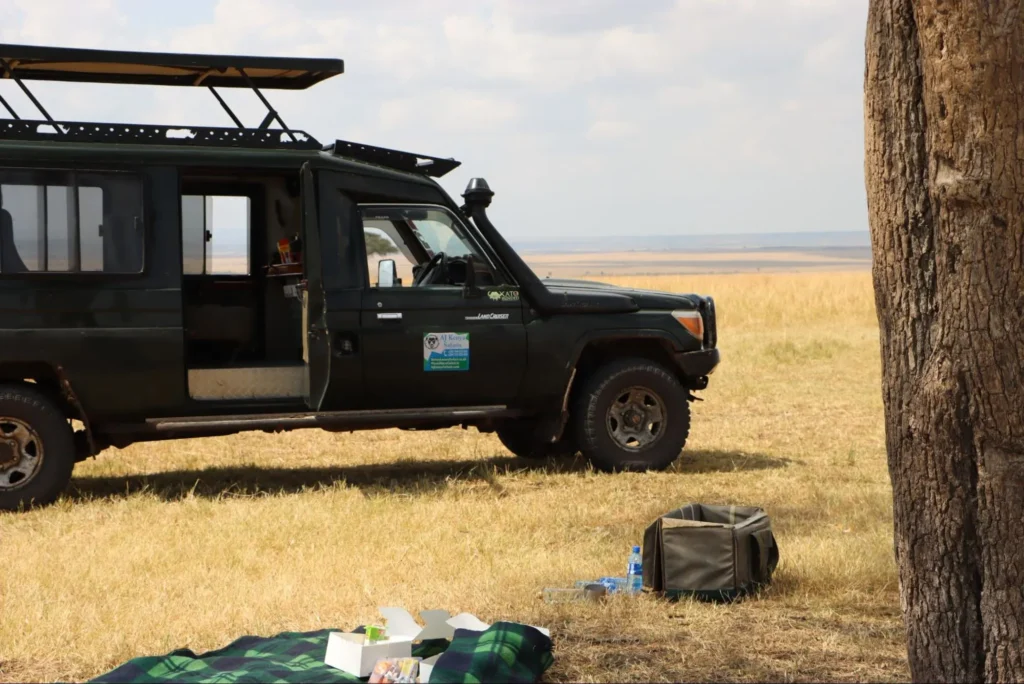
A Masai Mara, Amboseli, Nakuru and Naivasha safari puts four of Kenya’s best-known parks into one road trip: Amboseli’s elephants under Kilimanjaro, a boat on Lake Naivasha, the rhinos of Nakuru and the big cats of the Mara. For 2027 it runs 7 or 8 days and costs from USD 2,610 or KES 193,000 per person sharing.
Masai Mara, Amboseli, Nakuru and Naivasha Safari Costs (2027)
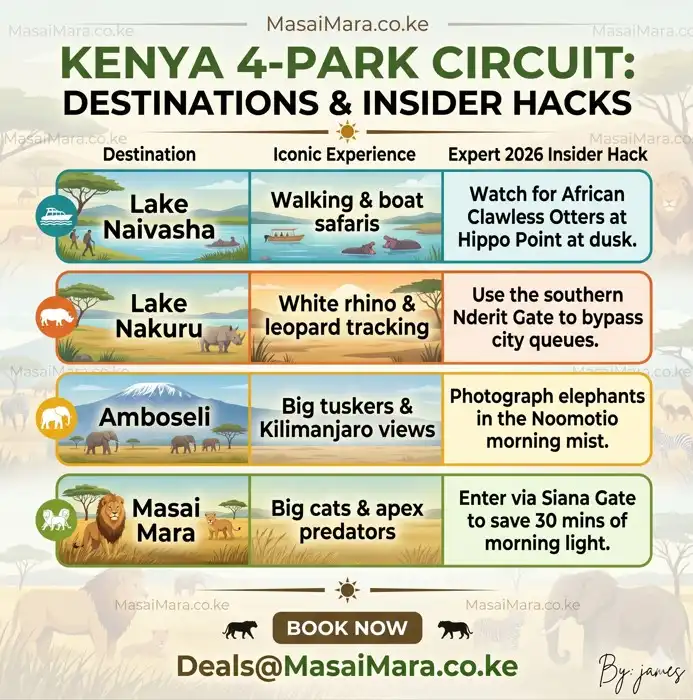
| Destination | Iconic Experience | 2027 Insider Tip |
|---|---|---|
| Amboseli | Big tuskers and Kilimanjaro | Be out at 6 AM, before cloud covers the mountain, usually by about 10 AM. |
| Lake Naivasha | A boat ride and a walking safari on Crescent Island | Ask the skipper to cut the engine by the papyrus. Otters are a lucky bonus. |
| Lake Naivasha (optional extras) | Cycling in Hell’s Gate, hiking Mount Longonot, horse riding at Sanctuary Farm, a night game drive at Oserengoni Wildlife Sanctuary, a visit to Lake Elementaita, or golf at the Great Rift Valley Lodge and Golf Resort | Each needs extra time, so ask us to add a second night at Naivasha. The Oserengoni night drive is only for guests staying at Chui Lodge. |
| Lake Nakuru | Black and white rhinos | Enter in the morning and work the southern grassland first. |
| Masai Mara | Big cats and the river crossings | We use the gate nearest your camp: Sekenani, Talek or Oloolaimutia. |
This circuit joins our Masai Mara, Amboseli and Lake Nakuru safari and our Masai Mara, Lake Nakuru and Lake Naivasha safari into one longer trip.
Prices are for the 7-day route, per person, two people sharing a private 4×4 Land Cruiser. Kenyan citizen prices are not the dollar price converted. Citizens and residents pay much lower park fees and lodge rates, and the prices are worked out from those.
International Visitors (USD)
| Tier | Lodges (Amboseli + Naivasha + Nakuru + Mara) | Jan-June | July-Dec |
|---|---|---|---|
| Budget | AA Lodge Amboseli + Kongoni Lodge + Ziwa Bush Lodge + Mara Sidai Camp | 2,610 | 3,100 |
| Mid-Range | Kibo Safari Camp + Lake Naivasha Sopa + Lake Nakuru Sopa + Mara Sopa Lodge | 3,080 | 3,740 |
| Luxury | Amboseli Serena + Enashipai Resort + Sarova Lion Hill + Sarova Mara Game Camp | 4,080 | 5,350 |
Kenyan Citizens (KES)
| Tier | Lodges (Amboseli + Naivasha + Nakuru + Mara) | Jan-June | July-Dec |
|---|---|---|---|
| Budget | AA Lodge Amboseli + Kongoni Lodge + Ziwa Bush Lodge + Mara Sidai Camp | 193,000 | 213,000 |
| Mid-Range | Kibo Safari Camp + Lake Naivasha Sopa + Lake Nakuru Sopa + Mara Sopa Lodge | 228,000 | 259,000 |
| Luxury | Amboseli Serena + Enashipai Resort + Sarova Lion Hill + Sarova Mara Game Camp | 299,000 | 376,000 |
The 8-day route, with a third night in the Mara and the same lodges, runs from USD 3,030 / KES 222,000 (Budget), USD 3,570 / KES 263,000 (Mid-Range) and USD 4,750 / KES 346,000 (Luxury) from January to June.
Foreign nationals living in Kenya on a work or residence permit pay resident park fees, which sit between the dollar and shilling prices. Tell us when you book and we will quote you on resident rates.
Note: Peak prices apply from July to December, when Mara park fees double and the lodges move to high-season rates. If you want to fly one leg, see our Masai Mara flying packages. For the lowest cost, see our budget safaris, and for camps above our Luxury tier, see our luxury safari Masai Mara options.
What Is Covered In The Price?
- Vehicle: A private 4×4 Land Cruiser with a pop-up roof for the whole trip, with fuel for every transfer and game drive.
- Guide: One TRA-licensed guide who drives you from Nairobi and back, through all four parks.
- Park Fees: All 2027 entries. Amboseli and Lake Nakuru are paid through KWS eCitizen, including the KWS vehicle fee. The Masai Mara is paid to Narok County, and Crescent Island to the private sanctuary.
- Naivasha: The boat ride on Lake Naivasha and the walking safari on Crescent Island.
- Accommodation: Full board for every night, with packed lunches on full game drive days.
- Water: Drinking water in reusable containers in the vehicle.
- Cover: AMREF Flying Doctors evacuation cover.
- Excluded: Tips (USD 15 to 20 / KES 2,000 to 2,500 per day), alcoholic and soft drinks, the hot air balloon (USD 500 / KES 58,500), the Maasai village visit (KES 1,500 for citizens / USD 20 for non-residents), night walks at Naivasha (paid locally), international flights, the Kenya eTA (USD 34) and Kenya’s inbound travel health insurance (up to USD 44 per person).
I have been guiding for ten years. This circuit covers about 1,000 km, and the four parks on it have almost nothing in common. Old elephants feeding at the swamp edge in Amboseli with Kilimanjaro behind them. A boat among the hippos on Lake Naivasha, then a walk among giraffes on Crescent Island. Rhinos at Nakuru. And the lions of the Mara grass to finish.
It is a lot of road, but the order makes it easy. Each road day ends with lunch at the next lodge and an afternoon in the park, and the drive that wears people out on other routes is cut in two.
The Route Order
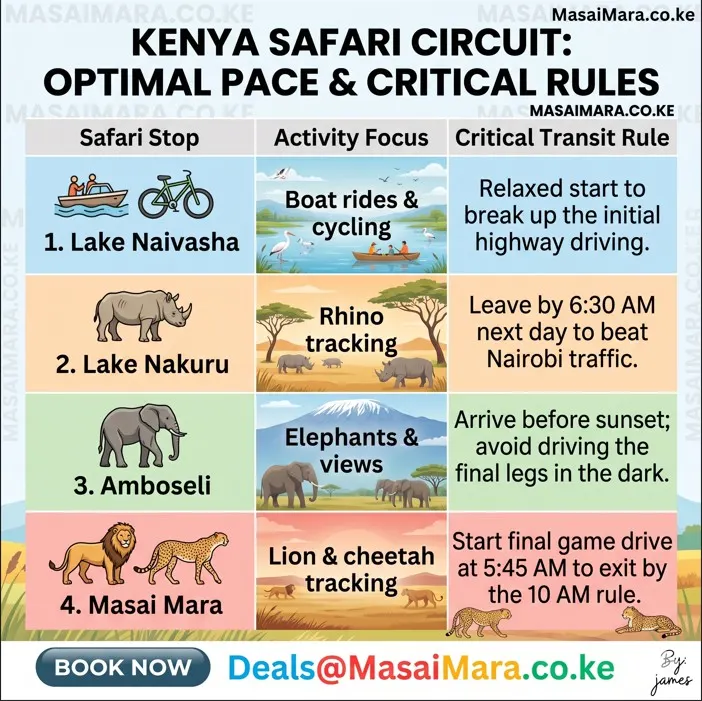
| Safari Stop | Activity Focus | Critical Transit Rule |
|---|---|---|
| 1. Amboseli | Elephants and Kilimanjaro | Leave Nairobi early, lunch at the lodge, out in the park by 3:30 PM. |
| 2. Lake Naivasha | The boat and Crescent Island | Leave Amboseli at 7 AM, lunch at the lodge, on the water by about 2:30 PM. |
| 3. Lake Nakuru | Rhino tracking | A short drive from Naivasha, so you are in the park by mid-morning. |
| 4. Masai Mara | Lions and cheetahs | No game drive on your last morning, and flights home after 9 PM. |
We run this circuit in one order: Nairobi, Amboseli, Naivasha, Nakuru, the Mara, then back to Nairobi. You pass Nairobi only once, on the Southern Bypass between Amboseli and Naivasha, and every other leg runs on through to the next park.
Why Naivasha sits in the middle. On a three-park trip with Amboseli and Nakuru, the hardest day is the long transfer from one to the other through Nairobi. Here, Naivasha takes that day. You drive from Amboseli to Naivasha, about 6 to 7 hours with the Nairobi bypass, have lunch and spend the afternoon on the water. The next morning, Nakuru is only about 1.5 hours up the Rift Valley floor, so you are in the park by mid-morning, with the rest of the day for rhinos.
Why we leave Amboseli at 7 AM. Your second Amboseli ticket is still valid until the middle of Day 3, so skipping a morning drive that day is a deliberate choice, not an oversight. The drive to Naivasha takes 6 to 7 hours. Leaving at 7 AM gets you round the Nairobi Southern Bypass before the midday traffic and onto the lake for lunch at about 1:30 PM, so you are on the boat before the afternoon wind puts a chop on the water. On the way we stop at Emali for fuel and a clean restroom, then take the Southern Bypass round the city. Where it joins the Nakuru highway, your guide picks one of two roads down to Naivasha. If the trucks are light, we take the old escarpment road through Mai Mahiu, with a photo stop at the Rift Valley viewpoint and a quick coffee to go at the Java House in Mai Mahiu. If the escarpment is jammed, we stay on the upper highway through Limuru, which is smoother and drops straight into Naivasha, and grab a coffee at a service station on the way instead.
Why not the other way round? Some operators run Naivasha, Nakuru, Amboseli, then the Mara. That order sends you from Nakuru back across Nairobi to Amboseli, and then from Amboseli all the way back across Nairobi to the Mara, a drive of 9 to 10 hours that cannot be done safely before the Mara gates close at 6 PM. We do not run it.
How the four parks complete the Big Five. Each park fills a gap the others leave:
- The Masai Mara is the place for lions, cheetahs, leopards and buffalo. It does have black rhinos, but only a few dozen, and they keep to thick cover, so seeing one is luck.
- Amboseli is the place for elephants, including some of the last super tuskers in Africa, under Kilimanjaro. It has no rhinos.
- Lake Nakuru is a fenced park with both black and white rhinos, and sightings are close to certain. It has no wild elephants.
- Lake Naivasha is the reset in the middle: a boat past the hippos and a walk among giraffes, with no vehicle at all.
Put together, the four give you the best chance of all five in one trip, and the animals in the Masai Mara guide covers the cats in more detail.
Two kinds of giraffe
| Giraffe | Where | How to tell it apart |
|---|---|---|
| Masai giraffe | Amboseli, Crescent Island at Naivasha and the Mara | Dark, jagged patches shaped like stars or vine leaves, running all the way down to the hooves |
| Rothschild’s giraffe | Lake Nakuru | Paler, smooth-edged patches and plain creamy legs below the knee, as if it is wearing socks |
The 7-day route at a glance
| Day | Plan |
|---|---|
| 1 | Nairobi to Amboseli, lunch at the lodge, afternoon game drive |
| 2 | Full day in Amboseli |
| 3 | Amboseli to Lake Naivasha (no morning drive), lunch, boat ride and Crescent Island walk |
| 4 | Naivasha to Lake Nakuru, mid-morning arrival game drive, lunch at the lodge, afternoon rhino drive from 3:30 to 6 PM |
| 5 | Nakuru to the Masai Mara (no morning game drive at Nakuru), lunch at camp, afternoon game drive |
| 6 | Full day in the Mara |
| 7 | The Mara to Nairobi (no morning drive), at the airport by about 3 to 4:30 PM |
On the 7-day route you get eight game drives, plus the boat and the walk: three in Amboseli (Day 1 afternoon and Day 2 morning and afternoon), two at Nakuru (the Day 4 arrival drive from the gate to your lodge, and the afternoon rhino drive) and three in the Mara (Day 5 afternoon and Day 6 morning and afternoon). There is no game drive on the morning you leave Amboseli, Nakuru or the Mara. If you want the hot air balloon, book it for your second day in the Mara, Day 6.
The 8-day route adds a second full day in the Mara on Day 7, and you drive home on Day 8. That gives you ten game drives, five of them in the Mara. Book the balloon for your second Mara day, Day 6. If the weather stops it flying, Day 7 is your buffer, and we move the flight there. If it flies, Day 7 is free for a whole day at the river crossing points.
Want Hell’s Gate too? Both routes skip Hell’s Gate National Park, near Naivasha, because cycling and the gorge walk take a full morning and would cost you the Nakuru rhino drive on Day 4. If cycling past Fischer’s Tower and walking the Ol Njorowa Gorge matter to you, ask us to add a second night at Naivasha. It is an extra day, and the rest of the route stays the same.
The full day-by-day for each one is on its own page:
- 7 Days Masai Mara, Amboseli, Nakuru and Naivasha Safari: from USD 2,610 / KES 193,000. Two nights in Amboseli, one each at Naivasha and Nakuru, two in the Mara.
- 8 Days Masai Mara, Amboseli, Nakuru and Naivasha Safari: from USD 3,030 / KES 222,000. The same route with a third Mara night.
Four parks or three? If you have only 5 or 6 days, drop one park. The Masai Mara, Amboseli and Lake Nakuru safari keeps the elephants and the rhinos. The Masai Mara, Lake Nakuru and Lake Naivasha safari keeps the lakes and skips the long drive to Amboseli. The four-park version needs at least 7 days.
The Route And Drive Times
| Leg | Route | Time |
|---|---|---|
| Nairobi to Amboseli | Mombasa Road, Emali and Kimana | 4 to 5 hours |
| Amboseli to Lake Naivasha | Emali, Mombasa Road, the Nairobi Southern Bypass and the Rift Valley | 6 to 7 hours |
| Lake Naivasha to Lake Nakuru | Along the Rift Valley floor | About 1.5 hours |
| Lake Nakuru to the Masai Mara | Njoro, Mau Narok and Narok | 5 to 6 hours |
| The Masai Mara to Nairobi | Narok, Mai Mahiu and the escarpment | 5 to 6 hours |
The Mau in the rains. On Day 5 the road from Nakuru climbs through Njoro and the high potato farms around Mau Narok. In April and May, and in the November showers, this stretch often has thick morning mist and mud washed onto the tarmac from the fields. We leave Nakuru by 7:30 AM so we are over the top before the heavy afternoon rain, and at your Mara camp by about 1:30 PM for lunch.
Flights on the last day. The drive from the Mara to Nairobi takes 5 to 6 hours through Narok and Mai Mahiu, and we skirt the city on the Southern Bypass to reach Jomo Kenyatta International Airport. Leaving after breakfast puts you at the airport by about 3 to 4:30 PM. International check-in usually opens about three hours before departure, so a flight after 9 PM leaves a safe buffer for truck delays on the escarpment.
Lake Naivasha Secrets
Naivasha is known for hippos and birds, and you will see plenty of both, but the lake is also where you get out of the vehicle for the first time on this trip.
The boat ride. We go out at about 2:30 PM, after lunch at the lodge. Hippos, fish eagles, pelicans and kingfishers are all close. Life jackets stay on, and the skipper keeps a safe distance from the hippos, which are far more dangerous than they look.
Crescent Island. After the boat, you land on Crescent Island for a walking safari. There are no lions here, so you walk among giraffes, zebras, waterbuck and wildebeest on foot, which is something no other park on this trip allows. Entry is paid to the private sanctuary, and it is in your package.
The otter watch. The quiet prize in Naivasha is the African clawless otter. Ask your skipper to cut the engine near the papyrus reeds late in the afternoon. Look for a ripple that is not a cormorant. It is never guaranteed, but some boats get lucky.
Where to sleep. The South Lake Road is busy with flower farms and greenhouses. Our lodges sit back from the road on the lake shore, which keeps the evenings quiet.
Lake Nakuru and the Nderit Gate
Lake Nakuru has risen by several metres since about 2010. It flooded the old Main Gate area, parts of the shoreline road and a belt of acacia forest, which now stands white and dead in the water near Hippo Point.
The gate. Your guide picks the gate by where you sleep and how the roads are that week. Lanet Gate, off the paved highway from Naivasha, is the quicker way in for lodges in the north and east of the park. The Nderit Gate in the south is a rougher, unpaved approach, but it drops you straight onto the southern grassland and the Makalia Falls circuit, away from the busier northern tracks. Choosing the wrong one can add a long drive across the park before lunch, so we decide before we leave Naivasha.
Makalia Falls. In the far south, the Makalia River drops over a small waterfall, with a picnic site nearby. It is quiet, and the drive there is good for buffalo and, with luck, leopard. Watch the baboons at the picnic site, which are bold and quick to grab food.
The flamingos. The rising water made the lake less salty, and flamingo numbers rise and fall with it. In some months there are thousands, in others very few.
Your Nakuru day. You leave Naivasha after breakfast and reach the gate between about 9:30 and 10:15 AM. From there, the drive across the park to your lodge is a slow arrival game drive of about 1.5 to 2 hours, so you see rhinos before lunch. After lunch and a rest, the afternoon rhino drive runs from about 3:30 to 6 PM. There is no game drive the next morning, when you leave for the Mara. Lake Nakuru Sopa and Sarova Lion Hill are inside the park, and Ziwa Bush Lodge is just outside. The gates close at 6 PM. The KWS Lake Nakuru page has the park rules, and our rhinos guide explains why Nakuru gives you the best odds on this trip.
Amboseli’s Swamp Mornings
Everyone heads for Observation Hill. It is worth the climb for the view across the swamps, but the real Amboseli is down on the ground.
The swamp edge. The old bulls stay near the Enkongo Narok swamp, where the grass is soft enough for their worn-down teeth. We park at the edge, switch off the engine and wait. Amboseli is one of the last places in Africa where you can still see super tuskers, bulls whose tusks each weigh more than 45 kg.
Kilimanjaro timing. The mountain is usually clearest at dawn and often disappears into cloud by about 10 AM. That is why we are out at 6 AM on Day 2.
The pelicans. Great white pelicans gather on the swamps and shallow water away from the vehicle crowds. Ask your guide where they are that week.
12 Things to Know Before You Go
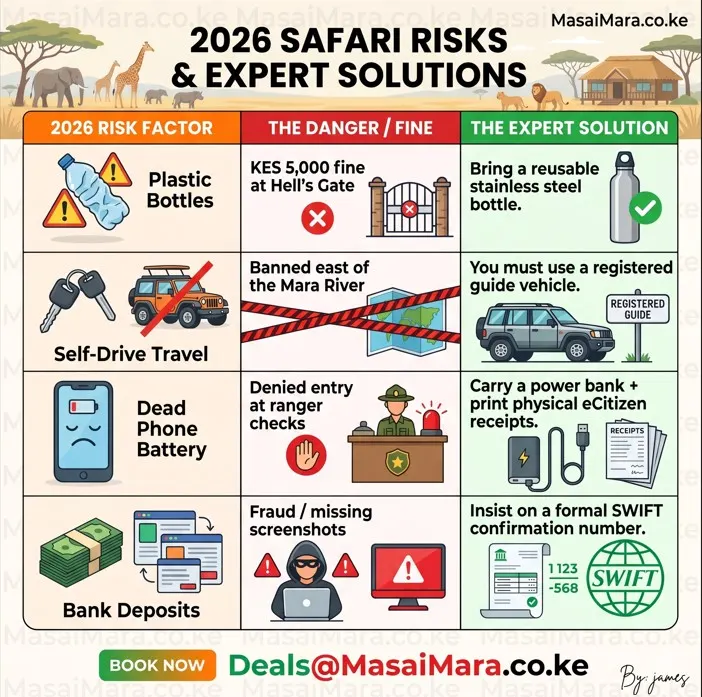
| 2027 Risk Factor | The Danger Or Fine | The Expert Solution |
|---|---|---|
| Plastic Bottles | Single-use plastics are banned in the parks | Use the reusable bottles we refill in the vehicle. |
| Kilimanjaro Cloud | The mountain hidden by mid-morning | Be out in Amboseli at 6 AM. |
| Three Fee Systems | Confusion at the gates | KWS, Narok County and Crescent Island, all paid before you arrive. |
| 10 AM Mara Rule (Inside Camps) | An extra day’s park fee | No game drive on your last morning. |
- Inbound Travel Health Insurance. From 5 October 2026, every non-Kenyan visitor staying under three months must buy Kenya’s inbound travel health insurance online before arriving, children included. It costs up to USD 44 per person and covers up to USD 50,000 for medical care and emergency evacuation. Buy it together with your eTA, because cover only starts once the policy is issued. Kenyan citizens, residents and East African Community nationals are exempt.
- Kilimanjaro Before 10 AM. The clearest views of the mountain come at dawn. Plan your best Amboseli photographs for the first three hours of the day.
- Boat Safety At Naivasha. Keep your life jacket on, stay seated, and never ask the skipper to get closer to the hippos.
- Plastic-Free Parks. Single-use plastics are banned in Kenya’s protected areas. Bring a reusable bottle, and we refill it from the water in the vehicle.
- South Lake Road Lights. The greenhouses on the South Lake Road throw a lot of light into the night sky, so Naivasha is not the place for stars. The darkest skies on this trip are in Amboseli and the Mara.
- Mau Honey. On the drive from Nakuru to the Mara over the Mau, look for roadside sellers with honey from the Mau Forest, including stingless-bee honey, which is thin and citrusy. It makes a good edible souvenir.
- The Right Mara Gate. We use the gate nearest your camp, usually Sekenani, Talek or Oloolaimutia. Sarova Mara Game Camp is inside the reserve, under 10 minutes from Sekenani Gate.
- The 10 AM Mara Exit. If your Mara camp is inside the reserve, you must leave by 10 AM on the day you go home. There is no game drive that morning. Camps outside the reserve have no exit deadline.
- One Guide, Four Parks. The same guide drives you all week, and he knows all four parks. Ask for his name in your booking confirmation.
- Quick Stops On Road Days. On long transfer days we stop for fruit, snacks, a stretch and a memory card if you need one. A guide who refuses every stop because he is behind schedule is looking after himself, not you.
- Families With Young Children. This circuit works well for families. Crescent Island lets children walk among giraffes, and the Naivasha boat breaks up the driving. Tell us the children’s ages when you book so we can plan the pace.
- Paying Your Deposit. If you pay by bank transfer, ask your bank for the formal transfer confirmation, not just a screenshot of the form. Carry small KES notes and use M-Pesa for tips and roadside stalls.
The Long Lunch That Nearly Cost the Boat
A family on this circuit asked to stop for a long lunch in Nairobi on the way from Amboseli to Naivasha. It looked like an easy break on a long day. I told them the boat on Naivasha runs best in the early afternoon, before the wind picks up on the lake, and that a sit-down lunch in the city would put us on the water late.
We compromised on a quick coffee stop and lunch at the lodge on the lake. We were on the boat by half past two, with the water calm, a fish eagle taking a fish twenty metres from the bow, and time for Crescent Island before the light went. The next day the father told me the boat had been his favourite afternoon of the trip.
On a four-park circuit, the road days are planned to the hour so that every afternoon ends in a park, not in traffic. If your guide asks you to keep a stop short, it is usually because the boat, the gate or the light will not wait.
2027 Park Fees
Amboseli and Lake Nakuru are KWS parks, with tickets that run 24 hours from entry. The Mara is run by Narok County and charges per calendar day, 6 AM to 6 PM. Crescent Island is a private sanctuary.
Non-Residents (USD)
| Park | Adult | Child |
|---|---|---|
| Amboseli | 90 | 45 (5 to 17) |
| Lake Nakuru | 90 | 45 (5 to 17) |
| Crescent Island | 33 | 16 (5 to 15) |
| Masai Mara | 100 Jan-June, 200 July-Dec | 50 (9 to 17), under 9 free |
Kenyan Citizens (KES)
| Park | Adult | Child |
|---|---|---|
| Amboseli | 1,500 | 750 |
| Lake Nakuru | 1,500 | 750 |
| Crescent Island | 800 | 400 |
| Masai Mara | 1,500 Jan-June, 3,000 July-Dec | 300 / 500 |
Kenya Residents (KES)
| Park | Adult | Child |
|---|---|---|
| Amboseli | 2,025 | 1,050 |
| Lake Nakuru | 2,025 | 1,050 |
| Crescent Island | 1,100 | 550 |
| Masai Mara | 2,500 Jan-June, 4,500 July-Dec | 1,250 / 2,500 |
Tickets you use on this trip
| Park | 7 Days | 8 Days |
|---|---|---|
| Amboseli | 2 tickets, Days 1 to 3 | 2 tickets, Days 1 to 3 |
| Crescent Island | 1 entry, Day 3 | 1 entry, Day 3 |
| Lake Nakuru | 1 ticket, Days 4 to 5 | 1 ticket, Days 4 to 5 |
| Masai Mara | 2 tickets, Days 5 and 6 | 3 tickets, Days 5 to 7 |
KWS also charges a vehicle fee of about KES 1,500 a day.
Optional Naivasha extras (with a second Naivasha night)
| Extra | Cost |
|---|---|
| Hell’s Gate entry | Non-residents USD 50 adult / USD 25 child. Citizens KES 500 / 250. Residents KES 675 / 350 |
| Hell’s Gate cycling | USD 10 for non-residents, KES 300 for citizens and residents, per day, plus bike hire at the gate |
| Mount Longonot hike | Non-residents USD 50 adult / USD 25 child. Citizens KES 500 / 250. Residents KES 675 / 350 |
| Horse riding at Sanctuary Farm | Rides of different lengths, priced by the farm and included in your quote |
| Oserengoni night drive | Chui Lodge guests only, in your quote |
| Lake Elementaita Wildlife Sanctuary | Non-residents USD 50 adult / USD 25 child. Citizens KES 500 / 250. Residents KES 675 / 350 |
Every ticket is in your package price, and we buy them all before you arrive: Amboseli and Nakuru through KWS eCitizen, the Mara through the Mara online ticketing system with fees set by Narok County, and Crescent Island through the sanctuary. See our Masai Mara park fee page for the full rules.
Best Time To Visit
| Season | Amboseli | Naivasha And Nakuru | Masai Mara |
|---|---|---|---|
| January to March (dry) | Clearest Kilimanjaro mornings | Calm water, easy rhino tracking | Short grass, good for cats |
| April and May (long rains) | Green, the mountain often in cloud | Muddy tracks, very quiet | Mud, very few vehicles |
| July to October (dry) | Big herds at the swamps | Good rhino viewing, busy lake | The Great Migration |
| November and December (short rains) | Short showers, good light | Green, migrant birds arriving | Green plains, newborn animals |
Month by month detail is in our best time to visit guide.
Frequently Asked Questions
How much does a Masai Mara, Amboseli, Nakuru and Naivasha safari cost?
From USD 2,610 for international visitors and KES 193,000 for Kenyan citizens, per person sharing, on the 7-day route from January to June. The 8-day route starts at USD 3,030 / KES 222,000. Every price includes the vehicle, the guide, park fees, the Naivasha boat and Crescent Island, and full board. July to December prices are higher because Mara park fees double.
How many days do I need?
At least 7. Four parks in 5 or 6 days means too much time in the vehicle. Seven works well, and eight adds a second full day in the Mara. If you have less time, pick one of the three-park circuits instead.
Which order should I do the parks in?
Amboseli, Naivasha, Nakuru, then the Mara. You cross Nairobi only once, Naivasha breaks the longest drive in two, and you finish with the Mara. The other way round means a 9 to 10-hour drive from Amboseli to the Mara.
What documents and insurance do I need to enter Kenya?
Two things, both bought online before you fly: the Kenya eTA at USD 34, and, from 5 October 2026, Kenya’s inbound travel health insurance at up to USD 44 per person, children included. Kenyan citizens, residents and East African Community nationals are exempt from the insurance. The rules are new, so check the eCitizen page close to your departure.
What is the best month for this circuit?
July to October for the migration in the Mara. January and February are best for clear Kilimanjaro views and good birding on the Rift Valley lakes.
Is a 4×4 Land Cruiser mandatory?
Yes. The Nakuru and Mara tracks turn to deep mud after rain, and a minivan cannot handle them. Every private safari we run on this route uses a Land Cruiser.
How much are the 2027 park fees?
For non-residents, Amboseli and Lake Nakuru are USD 90 per adult, Crescent Island is USD 33, and the Masai Mara is USD 100 per adult from January to June and USD 200 from July to December. Citizen and resident rates are in the tables above. See our Masai Mara park fee page for the full rules.
Can I fly to save time?
Yes. You can fly from the Mara back to Nairobi at the end and save the 5 to 6-hour drive home. See our Masai Mara flying packages.
What should I pack?
Layers (Amboseli and the Mara are cold at dawn), a power bank, binoculars, your physical passport, closed-toe shoes for the Crescent Island walk, a reusable water bottle and a Safaricom SIM. Full list in our packing list.
Is this trip safe?
Yes. All four parks have rangers, your guide carries a radio and the lodges are well established. We drive in daylight only.
What I Would Tell You Before You Book
This circuit joins two of the most popular routes in Kenya into one trip. By the last day you will have watched elephants under Kilimanjaro, sat in a boat among hippos, walked with giraffes, found rhinos at Nakuru and followed lions through the Mara grass. It is more driving than a single-park trip, but most of my guests say the change from one park to the next was the best part.
If 7 days feels like too much, drop one park and look at the Masai Mara, Lake Nakuru and Lake Naivasha safari or the Masai Mara and Amboseli safari. For a shorter Mara-only trip, see our 5 days Masai Mara safari. Browse everything on our Masai Mara safari packages page.
Related Reading:
- 7 Days Masai Mara, Amboseli, Nakuru and Naivasha Safari
- 8 Days Masai Mara, Amboseli, Nakuru and Naivasha Safari
- Masai Mara, Amboseli and Lake Nakuru Safari
- Masai Mara, Lake Nakuru and Lake Naivasha Safari
- Masai Mara and Amboseli Safari
- Masai Mara and Lake Naivasha Safari
- Masai Mara and Lake Nakuru Safari
- 5 Days Masai Mara Safari
- Masai Mara Safari Packages
- Luxury Safari Masai Mara
- Masai Mara Flying Packages
- Masai Mara Migration
- Masai Mara Park Fees
- KWS Park Fee Portal
Written by David Njunge, TRA-licensed safari guide with over 10 years in the Masai Mara. Edited by Cess Wambui, travel consultant, BSc Tourism and Hospitality Management. Verified for the 2027 season.
Welcome to Masaimara.co.ke
Thank you for visiting us! We're excited to help you plan an unforgettable safari adventure across Kenya.