
Cottar's 1920s Camp: Rates, Reviews & Insider Tips (2027)
Cottar’s 1920s Camp at a glance
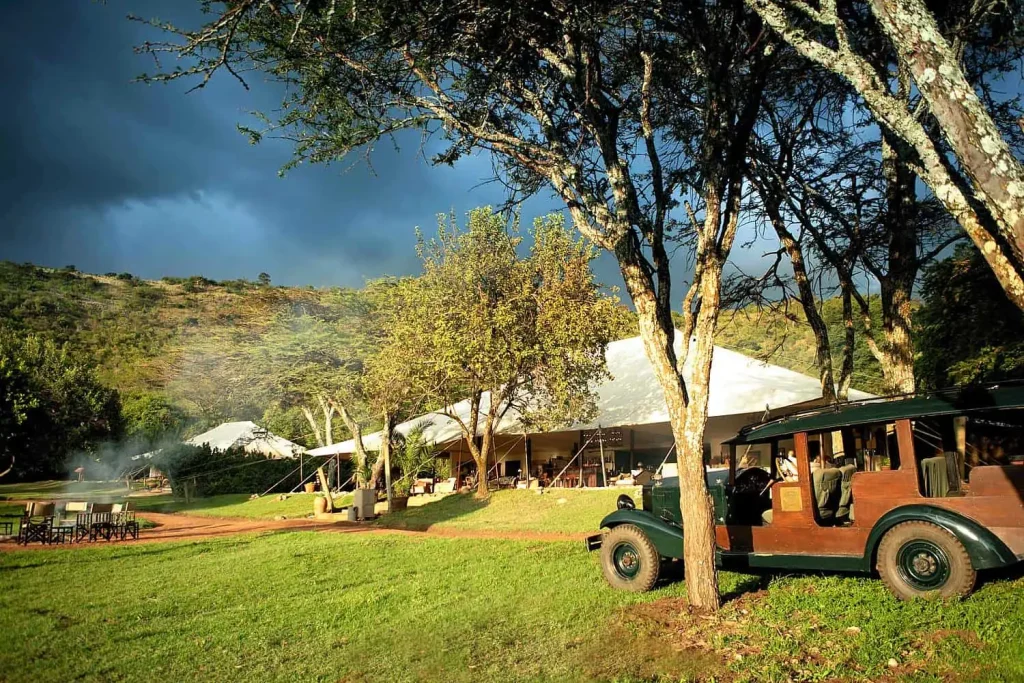
Cottar’s 1920s Camp is a fifth-generation family-run luxury safari camp in the private 7,608-acre Olderkesi Conservancy, bordering the Masai Mara National Reserve and Tanzania’s Serengeti. The Cottar family has run safaris in East Africa since 1919, which makes this one of the oldest continuously running safari operations on the continent. The camp has 11 tented suites (5 double, 4 family, 2 honeymoon) with original 1920s décor, butler service, and access to night drives and walking safaris. All-inclusive rates start at USD 1,150 (about KES 148,695) per person per night. Conservancy fees are extra, and Masai Mara park fees apply only on the days you drive into the reserve.
The Cottar Family Legacy
The Cottar family started leading safaris in East Africa in 1919. Five generations later, Calvin Cottar runs the operation with his wife Louise. This is documented history, not a marketing line, and it shapes everything about the camp.
Walking into the main mess tent feels like stepping onto a film set. Kerosene lanterns hang from the ceiling. Sepia photographs of early Cottar safaris line the canvas walls. A gramophone sits in the corner, and few people mention that it actually works. The staff will play it if you ask.
The camp operates only within the Olderkesi Conservancy, 7,608 acres of private land leased directly from Maasai families. Because it is a private conservancy and not part of the main reserve, you get night drives, walking safaris and off-road game viewing, none of which are permitted inside the Masai Mara National Reserve.
2027 Rates
Cottar’s 1920s Camp works on a “fully inclusive plus” model, which means most things are covered in your nightly rate.
Per person per night, sharing
Season | Dates | Rate (USD) | Rate (KES) |
Green/Private | Apr 1 to May 31 | USD 1,150 | KES 148,695 |
Mid | Jan 11 to Mar 31, Jun 1 to 14 | USD 1,500 | KES 193,950 |
Peak | Jun 15 to Oct 31 | USD 2,000 | KES 258,600 |
Private | Nov 1 to Dec 15 | USD 1,150 | KES 148,695 |
Festive | Dec 16 to Jan 10 | USD 2,000 | KES 258,600 |
Minimum stay: 2 nights.
A note on currency: Cottar’s sets its rates in US dollars. The shilling figures are worked out at about KES 129 to the dollar, so they will move a little with the exchange rate. We always invoice at the rate on the day you book.
What Is Included
- Full board (all meals, à la carte)
- House wines, beers, soft drinks and select spirits
- Two game drives a day or one full-day drive
- Night game drives within the conservancy
- Walking safaris with armed guides
- Maasai Warrior School for children
- Airstrip transfers (Cottar’s private airstrip or Keekorok)
- Canvas bush baths
- Cultural village transfers
- Laundry
- Nanny service
What Is Not Included
- Olderkesi Conservancy fee: USD 80 to 100 (KES 10,344 to 12,930) per adult a day depending on season, for every day you stay at camp
- Masai Mara park fees: USD 100 (KES 12,930) per adult a day from January to June, or USD 200 (KES 25,860) from July to December. These are set by the Narok County Government and apply only on the days you actually drive into the National Reserve. On days you stay on Olderkesi land for walks, night drives, e-bike rides or the Warrior School, you pay the conservancy fee only, which saves a family a good deal on a longer stay. Do not buy Mara tickets on the KWS eCitizen portal. They are not valid at the reserve gates, and we prepay the Narok County tickets for you.
- Premium champagne and luxury spirits: charged separately
- Cultural village entry: USD 20 (KES 2,586) per person
- Spa and massage treatments: from USD 50 (KES 6,465)
- Hot air balloon safari: USD 500 (KES 58,500) per person
- Exclusive vehicle use: USD 330 (KES 42,669) a day
- E-bike safari: USD 100 (KES 12,930) half day, USD 190 (KES 24,567) full day
- Calvin Cottar as private guide: USD 2,000 (KES 258,600) a day, when he is available
What Makes This Camp Different
The Location Philosophy
Cottar’s sits in the south-eastern corner of the greater Mara ecosystem, right on the Kenya-Tanzania border. This is forested, hilly country, quite different from the open plains most people picture when they think of the Masai Mara.
Wildlife is plentiful here. Lions are common. Buffalo, elephant, giraffe and zebra are all present. But this area is not known for big cats the way the northern Mara conservancies are. You might not see a leopard or a cheetah during your stay, and it is better to know that before you book.
What you do get is solitude. On one November visit, guests reported being the only people in camp for three days in a row. No other vehicles on game drives. Just wilderness. That is increasingly rare in the Mara.
The Vintage Aesthetic
This is not “vintage-themed.” The Cottars have collected original pieces over generations: dark wood furniture, oriental rugs worn soft by decades of use, brass lanterns, canvas director’s chairs, and steamer trunks that belonged to early safari-goers.
The tents open on three sides to the bush. Each has a separate lounge and bedroom, plus an en-suite bathroom with a claw-foot tub. Some tents have an outdoor canvas “bush bath,” and the staff will run you a hot bath under the stars.
The main area has a manicured lawn with a croquet pitch. Some guests find this charming. Others feel it is too much like a hotel and not rustic enough. If you want a wild camp where elephants walk past your breakfast table, Cottar’s may feel overly polished. If you want old-world elegance with serious wildlife access, it delivers.
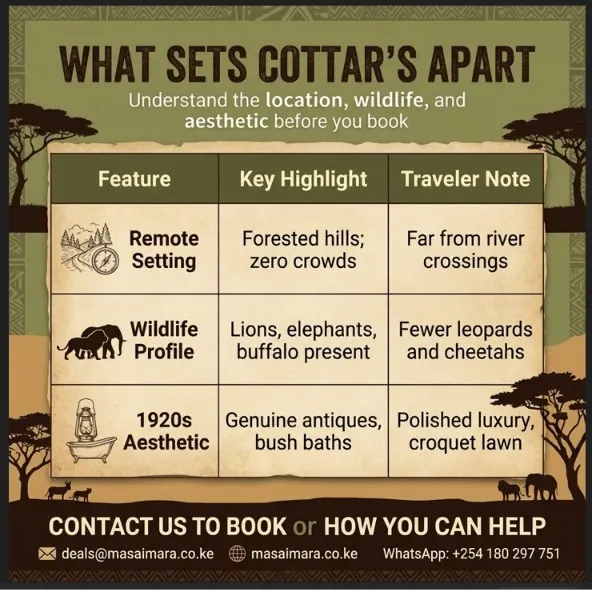
What Sets Cottar’s Apart
Understanding Cottar’s unique location, wildlife patterns, and vintage aesthetic helps determine if this historic luxury camp matches your safari expectations.
Feature | Key Highlight | Traveler Note |
Remote Setting | Forested hills; zero crowds | Far from river crossings |
Wildlife Profile | Lions, elephants, buffalo present | Fewer leopards and cheetahs |
1920s Aesthetic | Genuine antiques, bush baths | Polished luxury, croquet lawn |
Insider Tips Worth Knowing
The Airstrip Situation
Cottar’s has its own airstrip at Olderkesi, about 20 minutes from camp, but it is mainly used by private charter flights. Most scheduled flights land at Keekorok, the main airstrip for the southern Mara. That includes Safarilink and AirKenya from Nairobi’s Wilson Airport, and Mombasa Air Safari if you are flying in from Diani or Mombasa. From Keekorok it is a 1.5 to 2-hour game drive to camp.
When booking flights through Masaimara.co.ke, check which airstrip your flight uses. If you are landing at Keekorok, treat the transfer as a bonus game drive rather than just transport. Bags must be soft and no more than about 15 kg each. Our flying packages page explains how the flights work.
The Warrior School For Kids
This is not a typical kids’ club where children watch films while their parents go on safari. The Maasai Warrior School teaches traditional skills: tracking animals by footprints and dung, making fire, basic archery, identifying plants, and Maasai traditions.
Children receive a certificate at the end. It keeps older children busy and interested, and it gives parents time at the spa or on a walking safari.
Family-Style Dinners
Unlike most luxury camps, where you dine at a private table, Cottar’s serves dinner family-style with the hosts and guides. You will eat with Douglas, the camp director, or with your guide, and swap stories from the day’s drives.
Some guests love this. Others prefer privacy. Know which kind of guest you are before you go.
The Temperature Drop
The Olderkesi Conservancy sits higher than much of the Mara, and the nights get properly cold. Temperatures can fall to 10°C or lower in the dry season. Pack layers. The camp puts hot water bottles in the beds, but bring a fleece or jacket for evening drinks around the fire. Our packing list has the rest.
The Migration Factor
The Great Migration passes through this area, but Cottar’s location means you are not at the famous Mara River crossing points. From July to October you will see wildebeest and zebra in the conservancy, but reaching the river crossings takes long drives.
If the crossings are your priority, consider combining Cottar’s with a camp closer to the Mara River, such as one in the Mara Triangle or Mara North Conservancy.
Safari Packages With Pricing
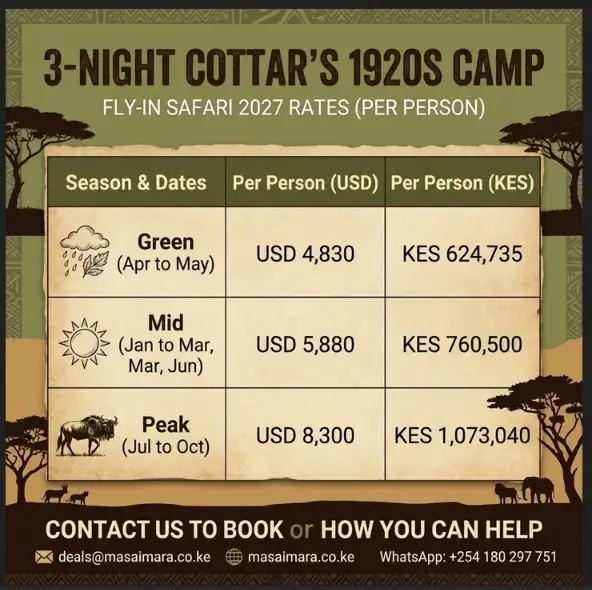
All packages arranged through Masaimara.co.ke include accommodation, meals, drinks, game drives, transfers, and park and conservancy fees unless noted.
3-Night Cottar’s 1920s Camp Fly-In Safari
Season | Per person (USD) | Per person (KES) |
Green (Apr to May) | USD 4,830 | KES 624,735 |
Mid (Jan to Mar, Jun) | USD 5,880 | KES 760,500 |
Peak (Jul to Oct) | USD 8,300 | KES 1,073,040 |
Itinerary
Day 1: Fly from Nairobi Wilson to Keekorok, or to Cottar’s own airstrip if we book you a charter. Game drive to camp. Settle into your tent. Afternoon game drive. Sundowner in the bush. Family-style dinner with the guides.
Day 2: Early morning game drive. Back for breakfast. Mid-morning at leisure (spa, pool, croquet). Afternoon game drive with a sundowner. Optional night drive after dinner.
Day 3: Walking safari at dawn. Breakfast. Full-day game drive with a bush lunch. Evening around the fire.
Day 4: Morning bush bath. Breakfast. Fly back to Nairobi.
Included
- 3 nights all-inclusive at Cottar’s 1920s Camp
- Return scheduled flights Nairobi to Keekorok, with the transfer to camp
- All game drives, night drives and a walking safari
- Park fees (3 days)
- Conservancy fees (3 days)
- Laundry
Not included
- Hot air balloon: USD 500 (KES 58,500) per person
- Premium spirits and champagne
- Spa treatments
- Tips: about USD 15 to 25 (KES 2,000 to 3,000) a day
4-Night Multi-Destination: Lake Naivasha And Cottar’s
For guests who want variety: hippos, flamingos, and then the Mara.
Season | Per person (USD) | Per person (KES) |
Mid season | USD 7,090 | KES 916,500 |
Peak season | USD 9,505 | KES 1,229,040 |
Itinerary
Day 1: Leave Nairobi. Drive to Lake Naivasha (2 hours). Lunch. Afternoon boat safari on the lake, with hippos, fish eagles and pelicans. Overnight at a lakeside lodge.
Day 2: Morning walk in Hell’s Gate National Park or on Crescent Island. Afternoon transfer to Cottar’s. Check into Cottar’s 1920s Camp. Sunset game drive.
Days 3 to 4: The full Cottar’s experience: game drives, night drives, a walking safari, and the Warrior School for children.
Day 5: Morning activity. Fly back to Nairobi.
Alternatives By Budget
Cottar’s suits luxury travellers looking for heritage and exclusivity. Here are alternatives at different price points:
Budget | Camp | Per night (USD) | Per night (KES) | Notes |
Luxury Plus | Cottar’s 1920s | 1,150 to 2,000 | 148,695 to 258,600 | Fifth generation, private conservancy |
Luxury | 890 to 1,300 | 115,336 to 168,349 | Escarpment views, contemporary | |
Luxury | Mara Bushtops | 1,120 to 1,870 | 144,816 to 241,791 | Salt lick, all-inclusive |
Mid-Range | 185 to 350 | 24,179 to 45,384 | Inside the reserve | |
Budget | 110 to 220 | 14,482 to 28,574 | Simple and authentic |
For more options, see our Masai Mara camps guide and our luxury safari page.
The Guides And Staff
Cottar’s employs some of the highest-rated guides in the Mara. Several hold KPSGA Gold certification, the highest professional guiding qualification in Kenya.
Douglas is the camp director and also guides. Guests regularly describe him as exceptional: engaging, funny and very knowledgeable. He has been with Cottar’s for years and knows the conservancy inside out.
Letaru guides with an assistant named Defender. They work as a tracking team, and guests mention their patience and their knowledge of the animals.
Mako is another senior guide. One guest described their first lunch with Mako as “a wonderful way to get to know him and the experience we were about to have.”
Sara looks after room service and has a reputation for going beyond what is expected, from outdoor bubble baths to special touches for honeymooners.
Calvin Cottar himself occasionally guides guests, at a premium of USD 2,000 (KES 258,600) a day. As a fifth-generation safari operator and one of Kenya’s most respected conservationists, having Calvin as your guide is a rare experience for those who can afford it.
The guides will ask what you want to see. Be specific. If Big Five photography is your goal, they will adjust. If you want to focus on birds or smaller species, they will do that too. Private game drives in a private conservancy make that flexibility possible.
Concerns Worth Considering
The Distance To River Crossings
If your main goal is to see wildebeest crossing the Mara River, Cottar’s location in the south-eastern Mara is not ideal. You can still reach the crossing points, but it takes long drives. Consider a night or two at a camp in the Mara Triangle or Mara North as well, for the full migration experience.
The Price Point
At USD 2,000 (KES 258,600) per person per night in peak season, plus conservancy and park fees, Cottar’s is among Kenya’s most expensive camps. A 3-night peak season stay for two costs roughly USD 16,000 (KES 2.1 million) before flights and extras. That is a serious amount of money.
However, the all-inclusive model means few surprise charges. Unlike some camps where premium drinks add up quickly, Cottar’s includes house wines, beers and select spirits. Whether it is good value depends on what matters most to you.
The Hotel-Like Feel
Some safari purists find Cottar’s too manicured. The croquet lawn. The polished service. The formal pattern of meals. It feels more like an Out of Africa film set than a rugged bush camp.
If you want raw wilderness where elephants wander through camp and nothing feels arranged, Cottar’s might not satisfy you. If you want vintage elegance with professional service and serious wildlife access, it delivers.
Leopard And Cheetah
The Olderkesi Conservancy is excellent for lions and plains game. But leopards and cheetahs are less common here than in the northern conservancies. Guests report great lion sightings but sometimes go a whole stay without seeing the shyer cats.
Frequently Asked Questions
Is Cottar’s 1920s Camp Inside The Masai Mara National Reserve?
No. It is in the private Olderkesi Conservancy, about 1 km from the reserve boundary. That is why night drives and walking safaris are possible, as neither is permitted inside the reserve.
How Do I Get To Cottar’s?
Most guests take a scheduled flight from Nairobi Wilson to Keekorok airstrip, then a 1.5 to 2-hour game drive to camp. Cottar’s own airstrip, 20 minutes from camp, is mainly for charter flights. By road from Nairobi it takes about 5 to 6 hours. Flying is recommended.
Is Cottar’s Good For Families?
Yes. Family tents sleep parents and children together. The Maasai Warrior School keeps older children busy with tracking, archery and Maasai traditions. Children under 5 stay free, and a nanny service is included.
What Is The Best Time To Visit Cottar’s?
For the migration: July to October. For lower rates and fewer guests: April and May, the green season. For a balance of good weather and value: November and December. See our best time to visit guide for the month by month picture.
Can I See The Great Migration From Cottar’s?
Yes. Wildebeest and zebra move through the conservancy in the migration months. But the famous river crossing points are some distance away. For crossings, combine Cottar’s with a camp closer to the Mara River.
What Is The Difference Between Cottar’s 1920s Camp And The Bush Villa?
The 1920s Camp has 11 tents that share a central mess area. The Bush Villa is a separate, private villa with its own pool, ideal for groups who want complete privacy.
Do I Need To Tip?
Tips are not included but are expected. Budget about USD 15 to 25 (KES 2,000 to 3,000) per person per day, shared among the guides, room staff and camp staff when you leave.
Related Reading
- Luxury safari Masai Mara
- Masai Mara flying packages
- Best time to visit Masai Mara
- Hot air balloon safari
- Masai Mara camps
- Game drives Masai Mara
- Masai Mara park fees
- Animals in Masai Mara
Plan Your Cottar’s Safari With Local Experts
Cottar’s 1920s Camp offers something increasingly rare: a real connection to safari history, combined with serious wildlife access in a private conservancy. The price is high. The experience matches it. For travellers who value heritage, exclusivity and family-style warmth over constant action, Cottar’s remains one of East Africa’s most distinctive camps.
With only 11 tents, the camp fills up early for July to October, often many months ahead. Tell us your dates, how many of you are travelling and how you would like to fly in. Our team at Sekenani will check availability with the camp and send a clear, itemised quote with the conservancy fees, any reserve days and your flights included.
- Email: [email protected]
- WhatsApp: +254 180 297 751
- Online booking: Get a Quote
Official resources: Cottar’s Safaris official website and the Narok County Government, which sets the Masai Mara park fees.
Written by David Njunge, TRA-licensed safari guide with over 10 years in the Masai Mara. Edited by Cess Wambui, travel consultant, BSc Tourism and Hospitality Management. Verified for the 2027 season.
Welcome to Masaimara.co.ke
Thank you for visiting us! We're excited to help you plan an unforgettable safari adventure across Kenya.