
7 Days Masai Mara, Amboseli And Tsavo Safari: 2027 Prices
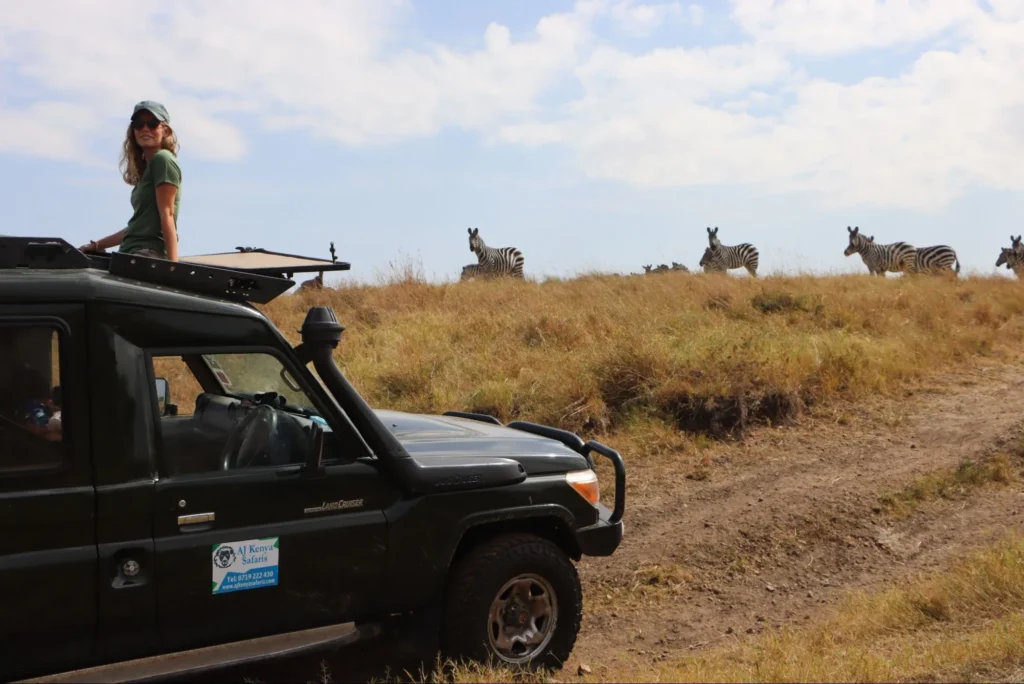
A 7-day Masai Mara, Amboseli and Tsavo safari runs from the Mara’s gold grass to Amboseli’s white dust and Tsavo’s red soil. For 2027 it costs from USD 3,520 or KES 285,000 per person sharing, including the Mara to Amboseli flight, two guides, park fees and full board.
7-Day Masai Mara, Amboseli And Tsavo Safari Costs (2027)
This is the 7-day version of our Masai Mara, Amboseli and Tsavo safari circuit. For an extra day in the Mara, see the 8-day option.
Prices are per person, two people travelling together, and include the scheduled flight from the Mara to Amboseli. Kenyan citizen prices are not the dollar price converted. Citizens and residents pay much lower park fees and lodge rates, and the prices are worked out from those.
International Visitors (USD)
| Tier | Lodges (Mara + Amboseli + Tsavo West + Tsavo East) | Jan-June | July-Dec |
|---|---|---|---|
| Budget | Jambo Mara + AA Lodge Amboseli + Ngulia Safari Lodge + Voi Safari Lodge | 3,520 | 4,130 |
| Mid-Range | Sentrim Mara + Sentrim Amboseli + Severin Safari Camp + Ashnil Aruba | 3,980 | 4,780 |
| Luxury | Mara Serena + Amboseli Serena + Kilaguni Serena + Satao Camp | 4,990 | 6,380 |
Kenyan Citizens (KES)
| Tier | Lodges (Mara + Amboseli + Tsavo West + Tsavo East) | Jan-June | July-Dec |
|---|---|---|---|
| Budget | Jambo Mara + AA Lodge Amboseli + Ngulia Safari Lodge + Voi Safari Lodge | 285,000 | 307,000 |
| Mid-Range | Sentrim Mara + Sentrim Amboseli + Severin Safari Camp + Ashnil Aruba | 320,000 | 353,000 |
| Luxury | Mara Serena + Amboseli Serena + Kilaguni Serena + Satao Camp | 391,000 | 470,000 |
Foreign nationals living in Kenya on a work or residence permit pay resident park fees, which sit between the dollar and shilling prices. Tell us when you book and we will quote you on resident rates.
Note: Peak prices apply from July to December, when Mara park fees double. Tsavo lodges are often better value than their Mara equivalents, so you can go a level up in Tsavo without stretching your budget. For higher-end camps, see our luxury safari Masai Mara options.
What Is Covered In The Price?
- Vehicles: A private 4×4 Land Cruiser with a pop-up roof in the Mara, and a second one waiting for you in Amboseli for the rest of the trip, with fuel for every transfer and game drive.
- Guides: Two TRA-licensed guides, one in the Mara and one who meets you in Amboseli and stays with you to the end.
- Flight: The scheduled flight from the Mara to Amboseli with Safarilink or Mombasa Air Safari.
- Park Fees: All 2027 entries. Amboseli, Tsavo West and Tsavo East are paid through KWS eCitizen, including the KWS vehicle fee. The Masai Mara is billed separately by Narok County.
- Accommodation: 6 nights full board, with packed lunches on full game drive days.
- Water: Drinking water in reusable containers, with extra reserves for Tsavo, where the distances are long.
- Cover: AMREF Flying Doctors evacuation cover.
- Excluded: Tips (USD 15 to 20 / KES 2,000 to 2,500 per day), alcoholic and soft drinks, the hot air balloon (USD 500 / KES 58,500), the Maasai village visit (KES 1,500 for citizens / USD 20 for non-residents), the SGR train if you choose it, international flights and the Kenya eTA (USD 34).
I have been guiding for ten years. This trip is a run through changing colours. You start in the gold of the Mara, move to the dusty white of Amboseli, and end in the blood-red soil of Tsavo. It is well over a thousand kilometres, and it is the trip that feels most like old Africa, because Tsavo is so empty you can drive for an hour without seeing another vehicle.
It is also a trip that runs on timing. The Ngulia rhino sanctuary opens for two hours a day. The Mara gates close at 6 PM. The flight to Amboseli leaves when it leaves. Get those right and everything else falls into place.
The 7-Day Itinerary
Two nights in the Mara, one in Amboseli, two in Tsavo West and one in Tsavo East. You get nine game drives: three in the Mara, two in Amboseli, three in Tsavo West and one in Tsavo East. There is no game drive on the morning you leave the Mara, Tsavo West or Tsavo East. The one exception is Amboseli, where the morning drive before the Tsavo transfer runs on the ticket you bought the afternoon before.
Pack soft from Day 1. You fly on Day 3, and light aircraft allow 15 kg per person in a soft duffel with no wheels or frames. Pack that way in Nairobi before you set off, and leave any extra luggage at your Nairobi hotel or tell us if you are ending at the coast.
Day 1: Nairobi To The Masai Mara, Afternoon Game Drive
We leave Nairobi at 7 AM, down the escarpment at Mai Mahiu and on through Narok on tarmac, about 5 to 6 hours. Lunch is at your camp at about 1:30 PM. If you want a Maasai village visit, the villages sit outside the reserve, so we go from about 2:30 to 3:45 PM and enter the gate at 4 PM for your first game drive, until the reserve closes at 6 PM. You lose no drive time.
Day 2: Full Day In The Masai Mara
Out at dawn with a picnic lunch, and we stay out, with the morning and afternoon drives run together. Mornings are for the lion prides and cheetahs on the move. From July to October we spend the middle of the day at the Mara River crossing points. This is your only full day in the reserve, so if you book the balloon, it takes your only dawn drive. Decide which matters more to you.
Day 3: Fly To Amboseli, Afternoon Game Drive
No game drive this morning. Your two Mara tickets covered Days 1 and 2. If you stay inside the reserve at Mara Serena, the drive to the airstrip is a closed-roof transit under the 10 AM exit rule. Jambo Mara and Sentrim Mara sit outside the reserve, and their flights go from airstrips outside the gates, so there is no ticket to buy that morning. After breakfast, your Mara guide drives you to the airstrip for the scheduled flight with Safarilink or Mombasa Air Safari. The flight lands in Amboseli at about 12:30 PM, and your second guide is waiting with his Land Cruiser. You check in, have lunch, and are out on your first Amboseli game drive by 2 PM, until the park closes at 6 PM. AA Lodge and Sentrim Amboseli sit outside the park, so on those tiers we leave through the gate before it closes.
Day 4: Morning In Amboseli, Transfer To Tsavo West
We are in the park by 6 AM, while Kilimanjaro is clear, for the swamps and the big tuskers. We drive until about 9:30 or 10 AM, then leave through Kimana Gate and cross the saddle between Kilimanjaro and the Chyulu Hills. After coming down off the volcanic Chyulu ridge, we enter Tsavo West at Chyulu Gate, about 2.5 to 3 hours in all. We pass the Shetani lava flow on the way in. Lunch is at your Tsavo West lodge, then an afternoon game drive.
Day 5: Full Day In Tsavo West
The busiest day of the trip. Mzima Springs in the morning, where an armed KWS ranger walks you down to the underwater viewing tank to watch hippos and fish below the surface. Then Roaring Rocks for the view, and a picnic lunch. The afternoon is planned around the Ngulia Rhino Sanctuary, which opens to visitors only from 4 PM to 6 PM. That window is your one real chance at a black rhino on this trip, so we are at the gate when it opens.
Day 6: Tsavo West To Tsavo East, Afternoon Game Drive
No game drive this morning. After breakfast we leave through Tsavo River Gate, beside the river where the man-eaters hunted in 1898, cross the highway and the railway, and enter Tsavo East at Manyani Gate, about 2.5 to 3 hours. That keeps us on park tracks and off the truck traffic of Mombasa Road. We drive straight to your Tsavo East lodge for lunch and a rest through the midday heat, when the animals are deep in the bush anyway. The afternoon drive takes us to Mudanda Rock from about 3:30 to 4:30 PM, when the rock has cooled and the red elephants come in to drink at the pool below, then on to Aruba Dam and the Kanderi Swamp for the lions that hunt the buffalo there.
Day 7: Tsavo East To Nairobi, Or On To The Coast
No game drive this morning. Breakfast, then out through Voi Gate. You have three ways home:
- By road to Nairobi: about 5 to 6 hours on Mombasa Road. If you are flying out the same day, book a flight that leaves after 9 PM, because the road through Athi River often jams with trucks.
- By SGR train from Voi: Voi station is a short drive from the gate. The Madaraka Express takes you to Nairobi Terminus at Syokimau, close to JKIA, and skips the highway. Seats are limited, so book on the Kenya Railways site as soon as booking opens.
- To the coast: the train from Voi reaches Mombasa in under two hours, or we drive you to Diani Beach in about 3 to 4 hours. See our Masai Mara and Diani Beach packages.
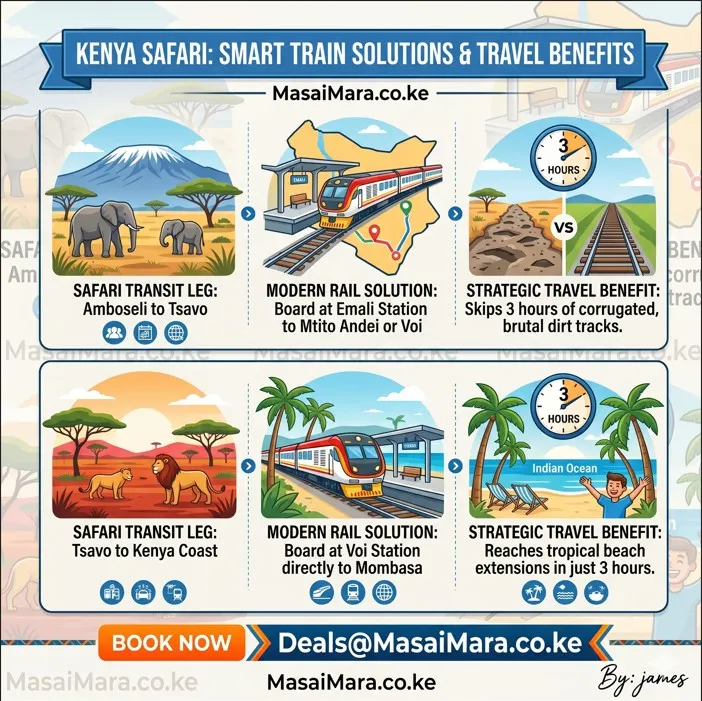
|
Safari Transit Leg |
Modern Rail Solution |
Strategic Travel Benefit |
|
Amboseli to Tsavo |
Board at Emali Station to Mtito Andei or Voi |
Skips 3 hours of corrugated, brutal dirt tracks. |
|
Tsavo to Kenya Coast |
Board at Voi Station directly to Mombasa |
Reaches tropical beach extensions in just 3 hours. |
The Route And Drive Times
| Leg | Route | Time |
|---|---|---|
| Nairobi to the Masai Mara | Mai Mahiu, Narok and the tarmac to the reserve | 5 to 6 hours |
| Masai Mara to Amboseli | Scheduled light-aircraft flight | Lands about 12:30 PM |
| Amboseli to Tsavo West | Kimana Gate, the Chyulu saddle, Chyulu Gate | 2.5 to 3 hours |
| Tsavo West to Tsavo East | Tsavo River Gate, across the highway, Manyani Gate | 2.5 to 3 hours |
| Tsavo East to Nairobi | Voi, then Mombasa Road | 5 to 6 hours |
Amboseli’s Old Tusker Swamps
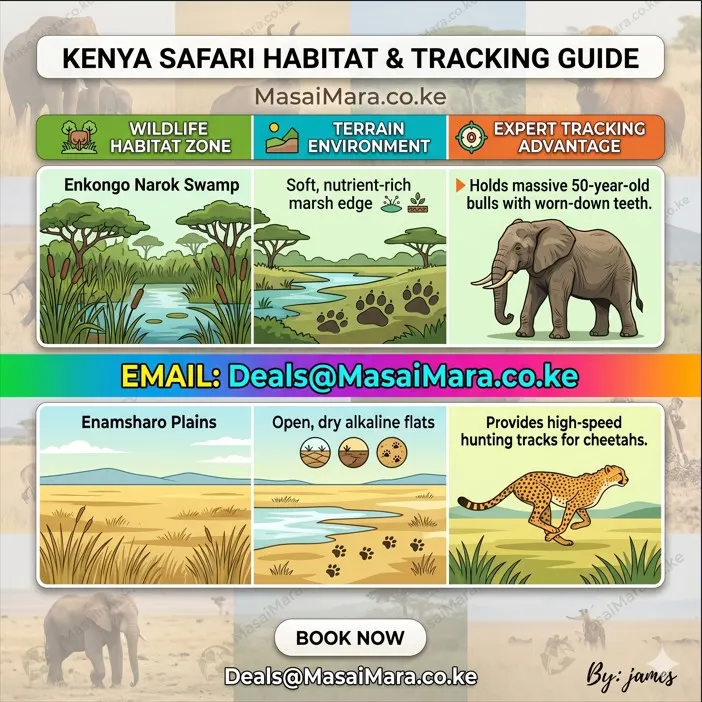
|
Wildlife Habitat Zone |
Terrain Environment |
Expert Tracking Advantage |
|
Enkongo Narok Swamp |
Soft, nutrient-rich marsh edge |
Holds massive 50-year-old bulls with worn-down teeth. |
|
Enamsharo Plains |
Open, dry alkaline flats |
Provides high-speed hunting tracks for cheetahs. |
Most Masai Mara and Amboseli safaris focus on the Kilimanjaro view. That is the Instagram shot. But the real Amboseli is in the swamps.
Enkongo Narok Swamp. Do not look for big elephants on the dry plains. The older bulls stay at the swamp edge because the vegetation is soft enough for their worn-down teeth. They are swamp-bound in old age. Park at the edge, switch off the engine and wait.
The super tuskers. Amboseli is one of the last places in Africa with super tuskers, bulls whose tusks each weigh more than 45 kg. The Amboseli Elephant Research Project has followed the same families since 1972, which is why they are so calm around vehicles.
Cheetahs. Lions own the swamps, so the cheetahs, when they are around, keep to the drier open plains. They are an occasional sighting here, not a sure thing.
Tsavo’s Red Elephants
People think Tsavo has its own breed of red elephant. It does not. The elephants coat themselves in iron-rich red soil, which works as sunscreen and keeps the insects off. After a dust bath they look rust-red from trunk to tail. The effect is strongest in Tsavo East. Do not wear white or light blue, because by Day 6 the red dust will be in your clothes for good. Call it your free Tsavo souvenir.
Mudanda Rock
This long ridge of bare rock, well over a kilometre end to end, catches rainwater in a pool at its base. In the dry seasons, July to October and January to March, elephants and buffalo come in their hundreds to drink, and you can walk up onto the rock to watch them from above. The bare rock gets very hot in the middle of the day, so we come in the late afternoon, from about 3:30 PM, when it has cooled and the herds arrive.
Mzima Springs
Crystal-clear spring water rises from under the lava here, and the underwater viewing tank lets you watch hippos move through it like slow-motion dancers. Look for the fish that clean the hippos’ skin. It is an ecosystem you cannot see from the surface. Hippos and crocodiles live along the banks, so an armed KWS ranger walks with every group. The path from the parking area runs through wild date palms and fig trees, a short walk of well under a kilometre. The springs pour out a huge volume of clear water every day, filtered through the lava of the Chyulu Hills. The walk and the escort are covered by your park ticket, and a tip of around KES 500 to 1,000 per group for the ranger is the custom.
The Galana River
Tsavo East’s Galana River holds some very big crocodiles. Lugard Falls, which is really a set of rapids squeezed through rock, is a good place to look for them. Most day-trippers from the coast never get this far.
Tsavo’s Dry-Country Specials
Tsavo has animals of the dry country that you will not see in the Mara or Amboseli. Here is what to look for:
- Fringe-eared oryx. A muscular desert antelope with long, straight, ringed horns and black tufts on the tips of its ears.
- Lesser kudu. A shy antelope of the thick bush, grey-brown with a dozen or so thin white stripes down its sides.
- Gerenuk. The “giraffe-gazelle”, which stands upright on its hind legs to browse thorny acacia twigs.
- Somali ostrich. Blue-grey neck and legs, where the Maasai ostrich in the Mara has pink ones.
The Shetani Lava Flow
Near the Chyulu Hills in Tsavo West lies a field of black lava only a couple of hundred years old, called Shetani, Swahili for “devil”. You can walk out onto it, but wear proper shoes, because the rock is razor sharp. Black rock, red soil and green bush all in one frame. Most operators skip it because it is “not wildlife”, but it sits right on our route on Day 4. If I hear a whoop from the mouth of the Shetani caves, we stay out. Hyenas use the lava tubes to keep cool.
Ngulia Rhino Sanctuary
The sanctuary is a fenced area of Tsavo West that protects black rhinos. It opens to visitors only from 4 PM to 6 PM. Arrive early and you wait at the gate. Arrive late and you have missed it. We plan Day 5 around that window.
Leopards at Ngulia Safari Lodge. If you are on the Budget tier, you sleep at Ngulia Safari Lodge, and that comes with a bonus. For decades the lodge has lit up the bush below its dining terrace in the evening, and leopards often come in after dark. You may well watch a wild leopard from your dinner table. It is never guaranteed, but it is one of the best chances of a leopard anywhere on this circuit.
The Man-Eaters of Tsavo
In 1898, two maneless lions killed a large number of the workers building the railway bridge over the Tsavo River. On Day 6 we leave Tsavo West right beside the river where it happened. If you care about history, ask me about the cave believed to have been the lions’ den. The lions themselves are in the Field Museum in Chicago.
13 Things to Know Before You Go
- Aruba Dam Birding. In the middle of the year, look for migrant bee-eaters near the water, flashes of green and bronze along the edge.
- The 10 AM Rule. If your Mara camp is inside the reserve, you must be out by 10 AM on the day you leave. On this trip that is Day 3, and the transit to the airstrip is well inside that time.
- End at the Beach. Tsavo East is the natural gateway to the coast. If your next stop is Diani or Mombasa, we leave through Voi instead of looping back to Nairobi.
- Red Dust and Cameras. Tsavo dust gets into everything. Wrap your camera in a pillowcase between sightings or your zoom ring may jam by Day 6.
- Vervet Monkey Raid. At the Amboseli lodges, lock your window pins before lunch. The monkeys watch you leave and then raid your room.
- No Night Drives in the Parks. Tsavo does not allow them. The LUMO Community Wildlife Sanctuary near Taita Hills does, and after dark you may see porcupines, bat-eared foxes and, with luck, an aardvark. It is paid locally.
- Extra Water. Distances in Tsavo are huge. I carry extra water well beyond the standard supply. Do not let a budget driver leave the gate with only three bottles.
- Gate Strategy. In August, the queue at Sekenani Gate can be long. We use whichever gate is closest to your camp, often Oloolaimutia.
- M-Pesa for Villages. Do not bring big dollar notes to a Maasai village. Use M-Pesa. It is easier for the community.
- Tsavo Expectations. In the Mara you see something every few minutes. In Tsavo you might go a long time between sightings. But when you find a red elephant herd, a big croc or a leopard, you have it to yourself.
- Two Guides, By Design. On this trip you change guide and vehicle once, at Amboseli airstrip. Get both guides’ names in your booking confirmation, and make sure nobody else swaps a vehicle in along the way.
- The Migration Window. From July to October, the Mara River crossing is the single most dramatic wildlife event on this circuit, which is one more reason the Mara comes first.
- Kilaguni Serena. Opened in 1962, it is one of Kenya’s original safari lodges. The waterhole draws elephants and buffalo in the evening. If you stay there, sit on the terrace at 5:30 PM with a cold Tusker. That is the real sundowner.
Why I Do Not Take Shortcuts Near the Chyulu Hills
I once guided a group on a Masai Mara and Amboseli safari who wanted a “scenic shortcut” near the Chyulu Hills in May. I told them the soil was black cotton. They said it looked fine from the vehicle.
Ten minutes later, the Land Cruiser was axle-deep. We spent four hours digging out while a leopard watched us from a rock. On this trip, we have time to go the long way and stay dry. When the soil changes colour, the conversation is over.
2027 Park Fees
The Mara is run by Narok County and charges per calendar day, 6 AM to 6 PM. Amboseli, Tsavo West and Tsavo East are KWS parks, with tickets that run 24 hours from entry. Tsavo West and Tsavo East are separate parks with separate tickets.
Non-Residents (USD)
| Park | Adult | Child |
|---|---|---|
| Masai Mara | 100 Jan-June, 200 July-Dec | 50 (9 to 17), under 9 free |
| Amboseli | 90 | 45 (5 to 17) |
| Tsavo West | 80 | 40 (5 to 17) |
| Tsavo East | 80 | 40 (5 to 17) |
Kenyan Citizens (KES)
| Park | Adult | Child |
|---|---|---|
| Masai Mara | 1,500 Jan-June, 3,000 July-Dec | 300 / 500 |
| Amboseli | 1,500 | 750 |
| Tsavo West | 1,000 | 500 |
| Tsavo East | 1,000 | 500 |
Kenya Residents (KES)
| Park | Adult | Child |
|---|---|---|
| Masai Mara | 2,500 Jan-June, 4,500 July-Dec | 1,250 / 2,500 |
| Amboseli | 2,025 | 1,050 |
| Tsavo West | 1,350 | 675 |
| Tsavo East | 1,350 | 675 |
KWS also charges a vehicle entry fee of about KES 1,500 a day for a safari Land Cruiser. Every ticket is in your package price. On this trip you use:
- Masai Mara: two calendar-day tickets, Days 1 and 2. On Day 3 there is no game drive. Mara Serena guests reach the airstrip on the 10 AM closed-roof transit, and guests at outside camps fly from airstrips outside the gates.
- Amboseli: one 24-hour ticket from about 1:30 PM on Day 3, covering the afternoon drive and the Day 4 morning drive until you leave at about 10 AM.
- Tsavo West: two 24-hour tickets. The first runs from your arrival on Day 4 to the middle of Day 5. The second covers the rest of Day 5, including Ngulia, the night and your exit on Day 6.
- Tsavo East: one 24-hour ticket from Manyani Gate on Day 6 to your exit through Voi Gate on Day 7.
Park fees change. Check Narok County and KWS eCitizen for the current rates, or see our Masai Mara park fee page.
Best Time To Visit
| Season | Masai Mara | Amboseli | Tsavo |
|---|---|---|---|
| January to March (dry) | Short grass, prime cat tracking | Clearest Kilimanjaro mornings | Hot, animals close to water |
| April and May (long rains) | Heavy mud, very few vehicles | Green, the mountain often in cloud | Lush, black cotton tracks soft |
| July to October (dry) | The Great Migration | Big herds at the swamps | Elephants at Mudanda and Aruba |
| November and December (short rains) | Green plains, newborn animals | Short showers, good light | Migrant birds, quieter lodges |
Month by month detail is in our best time to visit guide.
Frequently Asked Questions
How much does a 7-day Masai Mara, Amboseli and Tsavo safari cost?
From USD 3,520 for international visitors and KES 285,000 for Kenyan citizens, per person sharing, from January to June. That includes the flight from the Mara to Amboseli, two guides, all park fees and full board. July to December prices are higher because Mara park fees double.
Why do you fly from the Mara to Amboseli?
On this circuit that leg is always flown. The flight lands at about 12:30 PM, in time for lunch and a full afternoon drive, and your second guide meets you at the airstrip.
What is the best month for this safari?
July to October for the migration and for elephants at the Tsavo waterholes. January and February are best for clear Kilimanjaro views in Amboseli.
Is a 4×4 Land Cruiser mandatory?
Yes. A minivan cannot handle Tsavo’s corrugations or black cotton soil. Every safari we run on this route uses a Land Cruiser.
Can I finish the safari at the beach?
Yes, and this is where the route beats every other circuit. The Nakuru and Samburu loops send you back to Nairobi before you can fly to the coast. This one ends in Tsavo East, right on the coastal road. We drop you at Voi station for the train to Mombasa, under two hours, or drive you through the Kwale backcountry to Diani Beach in about 3 to 4 hours, with no airport connection and no domestic baggage limits.
How does this compare to the 8-day version?
The 8-day version follows the same route with a third night in the Mara, so you get two full days in the reserve. That means you can take the balloon and still keep a dawn drive, or give a whole day to a river crossing.
How does this compare to the Mara, Amboseli and Nakuru circuit?
The Masai Mara, Amboseli and Lake Nakuru safari swaps Tsavo for Lake Nakuru. Nakuru gives you easier rhinos in a small, fenced park. Tsavo gives you red elephants, the man-eaters history, underwater hippo viewing and total solitude.
What should I pack?
A soft duffel of 15 kg or less for the flight, layers, a power bank, binoculars (8×42), your physical passport, closed-toe shoes for the Shetani lava, dark clothes rather than white, and camera protection from the dust. Full list in our packing list.
Is this trip safe?
Yes. All the parks have rangers, your guides carry radios, and the lodges are well-established. We never drive the Nairobi to Mombasa highway after dark.
One Last Thing
This trip covers three parks that look nothing alike. Gold grass in the Mara. White alkaline dust in Amboseli. Blood-red soil in Tsavo. When you watch a rust-coloured elephant bull walk past your vehicle in complete silence, with no other cars, no engine noise, nothing but you and the bush, you will understand why some people do this trip twice.
If 7 days feels like too much, look at a 5-day Masai Mara safari or a 4-day Masai Mara safari. Want Nakuru instead of Tsavo? See our Masai Mara, Amboseli and Lake Nakuru safari.
Related Reading:
- Masai Mara, Amboseli and Tsavo Safari
- 8 Days Masai Mara, Amboseli and Tsavo Safari
- Masai Mara and Tsavo Safari
- Masai Mara, Tsavo and Mombasa Safari
- Masai Mara vs Tsavo
- Masai Mara and Amboseli Safari
- Masai Mara, Amboseli and Lake Nakuru Safari
- Masai Mara and Diani Beach Safari
- Luxury Safari Masai Mara
- Masai Mara Flying Packages
- Masai Mara Migration
- Masai Mara Park Fees
- KWS Park Fee Portal
Written by David Njunge, TRA-licensed safari guide with over 10 years in the Masai Mara. Edited by Cess Wambui, travel consultant, BSc Tourism and Hospitality Management. Verified for the 2027 season.
Welcome to Masaimara.co.ke
Thank you for visiting us! We're excited to help you plan an unforgettable safari adventure across Kenya.