
Saruni Eagle View: The 2027 Guide And Review
Saruni Eagle View at a glance
Saruni Eagle View, formerly Basecamp Eagle View, is an eleven-tent camp on an escarpment in the Naboisho Conservancy, above a salt lick and waterhole. It has an infinity pool, Wi-Fi in the tents, walks and night drives, and 2027 rates from USD 600 per person a night.
Saruni Eagle View sits on the edge of an escarpment in the Naboisho Conservancy, looking out over the Koiyaki plains north-east of the Masai Mara reserve. Right below the main area is a natural salt lick and waterhole, so the game comes to you between drives. It is the larger sister camp of Basecamp Wilderness, 3 km away.
Same Camp, New Name
If you know this camp as Basecamp Eagle View, you are looking at the same place. Saruni and Basecamp joined to form Saruni Basecamp, and the camp now trades as Saruni Eagle View. Older guidebooks, reviews and some booking sites still use the Basecamp name, so search for both when you read up on it.
The name is not the only change. The camp went through a major refurbishment and reopened in mid 2024 with redesigned interiors, a new infinity pool, a wellness space and a redesigned bar and lounge. This matters when you read reviews. Some older reviews from 2023 complain about the food, flies in the dining room and dark bathrooms. Those stays came before the rebuild, and reviews since then rate the camp far higher.
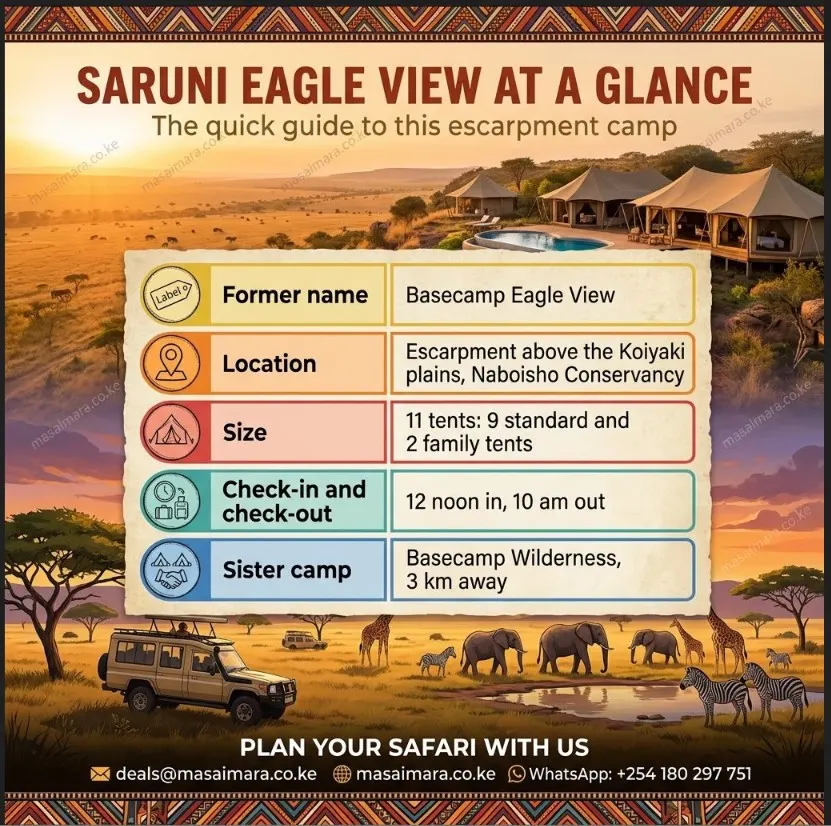
Saruni Eagle View | |
Former name | Basecamp Eagle View |
Location | Escarpment above the Koiyaki plains, Naboisho Conservancy |
Size | 11 tents: 9 standard and 2 family tents |
Check-in and check-out | 12 noon in, 10 am out |
Sister camp | Basecamp Wilderness, 3 km away |
The Tents, The Pool And The View
Eagle View has nine standard tents and two family tents, all raised on platforms facing the plains. Each standard tent has a king or twin beds, a private deck, a sunken bathtub, a hot shower and a bio-flush toilet. Guests describe the tents as closer to a hotel room than a bush tent, and several say they watched giraffe and eland from their deck without leaving the room.
A few tents are different from the rest, so ask for them by name when you book. The Honeymoon Tent has an extra outdoor shower and a private outdoor spa with two tubs and a massage area. One other tent has its own outdoor bathtub. Tent 5 sits near the main area and has very low stairs, so it is the one to ask for if steps are hard for you.
These are the details past guests mention that you will not find in the brochure.
The waterhole is the show. The salt lick and waterhole below the lodge draw animals all day, and there is a hippo pool in sight of the camp. At night you hear the hippos. One guest summed it up as sightings “without leaving your chair.”
The pool has little shade. The plunge pool by the bar has an infinity edge, looks across the savannah and is lit in the evening, but there are few umbrellas around it. Bring a hat and sunscreen for the middle of the day, and swim early or late.
Wi-Fi is in the tents. Unlimited internet in the tents is part of the rate. If you are combining this camp with Basecamp Wilderness, note that Wilderness has no pool, so Wilderness guests are brought here to swim.
A massage is already paid for. Every room gets one 30-minute back and neck massage per stay, in your tent, plus a yoga mat for your own practice. Further massages cost extra.
Early tea comes to you. Before the morning drive, tea, coffee and biscuits arrive at your tent at about 5:30 am. At night there is a hot water bottle in the bed, and staff walk you to your tent after dark, because the camp is unfenced.
The food has two choices. Each course comes with two options, one of them vegetarian, and guests on vegan diets say they were well looked after. On some days the kitchen serves traditional Kenyan dishes too.
What to expect | The reality | Tip |
Pool | Infinity pool facing the plains | Bring a hat, shade is limited |
Wi-Fi | Unlimited, in the tents | Included in the rate |
Massage | One 30-minute massage per room | Book it for your rest afternoon |
Nights | Cold in the dry season | Hot water bottles are provided |
Drives, Walks And What Guests Saw
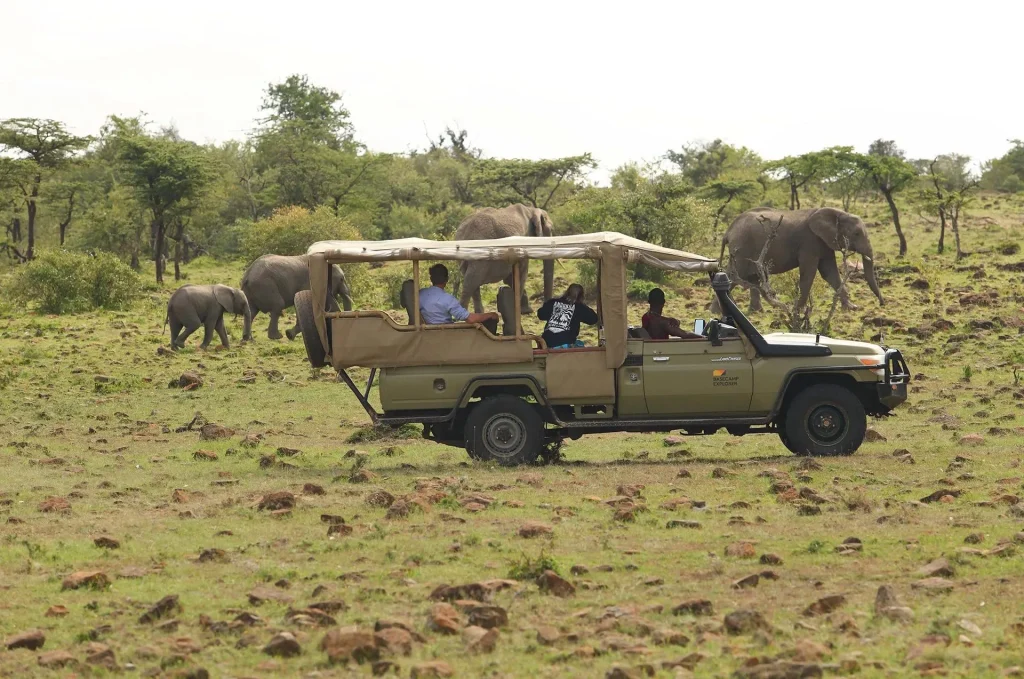
Game drives at Eagle View are shared, in open-sided 4x4s, and a private vehicle with its own guide costs USD 400 a day. Because the camp is in a private conservancy, night drives and walking safaris are included, and the guides can leave the track to get closer to a sighting. Walks are for guests aged 18 and over.
The guides know Naboisho well, and guests have praised several by name, among them Alfonso, Daniel, James and Kisemei. Drives start the moment you leave camp, and the lion count is high. One couple in 2025 saw lions on every drive, in an area where one pride had grown to about 36 lions. Naboisho has several resident prides, and the Mara Predator Conservation Programme tracks them by name, including the Ilkisiusiu, Moliban and Enesikiria prides. Ask your guide which pride is closest to camp that week. Other recent guests report a leopard hanging a kill in a tree, cheetah twice in three nights, a sundowner beside a hyena den and even a pangolin. Leopards and cheetahs both live in the conservancy all year.
For the big river crossings in the migration months, you can spend a day in the national reserve, entering through Talek Gate or Sekenani Gate. Plan for a long day. The main crossing points on the Mara River are a drive of about 2.5 to 3 hours from camp each way, so you spend 5 to 6 hours of the day on the road. A reserve ticket covers 6 am to 6 pm, so you need to be back in Naboisho before 6 pm. If the crossings are the main reason for your trip, pair Eagle View with a camp near the river, such as Serian Nkorombo, and save the drive.
The Narok County park fee for that day is USD 100 per adult from January to June and USD 200 from July to December, and USD 50 per child aged 9 to 17. That fee is added to the Naboisho conservancy fee, not charged instead of it, so an adult on a reserve day in August pays USD 350 in fees for that day. Reserve days also need a vehicle of your own. Saruni Basecamp charges exclusive use of the vehicle and guide on reserve visits, at USD 400 a day, on top of the park fees. For a couple in August, that is USD 400 in park fees plus USD 400 for the vehicle, or USD 800 for the day. Tickets from the KWS eCitizen portal are not valid at the Mara gates, so we prepay them for you.
Activity | Included? | Good to know |
Shared game drives | Yes | Private vehicle USD 400 a day |
Night drives | Yes | Not allowed in the reserve |
Walking safaris | Yes, aged 18 and over | Led by Maasai guides |
Maasai village visit | No, USD 30 a person | Book through the camp |
Balloon flight | No, USD 550 | Very early pick-up from Naboisho |
Families At Eagle View
Children of all ages are welcome, and the camp runs the Young Explorers Club, a programme of Maasai-led activities for children, listed on the 2027 rate sheet as the Warriors Academy. It is included in the rate but needs to be booked in advance. Children under 5 stay free when they share with their parents, and children aged 5 to 16 pay the child rate.
The two family tents are not the same. Family Tent 1 is two en-suite tents on separate platforms, linked by a short private terrace of about 7 metres. The Detached Family Tent has the same two tents, but the terrace between them is about 13 metres long. Each side has a king or twin beds and a sunken bathtub. Parents with young children usually prefer Family Tent 1, where the children sleep a few steps away, while families with teenagers often like the extra privacy of the detached one. Tell us which you want when you book. Both are priced per tent, for a minimum of four guests. One family in December 2025 loved the views from the standard tents but called the family tent “very disappointing”, so ask us for recent photos before you choose it.
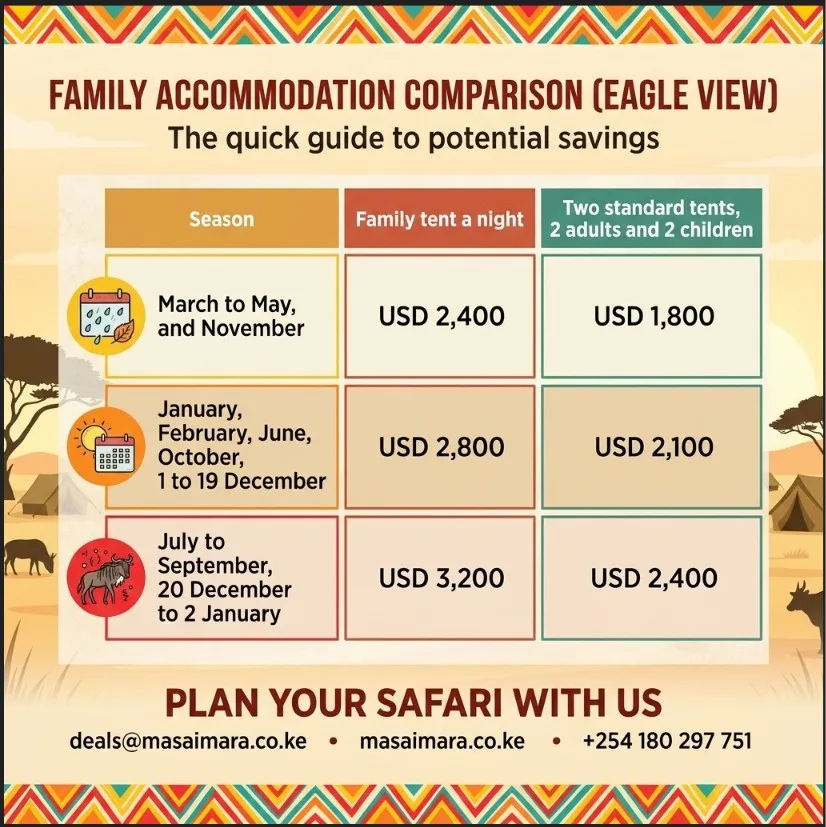
Here is a money tip most families miss. The family tent costs the same as four adults, because it is priced as a unit. A family of two adults and two children aged 5 to 16 could instead take two standard tents, each with one parent and one child, and pay the child rate for the children. At the published 2027 rates the difference looks like this:
Season | Family tent a night | Two standard tents, 2 adults and 2 children |
March to May, and November | USD 2,400 | USD 1,800 |
January, February, June, October, 1 to 19 December | USD 2,800 | USD 2,100 |
July to September, 20 December to 2 January | USD 3,200 | USD 2,400 |
Saruni Basecamp has the final say on how it bills a split family, so we confirm the figure with them before you book. The conservancy fee is the same either way: two adults at USD 150 each and two children at USD 75 each come to USD 450 a night. Add that to the camp rate and the total for the family looks like this:
- March to May, and November: USD 2,850 a night in the family tent, or USD 2,250 in two standard tents
- January, February, June, October and 1 to 19 December: USD 3,250 in the family tent, or USD 2,550 in two standard tents
- July to September and 20 December to 2 January: USD 3,650 in the family tent, or USD 2,850 in two standard tents
In the high season, that is a saving of USD 800 for every night you stay.
The camp is unfenced and wildlife walks through it, so it suits children who can follow the rules. For guests with limited mobility, ask for Tent 5. It is close to the main area and has very low stairs. Tell us when you book so we can reserve it for you.
Rates And What They Include
Saruni Eagle View costs USD 600 to 800 per person a night in 2027, two sharing. The Naboisho conservancy fee of USD 150 per adult a night is added on top, so the real cost is USD 750 to 950 per adult a night.
Months | Camp rate per person a night | With the conservancy fee, per adult |
March to May, and November | USD 600 | USD 750 |
January, February, June, October, 1 to 19 December | USD 700 | USD 850 |
July to September, 20 December to 2 January | USD 800 | USD 950 |
The last column is the number to budget with. There is no extra charge for Easter, Christmas or New Year beyond the high season rate. From July to September and over the festive season, the minimum stay is two nights. These are Saruni Basecamp’s official 2027 rates, valid from 3 January 2027 to 2 January 2028.
Guest | Camp rate a night | Conservancy fee a night |
Child under 5, sharing with parents | Free | Free |
Child aged 5 to 16, sharing | USD 300 to 400 | USD 75 |
Single traveller | USD 600 to 1,040 | USD 150 |
For one person travelling alone, the total with the conservancy fee is:
- March to May, and November: USD 750 a night (USD 600 camp rate plus USD 150 fee, no single supplement)
- January, February, June, October and 1 to 19 December: USD 1,060 a night (USD 910 plus USD 150)
- July to September and 20 December to 2 January: USD 1,190 a night (USD 1,040 plus USD 150)
Included: full board, soft drinks, house wines, selected beers and house spirits, bush meals, picnics and sundowners, tea and coffee in your tent, selected laundry, unlimited Wi-Fi in the tents, return airstrip transfers from Ol Seki (Naboisho) Airstrip, shared day and night game drives, a guided bush walk, one 30-minute massage per room per stay, a yoga mat, Young Explorers Club activities for children, a visit to Saruni Basecamp’s conservation and community projects, and VAT.
Not included: the Naboisho conservancy fee (USD 150 per adult and USD 75 per child aged 5 to 16 a night), premium spirits, champagne and premium wines and beers, extra massages, a private vehicle and guide (USD 400 a day), a Maasai manyatta visit (USD 30 per person), a late departure with an extra lunch (USD 180 per adult, USD 90 per child), Flying Doctors evacuation cover, park fees and vehicle costs on any day you go into the national reserve, balloon flights (USD 550), the Kenya eTA (USD 34) and tips for the staff (USD 15 to 20 a day). In our full packages, all conservancy and park fees are worked out and paid in advance.
Travel insurance is required. Saruni Basecamp asks every guest to carry travel and medical insurance that includes emergency evacuation cover.
Catching an evening flight? Check-out is at 10 am. If your flight leaves late in the day, the late departure with lunch costs USD 180 per adult, which is often cheaper than an extra night.
What Guests Want To Know
How Do I Get To Saruni Eagle View?
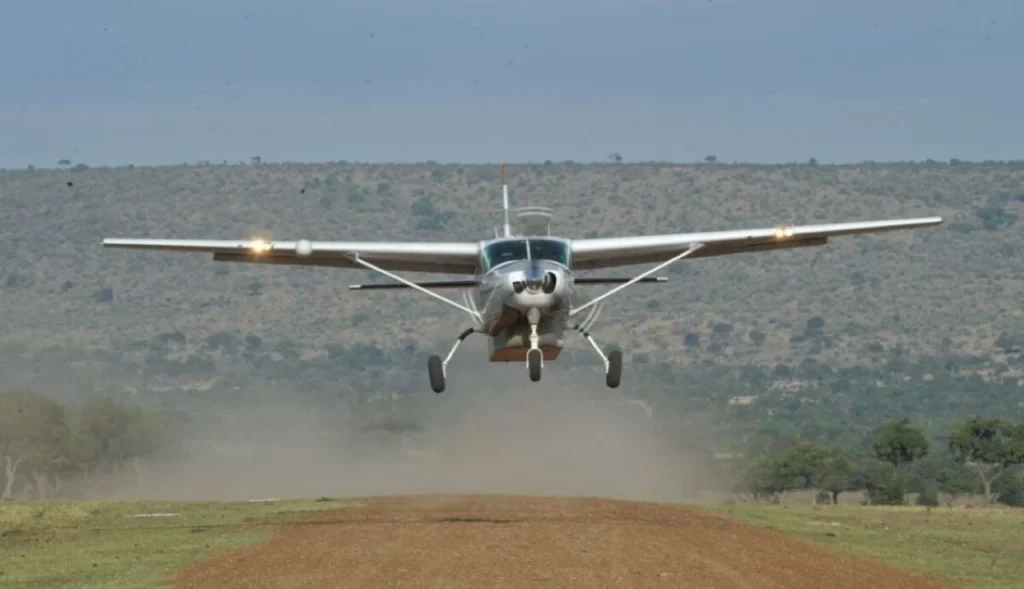
Fly from Nairobi’s Wilson Airport to the Ol Seki (Naboisho) airstrip, 45 to 60 minutes, where the camp vehicle meets you. The transfer turns into a game drive almost at once. The free transfer covers Ol Seki only. If you fly into another Mara airstrip, such as Keekorok or Mara North, the drive to Naboisho is long and charged separately, and if the route crosses the national reserve, the park fee applies for that day. We work out the best airstrip and quote the transfer before you book. Pack a soft duffel, because hard cases do not fit in the small planes and the weight limit is 15 kg. Our flying packages page explains how it works.
Is It The Same As Basecamp Wilderness?
No. Wilderness is the smaller, simpler sister camp 3 km away, with eight tents on the rim of Saddle Valley and no pool. Eagle View is larger, with bathtubs, a pool and the wellness space. You can walk between them with a guide, and some guests split their stay. See our Basecamp Wilderness guide.
How Does It Compare With Basecamp Masai Mara?
Basecamp Masai Mara is on the Talek River on the edge of the national reserve, where park fees apply every night and night drives are not allowed. Eagle View is inside a private conservancy, with fewer vehicles, night drives and walks.
Who Benefits From My Stay?
The land is leased from Maasai families who own it, and the conservancy fee you pay goes to the landowners and to conservation. About 96 percent of the camp’s staff come from the local Maasai community, and the camp is a member of The Long Run, a group of nature-based businesses held to conservation and community standards.
How Long Should I Stay?
Three nights gives you the drives, a night drive, a walk and an afternoon by the pool. In the high season two nights is the minimum. Add a night if you want a full day in the reserve for the crossings.
When Is The Best Time To Go?
The camp is open all year. July to September brings the migration and the highest rates. March to May and November are the cheapest months, with no single supplement, and the land is green after the rains. Our best time to visit guide has the month by month picture.
Plan Your Saruni Eagle View Safari
With eleven tents and only two family tents, Eagle View fills early for the migration and school holidays. Tell us your dates, how many of you are travelling and the children’s ages. Our team at Sekenani will check availability with Saruni Basecamp and send an itemised quote within 24 hours.
- Email: [email protected]
- WhatsApp: +254 180 297 751
- Online booking: Get a Quote
Related Reading
- Naboisho Conservancy
- Basecamp Wilderness
- Basecamp Masai Mara
- Walking safaris in Masai Mara
- Night game drives
- Masai Mara camps
- Masai Mara park fees
Sources
- Saruni Eagle View, the official page
- Saruni Basecamp, the official website, including the 2027 rates
- The Long Run
- Mara Predator Conservation Programme
- Narok County Government
Written by David Njunge, TRA-licensed safari guide with over 10 years in the Masai Mara. Edited by Cess Wambui, travel consultant, BSc Tourism and Hospitality Management. Verified for the 2027 season.
Welcome to Masaimara.co.ke
Thank you for visiting us! We're excited to help you plan an unforgettable safari adventure across Kenya.