
12 Days Kenya Safari: The Honest 2026 Guide
A 12 Days Kenya Safari is the full Kenya experience plus time to breathe. For the 2026/2027 season, expect all-inclusive rates for two people sharing to range from KES 795,000 ($6,115) to KES 2,150,000 ($16,540) per person. This covers a private 4×4 Land Cruiser, a TRA-licensed guide, all eCitizen park fees, and 11 nights of lodging. The natural structure is to split the trip: 6–8 days of safari in the north and south, then 4–6 days on the coast or across the border into Tanzania. That’s the difference between a 12-day trip that works and one that burns everyone out by Day 9.
12 Days Kenya Safari Costs (2026/2027)
Pricing reflects the updated park fees and the mandatory 4×4 Land Cruiser rates. These are all-inclusive prices for two people traveling together.
12-Day All-Inclusive Rates (Per Person Sharing)
Package Tier | Suggested Hotels | Regular (KES) | Peak (KES) |
Budget | Sentrim, Sweetwaters, Talek Bush Camp | KES 795,000 | KES 1,180,000 |
Mid-Range | Sarova, Ol Tukai, Ashnil Mara | KES 1,050,000 | KES 1,520,000 |
Luxury | Elephant Bedroom, The Cliff, Mara Serena | KES 1,480,000 | KES 1,920,000 |
Luxury Plus | Sasaab, Angama Mara, Tortilis Camp | KES 1,850,000 | KES 2,150,000 |
Book Now | Current Rates |
Note: Peak season is July–October during the wildebeest migration. If you want to fly one leg, check our Masai Mara flying packages. For a luxury safari upgrade, request a custom quote.
What’s Covered in the Price?
- Vehicle. Private 4×4 Safari Land Cruiser with pop-up roof.
- Guide. TRA-licensed guide for the full 12 days.
- Park Fees. All entries via eCitizen.
- Accommodation. 11 nights full board.
- Water. Bottled water in the vehicle.
Excluded. Tips (KES 3,500/day recommended), alcoholic drinks, hot air balloon ($450–$500), Ol Pejeta chimp tour ($40), Masai village visit (KES 4,500), international flights and Kenya eTA.
I’ve been guiding for ten years. A 12 Days Kenya Safari covers nearly 1,500 kilometres across ecosystems that share almost nothing in common. It’s a different kind of trip. By Day 8, you stop checking your phone. By Day 10, you forget what day of the week it is. That disconnection is the real point. But it only works if you don’t try to cram every park in Kenya into 12 days. Split it. Safari first, then coast or Tanzania. That’s how 12 days stays an adventure instead of becoming an endurance test.
The 12-Day Itinerary
Day(s) | Destination & Ecosystem | Primary Wildlife Target | David’s Route & Timing Secret |
Day 1 | Nairobi (Urban / Conservation) | Orphaned Elephants & Giraffes | Book the 11:00 AM Sheldrick slot months ahead; dine in Karen to completely bypass city traffic. |
Day 2–3 | Samburu National Reserve (Arid) | The “Special Five” & River Elephants | Scan the Doum Palms along the Ewaso Ng’iro River; leopards love these specific trees for cover. |
Day 4 | Meru National Park (Wet/Savanna) | Black & White Rhino | Use the morning for the secure Rhino Sanctuary. It gets zero crowds, allowing silent tracking. |
Day 5 | Ol Pejeta Conservancy (Laikipia) | Chimpanzees & Northern White Rhinos | Do not skip the night game drive here—it is your premier chance to spot servals and aardvarks. |
Day 6 | Lake Baringo & Lake Nakuru (Rift Valley) | Fish Eagles, Pelicans & Rhinos | Split the day: take the early morning boat ride at Baringo, then make the drive to Nakuru by midday. |
Day 7–10 | Masai Mara National Reserve (Savanna) | Big Cats & Migration Crossings | Leverage the 4-night stay for a “rest morning.” If visiting July–October, camp near the river banks. |
Day 11–12 | Amboseli OR Watamu Coast | Kilimanjaro Elephants OR Marine Life | If your beach extension exits via Tsavo East, choose Watamu over Diani for a quieter, closer finish. |
We start with the high-energy north, move through the Rift Valley, finish with the Mara, and then either head to Amboseli for Kilimanjaro or to the coast for rest.
Day 1: Nairobi Arrival
Start slow. David Sheldrick Wildlife Trust at 11 AM for the elephant orphans. Giraffe Centre in the afternoon. Dinner at The Talisman in Karen. Sleep in Nairobi.
Day 2–3: Samburu National Reserve
The Special Five. Elephants submerging in the Ewaso Ng’iro. Leopards in the Doum Palms. Two full days in a park with almost no other vehicles.
Day 4: Meru National Park
The Meru Rhino Sanctuary is the most secure in East Africa. Because it gets a fraction of the Mara’s traffic, you can spend an hour with a Black Rhino in total silence. See the Meru section below for Elsa’s Grave.
Day 5: Ol Pejeta Conservancy
The only place in Kenya to see chimpanzees. Baraka the blind rhino. Najin and Fatu, the last two northern white rhinos. Night game drives for servals and aardvarks.
Day 6: Lake Baringo and Nakuru
Morning boat ride at Lake Baringo for the Fish Eagle dive (see the Meru and Baringo section below). Afternoon rhino drive at Nakuru.
Day 7–10: Masai Mara
Four nights. Six game drives. Tracking lions, cheetahs, and leopards. If the migration is happening (July–October), we position near the Mara River crossing points. Four nights means we can afford a rest morning where you skip the 5:30 AM coffee and watch elephants from your porch.
Day 11–12: Amboseli or Watamu Coast
Two options. Fly to Amboseli for a Kilimanjaro finish with old elephants at the swamp edge. Or fly to Mombasa and drive south to Diani Beach or north to Watamu for snorkelling at Watamu Marine National Park and the Gede Ruins.
Why Meru and Baringo Belong on Longer Trips
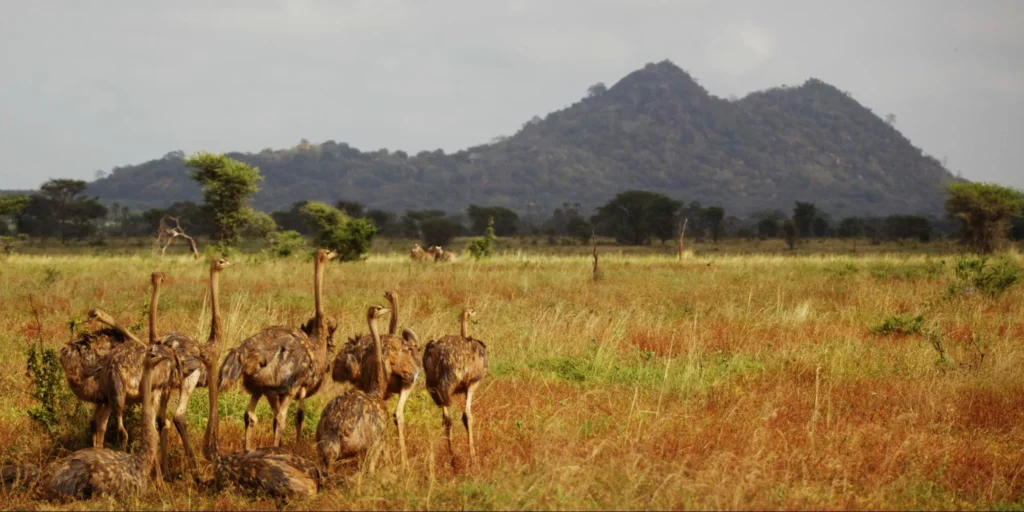
These two parks never fit on a 7- or 8-day trip. On 12 days, they do, and they’re worth the extra driving.
Meru has 13 rivers cutting through the park, which makes it feel nothing like the dusty Mara. Rivers cut through the park every few kilometres. The rhino sanctuary is fenced, guarded, and almost empty of tourists. You hear nothing but birds. Visit Elsa’s Grave on the southern border. It’s where Joy Adamson released the lioness from Born Free. It’s remote and quiet.
The Baringo whistle. When we boat on Lake Baringo, the Ilchamus captains use a specific high-pitched whistle while tossing a tilapia into the air. It triggers the African Fish Eagle to dive just three metres from the boat. This is a 12-day moment. Shorter trips never make it this far north.
What Happened to Nakuru’s Lions
Lake Nakuru has changed. The water levels have risen. The flamingos have mostly moved to Lake Bogoria, replaced by Great White Pelicans.
The rising alkaline mud is abrasive to the lions’ paws. They spend most of their day up in the Yellow Fever Trees instead of on the ground. If you see pelicans looking nervous in a tree, there’s likely a lion in the branch below them. Most visitors look at ground level and miss them entirely.
Solio Ranch. On the drive from Ol Pejeta to Nakuru, we stop at Solio Ranch. It’s the only place in Kenya where you can see 40+ rhinos in a single field of vision.
13 Things to Know Before You Go
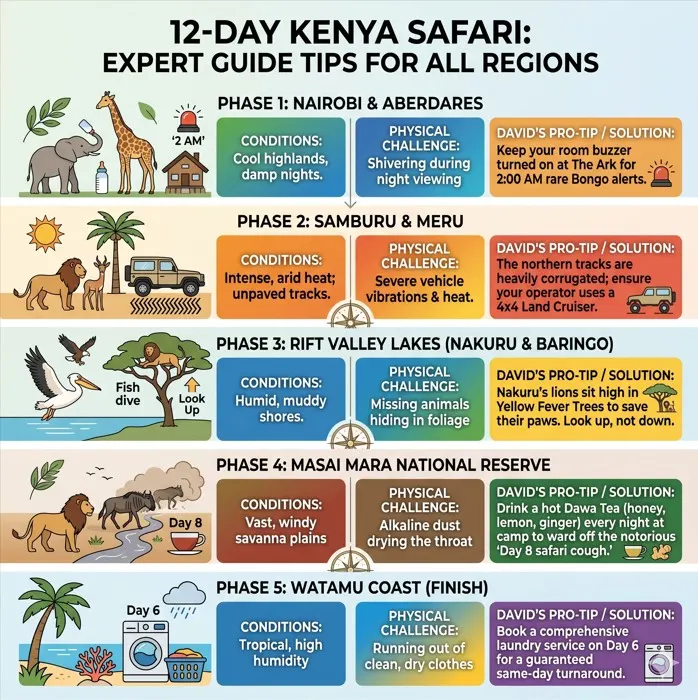
Trip Phase & Region | Microclimate & Terrain | Key Physical Challenge | David’s Pro-Tip / Solution |
Nairobi & Aberdares | Cool highlands, damp nights | Shivering during night viewing | Keep your room buzzer turned on at The Ark for 2:00 AM rare Bongo alerts. |
Samburu & Meru | Intense, arid heat; unpaved tracks | Severe vehicle vibrations & heat | The northern tracks are heavily corrugated; ensure your operator uses a 4×4 Land Cruiser. |
Rift Valley Lakes | Humid, muddy shores | Missing animals hiding in foliage | Nakuru’s lions sit high in Yellow Fever Trees to save their paws. Look up, not down. |
Masai Mara | Vast, windy savanna plains | Alkaline dust drying the throat | Drink a hot Dawa Tea every night at camp to ward off the notorious “Day 8 safari cough.” |
Watamu Coast | Tropical, high humidity | Running out of clean, dry clothes | Book a comprehensive laundry service on Day 6 for a guaranteed same-day turnaround. |
- Freight Seat on Internal Flights. On domestic flights via Masai Mara flying packages, you can buy an extra freight seat for about KES 20,000. It gives you 50 kg of extra allowance for wood carvings and Shukas. The normal limit is 15 kg.
- Dawa Tea Every Night. The Mara dust is alkaline and dries your throat over 12 days. Ask for Dawa (honey, lemon, ginger) at every lodge. It prevents the cough that hits most guests by Day 8.
- The Aberdare Bell. If staying at The Ark, don’t turn off the room buzzer. Four rings at 2 AM means a rare Bongo or Giant Forest Hog is at the salt lick.
- Laundry on Day 6. Plan a full wash at a lodge that offers same-day return (about KES 300 per item). Without this, you’ll be wearing dusty re-worn clothes for the last 4 days.
- Guide Rotation. Some operators swap guides at the midpoint on trips this long. A fresh guide on Day 7 brings fresh energy and different eyes. If you want one guide throughout, confirm in writing at booking.
- Credit Card Surcharge. Lodges charge 5–7% on card payments. On a 12-day trip, that can be KES 70,000 in hidden fees. Use Wise or a bank transfer for the bulk payment.
- Watamu Over Diani. See Day 11–12 in the itinerary. If your beach extension exits via Tsavo East, Watamu is closer and quieter.
- Miraa Trucks. North of Nanyuki, give way to the pickups with hazard lights. These are Khat delivery drivers heading to the border. They will not slow down.
- Waterhole Room Requests. On a 12-day trip, you spend roughly 30 hours in your room. Request rooms facing water holes or wildlife corridors at Ol Tukai, Sarova Shaba, Salt Lick, or The Ark. The room location determines whether you see elephants from your bed or a parking lot.
- Private Dinner Upgrade. Ask for a bush dinner on your last Mara night. Candles, a private chef, no other guests. About $150–$300 per couple at luxury camps. It reframes the whole trip.
- KATO and Ponzi Check. Verify your operator on the KATO directory. One reviewer discovered on Day 5 that their operator was paying for existing trips with money from new bookings. On a 12-day trip with deposits of $3,000+, this risk is real.
- Peak Season Books a Year Out. If you’re planning for July–October, start the booking process 10–12 months before departure. Lodge availability across 5+ parks is the bottleneck.
- Return Visitors Start Here. Multiple 12-day reviewers describe planning their next trip before leaving Kenya. Shorter trips satisfy curiosity. 12 days creates a relationship with the country. You learn your guide’s name, your favourite lodge chef, and which camp has the best sundowner spot.
The Group That Refused to Leave the Vehicle
I once guided a group on a trip that tried to cover 7 parks in 10 days. By Day 8, they were so tired from the roads and the constant packing that they refused to get out of the Land Cruiser for a cheetah sighting. They sat in the vehicle with the windows up and said they were done.
On a 12-day trip, that doesn’t happen. We take the scenic routes. We rotate seats so nobody gets stuck in the back for 6 hours. And we split the trip so the last 4 days are coast or Kilimanjaro, not more game drives. The extra days don’t just add more parks. They add the space to actually enjoy the parks you’re in.
Frequently Asked Questions
Is 12 days too long for a Kenya safari?
No. It’s the length where the trip stops feeling like a tour and starts feeling like immersion. By Day 8, the daily rhythm is your clock. Wake at 5:15. Coffee at 5:30. Drive at 5:45. That pattern becomes your life, and it’s the most restful two weeks you’ll have all year.
What is the best month?
July to October for the migration. Early December is the quiet season: green landscapes, fewer crowds, lower prices. January is best for Samburu and Kilimanjaro views. Check our best time to visit Masai Mara guide.
Can I add Tanzania?
Yes. A 6-day Kenya + 6-day Tanzania split is popular. Cross from the Mara into the Serengeti via Sand River. You need a Tanzania visa ($50) and a guide change at the border. See our Masai Mara vs Serengeti comparison.
Is a 4×4 Land Cruiser mandatory?
Yes. The northern tracks between Samburu and Meru are corrugated and steep. Every private safari we run uses a 4×4.
What should I pack?
Soft duffel bags (15 kg max if flying), layers for Samburu heat and Aberdare cold, power bank, binoculars (8×42), portable SSD for photos, DEET insect repellent, collapsible laundry bag, and a Safaricom SIM from the airport. Full list in our Masai Mara packing list.
Is this trip safe?
Yes. All parks have rangers, your guide carries a radio, and the lodges are established. Main road risk is the Miraa trucks north of Nanyuki. More in our Masai Mara safety guide.
What 12 Days Actually Feels Like
The first week is safari. Samburu, Ol Pejeta, Meru, Nakuru, the Mara. Your eye sharpens. You stop photographing every zebra and start reading the bush. You notice the oxpecker before the buffalo. You hear the alarm call before the leopard appears. By Day 8, you’ve seen more of Kenya than most people see in three visits, and you haven’t rushed any of it.
Then the second act starts. The coast, or Amboseli, or Tanzania. The pace drops. You sleep past 5:30 AM for the first time in a week. You sit on a beach or a porch with Kilimanjaro in front of you and no alarm set for the morning. That second act is what turns a safari into a story you tell for years.
If 12 days feels like too much, try a 5 days Masai Mara safari or a 4 days Masai Mara safari. Want a shorter multi-park circuit? See our Masai Mara Samburu Nakuru Safari or Masai Mara Amboseli Nakuru Safari. Browse everything on our Masai Mara packages page.
Ready to start? Fill out our booking form at Masaimara.co.ke here and I’ll get the Land Cruiser ready.
Related Reading:
- 10 Days Kenya Safari
- Masai Mara Samburu Nakuru Safari
- Masai Mara Amboseli Nakuru Naivasha Safari
- Masai Mara Amboseli Nakuru Safari
- Masai Mara Amboseli Tsavo Safari
- 6 Days Masai Mara Amboseli Safari
- 5 Days Masai Mara Safari
- 4 Days Masai Mara Safari
- Masai Mara and Diani Beach Safari
- Masai Mara and Mombasa Safari
- Masai Mara Packages
- Luxury Safari Masai Mara
- Masai Mara Flying Packages
- Masai Mara Migration
- Masai Mara Booking
- Wildebeest Migration Kenya
- Masai Mara vs Serengeti
- Nairobi National Park Day Trip
- Masai Mara Safari from Nairobi
- Official KWS Park Fee Portal
- Kenya Wildlife Service
This guide was authored by David Njunge, a TRA-licensed safari guide with over 10 years of experience, and edited by Cecilia Wambui, a travel consultant with a degree in Tourism and Hospitality Management.
Welcome to Masaimara.co.ke
Thank you for visiting us! We're excited to help you plan an unforgettable safari adventure across Kenya.