
8 Days Masai Mara, Amboseli and Lake Nakuru Safari: 2027 Prices
An 8 Days Masai Mara, Amboseli and Lake Nakuru safari is the most balanced three-park circuit in Kenya. It gives you enough time to see the Big Five across the Masai Mara, Lake Nakuru and Amboseli without the rush of shorter trips. For 2027, expect to pay from USD 3,060 or KES 220,000 per person, based on two people travelling together in a private 4×4 Land Cruiser. That covers seven nights, 3 in the Mara, 2 at Lake Nakuru and 2 in Amboseli, full board and every park fee.
8 Days Masai Mara, Amboseli And Lake Nakuru Safari Costs (2027)
This is the 8-day version of our Masai Mara, Amboseli and Lake Nakuru safari circuit. For shorter options, see the 5-day, 6-day or 7-day versions.
Prices are per person, two people sharing a private 4×4 Land Cruiser, and include the vehicle, fuel, my time as your guide, full board and every park fee. Kenyan prices are worked out on citizen park fees and resident lodge rates, so they are not the dollar price converted. A non-resident pays up to USD 960 in park fees on this route, while a Kenyan citizen pays KES 10,500 to 15,000.
International Visitors (USD)
| Tier | Lodges (Mara + Nakuru + Amboseli) | Jan-June | July-Dec |
|---|---|---|---|
| Budget | Mara Sidai + Ziwa Bush Lodge + AA Lodge Amboseli | 3,060 | 3,720 |
| Mid-Range | Mara Sopa + Lake Nakuru Sopa + Kibo Safari Camp | 3,610 | 4,470 |
| Luxury | Sarova Mara + Sarova Lion Hill + Amboseli Serena | 4,780 | 6,340 |
Kenyan Citizens (KES)
| Tier | Lodges (Mara + Nakuru + Amboseli) | Jan-June | July-Dec |
|---|---|---|---|
| Budget | Mara Sidai + Ziwa Bush Lodge + AA Lodge Amboseli | 220,000 | 245,000 |
| Mid-Range | Mara Sopa + Lake Nakuru Sopa + Kibo Safari Camp | 261,000 | 298,000 |
| Luxury | Sarova Mara + Sarova Lion Hill + Amboseli Serena | 343,000 | 435,000 |
Foreign nationals living in Kenya on a work or residence permit pay resident park fees, which sit between the two tables. Tell us when you book and we will quote you on resident rates.
Note: Peak prices apply from July to December, when Mara park fees double. If you want to fly one leg, check our Masai Mara flying packages. For higher-end camps, see our luxury safari Masai Mara options and request a custom quote.
What Is Covered In The Price?
- Vehicle: Private 4×4 Safari Land Cruiser with a pop-up roof and 12V inverter, plus fuel for every transfer and game drive.
- Guide: TRA-licensed guide for all 8 days.
- Park Fees: All 2027 entries. Lake Nakuru and Amboseli are paid through KWS eCitizen, including the KWS vehicle fee. The Masai Mara is billed separately by Narok County.
- Accommodation: 7 nights full board as per your tier, including packed lunches on full game drive days and lunch on the road on Day 6.
- Water: Drinking water in reusable containers in the vehicle.
- Cover: AMREF Flying Doctors evacuation cover.
- Excluded: Tips (USD 15 to 20 / KES 2,000 to 2,500 per day), alcoholic and soft drinks, the hot air balloon (USD 500 / KES 58,500), the Maasai village visit (KES 1,500 for citizens / USD 20 for non-residents), international flights and the Kenya eTA (USD 34).
I have been guiding out here for ten years. An 8-day Masai Mara, Amboseli and Lake Nakuru safari is the trip where you stop being a “tourist” and start feeling the rhythm of the bush. In five or six days, you are always checking the time. In eight days, you finally have room to sit with a pride of lions for two hours just to watch them wake up.
But here is the gritty truth. If your guide does not know when the trucks climb the Mai Mahiu escarpment, or how the park tickets work, you will lose hours you paid for.
Before we get into the moths, the Sand River and the rhino woodland, you can get a custom safari quote here to check vehicle availability for your 2027 dates.
The 8-Day Itinerary
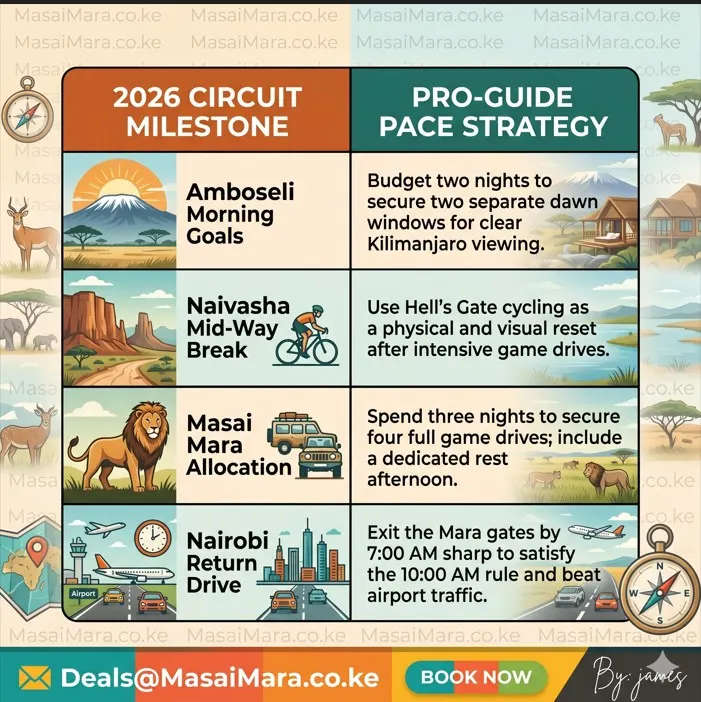
This is how I run the Masai Mara, Amboseli and Lake Nakuru safari when we have 8 days: 3 nights in the Mara, 2 at Lake Nakuru and 2 in Amboseli. You get eleven scheduled game drives: five in the Mara (the Day 1 afternoon, then morning and afternoon on Days 2 and 3), three at Nakuru (the Day 4 afternoon and two on Day 5) and three in Amboseli (the Day 6 afternoon and two on Day 7). Day 8 adds an optional twelfth, a short dawn loop in Amboseli on the ticket you already hold.
There is no game drive on the morning you leave the Mara or Nakuru. On those days you have breakfast and go, and lunch is at the next hotel, except on the long Day 6 drive, when we pick up a grab-and-go lunch at Mai Mahiu.
Day 1: Nairobi To The Masai Mara, Afternoon Game Drive
We leave Nairobi at 7:00 AM, down the escarpment at Mai Mahiu before the trucks build up, and on through Narok on tarmac, about 5 to 6 hours. Lunch is at your camp. Your first game drive starts at about 4 PM and runs until the reserve closes at 6 PM.
Days 2 And 3: Full Days In The Masai Mara
Two full days, with a morning and an afternoon drive each day. We go out at dawn with a picnic lunch from camp, so we eat on the plains and do not lose two hours driving back. This is where the Masai Mara migration happens (July to October), where leopards hunt along the Talek River and where cheetahs run on the open plains. With two full days, you can give one to waiting at the Mara River crossing points and keep the other for the cats. If you want the hot air balloon, book it for Day 2. It takes that morning’s dawn drive, and you still have a full dawn drive on Day 3.
Day 4: Masai Mara To Lake Nakuru, Afternoon Game Drive
No game drive this morning. Mara Sidai and Mara Sopa sit outside the reserve, so guests there leave after breakfast on the outside roads without passing through a gate. Sarova Mara is inside the reserve, a short way in from Sekenani Gate, so on the Luxury tier the drive out is a transit with the roof closed, and you must be through the gate by 10 AM. We head north through Narok, Mau Narok and Njoro, about 5 to 6 hours, and reach your Nakuru hotel for lunch at about 1:30 PM. Lake Nakuru Sopa and Sarova Lion Hill are inside the park, so on those tiers we enter the gate at about 1 PM on the way to lunch. Ziwa Bush Lodge is outside, so Budget guests have lunch at the lodge first, then we enter the park at about 3 PM for the afternoon game drive. On every tier, the next day is a full day in the park.
Day 5: Full Day At Lake Nakuru
This is the day most itineraries never give you. On every tier, it is a full-day game drive: out at 6 AM with a packed lunch, so we stay in the park all day, with the morning and afternoon drives run together. The morning is for rhinos in the southern woodland and the view from Baboon Cliff. We eat lunch at the Makalia Falls picnic site in the south of the park, then work the acacia woodland and Lion Hill in the afternoon. A warning about Makalia: the baboon troop there knows exactly what a lunch box looks like. Keep the windows up, eat inside the vehicle, and never leave food on a seat by an open window. They will jump in and take it. Budget guests at Ziwa Bush Lodge leave the park before it closes at 6 PM.
Day 6: Lake Nakuru To Amboseli, Afternoon Game Drive
No game drive this morning. This is the longest leg of the trip, 7.5 to 8.5 hours, so we are on the road by 6:30 AM:
- About 8 AM: coffee and a clean toilet at the Delamere farm shop near Naivasha, on the A104.
- Mid-morning: down to Mai Mahiu, with a 15-minute stop at the tiny Italian Catholic church built by prisoners of war in the Second World War. We also stop at the Java House in Mai Mahiu, where you order a grab-and-go lunch to take with you.
- Late morning to midday: round Nairobi on the Southern Bypass, so we never touch city centre traffic. You eat lunch in the vehicle on the bypass and Mombasa Road.
- Early afternoon: a last fuel and toilet stop at a service station in Emali on Mombasa Road, then south on the C102 to Kimana Gate.
We enter Amboseli at about 3 PM and game drive to the lodge.
Day 7: Full Day In Amboseli
On the tracks at 6 AM, while Kilimanjaro is clear. Observation Hill first, then the Enkongo Narok swamp for the big tuskers. Your lodge packs lunch, so we stay in the park all day, with the morning and afternoon drives run together. AA Lodge and Kibo Safari Camp sit outside the park near Kimana, so on those tiers we leave through Kimana Gate before it closes at 6 PM.
Day 8: Amboseli To Nairobi
Your second Amboseli ticket started at about 3 PM on Day 7, so it is still valid until about 3 PM today. You choose:
- A short dawn loop. From 6 AM to 8 AM under Kilimanjaro on the ticket you already hold, then breakfast and an 8:30 AM checkout. At AA Lodge and Kibo Safari Camp we go back in through Kimana Gate, and I tell the rangers the evening before that we are coming back at dawn.
- An early start. Breakfast, and on the road by 7:30 AM, to stay ahead of the afternoon trucks on Mombasa Road.
The drive back on the C102 and Mombasa Road takes about 4 to 5 hours. You reach Nairobi in the early to mid-afternoon. If you are flying home the same day, book a flight that leaves after 9 PM, because Mombasa Road through Athi River often jams with cargo trucks and international check-in at JKIA opens three hours before departure. We drive you straight to the airport.
Two ways to skip the highway on Day 8:
- The SGR from Emali. We drop you at Emali station, and the Madaraka Express takes you to Nairobi Terminus at Syokimau, near JKIA, in about 1.5 hours, or down to Mombasa for the coast. Emali is a stop on the inter-county train, with a small number of seats that go fast in the migration months and over Christmas. Book on the Kenya Railways Madaraka Express site on the day booking opens for your date. The afternoon train reaches Emali in the early afternoon, so you can have breakfast in Amboseli, leave at about 9 AM and still be at the station in good time. We confirm the exact train times when you book, because they change. Kenya Railways charges 30% of the fare to cancel and 10% to reschedule, so be sure of your dates first.
- A morning flight from Amboseli. Scheduled light aircraft fly from Amboseli to Wilson Airport in Nairobi in under an hour, with a limit of 15 kg per person in a soft bag. See our Masai Mara flying packages.
Why Two Nights At Nakuru Instead Of Naivasha
Most 8-day Kenya safaris run 3 nights in the Mara, 1 at Nakuru, 1 at Naivasha and 2 in Amboseli. We built this one differently, on purpose: no Naivasha, and two nights at Nakuru.
On the usual route, Nakuru is a three-hour drive-through on the way to Naivasha. You see a white rhino on the open grass, take a photo and leave. With a full day and two nights, you get the side of Nakuru most visitors miss:
- Black rhinos in the thick fever-tree woodland, where they browse and hide. They take patience, and patience needs time.
- Tree-climbing lions, which sometimes rest in the acacias in the south of the park.
- Rothschild’s giraffes in quiet morning light, before other vehicles arrive.
- Makalia Falls and the southern basin, without watching the clock.
So the choice is simple. If you want boat rides, Crescent Island and Hell’s Gate cycling, book our Masai Mara, Lake Nakuru, Naivasha and Amboseli safari. If you want serious Big Five tracking and time for photography, this two-night Nakuru circuit is the one.
The Route And Drive Times
| Leg | Route | Time |
|---|---|---|
| Nairobi to the Masai Mara | Mai Mahiu, Narok and the tarmac to the reserve | 5 to 6 hours |
| Masai Mara to Lake Nakuru | Narok, Mau Narok and Njoro | 5 to 6 hours |
| Lake Nakuru to Amboseli | Naivasha, Mai Mahiu, the Southern Bypass, Mombasa Road to Emali, then the C102 to Kimana Gate | 7.5 to 8.5 hours |
| Amboseli to Nairobi | The C102 and Mombasa Road | 4 to 5 hours |
Day 6 is the hard one, so the second Nakuru night matters. After a full day at Nakuru you start the long drive rested, not straight off a transfer. If you would rather break that drive with a night at Lake Naivasha, see our Masai Mara, Lake Nakuru, Naivasha and Amboseli safari.
Where to Find Cheetahs in Amboseli
|
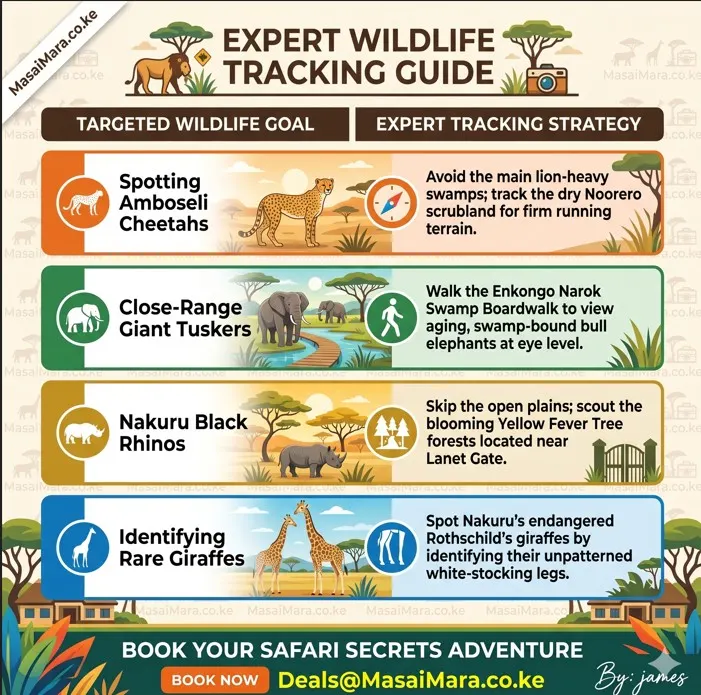
Targeted Wildlife Goal |
Expert Tracking Strategy |
|
Spotting Amboseli Cheetahs |
Avoid the main lion-heavy swamps; track the dry Noorero scrubland for firm running terrain. |
|
Close-Range Giant Tuskers |
Walk the Enkongo Narok Swamp Boardwalk to view aging, swamp-bound bull elephants at eye level. |
|
Nakuru Black Rhinos |
Skip the open plains; scout the blooming Yellow Fever Tree forests located near Lanet Gate. |
|
Identifying Rare Giraffes |
Spot Nakuru’s endangered Rothschild’s giraffes by identifying their unpatterned white-stocking legs. |
In Amboseli, everyone goes to Observation Hill. It is the standard shot, and on Day 7 we go there too, because it is one of the few places you can get out of the vehicle. But if you want cheetahs, ask me to work the drier plains away from the swamps.
Why the dry plains work: Lions own the swamps. Cheetahs avoid lions, so when they are in the park, they keep to the open, firmer ground where they can see trouble coming and have room to sprint. Cheetahs are an occasional sighting in Amboseli, not a sure thing, but with a full day on Day 7, we have time to look.
The big tuskers: Amboseli is one of the last places in Africa with super tuskers, bulls whose tusks each weigh more than 45 kg (about 100 lb). The Amboseli Elephant Research Project, started by Cynthia Moss in 1972, has followed the same families for more than 50 years, so these herds are calm around vehicles. In many parts of Africa, poaching left elephants wary of vehicles. In Amboseli, the same families have grown up with researchers and safari vehicles around them, which is why you can sit close to a big bull without him turning away. The older bulls stay at the swamp edge, where the grass is soft enough for their worn teeth. We park there, switch off the engine and let them come to us.
Who runs the park: Amboseli is still a KWS park for 2027. The government announced a move of its management to Kajiado County, but the High Court halted the transfer in 2026 and the case is still running. If the county takes over, ticketing could move to a calendar-day system like the Mara’s. We will update our quotes if that happens.
Finding Black Rhinos at Nakuru
People still come to Nakuru expecting flamingos. They are mostly gone, to Lake Bogoria and other Rift Valley lakes, since the water levels rose. But Nakuru traded pink for prehistoric. It is a rhino park now, and a good one. It became Kenya’s first rhino sanctuary in 1987, and the lake is part of the Kenya Lake System in the Great Rift Valley, a UNESCO World Heritage Site. The whole park sits inside an electric fence, so the rhinos cannot wander off into farmland.
The rising lake swallowed the old main gate and much of the shoreline grass. The best rhino tracking is now in the acacia woodland between Lion Hill, Baboon Cliff and the Makalia side of the park in the south. In the rains (April and May, and November), the black rhinos feed on fresh acacia shoots in the southern fever tree woodland. Most guides drive the shoreline. Wrong move.
Makalia Falls: We have time because this trip gives Nakuru a full day. We have lunch at the southern tip by Makalia Falls. After the long rains, it is loud, hidden and usually empty.
Rothschild’s giraffes: Nakuru is one of the strongholds of the Rothschild’s giraffe. Look at the legs. They have no markings below the knee, so they look like they are wearing white stockings. The Maasai giraffes in the Mara and Amboseli have jagged, star-shaped patches right down to the hooves. Most guides do not point out the difference. Ask yours.
Soda dust: Nakuru is a soda lake. Its fine dust is hard on cameras, so keep a UV filter on your lens, do not change lenses near Hippo Point or the shore, and use an air blower rather than a cloth on the glass.
11 Things to Know Before You Go
|
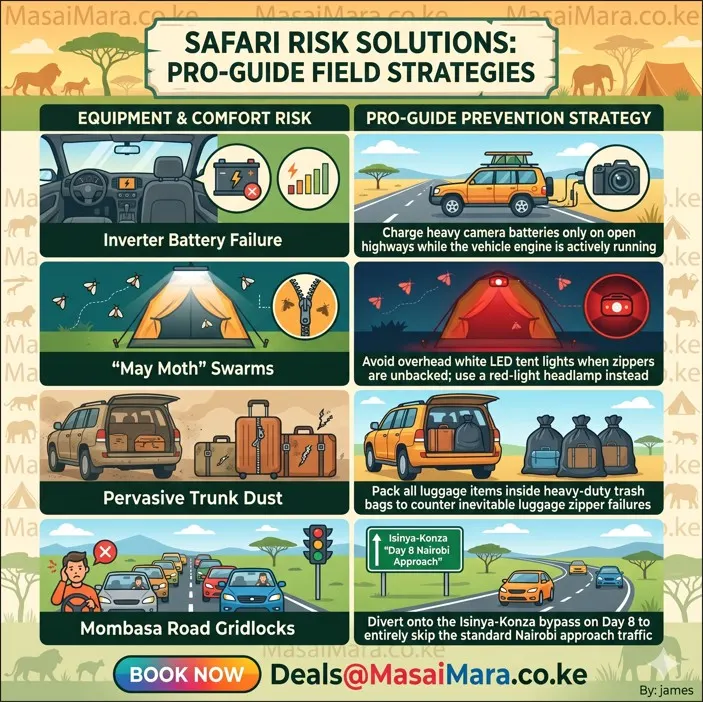
Equipment & Comfort Risk |
Pro-Guide Prevention Strategy |
|
Inverter Battery Failure |
Charge heavy camera batteries only on open highways while the vehicle engine is actively running. |
|
“May Moth” Swarms |
Avoid overhead white LED tent lights when zippers are unbacked; use a red-light headlamp instead. |
|
Pervasive Trunk Dust |
Pack all luggage items inside heavy-duty trash bags to counter inevitable luggage zipper failures. |
|
Mombasa Road Gridlocks |
Divert onto the Isinya-Konza bypass on Day 8 to entirely skip the standard Nairobi approach traffic. |
- The Dead Battery: On an 8-day trip, your vehicle’s inverter works hard. Charge heavy camera batteries while the engine is running on the road days, not while we sit with the engine off at a sighting.
- The Rainy Season Moths: In the rains, big moths swarm to white lights. Do not switch on the overhead light in your tent with the zip open. Use a red-light headlamp instead.
- Sand River Picnic: On Day 2 or 3, ask me to take you down to the Sand River in the south of the reserve. It is one of the quietest parts of the Mara, where you can sit on the riverbank and look across into the Serengeti. There is no crossing into Tanzania here, so it is a view, not a border stop.
- Rest When You Need It: On a long trip, you may hit a wall around the middle. If you do, tell me. On a full day we can head back to the lodge early for a swim and a nap, then go out again later. You will thank me on Day 7.
- The “Trash Bag” Hack: Bring heavy-duty trash bags to put your suitcases in before they go in the back. By Day 8, even “dust-proof” zips will have given up.
- The Java House Stop: On the long Day 6 drive, we stop at the Java House in Mai Mahiu. Order your lunch to go, and you eat it on the bypass instead of losing an hour at a table.
- Laundry Strategy: With two nights at Nakuru, the middle of the trip is the place for laundry. Most lodges charge a small fee. It saves you from overpacking.
- Gilanis in Nakuru: Skip the curio shops for snacks. Ask me to stop at Gilanis supermarket in Nakuru town on Day 4. It is where guides buy their own supplies, at a fraction of lodge prices.
- Individual Animal Names: I know many of the Mara’s leopards and lions by name and territory. Ask me. Tracking a cat you know the story of is better than just seeing “a leopard”.
- Phone Storage: You will run out by Day 5. Bring a portable SSD or a large SD card and offload your photos every night. Do not be the person deleting Mara lions to make room for Amboseli elephants.
- Bush Breakfast: On Day 3, upgrade to a bush breakfast in the Mara. White tablecloth, eggs, toast and coffee out on the open savannah. Your camp sets the price. After a few mornings in a dining hall, it hits differently.
Do Not Turn Eight Days Into a Race
I once guided a family who refused a rest afternoon. They wanted to game-drive 12 hours a day for 8 straight days. By Day 6, the kids were crying and the parents were arguing about camera settings. They fell asleep during a Mara River crossing because they were so exhausted.
This is not a race. On a 4-day Masai Mara safari, you push. On 8 days, you pace yourself.
One more thing about Day 8: do not book an early evening flight. The drive is 4 to 5 hours on a good day, and Mombasa Road can add an hour or two. I have had guests reach JKIA at 6:45 PM for a 7:30 PM flight. A flight after 9 PM, or the SGR from Emali, takes that stress away.
2027 Park Fees
The Mara is run by Narok County and charges per calendar day, 6 AM to 6 PM. Nakuru and Amboseli are KWS parks, and their tickets run 24 hours from entry.
Non-Residents (USD)
| Park | Adult | Child |
|---|---|---|
| Masai Mara | 100 Jan-June, 200 July-Dec | 50 (9 to 17), under 9 free |
| Lake Nakuru | 90 | 45 (5 to 17) |
| Amboseli | 90 | 45 (5 to 17) |
Kenyan Citizens (KES)
| Park | Adult | Child |
|---|---|---|
| Masai Mara | 1,500 Jan-June, 3,000 July-Dec | 300 / 500 |
| Lake Nakuru | 1,500 | 750 |
| Amboseli | 1,500 | 750 |
Kenya Residents (KES)
| Park | Adult | Child |
|---|---|---|
| Masai Mara | 2,500 Jan-June, 4,500 July-Dec | 1,250 / 2,500 |
| Lake Nakuru | 2,025 | 1,050 |
| Amboseli | 2,025 | 1,050 |
KWS also charges a vehicle entry fee of about KES 1,500 a day for a safari Land Cruiser. Every ticket, including the vehicle fee, is in your package price. On the 8-day route the tickets work like this:
- Masai Mara, Days 1 to 3: three calendar-day tickets. On Day 4 there is no game drive. Guests at the outside camps leave without touching a gate. The 10 AM closed-roof exit applies only to camps inside the reserve, such as Sarova Mara.
- Lake Nakuru, Days 4 to 6: two 24-hour tickets on every tier. At Lake Nakuru Sopa and Sarova Lion Hill, inside the park, the first starts when we enter for lunch at about 1 PM on Day 4 and covers the afternoon drive and the Day 5 morning. The second starts at about 1 PM on Day 5 and covers the rest of the full day, the night and your exit on Day 6. At Ziwa Bush Lodge, outside the park, the first starts at about 3 PM on Day 4 and covers the Day 5 morning, when we come back in at 6 AM. The second starts at about 3 PM on Day 5 and covers the afternoon, but Budget guests leave the park that evening, so the rest of it goes unused.
This is where the Mid-Range and Luxury tiers earn their price on an 8-day trip. Lake Nakuru Sopa and Sarova Lion Hill sit inside the park, so the second ticket works for you all the way through: the Day 5 afternoon, the evening light from the lodge, the night in the park and your drive out on Day 6. At an outside lodge, you pay for the same ticket and use only the afternoon.
- Amboseli, Days 6 to 8: two 24-hour tickets. The first starts when you enter around 3 PM on Day 6 and covers that afternoon and the Day 7 morning. At AA Lodge and Kibo Safari Camp you come back in through Kimana Gate at 6 AM on that ticket. The second starts around 3 PM on Day 7 and runs until about 3 PM on Day 8, so it covers the afternoon drive, the optional dawn loop and, at Amboseli Serena inside the park, the night and your drive out.
Park fees change. Check Narok County and KWS eCitizen for the current rates, or see our Masai Mara park fee page.
Best Time To Visit
| Season | Masai Mara | Lake Nakuru | Amboseli |
|---|---|---|---|
| January to March (dry) | Short grass, prime cat tracking | Good rhino viewing, dry tracks | Clearest Kilimanjaro mornings |
| April and May (long rains) | Heavy mud, very few vehicles, lowest lodge rates | Makalia Falls at full volume, rhinos in the fever trees | Green, the mountain often in cloud |
| July to October (dry) | The Great Migration and river crossings | Good rhino viewing | Big elephant herds at the swamps |
| November and December (short rains) | Green plains, newborn animals | Lush, migrant birds arrive | Short showers, good light |
July to October is the peak of the migration. January and February are best for clear Kilimanjaro views in Amboseli. Late June gives you the value sweet spot, before the Mara fee rise, with the first herds often arriving. Month by month detail is in our best time to visit guide.
5, 6, 7 Or 8 Days?
- 5 days: 2 Mara nights, 1 at Nakuru and 1 in Amboseli. The fastest version.
- 6 days: 2 Mara nights, 1 at Nakuru and 2 in Amboseli, adding a full Amboseli day.
- 7 days: 3 Mara nights, 1 at Nakuru and 2 in Amboseli. Two full Mara days.
- 8 days (this trip): 3 Mara nights, 2 at Nakuru and 2 in Amboseli. A full day in every park, and eleven scheduled game drives.
The second Nakuru night is what sets this trip apart. On every shorter version, Nakuru gets one afternoon, which is enough to see rhinos but not to explore the park. Here you get a full day for the southern woodland, Makalia Falls and the tree-climbing lions that sometimes rest in the fever trees, and you start the long Day 6 drive rested.
Frequently Asked Questions
What is the best month for an 8-day safari?
July to October is the peak of the Masai Mara migration. January and February are best for clear Kilimanjaro views in Amboseli. Late June gives you the value sweet spot: lower park fees and the first herds arriving.
How much does an 8-day Masai Mara, Amboseli and Lake Nakuru safari cost?
From USD 3,060 per person sharing for international visitors and KES 220,000 for Kenyan citizens, in the January to June season. July to December prices are higher because Mara park fees double. The vehicle, guide, full board and all park fees are included.
Is a 4×4 Land Cruiser mandatory?
Yes. For an 8-day circuit, a minivan will vibrate your teeth out, and it gets stuck in the Nakuru mud and the Mara’s black cotton soil. Every safari we run uses a 4×4 for a reason.
How do I book for the 2027 season?
Send us your dates through our booking form. We need a passport copy for each traveller and the ages of any children to pay the park fees, and you need your eTA before you fly.
How does this compare to shorter versions?
The 5-day gives you 2 Mara nights and 1 night each at Nakuru and Amboseli. The 6-day adds a full Amboseli day. The 7-day adds a third Mara night. This 8-day adds a second Nakuru night, so you get a full day in all three parks. In the January to June season it costs about USD 400 more per person than the 7-day.
Will I see the Big Five?
Your chances are very good, because each park fills a gap. The Mara gives you the big cats and buffalo, Nakuru the rhinos, and Amboseli the elephants. Leopards are always the hardest, but two full days in the Mara give you a fair shot.
Can I add Lake Naivasha?
Yes, but not on this route. If you want a boat ride, Crescent Island and Hell’s Gate cycling, see our Masai Mara, Lake Nakuru, Naivasha and Amboseli safari. It also breaks the long drive to Amboseli, which suits families with young children.
Can I add a beach after?
Yes. We run Masai Mara and Diani Beach combos. Or take the Emali SGR train to Mombasa. I can drop you at the station on Day 8.
What should I pack for 8 days?
Layers, a power bank, binoculars (8×42), your physical passport, a swimsuit for the lodge pools, trash bags for luggage and a portable SSD for photos. Full list in our packing list.
Is this trip safe?
Yes. All three parks have rangers, your guide carries a radio, and the lodges are well-established.
What I Would Tell a Friend
I love this land, but it is gritty. An 8-day Masai Mara, Amboseli and Lake Nakuru safari involves dust, long drives and 5:00 AM alarms. But when you see the sun hit the savannah for the first time, or watch an “Old Tusker” wade through the swamp at dawn, you will forget the bumps.
If 8 days feels like too much, check a 5-day Masai Mara safari or a 3-day Masai Mara safari. But if you want the full picture, let us get your Land Cruiser ready.
Ready to start?
Related Reading:
- Masai Mara, Amboseli and Lake Nakuru Safari
- 5-Day Masai Mara, Amboseli and Lake Nakuru Safari
- 6-Day Masai Mara, Amboseli and Lake Nakuru Safari
- 7-Day Masai Mara, Amboseli and Lake Nakuru Safari
- 8-Day Masai Mara, Lake Nakuru, Naivasha and Amboseli Safari
- Masai Mara and Amboseli Safari
- 5-Day Masai Mara Safari
- 4-Day Masai Mara Safari
- Luxury Safari Masai Mara
- Masai Mara Flying Packages
- Masai Mara Migration
- Masai Mara Park Fees
- KWS Park Fee Portal
Written by David Njunge, TRA-licensed safari guide with over 10 years in the Masai Mara. Edited by Cess Wambui, travel consultant, BSc Tourism and Hospitality Management. Verified for the 2027 season.
Welcome to Masaimara.co.ke
Thank you for visiting us! We're excited to help you plan an unforgettable safari adventure across Kenya.