
Masai Mara Month by Month: Choose Your Month
Masai Mara Month by Month at a Glance
The Masai Mara has no closed season. January to June is cheaper and quieter, with park fees at USD 100 a day. July to October is the wildebeest migration, with fees at USD 200 and the highest camp rates. This page summarises each month and links to its full guide.
Every month in the Mara has a case, and the twelve pages linked below make it in full: that month’s weather, park fees, prices for a 5-day safari, where the wildlife is, and how busy the reserve gets. This page is the short version, so you can pick two or three months to read properly.
Two things cut across all twelve. Park fees for non-residents are USD 100 a day from January to June and USD 200 from July to December, which is the single biggest driver of price. And the resident animals, the lions, leopards, cheetahs, elephants and giraffes, are here every month. Only the wildebeest come and go.
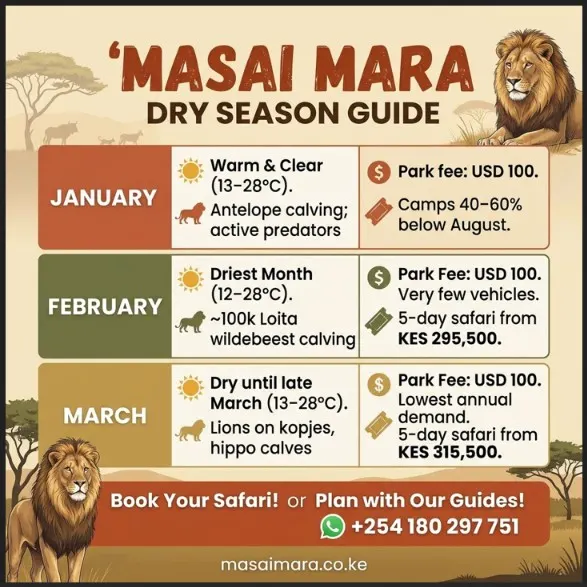
January to March: Dry Season
Month | Weather & Wildlife | Costs & Crowds |
January | • Warm & clear (13–28°C)
• Antelope calving; active predators | • Park fee: USD 100
• Camps 40–60% below August |
February | • Driest month (12–28°C)
• ~100k Loita wildebeest calving | • Park fee: USD 100
• Very few vehicles
• 5-day safari from KES 295,500 |
March | • Dry until late March
• Lions on kopjes, hippo calves | • Park fee: USD 100
• Lowest annual demand (excl. Easter)
• 5-day safari from KES 315,500 |
Short grass, long views and the lowest fees. The migration is in Tanzania, so the plains belong to the residents and the people who come for cats.
Masai Mara in January. Clear and warm, 13 to 15°C at dawn and 28°C by midday. Fees USD 100. Resident antelope are calving and the predators are busy. Camps 40 to 60% below August. A 5-day safari from KES 295,500 / USD 2,270.
Masai Mara in February. The driest month, 26 to 28°C by day, 12 to 14°C in the morning. The Loita herd of about 100,000 wildebeest calves in the eastern conservancies. Very few vehicles. A 5-day safari from KES 295,500 / USD 2,270.
Masai Mara in March. Still dry until the last week, lions on the kopjes and hippo calves in the pools. The lowest-demand month of the year outside the Easter weekend. A 5-day safari from KES 315,500 / USD 2,425.
April to May: Long Rains
The cheapest weeks of the year, and the emptiest. The plains turn green, the skies are dramatic, and the black cotton tracks need a 4×4.
Masai Mara in April. The heaviest rain, usually in afternoon storms with clear mornings. Fees USD 100. You will often have a sighting to yourself. A 5-day safari from KES 245,500 / USD 1,890.
Masai Mara in May. Rain easing through the month, camps at 10 to 20% occupancy, and the Loita herd moving into the eastern conservancies. The best value in the calendar. A 5-day safari from KES 245,500 / USD 1,890.
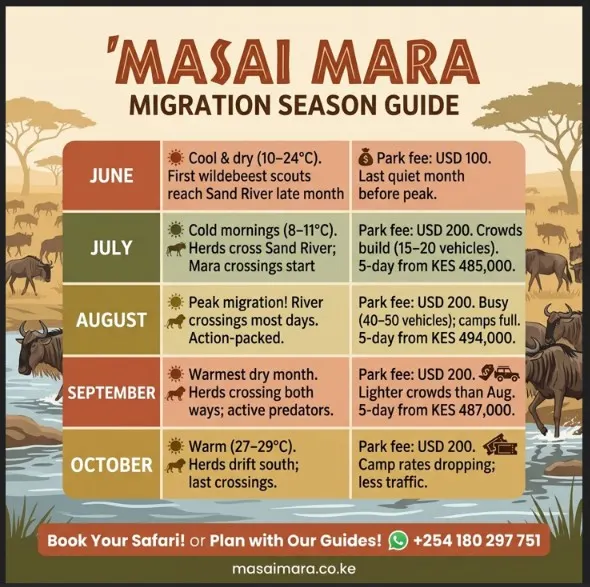
June to October: Migration Season
Month | Weather & Wildlife | Costs & Crowds |
June | • Cool & dry (10–12°C dawn, 22–24°C midday)
• First wildebeest scouts reach Sand River late month | • Park fee: USD 100 (until 30 June)
• Last quiet month before peak season |
July | • Cold mornings (8–11°C)
• Herds cross Sand River; first Mara River crossings mid-month | • Park fee: USD 200
• Crowds build (15–20 vehicles per sighting)
• 5-day safari from KES 485,000 |
August | • Peak migration
• River crossings most days | • Park fee: USD 200
• Peak crowds (40–50 vehicles at hot spots); camps full
• 5-day safari from KES 494,000 |
September | • Warmest dry-season month
• Herds cross both ways; predators at full strength | • Park fee: USD 200
• Crowds lighter than August (guides’ top pick)
• 5-day safari from KES 487,000 |
October | • Warm (27–29°C by day)
• Herds drift south; final Sand River crossings | • Park fee: USD 200
• Camp rates begin to drop
• Migration viewing without peak August traffic |
The wildebeest arrive from the Serengeti, the fees double on 1 July, and the camps on the Mara River sell out months ahead. The full story is on the Masai Mara migration page.
Masai Mara in June. Cool and dry, 10 to 12°C at dawn and 22 to 24°C by midday. Fees still USD 100 until 30 June. The first wildebeest scouts reach the Sand River in the last week. The last quiet month.A 5-day safari from KES 345,000 / USD 2,650.
Masai Mara in July. The herds pour in across the Sand River and the first Mara River crossings start mid-month. Cold mornings of 8 to 11°C. Fees USD 200. Crowds build to 15 to 20 vehicles a sighting. A 5-day safari from KES 485,000 / USD 3,730.
Masai Mara in August. Peak. Crossings most days, the busiest crossing points at 40 to 50 vehicles, and every river camp full. Fees USD 200. A 5-day safari from KES 494,000 / USD 3,800.
Masai Mara in September. The hottest dry-season month and the one guides prefer: the herds cross both ways, the predators are at full strength, and the crowds are lighter than August. Fees USD 200. A 5-day safari from KES 487,000 / USD 3,745.
Masai Mara in October. Warm, 27 to 29°C by day, and the herds drifting south with the last crossings at the Sand River. Fees USD 200, but camp rates start to drop. The migration without the August traffic. A 5-day safari from KES 425,000 / USD 3,270.
November to December: Short Rains
The herds are back in Tanzania, the short rains green the plains again, and the reserve empties until the Christmas week.
Masai Mara in November. Short, sharp showers and camps at 20 to 30% occupancy. Topi, hartebeest and gazelle are calving, which keeps the cats hunting in the open. Fees stay at USD 200. A 5-day safari from KES 275,500 / USD 2,120.
Masai Mara in December. Warm and mostly dry again, 26 to 28°C by day and 13 to 15°C at dawn. Quiet until 20 December, then the festive crowds and festive rates. Fees USD 200 until 31 December, then USD 100 from 1 January. A 5-day safari from KES 504,400 / USD 3,880 over the holidays.
Other Planning Guides
Once you have a month, these pages cover the rest of the planning.
- Best time to visit Masai Mara
- Masai Mara park fees
- Masai Mara safari cost
- Nairobi to Masai Mara
- Masai Mara entrance gates
- Masai Mara weather
- Kenya eTA and visa
- Masai Mara packing list
- First time safari
- Masai Mara safety
- Masai Mara travel tips
- Masai Mara facts
- Masai Mara vs Amboseli, vs Tsavo, vs Samburu, vs Serengeti
Frequently Asked Questions
Which month is best for the Masai Mara? August and September for the migration and river crossings. February for cheetahs and lion cubs on open ground with few vehicles. May for the lowest prices.
Which months are cheapest? April and May. Park fees are at the USD 100 rate and camps drop to 10 to 20% occupancy, so rates fall with them. Early June and November are the next cheapest.
When do park fees change? On 1 July, when the non-resident rate goes from USD 100 to USD 200 a day, and on 1 January, when it drops back. The 2027 rates are set by Narok County and confirmed on the park fees page.
Is there a bad month to visit? No. April has the most rain and the most mud, and the last ten days of December have the holiday crowds. Both still deliver lions, elephants and giraffes every morning.
Not Sure Which Month Fits You Best?
Whether you want river crossings in August, predator action on short grass in February, or low-season value in May, we will check real-time camp availability and seasonal permit costs for your travel window.
Send your preferred travel month and group size to [email protected], chat with a guide on WhatsApp at +254 180 297 751, or request an itemized proposal via our Get a Quote page..
Written by David Njunge, TRA-licensed safari guide with over 10 years in the Mara. Edited by Cess Wambui, travel consultant, BSc Tourism and Hospitality Management. Price verified for the 2027 season.
Welcome to Masaimara.co.ke
Thank you for visiting us! We're excited to help you plan an unforgettable safari adventure across Kenya.