
6 Days Masai Mara, Samburu And Lake Nakuru Safari: 2027 Route, Itinerary And Prices
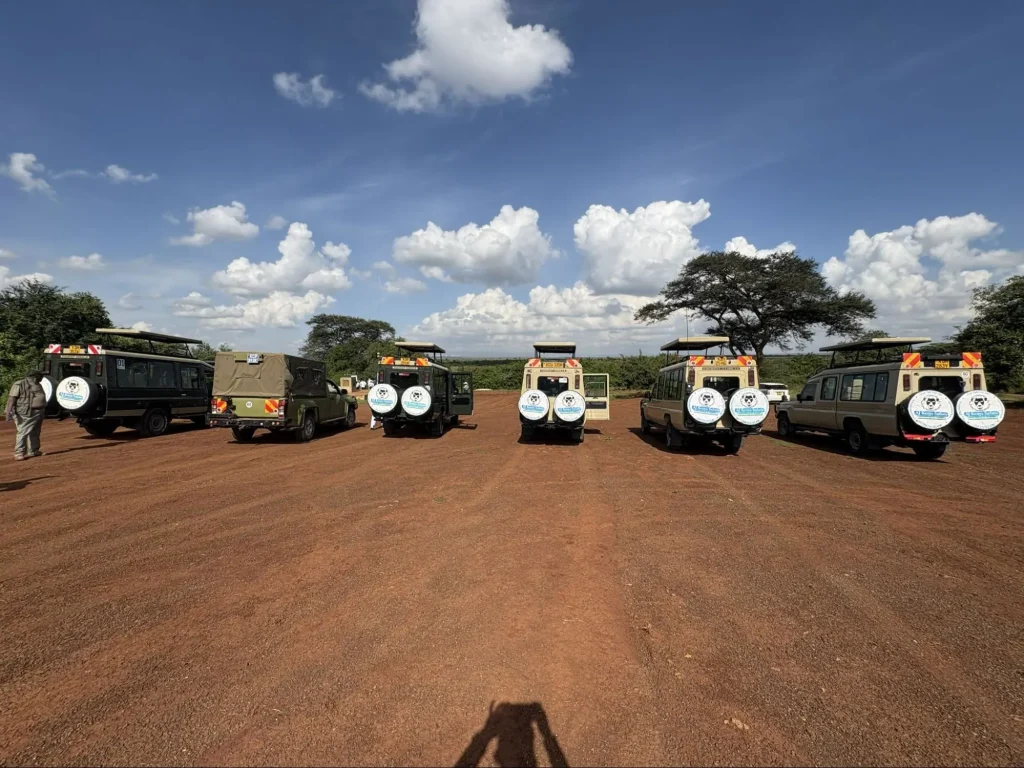
Masai Mara, Samburu and Lake Nakuru safari at a glance
A 6 days Masai Mara, Samburu and Lake Nakuru safari is a road loop from Nairobi through three very different parks: the dry north for the Samburu Special Five, the Rift Valley for the rhinos of Nakuru and the Mara for big cats. Two nights in Samburu, one at Nakuru and two in the Mara, from USD 2,220 or KES 161,000 per person sharing, with park fees and full board.
This is the route we recommend to anyone who wants to see Kenya change under the wheels. You leave Nairobi and cross the Equator at Nanyuki, drop into the hot, dry country of Samburu where the animals look like nothing in the Mara, climb back up past Thomson’s Falls to the Rift Valley and Lake Nakuru, then run south through Narok to the Masai Mara, and finish with the long view down the Rift Valley on the road home. It is six days and about 1,250 km on the road, all of it in your own 4×4 with a driver-guide. This page sets out the route as we drive it, what it costs in 2027, and the things that catch first-time visitors out. It is the shortest of our three versions of this circuit. The Masai Mara, Samburu and Lake Nakuru safari page compares all of them.
The route at a glance:
- Day 1: Nairobi to Samburu National Reserve, leaving at 6:30 AM, with the Equator stop at Nanyuki and an afternoon game drive
- Day 2: Full day of game drives in Samburu, tracking the Samburu Special Five
- Day 3: Samburu to Lake Nakuru via Thomson’s Falls, with an afternoon rhino drive
- Day 4: Lake Nakuru to the Masai Mara via Narok, with an afternoon game drive
- Day 5: Full day of game drives across the Mara plains and the Mara River
- Day 6: Breakfast, then the Masai Mara to Nairobi via the Great Rift Valley escarpment
Why These Three Parks In Six Days
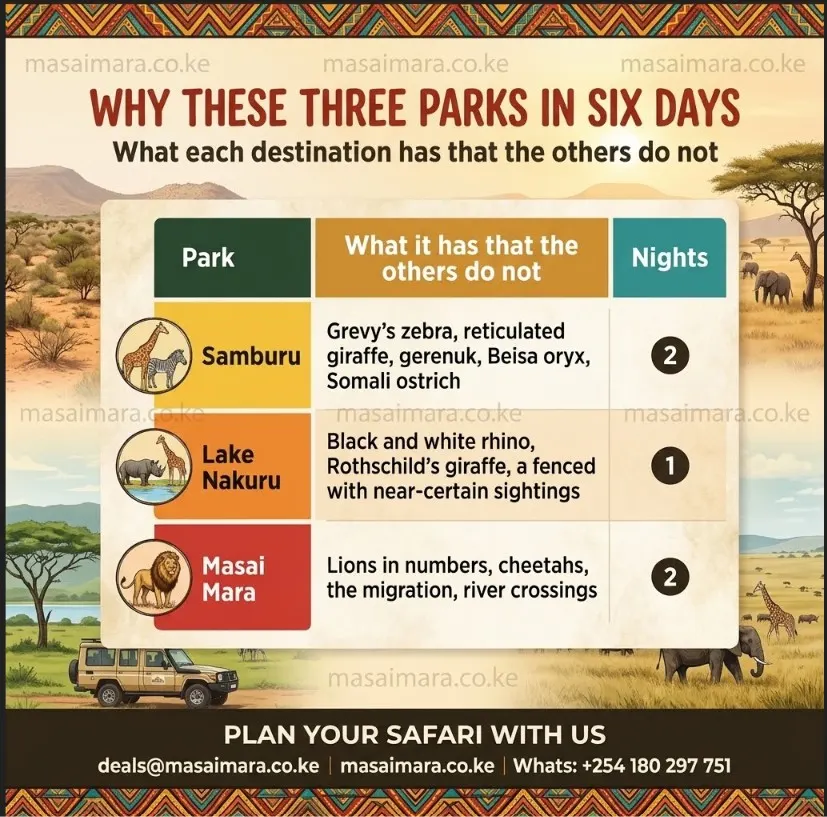
Samburu, Lake Nakuru and the Masai Mara sit in three different landscapes, and each one has animals the others do not.
Samburu National Reserve is hot, low and dry, on the Ewaso Nyiro River north of Mount Kenya. It is the home of the Samburu Special Five, Grevy’s zebra, reticulated giraffe, Beisa oryx, gerenuk and the Somali ostrich, none of which live in the Mara. The elephants here come down to the river in the heat of the day, and the leopards are easier to find than in most of Kenya because the bush is thin.
Lake Nakuru National Park is small, fenced and green, in the Rift Valley. It is the most reliable place in Kenya to see both black and white rhino, and Rothschild’s giraffe live here too. One night is enough.
The Masai Mara is open grassland with the highest density of lions in Kenya, cheetahs that hunt in the open and, from July to October, the wildebeest migration. Two nights gives you one full day inside the reserve.
Park | What it has that the others do not | Nights on this route |
Samburu | Grevy’s zebra, reticulated giraffe, gerenuk, Beisa oryx, Somali ostrich | 2 |
Lake Nakuru | Black and white rhino, Rothschild’s giraffe, a fenced park with near-certain sightings | 1 |
Masai Mara | Lions in numbers, cheetahs, the migration, river crossings | 2 |
The order matters. Samburu is the longest drive from Nairobi, so we do it first while everyone is fresh. Samburu to the Mara is too far for one day, and Nakuru sits between them on the map, so there is no backtracking, and you finish in the Mara, which is the park nobody wants to leave early.
What You Pay And What It Covers
This is a private road safari: your own Toyota Land Cruiser with a pop-up roof and a driver-guide from the moment you leave Nairobi until you are dropped back, with no flights. Prices are per person, two people sharing. From July to December the Mara park fee doubles and the lodges charge high-season rates. Kenyan citizen prices are not the dollar price converted. Citizens and residents pay much lower park fees and lodge rates, and the prices are worked out from those.
International Visitors (USD)
Tier | Lodges (Samburu + Nakuru + Mara) | Jan-June | July-Dec |
Budget | Lion King Bush Camp + Ziwa Bush Lodge + Crocodile Camp | 2,220 | 2,680 |
Mid-Range | Samburu Sopa Lodge + Lake Nakuru Sopa + Mara Sopa Lodge | 2,610 | 3,210 |
Luxury | Samburu Intrepids + Sarova Lion Hill + Mara Crossing Camp | 3,450 | 4,550 |
Kenyan Citizens (KES)
Tier | Lodges (Samburu + Nakuru + Mara) | Jan-June | July-Dec |
Budget | Lion King Bush Camp + Ziwa Bush Lodge + Crocodile Camp | 161,000 | 178,000 |
Mid-Range | Samburu Sopa Lodge + Lake Nakuru Sopa + Mara Sopa Lodge | 190,000 | 216,000 |
Luxury | Samburu Intrepids + Sarova Lion Hill + Mara Crossing Camp | 249,000 | 314,000 |
Foreign nationals living in Kenya on a work or residence permit pay resident park fees, which sit between the dollar and shilling prices. Tell us when you book and we will quote you on resident rates. A single traveller pays a single room supplement.
Included in every package:
- Return transfers from Nairobi, from the airport or your hotel
- A private 4×4 Land Cruiser with a pop-up roof, serviced before every trip
- An English-speaking TRA-licensed driver-guide for all six days
- Full board at the lodges and camps, five nights, with packed lunches on full game drive days
- All park fees for Samburu, Lake Nakuru and the Masai Mara, paid in advance, including the KWS vehicle fee at Nakuru
- Game drives as listed, with drinking water in the vehicle
- AMREF Flying Doctors emergency evacuation cover
Not included:
- The Kenya eTA, USD 34 per person, applied for at etakenya.go.ke before you fly
- Kenya’s inbound travel health insurance, up to USD 44 per person, required for non-Kenyan visitors from 5 October 2026
- International flights and your own travel insurance
- Drinks at the lodges, other than water in the vehicle
- Tips for your driver-guide and lodge staff, USD 15 to 20 / KES 2,000 to 2,500 a day for the guide
- Optional extras: a hot air balloon flight in the Mara (USD 500 / KES 58,500), a Maasai village visit (KES 1,500 for citizens / USD 20 for non-residents), a Samburu village visit arranged locally, and the small viewpoint fee at Thomson’s Falls
How the park fees add up. Across the six days you pay for two days in Samburu, one at Nakuru and two in the Mara, about USD 460 per adult from January to June, and all of it is in the price. There is no third Mara day on this route, because Day 6 has no morning game drive, which is one reason the 6-day version costs less than our 7-day one.
Hotels By Budget
The price depends mostly on where you sleep. These are the lodges we use on every version of this circuit.
Level | Samburu | Nakuru | Mara |
Budget | Lion King Bush Camp, Archers Post | Ziwa Bush Lodge | Crocodile Camp |
Mid-Range | Samburu Sopa Lodge | Lake Nakuru Sopa Lodge | Mara Sopa Lodge |
Luxury | Samburu Intrepids | Sarova Lion Hill | Mara Crossing Camp |
In Samburu, the river is everything. Samburu Intrepids sits on the Ewaso Nyiro inside Samburu National Reserve itself, so your Samburu ticket covers the lodge, and in the dry months the elephants walk past the tents to drink. Samburu Sopa Lodge is on higher ground inside the reserve with a pool, which matters more here than anywhere else on the route, because Samburu sits at about 900 metres and afternoons regularly pass 30 degrees. Lion King Bush Camp is a simple camp at Archers Post, just outside the gate, which keeps the price down.
At Nakuru, Lake Nakuru Sopa Lodge and Sarova Lion Hill are inside the park, so you wake up with the animals. Ziwa Bush Lodge is just outside the park, quiet and good value, and the trade-off at that price is that you sleep outside the fence.
In the Mara, Crocodile Camp is a simple en-suite tented camp on the Talek River near Talek Gate, Mara Sopa Lodge sits on a hill near Ololaimutia Gate with wide views, and Mara Crossing Camp is a quieter tented camp on the banks of the Mara River for the Luxury tier. Our Masai Mara camps guide compares the full range, and our luxury safari Masai Mara page covers the camps above this tier.
If one of these lodges is closed for maintenance on your dates, we move you to an equal lodge, such as Ashnil Samburu Camp for Samburu Sopa, and tell you before you pay.
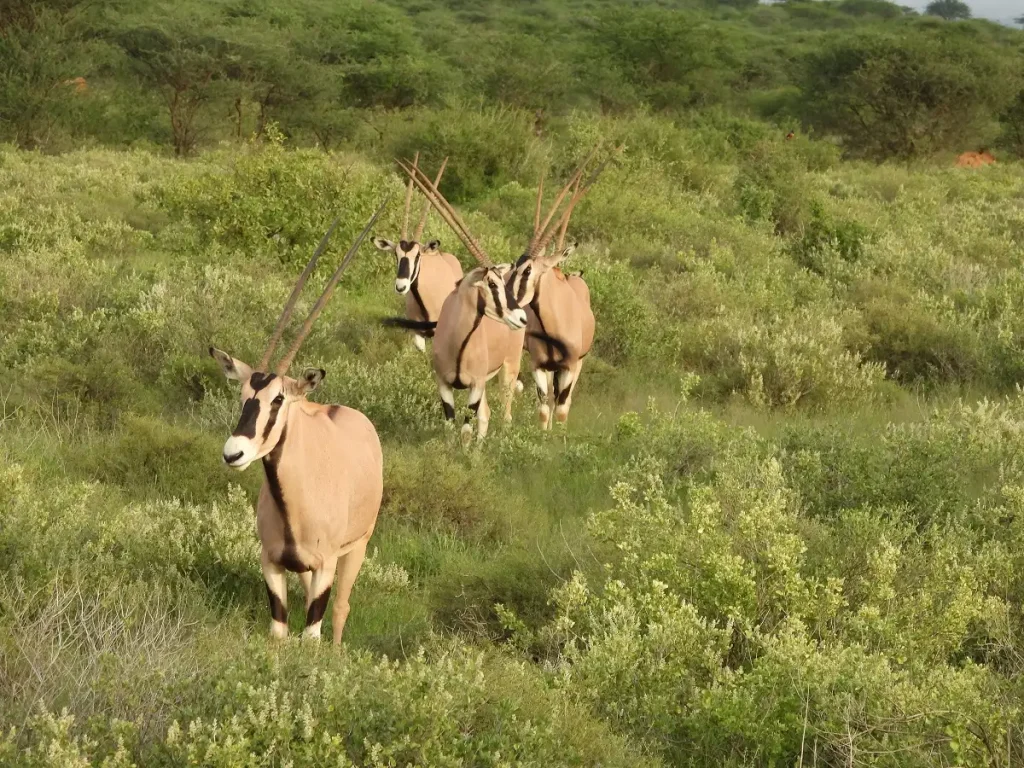
Alt Text: Beisa oryx with long straight horns walking through green bushland in Samburu National Reserve. Title: Beisa Oryx Tracking in Samburu National Reserve Caption: Beisa oryx in Samburu National Reserve, one of northern Kenya’s Samburu Special Five. Description: A small herd of Beisa oryx photographed during a game drive in Samburu, Kenya.
The Day By Day Itinerary
Day 1: Nairobi To Samburu National Reserve, 325 Km And 6 Hours
Nairobi to Samburu is about 325 km and six hours on tarmac, north on the A2 through Thika, Nanyuki and Isiolo to Archers Post, with the first game drive in the afternoon. We leave Nairobi at 6:30 AM, every time. That gets us past the morning traffic on Thika Road before it builds, to the Equator at Nanyuki by about 10:30 AM, and into Samburu for lunch at about 1 PM, with a rest before the afternoon drive.
Cross the Equator at Nanyuki. The line crosses the road just south of Nanyuki town, marked by a big yellow sign, and we stop there for 15 minutes for coffee and photos. There is a local institution at the sign: men with a jug of water and a matchstick who show the water spinning one way north of the line, the other way south of it, and straight down on the line. It is good theatre, and worth the small tip they ask for, but it is a trick. The spin of the earth is far too weak to turn water in a basin, and which way it goes depends on how the jug is poured. Enjoy the show, then look north, because on a clear morning Mount Kenya stands over the town.
The Equator market. The roadside stalls at the Equator sell carvings, beadwork and the kikoy cloths this part of Kenya is known for, and the prices are better than at any lodge shop. Start at half the asking price, and buy here rather than later, because there is very little to buy in Samburu itself.
Into the reserve. From Isiolo the land drops and dries, and by Archers Post you are in a different Kenya, red earth, doum palms and camels on the road. Samburu National Reserve is run by Samburu County, not KWS. The county runs cashless collection at the gate, by card or M-Pesa, and in our packages the permits are paid before you arrive, so you drive straight in. After lunch and a rest, the afternoon drive from about 3:30 PM follows the Ewaso Nyiro River, where the elephants come to drink and the reticulated giraffe browse the acacias.
Day 2: Full Day Wildlife Tracking In Samburu
Day 2 is a full day in Samburu National Reserve, with an early morning drive, a return to the lodge through the heat of the day, and an afternoon drive along the river until the light goes.
Samburu is hot, so the rhythm is different from the Mara. Out at 6 AM when the air is cool and the cats are still moving, back by 10 or 11 AM, and out again at 4 PM. The middle of the day is for the pool, and in Samburu that is not a luxury.
The Special Five. Your guide will tick them off as you go. Grevy’s zebra, with the narrow stripes and the white belly, are the rarest zebra on earth, and most of the world’s wild population lives in this part of Kenya. Reticulated giraffe have the clean, net-patterned coat. The Beisa oryx carries straight horns close to a metre long. The gerenuk stands on its hind legs to browse, which looks wrong the first time you see it. The Somali ostrich has blue-grey legs and neck instead of pink. Seeing all five in a day is normal here and impossible anywhere else on this route.
Leopards. Samburu is one of the best leopard reserves in Kenya, because the bush is thin and the cats use the riverside trees and the doum palms. Ask your guide to work the river in the late afternoon, and look up into the crowns of the palms, not at the trunks.
Two reserves, two tickets. Across the river is Buffalo Springs National Reserve, which looks the same but is run by Isiolo County with its own fee. Your Samburu ticket does not cover it. If your guide suggests crossing the bridge, that is an extra ticket, so ask first. Most guests do not need to cross.
Day 3: Samburu To Lake Nakuru Via Thomson’s Falls, 330 Km And 7 Hours
Samburu to Lake Nakuru is about 330 km, 5.5 to 6 hours of driving on tarmac and 6.5 to 7 hours door to door, with the stop at Thomson’s Falls, the climb down the Subukia valley and the gate at Nakuru. The road runs back through Isiolo and Nanyuki, then west through Nyahururu and down the Subukia valley to Nakuru, with a game drive at Nakuru in the afternoon. We leave after an early breakfast at 7 AM sharp. That half hour matters: most lodges clear the lunch buffet between 2 PM and 2:30 PM, and a 7:30 AM start puts you in the dining room just as the food goes away. There is no game drive this morning, but the road out runs through the reserve, so keep the camera on your lap.
Thomson’s Falls at Nyahururu. About two thirds of the way, the road climbs to Nyahururu, which at about 2,360 metres is one of the highest towns in Kenya, and it is much cooler than Samburu. On the edge of town the Ewaso Narok River drops 74 metres over Thomson’s Falls, named after the Scottish explorer Joseph Thomson, who reached it in 1883. It is a ten-minute detour from the main road, with a small viewpoint fee paid at the gate and a path to the bottom of the gorge for anyone who wants to stretch their legs after three hours in the car. Bring a jumper, and keep moving past the curio sellers unless you want to buy, because they are persistent. Local handlers may offer to show you a Jackson’s chameleon, the one with three horns, for a small tip. Lunch is at your Nakuru lodge at about 1:30 PM, with time to check in before the rhino drive at 3:30 PM.
The Subukia valley. Below Nyahururu the road drops off the Laikipia plateau through farm country, with long views down to the Rift Valley floor. By the time you reach Nakuru, the yellow fever trees around the lake are a world away from the doum palms of the morning.
Into Nakuru through Lanet Gate. The lake at Nakuru has risen so much since 2010 that it flooded the old Main Gate area and parts of the shoreline road, and we usually enter through Lanet Gate. Lanet puts you straight into the acacia forest, which is the leopard area, and the afternoon drive works the southern end of the park where the rhinos graze. If you are staying inside the park, we go to the lodge for lunch first and drive from there. On the Budget tier at Ziwa Bush Lodge, we have lunch at the lodge and enter the gate once, for an unbroken afternoon. The park gates close at 6 PM. The KWS Lake Nakuru page has the park rules.
Look at the giraffe’s legs here. No markings below the knee means a Rothschild’s giraffe, the pale one. You have now seen three of Kenya’s giraffes in three days, reticulated in Samburu, Rothschild’s at Nakuru, and the Masai giraffe is waiting in the Mara.
The Great Giraffe Trifecta
Giraffe | Where | How to tell it apart |
Reticulated giraffe | Samburu | Sharp, liver-red patches divided by clean white lines, like a net thrown over the body |
Rothschild’s giraffe | Lake Nakuru | Paler, fawn patches with softer edges, and plain white legs below the knee, as if it is wearing socks |
Masai giraffe | Masai Mara | Dark, jagged patches shaped like stars or vine leaves, running all the way down to the hooves |
Most safaris show you one kind of giraffe. This route shows you three, one in each park, and by Day 4 you will be telling them apart from the vehicle before your guide does.
Day 4: Lake Nakuru To Masai Mara Via Narok, 280 Km And 5.5 Hours
Lake Nakuru to the Masai Mara is about 280 km and five to six hours, on tarmac along the Njoro to Narok road over the Mau highlands through Mau Narok, then from Narok town south on the C12 to the reserve, with an afternoon game drive in the Mara.
There is no game drive at Nakuru this morning. We leave after an early breakfast at about 7:30 AM with the luggage in the vehicle. If you slept inside the park, the road out to the gate runs through rhino country, so watch the grass on both sides. Then it is south through Njoro, past the gate of Lord Egerton Castle, which is a photo stop at most on this day, and over the shoulder of the Mau to Narok.
Narok town. Narok is the last real town before the Mara and the capital of the county that runs the reserve. We stop briefly to fuel up, and this is the place to draw cash if you need it, because the next ATM is a long way off. From Narok the C12 is smooth tarmac, so the last stretch is quick.
Into the Mara. You reach your camp at about 1:30 PM for lunch and a short rest. The afternoon drive leaves at about 3:30 PM through Talek, Ololaimutia or Sekenani Gate, whichever is nearest your camp, and runs until the reserve closes at 6 PM. The dust and the rough tracks begin inside the gate, so this is where the buff or scarf comes out. Your guide will already know where the cats were seen that morning.
Day 5: Full Day Game Drives In The Masai Mara
Day 5 is a full day inside the reserve from the 6 AM gate opening to the 6 PM close, with a packed breakfast and lunch so you stay out in the good country rather than driving back to camp in the middle of the day.
Out at 5:45 AM, when it is cold and the light is gold. The Talek riverine forest is the place for leopards early, because they drag kills into the trees before the sun gets high. From there the morning works west towards the Mara River for the hippo pools, the crocodiles and, from July to October, the chance of a river crossing. Lunch is under a tree near the river, and the afternoon works south to the Sand River corridor along the Tanzanian border, which is quieter than the main circuits.
Watch the topi. Local guides look at the antelope, not for the cats. A topi standing perfectly still on a termite mound, staring in one direction, has seen a predator. Topi have very good eyesight, and they stand on termite mounds on purpose, as lookouts for the rest of the herd. When a topi locks its stare and points its ears hard at a dry gully or a patch of tall grass, a lion or cheetah is very often lying in that blind spot. Say “what is that topi looking at” and your guide will slow down.
Back in camp before the 6 PM gate time, with the last sundowner of the trip.
If you want the hot air balloon, this is the only morning it can go, and it takes your dawn drive. If both matter to you, the 7-day version gives you a second full Mara day.
Day 6: Masai Mara To Nairobi Via The Great Rift Valley Viewpoint, 270 Km
Day 6 has no morning game drive. You have breakfast, check out, and drive about 270 km and five to six hours back to Nairobi, on tarmac through Narok, with the Great Rift Valley viewpoint on the way.
If your camp is inside the reserve, one rule applies. Your Day 5 ticket covers the night, but you must be through the exit gate by 10 AM, or Narok County charges another full day. A relaxed breakfast is fine, a lazy one is not, and we target the gate at 9:30. Guests at camps outside the gates have no gate to clear, and we tell you which applies to your camp when we confirm the booking.
The Great Rift Valley. From Narok the road climbs to Mai Mahiu and then up the escarpment wall, and near the top the whole Rift Valley opens out below you, with the crater of Mount Longonot straight ahead and Lake Naivasha glinting beyond it. Sit on the left for this stretch. The main viewpoint is crowded with curio sellers, so we stop a little further along where it is quieter, and this is the photograph that most guests end up putting on the wall.
If Day 6 is a Sunday, we leave the Mara by 8 AM with a packed breakfast. The trucks from Uganda and Rwanda jam the Mai Mahiu escarpment on Sunday afternoons, and a six-hour drive becomes eight to ten. We have had guests miss evening flights because of it, so if you are flying home the same day, book a flight that leaves after 9 PM. You are dropped at your Nairobi hotel or at the airport by late afternoon.
Day | Route | Driving time |
1 | Nairobi to Samburu via the Equator at Nanyuki | About 6 hours |
2 | Samburu, full day | Game drives only |
3 | Samburu to Lake Nakuru via Thomson’s Falls | 6 to 7 hours |
4 | Lake Nakuru to the Masai Mara via Narok | 5 to 6 hours |
5 | Masai Mara, full day | Game drives only |
6 | Masai Mara to Nairobi via the Rift Valley viewpoint | 5 to 6 hours |
Park Fees And Gate Rules
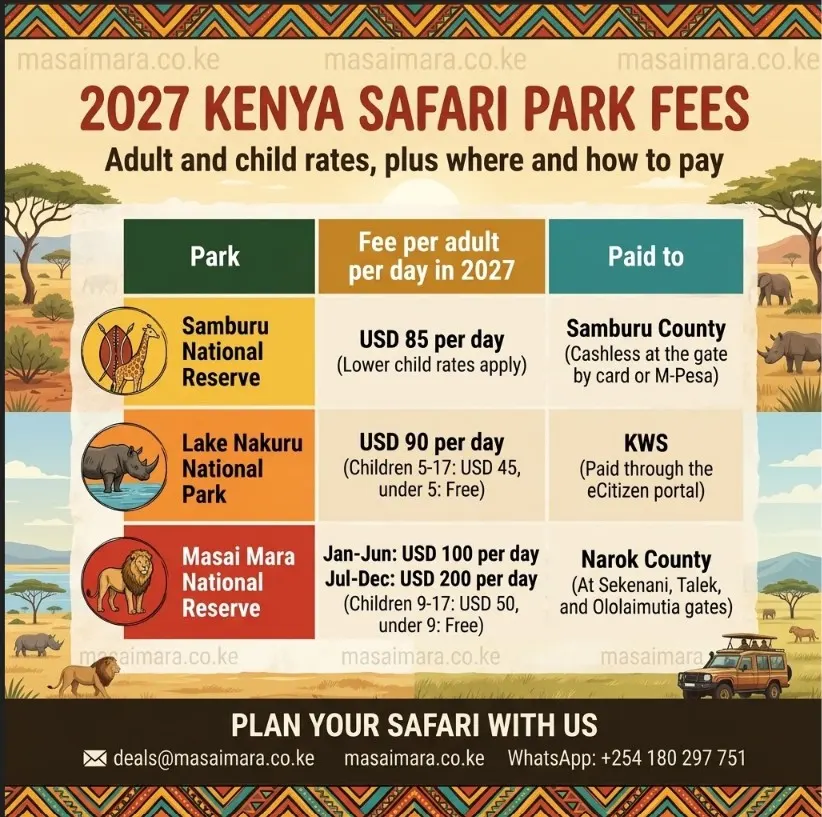
Three parks, three different authorities, three sets of rules. In our packages all the fees are paid before you arrive, but it helps to know how they work.
Non-Residents (USD)
Park | Adult | Child |
Samburu | 85 | 50 |
Lake Nakuru | 90 | 45 (5 to 17), under 5 free |
Masai Mara | 100 Jan-June, 200 July-Dec | 50 (9 to 17), under 9 free |
Kenyan Citizens (KES)
Park | Adult | Child |
Samburu | 800 | 300 |
Lake Nakuru | 1,500 | 750 |
Masai Mara | 1,500 Jan-June, 3,000 July-Dec | 300 / 500 |
Kenya Residents (KES)
Park | Adult | Child |
Samburu | 1,600 | 500 |
Lake Nakuru | 2,025 | 1,050 |
Masai Mara | 2,500 Jan-June, 4,500 July-Dec | 1,250 / 2,500 |
- Samburu is run by Samburu County, not KWS, and is not on eCitizen. Tickets are paid at the gate by card or M-Pesa rather than cash, and run 24 hours from entry. Buffalo Springs across the river is a separate reserve with a separate ticket from Isiolo County.
- Nakuru tickets are paid through KWS eCitizen and run for 24 hours from the time you enter, so an afternoon entry on Day 3 covers your night and your exit on Day 4. KWS also charges a vehicle fee of about KES 1,500 a day.
- Masai Mara tickets are set by Narok County and run by calendar day, from 6 AM to 6 PM, and KWS eCitizen tickets are not valid at the Mara gates. We buy them through the Mara online ticketing system, where the ticket is tied to your dates and your camp. Guests sleeping inside the reserve must be out through a gate by 10 AM on their last morning. If you add the Mara Triangle, its fees go through the Mara Conservancy, which we also handle.
The full rules are on our Masai Mara park fee page.
What Travellers Want To Know
How Much Does A 6 Days Masai Mara, Samburu And Lake Nakuru Safari Cost?
From USD 2,220 for international visitors and KES 161,000 for Kenyan citizens, per person sharing, from January to June, on the Budget tier. Mid-Range starts at USD 2,610 / KES 190,000 and Luxury at USD 3,450 / KES 249,000. Every price includes the vehicle, the guide, park fees and full board. July to December prices are higher because Mara park fees double.
Is Six Days Enough For Samburu, Nakuru And The Mara?
Yes, if you accept the pace. Three of the six days are road days, with 5 to 7 hours in the vehicle and a game drive at the end of each. You get one full day in Samburu and one full day in the Mara, which is enough to see the Special Five and the big cats, and one afternoon at Nakuru, which is enough for the rhinos. If your budget allows, the 7-day version costs about USD 420 / KES 28,000 more per person on the Budget tier and adds a second full day in the Mara, which doubles your time with the big cats without adding a single road transfer. The 7-day is the one I recommend if you can stretch to it, and the 8-day version adds a second full day in Samburu as well.
What Documents And Insurance Do I Need To Enter Kenya?
Two things, both bought online before you fly. First, the Kenya eTA, at USD 34. Second, from 5 October 2026, every non-Kenyan visitor staying under three months needs Kenya’s inbound travel health insurance, children included. It costs up to USD 44 per person and covers up to USD 50,000, including medical treatment and emergency evacuation. Cover only starts once the policy is issued, so buy it before you travel. Kenyan citizens, residents and East African Community nationals are exempt. The rules are new, so check the eCitizen page close to your departure.
What Should I Pack For Three Climates?
This route goes from the hottest park in the itinerary to one of the coldest towns in Kenya in a single morning. Pack for Samburu heat, light long sleeves, a hat and sunscreen, and for the Mara and Nyahururu cold, a fleece and a warm layer for the 6 AM drives. A buff or scarf for the dust inside the Mara, and a polarising filter for the lake at Nakuru. Soft bags are easier in the vehicle than hard cases, and hard suitcases crack on the corrugated Samburu tracks. Our packing list has the full list.
When Is The Best Time To Go?
January to March is dry in all three parks, with the Mara fee at its lower rate. July to October brings the migration to the Mara and peak prices, and it is the best season for the Samburu river too, because the elephants are tied to the water. April and May are the long rains, when the Samburu roads can flood and some Mara tracks turn to mud, but lodge rates are lower. Our best time to visit guide has the month by month picture.
Is This Safari Suitable For Children?
Yes, for children who can handle long days in the car. The park fees help: children under 9 enter the Mara free, children under 5 enter Nakuru free, and Samburu has reduced child rates. The lodges in every tier take families, and the Equator stop, Thomson’s Falls and the Rift Valley viewpoint break the driving days up. Every child also needs the inbound travel health insurance.
Why Not Fly?
You can fly to Samburu and the Mara, but this is a road itinerary on purpose. The Equator, Thomson’s Falls, Narok and the Rift Valley are the point of it, and the road is how you see Kenya change from the dry north to the green south. If you would rather skip the driving, our Masai Mara and Samburu safari page has fly-in routes, and our flying packages page covers the Mara by air.
Book Through Masaimara.co.ke
We drive this loop every month. The vehicles are ours and are serviced in our own workshop, and our guides are full-time employees who know all three parks, led by David Njunge. Tell us your dates, who is travelling and the children’s ages, and our team at Sekenani will send a day by day plan and an itemised quote, with every park fee shown, within 24 hours.
- Email: [email protected]
- WhatsApp: +254 180 297 751
Related Safaris
- Masai Mara, Samburu and Lake Nakuru Safari, all three versions compared
- 7 Days Masai Mara, Samburu and Lake Nakuru Safari, a second full day in the Mara
- 8 Days Masai Mara, Samburu and Lake Nakuru Safari, a second full day in Samburu and the Mara
- Masai Mara and Samburu Safari
- Masai Mara and Lake Nakuru Safari
- Masai Mara vs Samburu
- Masai Mara Safari Packages
Written by David Njunge, TRA-licensed safari guide with over 10 years in the Masai Mara. Edited by Cess Wambui, travel consultant, BSc Tourism and Hospitality Management. Verified for the 2027 season.
Welcome to Masaimara.co.ke
Thank you for visiting us! We're excited to help you plan an unforgettable safari adventure across Kenya.