
Masai Mara, Samburu And Lake Nakuru Safari: 2027 Routes, Itineraries And Prices
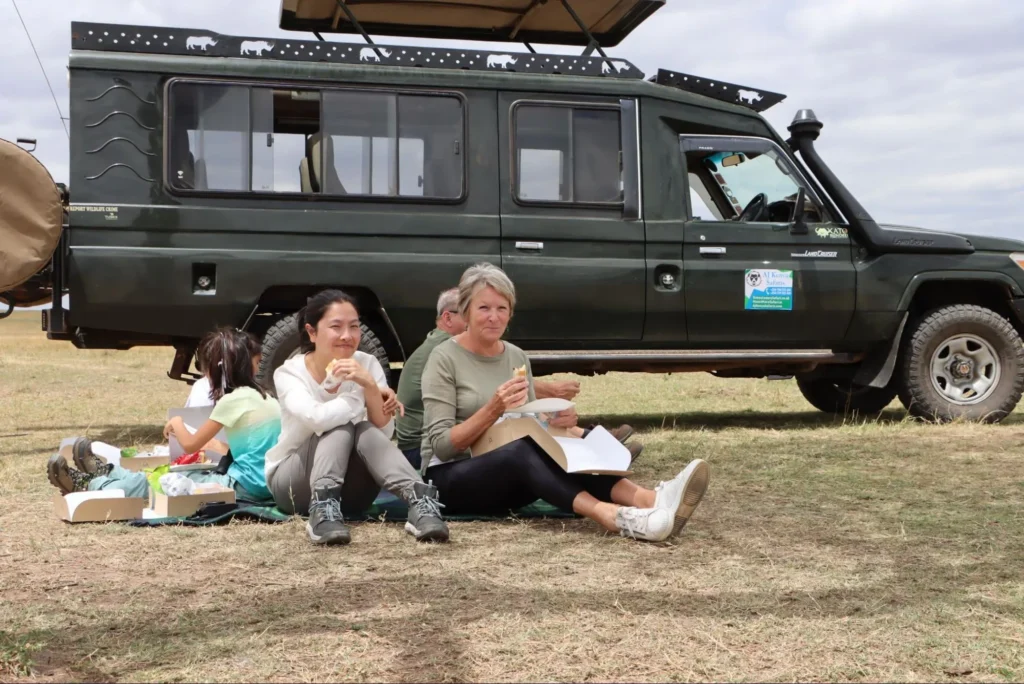
A Masai Mara, Samburu and Lake Nakuru safari is a road loop through three parks that share almost nothing: the dry north of Samburu, the rhino lake of Nakuru in the Rift Valley and the grass plains of the Masai Mara National Reserve. For 2027 it runs 6 to 8 days and costs from USD 2,220 or KES 161,000 per person sharing, with park fees and full board.
Choose Your Duration
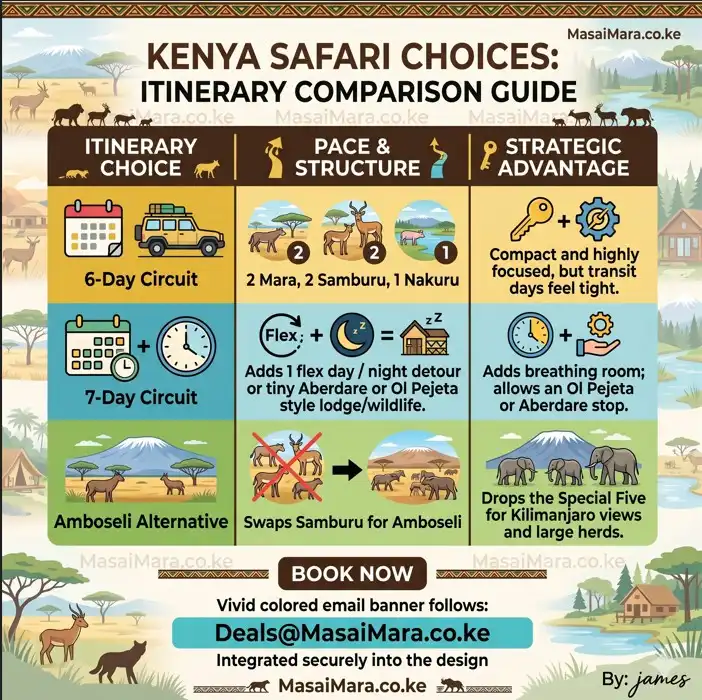
| Itinerary Choice | Nights | What You Get |
|---|---|---|
| 6-Day Circuit | 2 Samburu, 1 Nakuru, 2 Mara | Every park, one full day in the Mara |
| 7-Day Circuit | 2 Samburu, 1 Nakuru, 3 Mara | Two full Mara days, the one most guests choose |
| 8-Day Circuit | 3 Samburu, 1 Nakuru, 3 Mara | Two full days in Samburu and two in the Mara |
| Amboseli Alternative | Mara, Nakuru and Amboseli | Kilimanjaro and big tuskers instead of the Special Five |
Every route runs the same way: Nairobi to Samburu first, Lake Nakuru in the middle, and the Mara last. Samburu is the longest drive from Nairobi, so we do it while you are fresh. Samburu to the Mara is too far for one day, and Nakuru sits between them, so the lake is where we break the drive. If you would rather fly that leg, see our Masai Mara flying packages. You finish in the Mara, which is the park nobody wants to leave early.
- 6 Days Masai Mara, Samburu and Lake Nakuru Safari: from USD 2,220 / KES 161,000. Every park, but only one full day in the Mara.
- 7 Days Masai Mara, Samburu and Lake Nakuru Safari: from USD 2,640 / KES 189,000. A second full Mara day, so a slow day at the river crossing or a balloon flight does not cost you the cats.
- 8 Days Masai Mara, Samburu and Lake Nakuru Safari: from USD 3,040 / KES 217,000. A third Samburu night gives you a second full day in the north, so you have time for the gerenuk, the river leopards and the singing wells.
The 6-day route at a glance
| Day | Plan |
|---|---|
| 1 | Leave Nairobi at 6:30 AM, Equator stop at Nanyuki, Samburu by about 1 PM, afternoon game drive |
| 2 | Full day in Samburu |
| 3 | Samburu to Lake Nakuru via Thomson’s Falls, afternoon game drive |
| 4 | Lake Nakuru to the Masai Mara, afternoon game drive |
| 5 | Full day in the Mara |
| 6 | The Mara to Nairobi |
The 7-day route at a glance
| Day | Plan |
|---|---|
| 1 | Leave Nairobi at 6:30 AM, Equator stop at Nanyuki, Samburu by about 1 PM, afternoon game drive |
| 2 | Full day in Samburu |
| 3 | Samburu to Lake Nakuru via Thomson’s Falls, afternoon game drive |
| 4 | Lake Nakuru to the Masai Mara, afternoon game drive |
| 5 | Full day in the Mara |
| 6 | Second full day in the Mara |
| 7 | The Mara to Nairobi |
Why 6:30 AM. We leave Nairobi at 6:30 AM on Day 1, every time. That gets us past the morning traffic on Thika Road before it builds, to the Equator at Nanyuki by about 10:30 AM, and into Samburu for lunch at about 1 PM, with a rest before the afternoon drive. Leave at 8 AM and you reach Samburu mid-afternoon, tired, with half the drive gone. At Nanyuki we stop for 15 minutes at the Equator sign. Local demonstrators pour water through a funnel on each side of the line to show it swirling in opposite directions. It is a fun show rather than real physics, but it is a good place for coffee and a photo before the road drops north into the dry country.
The 8-day route adds a second full day in the Mara, as on the 7-day route, and also adds a second full day in Samburu on Day 3, so you reach Nakuru on Day 4 and the Mara on Day 5, and drive home on Day 8. The full day-by-day for each one is on its own page.
More days: Ol Pejeta or the Aberdares. Ol Pejeta Conservancy, below Mount Kenya near Nanyuki, is home to the last two northern white rhinos on earth and to Sweetwaters Chimpanzee Sanctuary. It sits on the road north, so one or two nights there before Samburu fit well. The Ark, a tree lodge in the Aberdare National Park, is the other option on that road. Both add days to the trip rather than replacing one.
How this differs from the Amboseli and Nakuru circuit. The Masai Mara, Amboseli and Lake Nakuru safari swaps Samburu for Amboseli. Amboseli gives you Kilimanjaro and big tuskers. This circuit gives you the Special Five, the river leopards of Samburu and a dry landscape that looks nothing like the Mara. If you only want Samburu and the Mara, see our Masai Mara and Samburu safari.
Masai Mara Samburu Lake Nakuru Safari Costs (2027)
Prices are per person, two people sharing a private 4×4 Land Cruiser, for the 7-day route. Kenyan citizen prices are not the dollar price converted. Citizens and residents pay much lower park fees and lodge rates, and the prices are worked out from those.
International Visitors (USD)
| Tier | Lodges (Samburu + Nakuru + Mara) | Jan-June | July-Dec |
|---|---|---|---|
| Budget | Lion King Bush Camp + Ziwa Bush Lodge + Crocodile Camp | 2,640 | 3,260 |
| Mid-Range | Samburu Sopa Lodge + Lake Nakuru Sopa + Mara Sopa Lodge | 3,110 | 3,900 |
| Luxury | Samburu Intrepids + Sarova Lion Hill + Mara Crossing Camp | 4,120 | 5,510 |
Kenyan Citizens (KES)
| Tier | Lodges (Samburu + Nakuru + Mara) | Jan-June | July-Dec |
|---|---|---|---|
| Budget | Lion King Bush Camp + Ziwa Bush Lodge + Crocodile Camp | 189,000 | 211,000 |
| Mid-Range | Samburu Sopa Lodge + Lake Nakuru Sopa + Mara Sopa Lodge | 224,000 | 257,000 |
| Luxury | Samburu Intrepids + Sarova Lion Hill + Mara Crossing Camp | 295,000 | 374,000 |
The 6-day route, with the same lodges and one Mara night fewer, runs from USD 2,220 / KES 161,000 (Budget), USD 2,610 / KES 190,000 (Mid-Range) and USD 3,450 / KES 249,000 (Luxury) from January to June.
The 8-day route, with a third Samburu night, runs from USD 3,040 / KES 217,000 (Budget), USD 3,590 / KES 258,000 (Mid-Range) and USD 4,760 / KES 341,000 (Luxury) from January to June.
Foreign nationals living in Kenya on a work or residence permit pay resident park fees, which sit between the dollar and shilling prices. Tell us when you book and we will quote you on resident rates.
Note: Peak prices apply from July to December, when Mara park fees double and the lodges move to high-season rates. If one of these lodges is closed for maintenance on your dates, we move you to an equal lodge, such as Ashnil Samburu Camp for Samburu Sopa, and tell you before you pay. For the lowest cost, see our budget safaris. For camps above our Luxury tier, see our luxury safari Masai Mara options.
What Is Covered In The Price?
- Vehicle: A private 4×4 Land Cruiser with a pop-up roof for the whole trip, with fuel for every transfer and game drive.
- Guide: A TRA-licensed guide who drives you from Nairobi and back.
- Park Fees: All 2027 entries. Samburu is paid to Samburu County, Lake Nakuru through KWS eCitizen, including the KWS vehicle fee, and the Masai Mara to Narok County.
- Accommodation: Full board for every night, with packed lunches on full game drive days.
- Water: Drinking water in reusable containers, with extra for the hot Samburu days.
- Cover: AMREF Flying Doctors evacuation cover.
- Excluded: Tips (USD 15 to 20 / KES 2,000 to 2,500 per day), alcoholic and soft drinks, the hot air balloon (USD 500 / KES 58,500), the Maasai village visit (KES 1,500 for citizens / USD 20 for non-residents), international flights, the Kenya eTA (USD 34) and Kenya’s inbound travel health insurance (up to USD 44 per person).
I have been guiding for ten years, and this is the trip that shows you the most of Kenya from one seat. Semi-desert in the north. A soda lake in the Rift Valley. Open grassland in the south-west. No two days look the same, and you cross the Equator on the way.
The distance is real, though. The loop covers well over 1,000 km of road, and the long days are Nairobi to Samburu and Samburu to Nakuru. A guide who knows where the road is slow, where to stop for lunch and which tracks to skip after rain gives you more time with the animals and less behind a truck.
The 10-Species Achievement
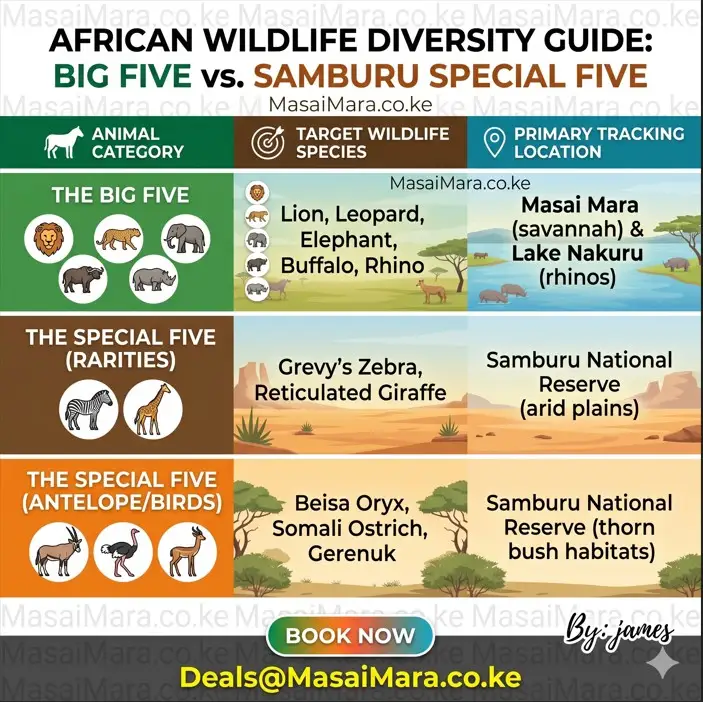
| Animal Category | Species | Where We Find Them |
|---|---|---|
| The Big Five | Lion, leopard, elephant, buffalo | The Masai Mara, with leopards also in Samburu |
| The Big Five | Black and white rhino | Lake Nakuru |
| The Special Five | Grevy’s zebra, reticulated giraffe | Samburu, on the open plains |
| The Special Five | Beisa oryx, Somali ostrich, gerenuk | Samburu, in the thorn bush |
Most Masai Mara trips are built around the Big Five, and most of them leave out the rhino. The Mara does have black rhinos, but only a few dozen, and they keep to thick cover, so seeing one there is luck. That is why Nakuru matters on this route. It is a small, fenced park with both black and white rhinos, and it fills the gap the Mara leaves.
The Big Five. Lions, leopards, elephants and buffalo in the Mara (see our guide to the animals in the Masai Mara), and rhinos at Nakuru.
The Special Five. Grevy’s zebra, reticulated giraffe, Beisa oryx, Somali ostrich and gerenuk. All five live in the dry north, and you will not find them in the Mara or at Nakuru.
On a single trip, that is ten headline animals across three parks. The gerenuk is usually the last one we tick off, because it feeds alone in thick thorn bush. I ask the rangers and the other guides where they have seen one that morning, and that saves a lot of searching.
The Road From Samburu To Nakuru
On Day 3 (Day 4 on the 8-day route) you leave the heat of Samburu after breakfast and climb south, about 5.5 to 6 hours to Nakuru. We go through Isiolo and Nanyuki, then west across the Laikipia plateau to Nyahururu, and down through the green Subukia valley to Nakuru. It is the best route, it avoids Nairobi completely, and it has two good stops.
Thomson’s Falls. At Nyahururu, one of the highest towns in Kenya, the Ewaso Narok River drops over a cliff in a single fall. It is a good place to stretch your legs. Local handlers often show visitors a Jackson’s chameleon, the one with three horns like a tiny Triceratops, for a small tip. Look, take a photo and let them put it back on the branch.
The Subukia valley. Below Nyahururu the road drops off the plateau into farm country, with maize, dairy and small coffee plots, and long views down to the Rift Valley floor. By the time you reach Nakuru, the yellow fever trees around the lake are a world away from the doum palms of the morning. After days of thorn bush, the green is a shock.
Lord Egerton Castle. On the road from Nakuru to the Mara, near Njoro, stands the stone mansion Lord Egerton built between the late 1930s and the 1950s. The story goes that the woman he hoped to marry said his first house was too small, so he built this one, and she still said no. On the day we drive from Nakuru to the Mara, it is a photo stop from the gate at most. A proper visit means a detour off the main road, tickets and a guided tour of close to an hour, and that would push your Mara arrival past 3 PM and cost you lunch or the afternoon game drive. If you want the full tour, tell us and we will plan an extra night around it.
Samburu: Singing Wells & Snorkel Elephants
Samburu is hot, often 35°C in the afternoon, and the animals live around one river, the Ewaso Nyiro. Everything here behaves differently from the Mara.
The river elephants. In the heat of the day, the elephants come down to the Ewaso Nyiro to drink and cross. After rain upriver, when the water runs deep, you may see them cross with only their trunks showing above the surface. In the dry months the river drops to sand, and they dig into the riverbed for water with their feet and trunks. We watch from the Samburu bank. Buffalo Springs, across the bridge, is a separate reserve with its own ticket, so we do not cross unless you ask.
Doum palm leopards. In the Mara, leopards rest in yellow-barked acacias. In Samburu, look up into the doum palms and the thick riverine trees. Most visitors scan the trunks. We scan the crowns, where the leopard lies along a frond in the shade.
The singing wells. In the dry season, Samburu herders dig wells into the sandy riverbeds outside the reserve, and the men sing to their cattle as they pass the water up by hand. Each family has its own songs, and the cattle know them. We can only watch if a family agrees, and when they do, leave the camera in the vehicle. It is their daily work, not a show.
What Happened to Nakuru’s Shoreline
Since about 2010 the lake has risen by several metres. It flooded the old main gate, parts of the shoreline road and a belt of acacia forest. Near Hippo Point you now drive past a forest of drowned white trees standing in the water.
The flamingos. Rising water made the lake less salty, and flamingo numbers rise and fall with it. In some months there are thousands on the shore, in others very few. I check the week before you come, and I will tell you what to expect.
The rhinos. With the northern shore under water, the white rhinos graze the open grassland further south in the park. We head there first, while the light is soft.
Hyrax Hill. Ten minutes from the park on the Nairobi road is Hyrax Hill, a prehistoric site with remains going back about 3,000 years and a small museum. It is a short stop on the day you arrive from Samburu if the road runs well, or we can add it to the next morning before we leave for the Mara.
The park itself. Lake Nakuru covers 188 km² and holds around 450 bird species. In 1987 it became Kenya’s first government-run rhino sanctuary, which is why the rhinos here are so used to vehicles. The gates open at 6 AM and close at 6 PM, unless you are sleeping inside. You can read more on the KWS Lake Nakuru page.
Inside or outside the park. Lake Nakuru Sopa and Sarova Lion Hill are inside the park, so your evening and morning are among the animals. Ziwa Bush Lodge, our Budget pick, is just outside, quiet and good value. If you want Nakuru with a boat ride on Lake Naivasha instead of Samburu, see our Masai Mara, Lake Nakuru and Lake Naivasha safari.
12 Things to Know Before You Go
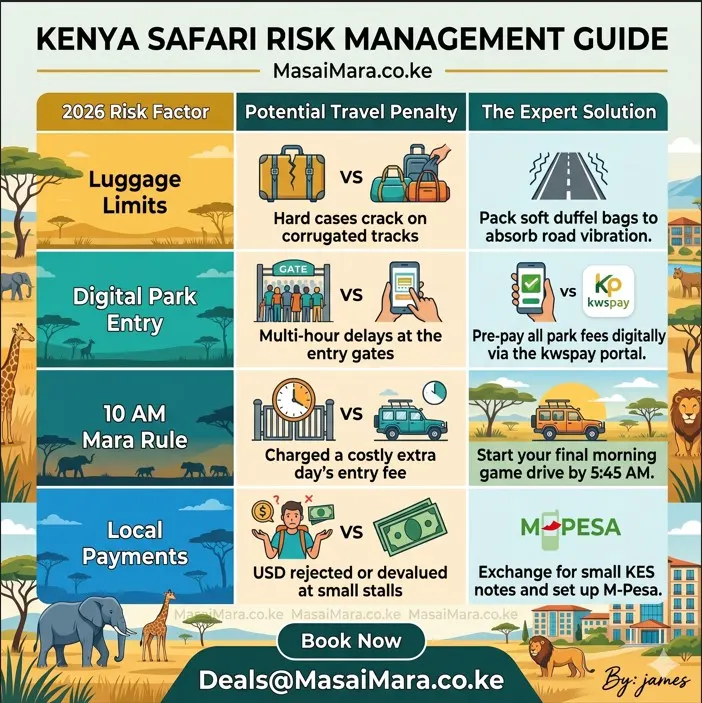
| 2027 Risk Factor | What Goes Wrong | The Expert Fix |
|---|---|---|
| Hard Suitcases | Cracked on corrugated tracks | Pack soft duffel bags. |
| Three Fee Systems | Confusion at the gates | Samburu County, KWS and Narok County are all in your package. |
| 10 AM Mara Rule (Inside Camps) | An extra day’s park fee | No game drive on the last morning, out by 10 AM. |
| Local Payments | Big dollar notes refused at stalls | Carry small KES notes and use M-Pesa. |
- Inbound Travel Health Insurance. From 5 October 2026, every non-Kenyan visitor staying under three months must buy Kenya’s inbound travel health insurance online before arriving, children included. It costs up to USD 44 per person and covers up to USD 50,000 for medical care and emergency evacuation. Buy it together with your eTA, because cover only starts once the policy is issued. Kenyan citizens, residents and East African Community nationals are exempt.
- Soft Bags Only. Hard suitcases take a beating on the corrugated tracks into Samburu. Zips burst and wheels snap. Bring a soft duffel bag.
- Monkeys And Baboons. At the Samburu and Nakuru lodges, close your windows and lock the door when you go to lunch. Vervets and baboons watch the rooms and go straight for food and phones.
- Ol Pejeta And The Ark. Both sit on the road north. If you have extra days, add one or two nights at either before Samburu. See Choose Your Duration above.
- Paying For Your Safari. International bank transfers can carry high fees on both sides. Ask us about card or online transfer options when you book, and compare the cost first.
- Binoculars. I carry two pairs in the vehicle. In Samburu, where the leopards lie high in the palms, binoculars are the difference between a shape and a face.
- Kuku Kienyeji. For a local lunch, ask for kuku kienyeji, free-range chicken, on the road through Nyahururu or Nakuru. It is tougher than lodge chicken, but much tastier.
- The 10 AM Mara Exit. If your Mara camp is inside the reserve, you must leave by 10 AM on the day you go home. There is no game drive that morning. Camps outside the reserve have no exit deadline.
- Vegetarian Meals. The larger lodges cook good vegetarian food, including Indian dishes, but tell us when you book so we can warn each kitchen ahead.
- Phone Signal. Signal comes and goes on the Samburu tracks and on the road from Nakuru to the Mara. Make important calls from the lodges.
- Private, Not Group. Every trip on this page is private, in your own vehicle. If you compare us with a group departure, ask that operator how many people are confirmed on your date.
- Shillings Over Dollars. Tips, village visits, roadside food and small shops run on Kenyan shillings. Carry small KES notes, and buy a Safaricom SIM at the airport for M-Pesa.
The Hard Suitcase That Did Not Survive Day 2
I had a family on this circuit who brought two hard-shell suitcases. At the airport I told them the tracks into Samburu would be rough. They said the cases were indestructible.
By the time we reached the lodge, one case had cracked along the hinge, and the zip on the other had burst open in the back of the Land Cruiser. We spent half an hour repacking everything into lodge laundry bags.
On a loop of well over 1,000 km of mixed road, your luggage takes more punishment than you do. Soft bags flex with the bumps. Hard cases crack. If your guide tells you to switch bags, listen.
The Route And Drive Times
| Leg | Route | Time |
|---|---|---|
| Nairobi to Samburu | Thika Road, Nanyuki, Isiolo and Archers Post | 5 to 6 hours |
| Samburu to Lake Nakuru | Isiolo, Nanyuki, Nyahururu and the Subukia valley | 5.5 to 6 hours |
| Lake Nakuru to the Masai Mara | Njoro, Mau Narok and Narok | 5 to 6 hours |
| The Masai Mara to Nairobi | Narok, Mai Mahiu and the escarpment | 5 to 6 hours |
If you are flying out on the last day, book a flight that leaves after 9 PM, because the traffic into Nairobi can be heavy.
2027 Park Fees
Samburu National Reserve is run by Samburu County and the Masai Mara by Narok County. Lake Nakuru is a KWS park. Samburu and Nakuru tickets run 24 hours from entry. The Mara charges per calendar day, 6 AM to 6 PM.
Non-Residents (USD)
| Park | Adult | Child |
|---|---|---|
| Samburu | 85 | 50 |
| Lake Nakuru | 90 | 45 (5 to 17) |
| Masai Mara | 100 Jan-June, 200 July-Dec | 50 (9 to 17), under 9 free |
Kenyan Citizens (KES)
| Park | Adult | Child |
|---|---|---|
| Samburu | 800 | 300 |
| Lake Nakuru | 1,500 | 750 |
| Masai Mara | 1,500 Jan-June, 3,000 July-Dec | 300 / 500 |
Kenya Residents (KES)
| Park | Adult | Child |
|---|---|---|
| Samburu | 1,600 | 500 |
| Lake Nakuru | 2,025 | 1,050 |
| Masai Mara | 2,500 Jan-June, 4,500 July-Dec | 1,250 / 2,500 |
KWS also charges a vehicle entry fee of about KES 1,500 a day at Nakuru. Every ticket is in your package price, and we buy them all for you before you arrive: Nakuru through KWS eCitizen and the Mara, including the Mara Triangle if you visit it, through the Mara online ticketing system, where the ticket is tied to your dates and the camp you sleep at. Buffalo Springs, across the river from Samburu, is a separate Isiolo County reserve with its own fee, and it is only added if you ask for it. Check Samburu County, KWS eCitizen and Narok County for current rates, or see our Masai Mara park fee page.
Best Time To Visit
| Season | Samburu | Lake Nakuru | Masai Mara |
|---|---|---|---|
| January to March (dry) | Animals close to the river | Clear skies, easy rhino tracking | Short grass, good for cats |
| April and May (long rains) | Green, animals spread out | Muddy tracks, very quiet | Mud, very few vehicles |
| July to October (dry) | The best Special Five viewing | Good rhino viewing | The Great Migration |
| November and December (short rains) | Green and quiet | Green, birds arriving | Green plains, newborn animals |
Month by month detail is in our best time to visit guide.
Frequently Asked Questions
How much does a Masai Mara, Samburu and Lake Nakuru safari cost?
From USD 2,220 for international visitors and KES 161,000 for Kenyan citizens, per person sharing, on the 6-day route from January to June. The 7-day route starts at USD 2,640 / KES 189,000 and the 8-day at USD 3,040 / KES 217,000. Every price includes the vehicle, the guide, park fees and full board.
How many days do I need?
Seven is the best balance. Six works, but you get only one full day in the Mara. Eight adds a second full day in Samburu as well. See Choose Your Duration above.
Can I drive from Samburu to the Mara in one day?
We do not. Even on the best route it is 9 to 10 hours, and the Mara gates close at 6 PM. Lake Nakuru sits halfway, so we stop there for the night and add the rhinos.
What is the best month for this safari?
July to October for the migration in the Mara and the best Special Five viewing in Samburu. January and February are also very good, with short grass and animals close to water.
What documents and insurance do I need to enter Kenya?
Two things, both bought online before you fly. First, the Kenya eTA, the electronic travel authorisation, at USD 34. Second, from 5 October 2026, every non-Kenyan visitor staying under three months needs Kenya’s inbound travel health insurance, children included. It costs up to USD 44 per person and covers up to USD 50,000, including medical treatment and emergency evacuation. Cover only starts once the policy is issued, so buy it before you travel. Kenyan citizens, residents and East African Community nationals are exempt. The rules are new, so check the eCitizen page close to your departure.
Is a 4×4 Land Cruiser mandatory?
Yes. A minivan struggles on the Samburu tracks and the Nakuru mud. Every private safari we run on this route uses a Land Cruiser.
How does this compare to the Mara, Amboseli and Nakuru circuit?
The Masai Mara, Amboseli and Lake Nakuru safari gives you Kilimanjaro and big tuskers. This circuit gives you the Special Five and the river leopards of Samburu. Read our Masai Mara vs Samburu guide for more.
What should I pack?
Soft duffel bags, layers (Samburu is hot, the Mara is cold at dawn), a wide-brimmed hat, strong sunscreen, a power bank, binoculars and a Safaricom SIM. Full list in our packing list.
Is this trip safe?
Yes. All three parks have rangers, your guide carries a radio and the lodges are well established. We drive in daylight only.
What I Would Tell a First-Timer
This circuit is a lot of driving. By Day 3 the bumps feel normal. By Day 4 you stop noticing the dust. And on your last morning in the Mara, outside your Masai Mara camp, watching a pride of lions wake up in the mist, you realise the distance was the point. Each park felt like a different country: the Samburu heat, the Nakuru lake, the Mara grass. Ten headline animals, three parks, one vehicle.
If this feels like too much ground, look at a 5 days Masai Mara safari or a 4 days Masai Mara safari. Want Amboseli instead of Samburu? See the Masai Mara, Amboseli and Lake Nakuru safari. Browse everything on our Masai Mara safari packages page.
Related Reading:
- 6 Days Masai Mara, Samburu and Lake Nakuru Safari
- 7 Days Masai Mara, Samburu and Lake Nakuru Safari
- 8 Days Masai Mara, Samburu and Lake Nakuru Safari
- Masai Mara and Samburu Safari
- Masai Mara and Lake Nakuru Safari
- Masai Mara, Amboseli and Lake Nakuru Safari
- Masai Mara vs Samburu
- 5 Days Masai Mara Safari
- 4 Days Masai Mara Safari
- Masai Mara Safari Packages
- Luxury Safari Masai Mara
- Masai Mara Flying Packages
- Masai Mara Migration
- Mara River Crossing
- Masai Mara Park Fees
- KWS Park Fee Portal
Written by David Njunge, TRA-licensed safari guide with over 10 years in the Masai Mara. Edited by Cess Wambui, travel consultant, BSc Tourism and Hospitality Management. Verified for the 2027 season.
Welcome to Masaimara.co.ke
Thank you for visiting us! We're excited to help you plan an unforgettable safari adventure across Kenya.