
6 Days Masai Mara Tsavo Safari – Does the Order Matter?
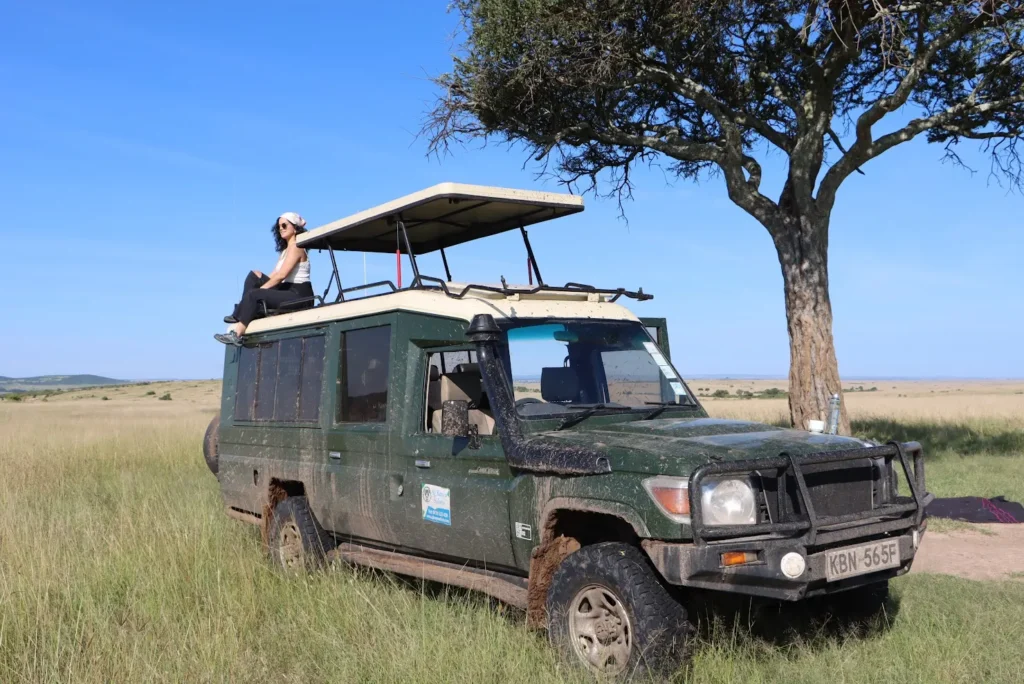
Start with the Mara? Or Tsavo?
I get asked this constantly. People assume it doesn’t matter. Just see both parks, right? But the sequence changes the whole experience.
6 Days Masai Mara Tsavo Safari runs USD 2,050 to USD 4,480 for non-residents, KES 267,000 to KES 582,000 for Kenyan residents. At Masaimara.co.ke we do both directions. I’ll explain why it matters.
What It Costs

Itinerary Sequence | The Safari Experience | Best For… |
Tsavo First $\rightarrow$ Mara Last | Starts with quiet patience; ends with an explosive wildlife reward. | Travelers who want a grand crescendo finish. |
Mara First $\rightarrow$ Tsavo Last | Instant high-density action; ends in vast, silent landscapes. | Tight migration windows (e.g., late October). |
Two sharing. Private Land Cruiser. All driving unless noted.
Park Fees (Non-Resident, USD)
- Masai Mara: USD 100/day (low) / USD 200/day (peak)
- Tsavo West: USD 80/day
- Tsavo East: USD 80/day
6 Days (3 Mara + 2 Tsavo) – Non-Residents (USD)
Tier | Low Season | Peak Season | Lodges |
Budget | 2,050 | 3,710 | Jambo Mara, Ngulia Lodge, Voi Safari Lodge |
Mid-Range | 2,380 | 4,080 | Sentrim Mara, Kilaguni Serena, Ashnil Aruba |
Luxury | 2,880 | 4,480 | Mara Serena, Kilaguni, Satao Camp |
6 Days – Kenyan Residents (KES)
Tier | Low Season | Peak Season | Lodges |
Budget | 267,000 | 428,000 | Jambo Mara, Ngulia Lodge, Voi Safari Lodge |
Mid-Range | 309,000 | 498,000 | Sentrim Mara, Kilaguni Serena, Ashnil Aruba |
Luxury | 374,000 | 582,000 | Mara Serena, Kilaguni, Satao Camp |
Flying out of the Mara instead of driving? Add USD 280 / KES 36,000 per person.
What’s Included
- Private 4×4 Land Cruiser with pop-up roof
- English-speaking driver-guide throughout
- Fuel for all transfers and game drives
- Full board accommodation (all meals)
- Park entry fees: Masai Mara (3 days), Tsavo West (1 day), Tsavo East (1 day)
- Bottled drinking water during drives
- AMREF Flying Doctors emergency evacuation cover
- Airport/hotel pickup and drop-off in Nairobi
What’s Not Included
- Tips for driver-guide (USD 15-20 / KES 2,000-2,500 per day)
- Tips for lodge staff
- Alcoholic and soft drinks
- Travel insurance (required)
- Visa/eTA fees (etakenya.go.ke)
- Personal expenses: laundry, souvenirs
- Hot air balloon in Mara (USD 500 / KES 65,000)
- Mzima Springs underwater tank entry (USD 15 / KES 2,000)
- Internal flights if upgrading from road transfers
Why Sequence Matters for Safari Fatigue
The Mara is intense. Lions within the first hour. Cheetahs on every drive. Wildebeest grunting constantly during migration. Vehicle convoys at every sighting.
Then you get to Tsavo.
Empty. Quiet. You might drive 45 minutes without seeing anything. The red dust. The heat – mid-30s, sometimes 40. The animals are there but spread across 14,000 square kilometers.
If you do Mara first, Tsavo feels like a letdown for some people. I’ve had clients complain. “Where are all the animals?” They’d just come from the most wildlife-dense savanna in Africa. Tsavo couldn’t compete.
But flip it.
Start with Tsavo’s vast emptiness. Get used to the patience it requires. Learn to appreciate the volcanic landscape, the silence, the red elephants dusting themselves. Then arrive in the Mara on Day 4.
The green hits you. The density. The noise. It feels like a reward instead of an expectation.
That said – if migration timing is tight (late October when herds leave), you want maximum Mara days. Starting with Tsavo loads your Mara time at the end. Weather delays could compress it. Know your priorities.
Day 1
Stock up at The Hub in Karen. It’s the last place to get sunblock and snacks at normal prices. Narok has a supermarket but everything costs double.
Five hours to the Mara.
Gate choice matters when you only have 3 nights. Sekenani is paved and fast but puts you far from the action. Talek Gate drops you right into big cat territory. Musiara is even better. Ask your operator about this – they default to Sekenani because it’s easier, not because it’s better.
Afternoon drive.
The Mara smells like grass and dung and dust. That smell stays in your clothes.
Days 2 and 3
Up at 5:45. Out by 6.
Lions are still active from night hunts. Cheetahs scan for breakfast. Hyenas retreat to their dens.
About tickets – they run on 12-hour windows now. Enter at 4 PM on Day 1 and your ticket might expire before your morning drive finishes. Confirm with your guide whether it’s “Transit” or “Full Day.” Getting double-charged at the gate ruins the morning.
The Mara is loud during migration. Constant wildebeest grunting. You stop noticing until you get to Tsavo and realize how quiet the bush can be.
One thing most tourists don’t do: book a balloon in advance. Ground drives are fantastic but the aerial view is completely different. Decide before you travel or you’ll find the slots full.
If your guide points out whistling thorn acacia – look at the black ant galls on the branches. Wind blows through them and they sing. A faint sound. Most people chasing lions drive right past.
Day 4 – The Hard Part
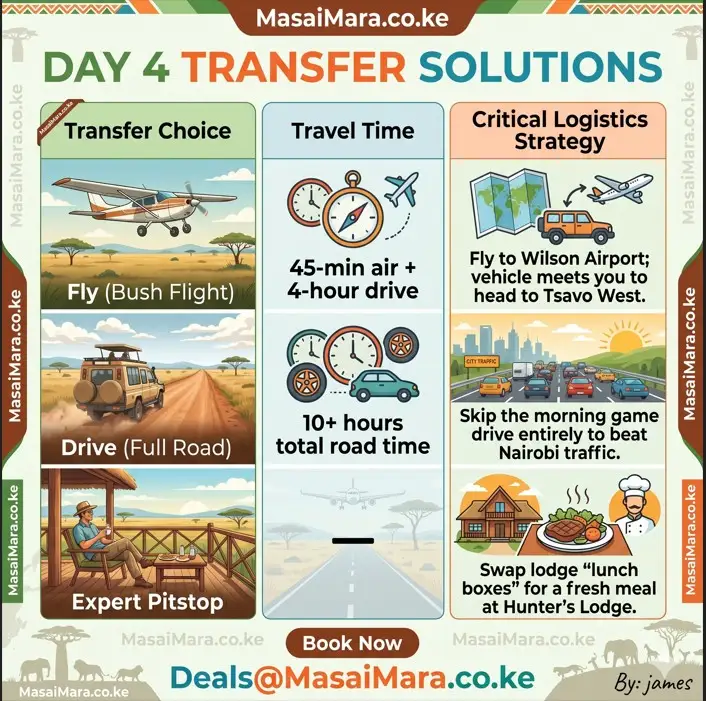
Transfer Choice | Travel Time | Critical Logistics Strategy |
Fly (Bush Flight) | 45-min air + 4-hour drive | Fly to Wilson Airport; vehicle meets you to head to Tsavo West. |
Drive (Full Road) | 10+ hours total road time | Skip the morning game drive entirely to beat Nairobi traffic. |
Expert Pitstop | — | Swap lodge “lunch boxes” for a fresh meal at Hunter’s Lodge. |
This is the transfer day. No way around it. The parks are in opposite directions from Nairobi.
If flying: Morning drive in the Mara. Bush flight around 10:30 AM. Lands at Wilson Airport 45 minutes later. Your vehicle meets you. Drive to Tsavo West (4-5 hours via Mtito Andei). Arrive late afternoon.
If driving: Skip the morning game drive. Leave the Mara by 6 AM. You’ll hit Nairobi traffic around noon. Reach Tsavo West by 6 PM if you’re lucky.
Either way – tell your Mara lodge you want a “Breakfast Box” instead of “Lunch Box.” Safari lunch boxes are dry chicken and a hard-boiled egg. By midday they’re warm and sad. Take a breakfast box and stop for a real lunch at Hunter’s Lodge in Kiboko. It’s a historic spot – the actual location of the Man-Eaters of Tsavo railway attacks in 1898. Clean facilities. Decent food. Breaks up the drive.
Your guide should be checking road conditions. If it’s rained, shortcuts between the Mara and the main road turn into mud traps. Guides use WhatsApp networks to check bridge clearances. If yours isn’t checking his phone for road status, he might add 4 hours to your transfer.
Day 5 – Tsavo West
Different world.
Red dust. Volcanic rock. Baobabs instead of acacia. The light is harsher.
Start at Mzima Springs early – 8 AM. There’s an underground tank where you watch hippos from below. By midday the water gets murky from all the movement. Morning only for that clear view.
The springs have these “walking trees” – Ficus that grow over the volcanic rocks with roots snaking everywhere. Most visitors just look for hippos. But the roots are the thing.
Shetani Caves. Wear boots. Actual boots, not hiking sandals. The volcanic rock is microscopic glass. I’ve seen expensive shoes shredded in ten minutes.
Roaring Rocks for sundowner if your guide suggests it. Short hike. The wind howls through the rock formation – that’s where the name comes from. Best view of the Chyulu Hills.
The silence after the Mara is jarring. Locals call it “Safari Ear.” Your brain adjusts to constant noise in the Mara, and when it disappears, the pressure feels weird. Ask your driver to kill the engine near a Baobab for 15 minutes. Just sit. This is when Lesser Kudu appear – a ghost antelope that vanishes at engine noise. Tsavo drives are like fishing. Long empty stretches, then suddenly everything.
About the Pipeline lions. There’s an old water pipe running through the park – Mzima to Mombasa. It leaks at specific air valves. Look for clusters of green grass in red dust. That’s a leak point. Predators know these spots. If there’s green grass, there’s almost certainly something hunting nearby.
Cross to Tsavo East late afternoon. Two hours on internal roads.
One thing about Tsavo lodges – the views from the deck can rival the game drives. Kilaguni, Satao, some East properties have waterholes that light up at night. Bring binoculars and a small torch. Plan at least one evening just watching instead of driving.
Day 6 – Tsavo East and Out
Tsavo East is flatter. More open. Better visibility. The Galana River cuts through.
The lions here. Males often have sparse manes or none at all. Heat adaptation, probably. They look different from Mara lions – more wild, more prehistoric. Here’s how to tell maneless males from females: thick necks and scarred faces on the males. Once you know, you can sex them from distance. Seeing a maneless king is a badge of honor that Mara tourists don’t get.
Lugard Falls – actually rapids, not a waterfall. The volcanic gorges are dramatic. But the real draw is Giant Crocodile Point downstream. Massive crocs. They sunbathe there in ways you rarely see elsewhere.
Voi Safari Lodge has an underground photo hide. Worth the fee even if you’re not staying there. A tunnel leads to a bunker at waterhole level.
The trick: wear black or dark grey in the hide. Not khaki. Not white. The windows are at elephant eye-level. If they see movement behind the glass, they won’t approach the edge. To get the close shots, you need to disappear into the shadow.
Then 5 hours back to Nairobi. Or 4 hours to Mombasa if you’re heading to the coast.
Stuff That Goes Wrong

What Goes Wrong | The Real Threat | Expert Field Fix |
Volcanic Dust | Sticky glass silt scratches camera lens coatings. | Use a blower brush or Dust Room air nozzle; never wipe dry. |
Safari Fatigue | Consecutive 6 AM starts exhaust travelers. | Schedule an intentional pool or spa afternoon on Day 5. |
Hide Visibility | Elephants spot movement and refuse to approach. | Wear black or dark grey inside the Voi underground hide. |
The dust gets in everything. By Day 5 it’s in your teeth. In your charging ports. The red Tsavo dust is volcanic – essentially fine glass. Never wipe your lens with a cloth or you’ll scratch the coating. Many lodges have pressurized air nozzles in a “Dust Room” near the entrance. Use that or a blower brush before touching glass.
People get tired. Six days of 6 AM starts wears you down. Some clients wish they’d asked for one late-start morning. A pool or spa afternoon on Day 5 can reset you. Frame this as intentional when booking, not as being lazy.
Seat rotation causes fights. On a 6-day trip, someone always ends up stuck in the middle. Good operators enforce rotation so everyone gets the photography window or roof spot. Spell this out before departure.
Different guides for each park can be frustrating. By Day 4 a good guide knows your preferences, your mobility limits, your pace. Switching guides at Nairobi means starting over. Ask specifically for a through-guide when booking.
Tsavo requires patience. You might go an hour without seeing animals, then hit a 20-minute window of elephants and cats everywhere. If you expect Mara-style constant action, you’ll be disappointed. Treat it like fishing, not theme park.
The Train Alternative
If you’re doing Tsavo-first (or returning from Tsavo-last), the SGR train is worth knowing about.
Madaraka Express. Voi station to Nairobi. About KES 4,000 for First Class.
The tracks cut through Tsavo. You often see elephants from the window.
Booking trick: request right-hand side seats facing direction of travel. The railway is the boundary between Tsavo East and West. Most elephant herds and red watering holes are on the East side – right side when heading to Nairobi. Left side shows you Tsavo West’s hilly scrub with less visibility.
Your vehicle meets you at Nairobi Terminus. From there you can continue to the Mara same day if starting with Tsavo.
David Njunge · August 2026
Related: 5-Day Mara Safari · 7-Day Options · Budget Trips · First Safari Tips · Mara Packages
Welcome to Masaimara.co.ke
Thank you for visiting us! We're excited to help you plan an unforgettable safari adventure across Kenya.