
7 Days Masai Mara, Amboseli, Nakuru and Naivasha Safari: 2027 Routes & Prices
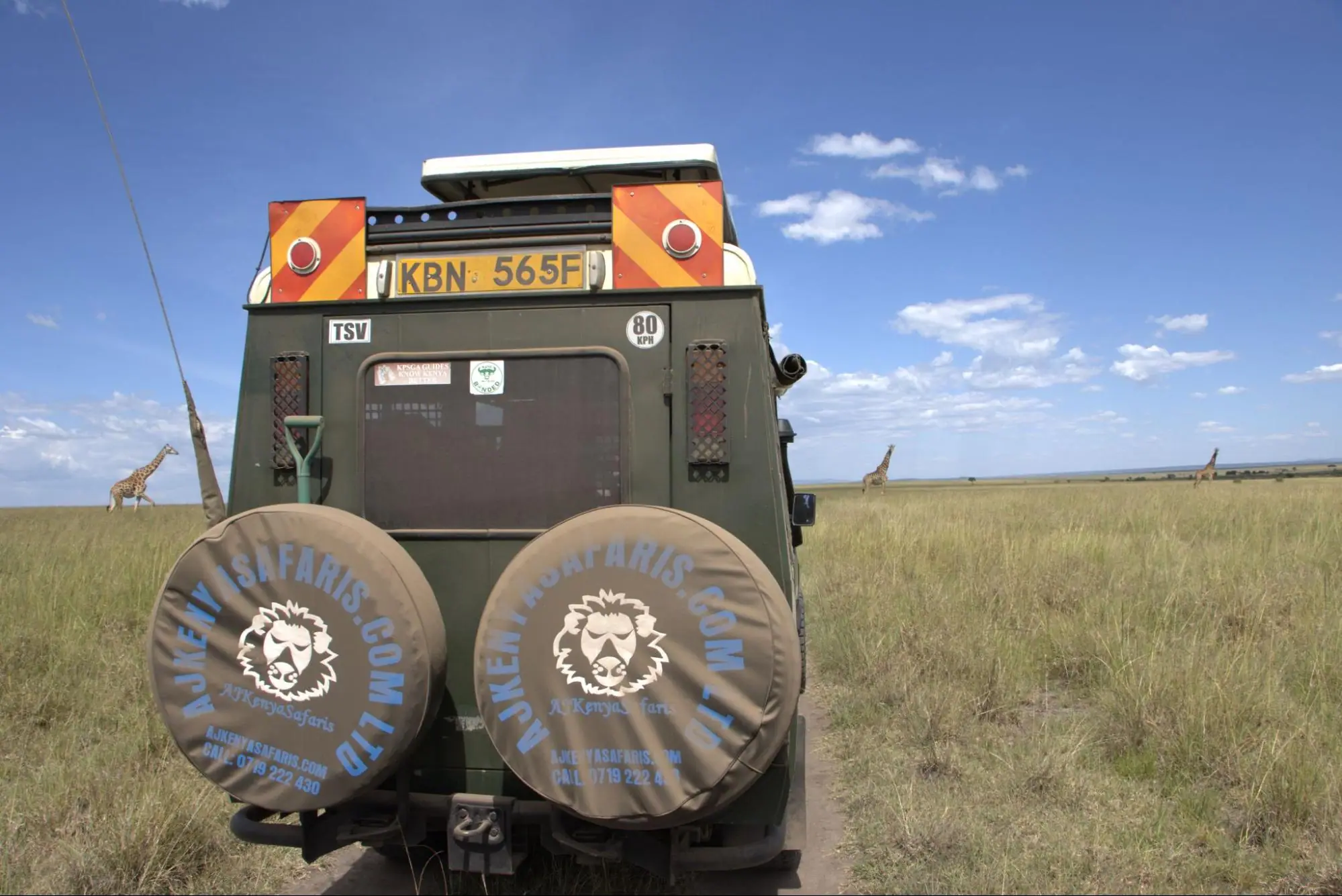
A 7 days Masai Mara, Amboseli, Nakuru and Naivasha safari costs KES 389,000 to KES 849,000 (about USD 2,990 to 6,530) per person sharing in 2027, by road the whole way. At seven days, safaris start to feel different. You stop counting game drives and start noticing how the light changes through the week. You learn the rhythm of specific lion prides. You have time to sit still.
Three Circuit Options

Circuit Option | Best For | Key Trade-Off |
Classic Kenya (2N Mara, 1N Nakuru, 1N Naivasha, 2N Amboseli) | First-time visitors tracking maximum wildlife variety. | Only 3 Mara game drives, and one night each at Nakuru and Naivasha. |
Southern Focus (3N Mara, 3N Amboseli) | Photographers and repeat guests seeking deep animal tracking. | Misses out on rhino tracking and lake boat tours. |
Extended Mara (3N Mara, 1N Nakuru or Naivasha, 2N Amboseli) | Maximizing Great Migration river crossing windows. | Drops one lake stop: either the Nakuru rhinos or the Naivasha boat ride. |
With 7 days, you are not squeezing parks into a schedule. You are designing a circuit. Here are the three that work best. All three run by road, in one private Land Cruiser with the same guide all week.
The Classic Kenya Circuit (Most Popular)
Route: Masai Mara (2N) → Lake Nakuru (1N) → Lake Naivasha (1N) → Amboseli (2N)
Kenya’s signature safari. The Mara for predators and migration. Nakuru for rhinos. Naivasha for the boat ride and a walk on Crescent Island. Amboseli for elephants and Kilimanjaro.
Who it is for: First-time visitors wanting variety. Travelers completing the Big 5.
Trade-off: Two nights in the Mara gives you three Mara game drives, which is enough for lions and most of the big names but tight for a river crossing. Nakuru gets one night and two game drives. Naivasha gets one night for the boat ride and Crescent Island. Amboseli gets two nights and three game drives, with a full day for Kilimanjaro and one more look at the mountain as you leave.
About that Naivasha night: I used to think it was padding, an unnecessary stop between Nakuru and Amboseli. Then I ran a group that skipped it. We hit traffic at Mai Mahiu, arrived at Amboseli after dark, missed the sunset drive entirely, and everyone was exhausted for the next two days. Now I tell people: that Naivasha night is your buffer. One delay without it cascades through everything.
Route clarification: This is Kenya-only. Amboseli sits right on the Tanzania border, but you do not cross it. If you are seeing itineraries mentioning Serengeti or Ngorongoro, that is a different (longer) trip.
The Southern Focus
Route: Masai Mara (3N) → Amboseli (3N)
Maximum time in Kenya’s two flagship parks. Five game drives per park. You will learn specific territories and recognize individual animals.
Who it is for: Repeat visitors. Photographers who need time. Those who value depth over variety.
Trade-off: No rhinos. No lake experiences. And the Mara to Amboseli road day is 8 to 9 hours.
On splitting the nights: Some travelers prefer 4 nights Mara + 2 nights Amboseli. The thinking: Kilimanjaro visibility is unpredictable while the Mara delivers reliably. Two Amboseli mornings gives you two chances at the mountain. I am not sure there is a “right” answer here. It depends on what you are prioritizing.
Consider reversing the order: If your dates are flexible, ask your operator to start in Amboseli and finish in the Mara. Your trip ends with the highest-density predator sightings rather than tapering off. You are also doing the longest drives when freshest. Not everyone agrees this is better, but it is worth considering.
The Extended Mara
Route: Masai Mara (3N) → Lake Nakuru or Lake Naivasha (1N) → Amboseli (2N)
The extra Mara night comes from dropping one of the two lakes. During migration (July to October), that night significantly increases crossing chances. Five Mara game drives instead of three, and you keep both Amboseli nights.
Who it is for: Migration-focused travelers. Serious photographers.
Trade-off: You choose one lake. Pick Nakuru if rhinos matter, Naivasha if you want the boat ride and the walk on Crescent Island.
Before You Book: A Few Things
Ask about guide continuity. In my experience, and from what guests tell me afterward, the individual guide matters more than the vehicle or lodge tier. On a road circuit like this one, you should have the same guide and vehicle from Nairobi back to Nairobi. If an operator mentions regional handoffs, get specifics: who meets you where, who is responsible if something slips.
For group or joining safaris, ask about your seat. On shared vehicle formats, comfort and photography come down to seat position and window access. Before booking, ask: Do you have a dedicated seat for the week, or is there a rotation system? This rarely comes up in marketing.
Test their precision. When comparing operators, message them with 2 or 3 specific questions: Vehicle type? Same guide throughout? Seat rotation policy? How they answer tells you something about how the week will actually run. Vague answers are not necessarily a dealbreaker, but they are a data point.
Package Pricing 2027
Per person sharing. Based on two travelers. Prices in Kenya Shillings, with the USD equivalent for non-residents at about KES 130 to the dollar.
Classic Kenya Circuit (Road Safari Throughout)
Tier | Low Season | Peak Season | Accommodation |
Mid-Range | KES 389,000 (USD 2,990 | KES 632,000 (USD 4,860 | Mara Sidai + Taidy’s Suites + Naivasha Kongoni Lodge + AA Lodge |
Luxury | KES 479,000 (USD 3,690) | KES 719,000 (USD 5,530) | Mara Sopa + Lake Nakuru Sopa + Lake Naivasha Sopa + Kibo Safari |
Premium | KES 602,000 (USD 4,630) | KES 849,000 (USD 6,530) | Sarova Mara + Sarova Lion Hill + Enashipai + Amboseli Serena |
The Southern Focus and Extended Mara circuits are priced on request, because the extra Mara nights change most with the season and the camp. Ask for those rates.
Low season: January to June, November to mid December Peak season: July to October, Christmas/New Year
What Is Included
Note: “7 days” means 6 nights of accommodation. Day 7 ends with your return to Nairobi.
Covered: All road transport in a private 4×4 Land Cruiser, park fees, 6 nights full board, all meals, scheduled game drives, bottled water, the Naivasha boat ride and the Crescent Island walk.
Not covered: Alcoholic drinks, tips (budget KES 12,000 to 18,000), travel insurance, Kenya eTA (USD 34), optional activities.
Optional: Hot air balloon on Day 2 (KES 58,500 / USD 500), Maasai village (KES 1,500 / USD 20), night game drive if you stay in a conservancy (KES 9,100 / USD 100).
Day-By-Day: Classic Kenya Circuit
This is the most popular 7-day configuration, and it runs by road all the way. Your guide collects you in Nairobi on Day 1 and drops you back on Day 7.
Day 1: Nairobi To Masai Mara & Afternoon Game Drive
Leave Nairobi around 7 AM. The road runs down the A104 to the Rift Valley escarpment and Mai Mahiu, then the B3 to Narok and the tarmac C12 to Sekenani Gate. Total: 5 to 6 hours.
Do not treat the Rift Valley viewpoint on the way down as just a bathroom stop. Give yourself 15 to 20 minutes. The view across what is essentially a crack in the earth’s crust, with Mount Longonot and Mount Suswa on the valley floor, is one of Kenya’s most dramatic. I have rushed past it too many times and always regretted it.
Arrive at camp for lunch. Rest through the midday heat.
Afternoon drive from 3:30 to 6:00 PM. Your guide uses this session to map the territory: pride locations, areas with good grass, what other vehicles found today.
Overnight: Masai Mara
Day 2: Full Day Game Drives In Masai Mara
Morning drive at 6:15 AM. The Mara’s lions are most active in early light. Leopards hunt before retreating to trees. Your guide has overnight intel from camp watchmen who heard roaring.
This is your one balloon morning if you want it. The balloon launches at 6 AM and lands around 8 AM with champagne breakfast in the bush. You miss the morning drive but gain a perspective that only aerial viewing provides.
By Day 2, you are starting to understand the landscape. The Mara is not one uniform savanna. It is a patchwork of micro-territories. The riverine forest along the Talek River. The open plains near Musiara. The rocky outcrops where leopards den.
If you need clothes washed, hand them in this morning, not in the evening. Most camps sun-dry laundry. Hand in clothes the night before a transfer day and they will still be damp when you leave the next morning. I learned this in 2023 when a client packed wet shirts and they smelled like mildew for the rest of the trip.
Something about cheetahs on termite mounds: they use them as lookout posts and as “thermal heaters” in the morning. If your vehicle’s shadow hits the mound, you are blocking the warmth. The cheetah will often leave. I have watched it happen. The guide parks in the wrong spot, and the cat gets up and moves within two minutes. If you notice your shadow falling on the mound, ask to reposition.
In the thicker riverine areas, you will see blue and black cloths hanging from trees. These are tsetse fly traps saturated with attractants. Do not let your guide park near one for a “photo op”. Tourists sometimes think they are markers. You will have a vehicle full of biting flies within minutes.
During migration (July to October), your guide may spend much of the day working river crossing positions. In September 2025, I sat with guests at the Mara River for nearly 5 hours. Thousands of wildebeest on the north bank, pacing but not crossing. We gave up for lunch. The crossing happened 25 minutes later. Another guide sent photos. That is the reality of crossings. You can position and wait, but you cannot force it. With only one full Mara day on this circuit, if a crossing is the main reason for your trip, look at the Extended Mara instead.
One thing nobody mentions about crossings: the smell. During peak migration, the crossing points smell of ammonia from fear-urine and decay from carcasses lodged in rocks. If you have a sensitive stomach and plan to wait hours, pack Tiger Balm or Vicks. Dab some under your nose.
Afternoon drive from 3:30 to 6:00 PM.
If you are staying in the North Mara (Musiara or Triangle area), you will hear a loud rhythmic “clack-clack-clack” at night. Sounds exactly like someone chopping wood outside your tent. Most guests call security thinking there is illegal logging. It is actually the Square-marked Toad.
Overnight: Masai Mara
Day 3: Transfer To Lake Nakuru & Afternoon Game Drive
There is no game drive this morning. Breakfast, then leave the Mara by about 8 AM. If your camp is inside the reserve, you must clear the gate by 10 AM or pay another day’s fee. If your camp sits outside the reserve, your Day 2 ticket expired at 6 PM, so you simply drive out.
The Mara Triangle is run by the Mara Conservancy and takes payment through its own KAPS system. If your camp is in the Triangle and you leave through Oloololo Gate, any payment there, such as an overstay fee for an exit after 10 AM, is strictly cashless. Many international credit cards fail due to poor signal. Have your guide keep enough on their M-Pesa to cover an extra-day fee as backup.
Drive to Lake Nakuru through Narok town, then north through Mau Narok and Njoro. Total: 5 to 6 hours, all on tarmac once you are out of the reserve.
Arrive at Lake Nakuru in the early afternoon and go straight into an afternoon game drive. Nakuru is a KWS park and its ticket runs 24 hours from the moment you enter, so this afternoon’s entry also covers tomorrow’s morning drive.
Overnight: Lake Nakuru
Day 4: Nakuru Morning Drive, Transfer To Naivasha, Boat Ride & Crescent Island
Morning game drive in Nakuru. Focus on rhinos. Both black and white species are reliable here. If completing the Big 5 matters to you, this is where it happens. Be out of the park before your 24-hour ticket runs out in the early afternoon.
About the flamingos: numbers depend on water levels and algae. Some years the shoreline is carpeted pink. Other years, most have moved to Lake Bogoria. Check recent visitor photos before getting hopes up. I have had guests arrive expecting hundreds of thousands of flamingos and find maybe a few hundred. It is disappointing when it happens.
Drive to Lake Naivasha, about 1.5 to 2 hours. Lunch at your lodge.
In the afternoon, the boat takes you across the lake to Crescent Island. You walk among zebra, giraffe and wildebeest, with no predators and no vehicles. After days in a vehicle, the change in perspective is striking. The boat brings you back around 4:30 PM, when the wind drops and the hippos start moving. You will hear them grunt and blow, that deep mechanical sound that carries across the water.
Overnight: Lake Naivasha
Day 5: Transfer To Amboseli & Afternoon Game Drive
Leave Naivasha by 7 AM with a packed lunch from your lodge, because you will reach Amboseli after lodge lunch service ends. Route: Mai Mahiu, up the Rift Valley escarpment, the Southern Bypass, then Mombasa Road (A109) to Emali and the tarmac C102 south to Kimana. Total: 6.5 to 7.5 hours, because of the truck traffic climbing the Mai Mahiu escarpment and along Mombasa Road. We avoid the C103 via Namanga, which is the rougher road. Amboseli gates close at 6 PM, which is why we leave early.
Ask your guide about transiting through Kimana Sanctuary instead of driving straight into the main Amboseli gates. It is a community-owned corridor where you can sometimes see super-tuskers in a lush, wooded setting rather than Amboseli’s dusty plains. Turns a long transfer into something more interesting. The C102 drops you right beside it, so it adds little time, but not every guide does this route, so you may need to request it specifically.
About entering Amboseli: the signal at the gate is unreliable. Take a high-resolution screenshot of your QR code and payment confirmation from the KWS eCitizen portal. Rangers will not let you through without a scannable code, and I have seen groups wait 30+ minutes for signal to load. Screenshots solve this.
Enter Amboseli by mid-afternoon and game drive to your lodge. Like Nakuru, Amboseli tickets run 24 hours from entry, so with two tickets your stay is covered until mid-afternoon on Day 7.
Overnight: Amboseli
Day 6: Full Day Game Drives In Amboseli
This is your first Kilimanjaro morning. Early departure, 5:45 AM if your lodge allows. The mountain is most likely clear before 8 AM.
In my experience, January to March offers the best visibility, maybe 7 out of 10 mornings you will see something. July and August are harder. The mountain creates its own weather and there is no predicting it.
About Observation Hill (Noomotio): every guide suggests it for the combined swamp-and-mountain view. But it has become crowded, 40+ vehicles by 8:30 AM in peak season. You also have to park and walk up stairs, leaving the vehicle. Some guests prefer a “tailgate breakfast” at the Enkongo Narok swamp edge instead. Same elephant-and-mountain view, but you stay in the vehicle and can follow any action immediately.
The elephants are already moving toward the springs when you arrive. Family groups crossing from acacia groves through the alkaline dust, fine grey powder that smells mineral, like wet concrete curing.
Back at the lodge by mid-morning. The mountain usually clouds over by 10 AM. Afternoon drive from 3:30 PM around the swamps: hippos, buffalo, maybe the Amboseli lion prides.
Overnight: Amboseli
Day 7: Transfer To Nairobi
No game drive this morning. Breakfast, then leave by about 8 AM. Keep your camera handy on the way out of the park. If the mountain hid yesterday, it sometimes shows for 15 to 20 minutes in the early morning, and the road out gives you one more look.
Drive to Nairobi on the C102 and Mombasa Road (4 to 5 hours). Arrive early afternoon depending on Athi River traffic.
Rest Days And The Week-Long Rhythm
Seven days is long enough that rest becomes strategic. If you are feeling the cumulative effect of early mornings and bumpy roads, usually around Day 4 or 5, skip a drive. The camps are designed for this.
I would avoid resting on Day 2 in the Mara or Day 6 in Amboseli though. Those are your only full days in each park. You are warmed up, and your guide is building momentum.
Some couples have different energy thresholds. One wants every game drive, the other needs downtime. This is fine. One goes on the afternoon drive while the other stays at camp.
Something shifts around mid-week. The initial adrenaline fades. Lions become… lions. This is not bad. It is when safaris become interesting. You start noticing things: how coalition males interact, how zebra position relative to watering holes, how to read vulture flight patterns. Your guide can show you things that would have been lost in Day 1 excitement. This is what shorter safaris cannot offer.
What Actually Goes Wrong
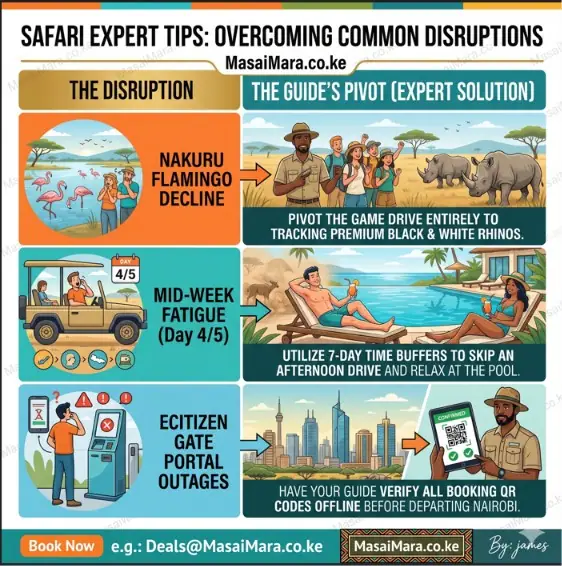
The Disruption | The Guide’s Pivot (Expert Solution) |
Nakuru Flamingo Decline | Pivot the game drive entirely to tracking premium black & white rhinos. |
Mid-Week Fatigue (Day 4/5) | Utilize 7-day time buffers to skip an afternoon drive and relax at the pool. |
eCitizen Gate Portal Outages | Have your guide verify all booking QR codes offline before departing Nairobi. |
The Day 6-7 energy crash: Some travelers hit a wall near the end. Early mornings accumulate. Build in rest, book the balloon for Day 2 (Day 3 is a transfer day with a 10 AM gate exit, so a balloon is not possible then), and accept that skipping a drive is okay.
The Nakuru flamingo disappointment: Guests arrive expecting pink-carpeted shorelines and find a few hundred birds instead. Flamingo numbers fluctuate with water chemistry. There is no guarantee. Refocus on rhinos. Both black and white species are more reliable here than anywhere in Kenya.
Single nights mean single chances: The Classic Circuit gives you one night each at Nakuru and Naivasha. If the Nakuru rhinos hide on both of your drives there, there is no third chance. Amboseli is safer, with three game drives and a full day for Kilimanjaro. If more Mara time matters, consider the Extended Mara circuit instead.
Park Fees 2027
Included in all packages. Listed for reference.
Masai Mara (Narok County): USD 100 per calendar day (January to June) or USD 200 per calendar day (July to December) for non-resident adults. Children aged 9 to 17 pay USD 50, under 9 free. Citizens pay KES 1,500 to 3,000 a day. Tickets are valid from 6 AM to 6 PM on the date of entry. More on our park fee page.
Lake Nakuru (via KWS eCitizen): USD 90 per 24 hours for non-resident adults, USD 45 per child aged 5 to 17, under 5 free. East African citizens about KES 1,500, Kenya residents KES 2,025.
Lake Naivasha: No park entry fee for the lake. Crescent Island about USD 33 (KES 4,290). Boat rides about KES 3,000 to 4,000 per boat. Both are included in this circuit.
Amboseli (via KWS eCitizen): USD 90 per 24 hours for non-resident adults, USD 45 per child aged 5 to 17, under 5 free. East African citizens about KES 1,500, Kenya residents KES 2,025.
See KWS eCitizen for current rates.
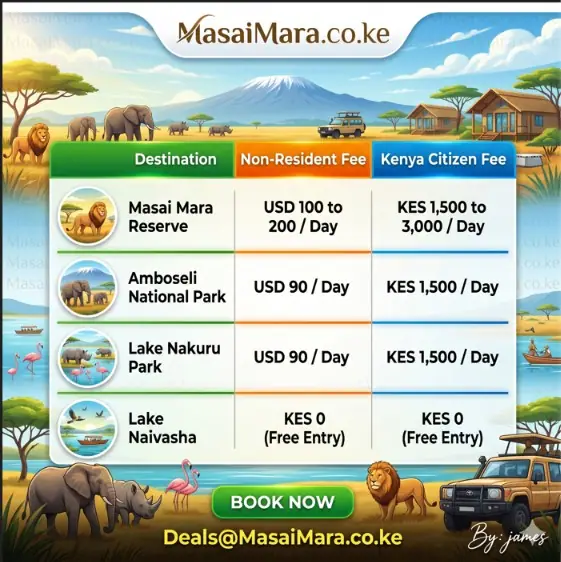
Destination | Non-Resident Fee | Kenya Citizen Fee |
Masai Mara Reserve | USD 100 to 200 / Day | KES 1,500 to 3,000 / Day |
Amboseli National Park | USD 90 / Day | KES 1,500 / Day |
Lake Nakuru Park | USD 90 / Day | KES 1,500 / Day |
Lake Naivasha (Waterbody) | KES 0 (Free Entry) (Activities fee apply) | KES 0 (Free Entry) (Activities fee apply) |
Practical Notes
The Land Cruiser carries your bags all week, so there is no 15 kg bush-flight limit on this circuit. Bring a soft bag anyway. It packs into the back of the vehicle far better than a hard case.
For Amboseli, pack a dust kit: lens blower, microfiber cloths, ziplock bags, bandana. The Land Cruiser’s pop-up roof is great for photos but lets the dust straight in, so close it on the dustiest stretches.
One more thing about 7-day trips specifically: seven days of sharing binoculars in Amboseli’s volcanic dust and the Mara’s red earth can cause eye irritation. Several guests have mentioned this over the years. Bring alcohol-free antibacterial wipes for the binocular eye-cups, not just lens wipes. A quick wipe each morning helps.
Frequently Asked Questions
How much does a 7 days Masai Mara, Amboseli, Nakuru & Naivasha safari cost? KES 389,000 to KES 849,000 (about USD 2,990 to 6,530) per person by road, depending on accommodation tier and season.
Is 7 days too long for a Kenya safari? No. Seven days is where safaris stop feeling rushed and deeper immersion becomes possible.
Which circuit is best for first-time visitors? The Classic Kenya Circuit (Mara → Nakuru → Naivasha → Amboseli) offers the most variety and best Big 5 chances.
What is the best time for a 7-day safari? July to October for migration. January to March for best Kilimanjaro visibility. Our best time to visit guide goes month by month.
Can I add a beach extension? Yes. Fly to Diani, Mombasa, or Malindi after Day 7. A 7-day safari + 3-night beach makes an ideal Kenya trip. See our Mara and Diani beach safaris.
Ready to Build Your Week?
Tell us which circuit appeals, when you want to travel, and what matters most. We’ll put together a custom itinerary.
Related Safaris
- 5 Days Masai Mara Safari
- 6 Days Masai Mara Safari
- Masai Mara Lake Nakuru Safari
- Masai Mara Amboseli Safari
- Best Time to Visit Masai Mara
Prices verified for the 2027 season. Park fees per Narok County and KWS.
Written by David Njunge, TRA-licensed safari guide with over 10 years in the Masai Mara. Edited by Cess Wambui, travel consultant, BSc Tourism and Hospitality Management.
Welcome to Masaimara.co.ke
Thank you for visiting us! We're excited to help you plan an unforgettable safari adventure across Kenya.